

UK businesses have improved female representation on their boards, research shows, but two-fifths of FTSE 100 firms still do not have a woman in one of their top four executive roles.
The proportion of women on the boards of the FTSE all-share listed companies has risen over the past year from 36% to 40%, according to the analysis of Companies House data.
However, the number of female bosses has flatlined, with just a tenth of executive roles occupied by women, excluding company secretaries. On a more positive note, the number of firms with all-male boards has halved to just four.
Under Financial Conduct Authority rules, women should make up at least 40% of a company board, and at least one of the senior board positions – chair, chief executive, chief financial officer or senior independent director – should be occupied by a woman.
The research by the campaign group Women on Boards found that nearly a fifth of FTSE 100 firms (19%) do not meet the FCA’s 40% target. They include the retailers Frasers Group and Ocado, the miner Rio Tinto and the insurer Hiscox.
Among FTSE 250 companies, 36% have failed, and 41% of the smaller companies listed on the FTSE. Nearly three-quarters (73%) of AIM-listed companies are yet to reach this goal.
Further analysis by Women on Boards shows that 40 FTSE 100 firms are not meeting the FCA target of having a woman in one of their top four roles.
Fiona Hathorn, the chief executive of Women on Boards, said: “Since we started these reports three years ago, we’re pleased with the progress made on women non-executive directors outside of the FTSE 350 [the FTSE 100 and 250 combined], but just having women in non-executive director roles is not sufficient to have an impact on the executive pipeline … We don’t have the women’s strong voice in the boardroom.”
She said the very narrow range of expertise on boards was another significant concern, with a lack of input from employees a particular issue in the area of sexual harassment. “You’ve had scandal after scandal,” she said. “There isn’t a people’s voice in the boardroom. Where is the expertise or the knowledge?”
The report shows that of 4,800 board directors at listed UK companies, only three are chief people officers tasked with representing the workforce – at the leisure firm Hollywood Bowl, safety equipment provider Halma and asset manager Intermediate Capital Group.
Hathorn added: “You need experts that understand culture and issues. You need somebody talking to people, who is reporting to the [the top executives],” she said, suggesting they should be asking: “How are you feeling? What’s going on? What are you concerned about? Are there any scandals? Are you feeling comfortable? What’s the wellbeing like in
Sheila Flavell CBE, Chief Operating Officer of FDM Group, commented: “It is alarming to see how stark the underrepresentation of women in executive positions at large organisations is, despite the rise in female board members. This underrepresentation often accompanies other underlying issues such as a gender pay gap and lack access to learning and development opportunities which is something that has to be addressed by all businesses, not just FTSE 100 ones.”
“Fixing the gender gap in industry is not something that can be achieved in an instant but is important that businesses recognise this shortfall and outline consistent progress to achieving true equality in the workplace. Actions such as mentoring from senior female leadership, implementing flexible policies around childcare, and female-focused networking can all empower female staff – the next step is giving them the opportunity to thrive in senior roles.”
Read more:
Slight rise in female FTSE board members, but just a tenth of company management is a woman
Month: June 2023
Small business exodus predicted if Labour wins next election

If the Labour party wins the next general election many UK small business owners will either shut down or try to sell their business.
That’s the view of leading business consultant Paul Vousden based on the conclusions of a survey carried out by wealth manager Evelyn Partners.
The survey reveals that two-thirds of UK businesses with a turnover of at least £5m are already preparing plans to exit their firm in the event of a Labour win. Two in five owners polled are planning to sell or wind down their business within the next year. Nearly one in four business owners said they had expedited such plans in the last year.
Business consultant Paul Vousden of Corporate Counsel, who advises businesses on succession planning said:”Despite Rishi Sunak’s determination to get the UK Government back to a more sensible and focused agenda he seems to be constantly interrupted by controversy and infighting within his own party.
The latest news that Boris Johnson has resigned as an MP with several of his MP supporters following behind has created another mini crisis for the Prime Minister as he battles to steady the ship and head for recovery. This of course is great news for Labour who are streets ahead in the polls and seem on course for a majority in next year’s elections.”
He added: “Concerns over a change in Government and potential tax rises were the most common reasons amongst those speeding up plans to sell or wind down their business, cited by 26% of respondents. However, businesses rushing to sell should be wary of selling too cheaply, a decision they could regret for the rest of their lives. The sale must be planned properly so owners achieve the best possible price for their companies and walk away with a fair reward for their life’s work.
“Statistics show that almost half of all planned business sales will fail, often at the last stage once substantial legal and accountancy costs have been incurred by the seller. One of the most common reasons for the deal to fall apart is a lack of preparation, particularly in terms of due diligence from the buyer.
When we work with a seller we look at all aspects of the business such as staffing, contracts, systems, sales and marketing and much more. We can also help with the actual price negotiations as having a third party involved can remove some of the emotion involved in selling a business. We aim to make sure that clients get the maxmum rewards for the hard work they have put into their firms.”
Any business owner thinking of selling their business can speak to Corporate Counsel for a no obligation confidential chat about their requirements.
Read more:
Small business exodus predicted if Labour wins next election
Remote workers feel “policed” by unpredictable managers

Daily monitoring can lead to remote workers feeling that their managers have less trust in them, research from NEOMA Business School reveals.
Birgit Schyns, Distinguished Professor of People and Organisations at NEOMA, co-authored a study analysing survey data on 450 employees at UK-based firms.
According to the researchers, when working from home, employees can feel that they have less autonomy and are under constant surveillance if monitored too frequently. These feelings can be exacerbated if managers’ behaviour is unpredictable, they say.
“Day-to-day monitoring leaves remote workers wondering why their managers are making such frequent demands, which may leave them questioning their own ability and putting themselves down. At the end of the day, some employees feel physically and intellectually exhausted” says Professor Schyns.
The researchers recommend managers establish clear guidelines for checking on employees’ progress. Once communicated, these guidelines must be observed, they add.
The impact of remote management is so important that the authors recommend that business leaders should also tackle the issue. This role includes providing managers with guidance about their conduct and defining appropriate benchmarks for managerial behaviour.
Read more:
Remote workers feel “policed” by unpredictable managers
Elon Musk is the entrepreneur the world is ‘most curious’ about, s …

Elon Musk is the CEO the world is most curious about; a new study has found.
The new research analysed Google Keyword Planner data to determine which entrepreneurs’ people from around the world are most interested in. After devising a list of more than 300 of the world’s most prominent CEO’s, the study combined five common search terms related to entrepreneurship to reveal the average monthly search volume for entrepreneurs over the past twelve months. The businesspeople were then ranked from highest to lowest.
Elon Musk is by far and away the entrepreneur people are most curious about. The SpaceX founder and CEO of Tesla amassed an average monthly search volume of more than 10 million (10,754,200) over the course of the past year – a figure that is more than eight million more than the next entrepreneur. Musk’s $44billion acquisition of Twitter in 2022, in addition to his regular promotion of cryptocurrencies like memecoins, has helped him to also become the most searched for name in both the USA and UK, as well as the standout searched for CEO in the field of technology.
The second entrepreneur the world is most interested in is American business tycoon, Bill Gates. The Microsoft co-founder is the only other CEO to have amassed more than two million (2,079,675) average monthly searches over the past 12 months, edging Amazon founder Jeff Bezos (1,998,241.7) in the rankings, who fell just short of the two million mark and consequently ranked third. However, Bezos did accumulate more searches than Gates in both the USA and UK.
Mark Zuckerberg ranked in fourth. The Facebook CEO amassed nearly 1.7million (1,698,675) average monthly searches over the past year, with more than 347,000 of those coming directly from the USA.
With more than 1.2million (1,287,511.7) monthly average searches, LVMH founder Bernard Arnault ranked in fifth, making him the most searched for CEO in the fashion industry. Meanwhile, Warren Buffet was the only other businessperson to amass more than a million (1,190,466.7) monthly average searches, making the Berkshire Hathaway CEO the most searched for entrepreneur in the finance and investments sector.
James Gunn ranked highest for entrepreneurs relating to the television industry. The filmmaker and DC studios co-CEO averaged more than 782,000 (782,695) monthly searches over the past year, with more than 245,000 of those searches coming from the USA alone.
Sundar Pichai followed next with more than 730,000 (730,423.3) average monthly searches. However, the Indian-American business executive, famed for being the CEO of Alphabet Inc. And its subsidiary Google, wasn’t among the top five searched for technology entrepreneurs in either the USA or the UK.
Fashion designer Giorgio Armani, who rose to prominence working for labels Cerutti, Allegri, Bagutta, Hilton and many others before launching his own company ‘Armani’ in 1975, ranked in ninth with more than 637,000 (637,450) average monthly searches.
Hungarian-American businessman George Soros, who was dubbed by Forbes as the ‘most generous giver’ thanks to his $32billion donations to the Open Society Foundations, ranked in tenth and is the final entrepreneur to amass more than 500,000 (583,143.3) monthly searches.
Apple CEO Tim Cook, Spotify CEO Daniel Ek, Google co-founder Larry Page, business magnate Jack Ma and Kering CEO Francois Henri-Pinault all ranked in the top 15.
Dallas Cowboys owner Jerry Jones, who ranked 17th globally, was the most searched for entrepreneur related to the sports industry. Meanwhile, former YouTube CEO Susan Wojcicki is the most globally searched for businesswoman with more than 210,000 average monthly searches (210,405).
Steven Bartlett, who ranked 25th globally for CEO’s people are most curious about, ranked significantly higher in the UK. In fact, the British entrepreneur, who hosts one of Europe’s most listened to podcasts labelled ‘The Diary of a CEO’, ranked second in the UK’s average monthly searches (127,782.5) behind only Musk himself.
Filippo Ucchino, CEO of InvestinGoal, who commissioned the research, commented on the findings: “As some of the most powerful people globally, world renowned CEOs are capable of impacting society in many ways, and many have done so as a direct result of their wealth. It is therefore understandable that the public are directly interested in their lives and background. This research ultimately offers a fascinating insight into exactly how much that curiosity spans.”
Read more:
Elon Musk is the entrepreneur the world is ‘most curious’ about, study reveals
UK exports in last decade worse than any G7 country except Japan

Britain has endured the worst exports record of any member of the G7 besides Japan over the last decade, according to a new analysis that will raise pressure on the government to reconsider its post-Brexit trade deal with the EU.
As most of the world’s other major seven economies have rebounded from the pandemic, export growth has remained sluggish in the UK at a time when businesses trading with the EU faced extra red tape and costs as a result of the country leaving the bloc.
Figures from the United Nations Conference on Trade and Development (UNCTAD) show that the UK’s goods and services exports had a value of £813bn in 2012 and rose by just 6% to £862.6bn by 2021.
That compares with the double-digit increases enjoyed by Canada (10.2%), France (16.1%), Germany (22.7%), Italy (15.9%) and the US (13.8%). The EU’s 27 member states as a whole enjoyed a 29.1% increase in the value of their exports in the same period.
The value of UK exports in 2019, before the pandemic, was £881.6bn, around £20bn higher than the figure posted in 2021, according to an analysis of the UNCTAD figures provided by the House of Commons library.
Only Japan, which has been particularly exposed to a drop in demand from China as it has become increasingly self-sufficient in goods such as cars, car parts and steel, posted worse results than the UK, with the value of trade rising by just 0.5% from £912.2bn in 2012 to £917.5bn in 2021.
The trade and cooperation agreement the UK struck with the EU after years of wrangling is up for review in 2024. The Labour leader, Keir Starmer, has said that a government led by him would seek better terms of trade, although he has limited the scope of any changes by ruling out rejoining the single market or negotiating a new customs union.
There have been repeated complaints from business leaders about a range of post-Brexit obstacles to trading with the EU and the lack of effort by the UK government in seeking to address them.
Most recently, three of the world’s largest carmakers, Vauxhall, Jaguar Land Rover and Ford, told the government that it needed to renegotiate with the EU to change post-Brexit rules due to come in next year that they say threaten UK electric vehicle production.
In its most recent forecast, the Office for Budget Responsibility said it expected the weakness in UK overall trade to persist for the next two years, with export volumes forecast to fall by 6.6% in 2023 and by 0.3% in 2024.
The shadow trade minister Gareth Thomas said that the disappointing growth in exports over the last decade was a direct result of the extra burdens on businesses exporting into Europe, which remains the country’s biggest market.
He said: “In the last decade the Tories have failed to deliver on key trade targets, have cut support to businesses wanting to win new export contracts and have made trade with key allies more difficult.
A spokesperson for the Department for Business and Trade did not provide an explanation for the comparatively poor performance over the last decade but provided a figure from the Office of National Statistics to suggest that exports were up year on year.
The government also pointed to the more healthy export results in services, such as finance, where trade is less dependent on the EU than in goods. Around 36% of services exports are made into the bloc compared with 47% of goods exports.
A government spokesperson said: “In the 12 months to March 2023 the value of UK exports were up 24% in current prices and services exports reached a record high of £415bn.
“It’s clear that appetite for world-class UK goods and services continues to grow globally, and we’ll keep supporting these fantastic businesses in their exporting journey, helping to create more jobs, pay higher wages and grow the economy.”
Read more:
UK exports in last decade worse than any G7 country except Japan
UK wage growth rises at fastest pace in two years

Wages grew at their fastest pace in nearly two years as workers benefited from new pay deals and a rise in the national minimum wage.
Official figures from the Office for National Statistics showed average weekly earnings, excluding bonuses, rose from 6.7 per cent to 7.2 per cent in the three months to April, ahead of economist forecasts of a jump to 6.9 per cent.
It was the fastest acceleration in regular pay since June 2021 and the highest on record outside the pandemic, said the ONS.
Stronger wage growth was widely anticipated on the back of the introduction of a higher national minimum wage and living wage in April. Many private sector employees also set new annual pay awards which began during the three-month period which coincides with the start of the tax year.
The ONS said weekly pay including bonuses climbed from 5.8 per cent to 6.5 per cent, also above economist forecasts.
The figures will pile the pressure on rate-setters at the Bank of England who are looking for signs of inflationary pressures strengthening across the economy. Strong wage growth often translates to rising inflation as employees are partially compensated for higher prices and can maintain their spending habits.
Real wage growth, which strips out inflation, remained negative due to the double-digit inflation reported in February and March.
The labour market showed some signs of cooling as the unemployment rate edged up by 0.1 percentage points to 3.8 per cent in the three months to April, below the 4 per cent forecast by economists. The ONS said the rise in the jobless rate was driven by people who had been out of work for over a year.
The UK labour market has been running hot for the last year, defying the pressure from rapidly rising interest rates as companies have continued to hire and retain workers.
The number of vacancies in the economy, which has been steadily declining after hitting a record last summer, fell by 79,000 to 1.05 million. Total payrolled employees were up in May, rising by 23,000, after an unexpected drop of 135,000 in April to take the total to a record of 30 million people in jobs.
April’s labour market report comes ahead of the Bank’s next interest rate decision on June 22, where the MPC is expected to increase borrowing costs by another quarter of a percentage point to 4.75 per cent. Inflation has failed to come down in line with the MPC’s projections and was at 8.7 per cent in April.
Yael Selfin, chief economist at KPMG, said: “Continued strength in pay growth will warrant higher interest rates. The pickup in regular pay growth is the latest sign that inflation is driving up pay demands, which in turn is making inflation stickier.”
A closely-watched measure of labour force inactivity, which calculates the proportion of the population not looking for work, dropped by 0.4 percentage points to 21 per cent. The ONS said that the number of people who reported long-term sickness as their reason for not working hit a record between February and April.
The UK has suffered from one of the worst declines in labour force participation after the pandemic, a factor which has drastically reduced the supply of workers and helped existing employees negotiate better pay deals.
Catherine Mann, an external member of the Bank’s Monetary Policy Committee, this week warned that early retirees risked stoking intergenerational tensions as younger workers would be forced to shoulder the burden of their retirement through higher taxes to fund public services.
Read more:
UK wage growth rises at fastest pace in two years
Jeremy Hunt announces plans to slash taxes
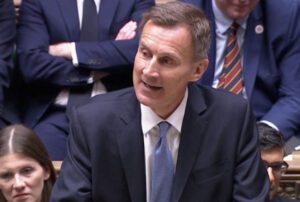
Jeremy Hunt said he has set Britain on a “sustainable path to lower taxes” as senior Conservatives urged the Chancellor to cut the burden in a bid to end Tory turmoil.
Hunt, who was appointed to No11 following Kwasi Kwarteng’s mini-budget last autumn, revealed he will launch a major review on how to make the public sector more productive.
The Chancellor argued the country could save money and travel down a “path to lower taxes” if the state sector was as efficient as the private sector.
Speaking at the right-leaning Centre for Policy Studies on Monday, Hunt announced the new public sector productivity review would report back by the autumn.
He said: “That would mean a boost not just to GDP, but GDP per capita.
“It would mean increasing tax revenues without increasing tax rates.
“And it would put us on a sustainable path to lower taxes.
“It is also the route followed by Margaret Thatcher whose union reforms, privatisations and support for competition delivered lasting growth and productivity.”
A Treasury source also claimed: “The public sector must challenge itself on how we can evolve in better ways and new delivery models, rather than being reliant on ‘just a little bit more’.”
The review will be conducted by Chief Secretary to the Treasury John Glen.
Hunt hopes increasing the efficiency of the state will help improve living standards and drive growth.
Despite the Chancellor’s comments, a pressure group pushing for tax cuts stressed Britons now want action.
Joe Ventre, digital campaign manager at the TaxPayers’ Alliance, told media: “Hard-pressed Brits have had enough of promises of tax cuts and no action.
“It should be incumbent on any Government to find efficiencies and save taxpayers’ money.
“The Chancellor must bear down on excessive spending and pass the dividend on to taxpayers now, not in the distant future.”
UK growth forecasts have been revised to show the nation will escape recession.
Accountancy firm KPMG predicted growth of 0.3 per cent this year, up from its previous estimate of 0.1 per cent.
The accountancy firm has pencilled in 1.1 per cent growth for 2024, with inflation expected to fall back to 2.9 per cent.
The Confederation of British Industry was also forced to revise its dire 0.4 per cent decline estimate to growth of 0.4 per cent.
However, the Eurozone was last week plunged into a technical recession with Germany and Ireland among the 20-member bloc recording two consecutive quarters of negative growth.
Hunt’s comments at the CPS event come after two Tory bigwigs urged Prime Minister Rishi Sunak to cut tax to bring the Conservative Party together.
Ex-Leader of the Opposition Sir Iain Duncan Smith and former Welsh Secretary Sir John Redwood have ramped up pressure on Number 10 to reduce the tax burden on Britons amid the cost-of-living crisis and an ongoing crisis engulfing the Conservative Party.
Allies close to former Prime Ministers Boris Johnson and Liz Truss have been pushing for Sunak to cut tax in a bid to boost the economy.
During his explosive resignation letter released on Friday, Johnson also took aim at his former Chancellor and leadership rival.
He said: “Our party needs urgently to recapture its sense of momentum and its belief in what this country can do.
“We need to show how we are making the most of Brexit and we need in the next months to be setting out a pro-growth and pro-investment agenda.
“We need to cut business and personal taxes – and not just as pre-election gimmicks – rather than endlessly putting them up.
“We must not be afraid to be a properly Conservative Government.”
However, the Prime Minister and his Chancellor have remained steadfast in their pledge to bring down inflation first.
The Consumer Price Index peaked at 11.1 per cent last October, reaching its highest figure since 1981.
Inflation fell to 8.7 per cent last month and Sunak hopes the figure can dip to around five per cent by the end of the year.
Read more:
Jeremy Hunt announces plans to slash taxes
Why carbon offsetting is crucial for the future of the finance industr …

Offsetting carbon output in the finance sector and why factoring environmentalism into a business plan is more important than ever.
But we need to be clear that while carbon offsetting is not the nirvana we all think it is, it is the best the fintech industry has today. This is according to Jeremy Baber, Chief Executive Officer, Lanistar.
“Concerns regarding the environment are at an all-time high. According to research conducted by The Round Up, 84% of customers would feel alienated from a brand or company with poor environmental practices, and products marketed as sustainable would grow 2.7x faster than those that aren’t,” stated Jeremy Baber.
“Someone has to be the first to make a stand against plastic waste. Our approach completely eliminates factory development, which already offsets our carbon output dramatically, but the virtual card? That reduces our plastic waste to near zero.”
Studies from institutions such as The Central Bank of the Netherlands revealed that, in 2015, the nation’s financial sector’s global warming potential (GWP) was 17 million kg CO2 equivalent (CO2e). The biggest contributing factors to this number were point-of-sale terminals, followed by debit card payment processing centres and plastic card manufacturing.
“Fundamentally, from the journey that we’ve started here, I envision that the rest of the world will want to follow. To move in that direction, of cutting plastic out, is what it’s really about. We have access to the virtual environment, and finance can thrive in that,” added Baber.
“And if you’re adopting a green strategy, it’s really about taking plastic out of the equation altogether and making sure that you can still have the same functionality and capabilities, but in a virtual space.”
It is clear to see that, now more than ever, businesses must consider their carbon output when putting together their business strategies. As awareness of the issue continues to grow and more measures are put in place to try and reverse the effects of climate change, it is likely that businesses will need to adapt or be left behind.
Fintech startup Lanistar has taken this new wave of environmental awareness and brought it to its financial product. A 100% virtual payment card hosted on the Lanistar app, which can be used to pay for goods using technologies like Google Pay for both online and offline transactions.
The Lanistar app is currently available in Brazil, with plans to have the product launched in the UK and further in Europe in 2023. Apple Pay operability is also set to become available to Lanistar app users in Summer 2023, allowing iPhone users to also get the most from their virtual card experience.
Read more:
Why carbon offsetting is crucial for the future of the finance industry
F1 Arcade secures £30M for global expansion

A Formula 1 competitive gaming chain, founded by hospitality heavyweight Adam Breeden, has secured £30m in funding from investors to fuel its expansion globally.
The concept, F1 Arcade, launched last year in St Paul’s, London and merges simulator racing with cocktails and food.
The sport has grown in popularity in recent years, largely made popular by Netflix’s ‘Drive to Survive’ series – with F1 Arcade already securing plans to bring its F1 Arcade to Boston and Birmingham.
However, a fresh funding round led by Liberty Media and Formula 1 will help the business expand across 30 further sites across the US, UK, Australia and the Middle East by 2027.
“Given the success of the first location and its appeal to such a diverse audience, we believe F1 Arcade has the potential to become one of the most sought-after experiential hospitality brands globally,” founder Adam Breeden said.
“For now, we are eagerly anticipating the opening of Birmingham UK in late 2023 and our first US site in Boston in early 2024 as well as announcing further locations imminently.”
Breeden is the co-founder of other popular competitive gaming chains such as Puttshack and Bounce.
Demand for experiential social experiences has surged recently, with Breeden saying that that experiential hospitality venues were “exploding” with popularity post-Covid.
Read more:
F1 Arcade secures £30M for global expansion

