
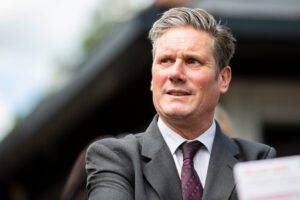
Senior business leaders and trade bodies have backed Keir Starmer’s comments that Britain should not part from the European Union on standards ranging from the environment to employment.
The Labour leader has come under fire from the Conservatives, who accused him of wanting to “unpick” Brexit after saying that “most of the conflict” since 2016 had arisen because the UK “wants to diverge and do different things to the rest of our EU partners”.
In a letter to the Guardian, dozens of business leaders and trade bodies joined with political figures hostile to Brexit in endorsing what they described as a “policy of alignment with EU standards and regulations, unless it is explicitly not in the UK’s interests to do so”.
Signatories to the letter included Peter Norris, the chair of Virgin, and Paul Drechsler, from the International Chamber of Commerce (ICC), who said that such a policy would “enable businesses and investors to have confidence in the UK’s regulatory foundations, while still allowing the UK to maintain its own regulatory autonomy”.
The letter adds: “By taking this approach, any future UK government will be able to reassure businesses and investors, both domestically and internationally, that the UK is committed to maintaining high standards and protections, strong relationships with its trading partners, while also protecting the interests of UK businesses.”
The position of “beneficial alignment” differs from “dynamic alignment” – the idea that the UK would follow evolving EU rules in an area indefinitely, which Labour is at pains to stress that it does not support.
Other signatories to the letter included Richard Griffiths, chief executive of the British Poultry Council, and Steve Brambley, chief executive of Gambica (the UK Trade Association for Instrumentation, Control, Automation and Laboratory Technology). The letter was organised by Best for Britain, which was originally launched in 2017 to oppose Brexit.
Norris said: “Leaving the single market has already increased costs for businesses and consumers and further divergence will only hike prices further during a cost of living crisis.”
The intervention comes before the Labour party conference in October, where Starmer is also likely to come under greater pressure from members of his own party who are eager for him to take an even more forthright position on deepening ties with the EU.
External groups such as Best for Britain have also been keen to add to the political argument that polling shows alignment in UK-EU relations is the most popular option in all but six constituencies in England, Wales and Scotland.
Starmer’s comments, made on a visit to Canada at an event bringing together progressive leaders, opened him up to attack from the Tories and prompted surprise from some in his own party who had come to regard Brexit as dangerous territory.
The chancellor, Jeremy Hunt, told LBC radio: “I think those kinds of comments about not wanting to diverge will worry a lot of people that what he really wants to do is to unpick Brexit.”
Read more:
Senior business leaders back Keir Starmer’s call not to ‘diverge’ from EU
Month: September 2023
Number of workers taking sick leave hits 10-year high

Stress was one of the biggest contributors to a rise in workplace absences over the past year, according to research that found the number of workers taking sick leave has hit a 10-year high.
The Chartered Institute of Personnel & Development (CIPD) analysed sickness absence and employee health among 918 organisations representing 6.5 million employees, with 76% of respondents reporting they had taken time off due to stress in the past year.
Recurring cases of Covid-19 and long Covid were another trigger for workers to take time off while the cost-of-living crisis was cited by many as a reason behind sick leave.
The report comes as firms warn of continuing difficulties with recruitment and a lack of skilled staff, prompting its authors to say it was clear employers needed to offer more support to get people back to work.
They found that staff were absent from work for an average of 7.8 days over the past year, up from 5.8 days in 2019, before the pandemic and the highest since 2010.
Rachel Suff, senior employee wellbeing adviser at the CIPD, said: “External factors like the Covid-19 pandemic and the cost-of-living crisis have had profound impacts on many people’s wellbeing.”
Of the organisations responding, 50% said they have employees over the past 12 months who have experienced, or are experiencing long Covid – ie with symptoms that last 12 weeks or more – up from 46% the previous year. More than a third (37%) of organisations reported Covid-19 as still being a significant cause of short-term absence.
“These figures may underestimate the issue as not all employees with the condition report their symptoms and a fifth of respondents didn’t know whether any employees had long Covid-19 symptoms,” said the report, based on a survey conducted with the insurer Simplyhealth.
The main cause of long-term absences was mental ill health, which 63% of respondents cited as the top cause, while short-term absences continued to be dominated by minor illnesses like colds and musculoskeletal injuries, though mental ill health was also cited by 43% of respondents as a reason for workers to take a few days off work.
The rise in sickness absences comes amid a growing demand from employees to work more flexibly and to work from home in response to caring responsibilities, rising costs and stress at work.
A recent report by KPMG said two-fifths of UK workers are considering a career change due to the rising cost of living, up from 35% in 2022. The accountancy firm surveyed 1,500 UK employees about their working habits and career aspirations and found a challenging economic environment is changing their employment priorities.
A report on Monday by economists at the same firm said the UK’s low productivity, which measures the amount produced by a worker each hour, will weigh on the economy and with continued political uncertainty and high interest and slow growth in the second half of this year.
They fear the UK could “struggle to keep its head above water in the second half of the year” as “renewed signs of stress” hit the economy.
KPMG predicted UK growth will slow to just 0.4% this year, down from 4.1% in 2022, and slow further to just 0.3% in 2024, less than half the 0.8% forecast by the Organisation for Economic Cooperation & Development (OECD).
Labour said the UK was the only OECD country to have gone backwards on all three rates of employment, unemployment and economic inactivity since the start of the pandemic.
Analysis of recently published data from the OECD shows that across the Paris-based organisation’s 38 member countries, the UK is the only one to have a lower employment rate, a higher rate of unemployment and a higher rate of economic inactivity than in early 2020.
“Five other countries also have a lower employment rate, while 14 others have seen unemployment rise and five others have seen economic inactivity increase. But, under the Tories, the UK is uniquely failing on all three fronts,” Labour said.
Labour’s new shadow work and pensions secretary, Liz Kendall, said the UK was suffering a “crisis of economic inactivity” that has especially affected the over-50s and young people.
Read more:
Number of workers taking sick leave hits 10-year high
Creative UK dishes out £35m investment fund

Creative UK has launched a new creative industries investment fund to support the UK’s ambitions to grow the sector by £50bn and create one million extra creative jobs by 2030.
The £35m Creative Growth Finance II (CGF II) fund will provide the investment needed to meet the targets set out in the UK government and Creative Industries Council’s recently published Sector Vision.
Caroline Norbury OBE, chief executive, Creative UK, explains: “Over the past decade, the UK’s creative industries have grown more than 1.5 times the rate of the wider economy, currently generating £108bn in economic value and employing 2.3m people. However, this country’s talented creative businesses are experiencing a significant gap between their immense growth potential and access to the vital capital they need to succeed.”
Delivered in partnership with Triodos Bank, CGF II is the largest single fund to be delivered by Creative UK, following its investment of more than £50m into the UK’s creative industries over the past decade.
Tech expert Sjuul van der Leeuw, CEO of Deployteq said: “The creative industries are at a really exciting moment, with tech innovation like AI revolutionising areas such as marketing and creative production, so it’s fantastic to see the UK’s commitment to supporting this growth. This extra investment will enable companies to master emerging technologies and turbocharge the sector’s growth, adding significant value for businesses and the wider economy.
“The funding will also enable the onboarding and training highly skilled staff adds a new dimension to businesses’ creative offerings as well as their capacity to make use of automation-enabled technologies to boost the efficiency of critical processes and reach new audiences through channels such as email marketing” he added.
CGF II continues on from the first Creative Growth Finance fund, which launched in 2019 and has since invested over £17m into more than 30 creative businesses located across the UK and operating within sectors including film & TV, virtual production, video games, advertising and software.
The existing CGF fund portfolio has so far experienced an 108% improvement of average monthly revenues, a 39% headcount growth average with more than 225 jobs created, and nearly £19m raised in further third party funding.
Phillip Bate, director of business banking, Triodos Bank UK, said: “Four years on from the launch of the first Creative Growth Finance fund, our partnership with Creative UK goes from strength to strength and continues to support companies at the forefront of innovation. For a bank only focused on financing projects with positive impact, we can see the social importance of these organisations to the UK. Creative UK’s expertise has been key to helping us grow our funding of this important sector.”
Companies benefiting from Creative UK funding include Dimension Studio (virtual production), Moonraker VFX.
Read more:
Creative UK dishes out £35m investment fund
Hollywood writers in deal to end US studio strike
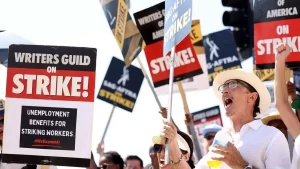
Screenwriters in the US say they have reached a tentative deal with studio bosses that could see them end a strike that has lasted nearly five months.
The Writers Guild of America (WGA) said it was “exceptional – with meaningful gains and protections for writers”. WGA members must still have a final say.
Hollywood writers are striking in a row over pay and the use of artificial intelligence (AI) in the industry.
Stranger Things and the Last of Us are among the shows which have been paused.
It is the longest strike to affect Hollywood in decades and has halted most film and TV production.
A separate dispute involves actors, who are also on strike.
The writers’ walkout, which began on 2 May, has cost the US economy around $5bn (£4.08bn), according to an estimate from Milken Institute economist Kevin Klowden.
The dispute has shut down many of America’s top shows, including Billions, The Handmaid’s Tale, Hacks, Severance, Yellowjackets, The Last of Us, Stranger Things, Abbott Elementary and several daytime and late-night talk shows.
As well as issues around pay, the writers fear the impact of artificial intelligence potentially supplanting their talents.
Negotiations also broke down over staffing levels and the royalty payments that writers receive for popular streaming shows. They complain that those residuals are just a fraction of the earnings they would get from a broadcast TV show.
Traditionally, writers would receive additional payments when their programmes were repeated on a broadcast network. However, this model was undermined with the advent of streaming.
As a result part of the payments writers now receive generally include a certain amount of money which is intended to compensate for the royalties they are not receiving from broadcast repeats.
The WGA leadership and union members need to agree a three-year contract with the Alliance of Motion Picture and Television Producers (AMPTP) before they return to work.
The guild’s message on the proposed deal said details still had to be finalised, and it was not yet calling off the strike, but “we are, as of today, suspending WGA picketing”.
Hollywood trade publication Variety reported that staff on late-night talk shows could return to work as soon as Tuesday following the announcement, adding broadcasts could resume as soon as October.
But in its message to members, the union’s negotiating committee asked for patience on details of the pact.
“What remains now is for our staff to make sure everything we have agreed to is codified in final contract language,” the union said.
“And though we are eager to share the details of what has been achieved with you, we cannot do that until the last ‘i’ is dotted.”
Commenting on the news, Alistair Dent, Chief Commercial Officer at data company Profusion, said: “The deal to end the WGA strike is an interesting first glimpse into how professionals in different sectors could react to generative AI. The first thing to note is that the writers were able to act pre-emptively to protect their careers. This is because the use case for gen AI in the creative industries – like writing and image generation – is very clear. It’s much easier to secure safeguards against a technology before it has gained widespread adoption. For other professionals this may be more difficult because we simply can’t be certain how quickly AI will develop and its capacity to automate other jobs. Some may find that AI automation happens incrementally and their chosen career slowly becomes obsolete preventing a single moment to push back.
“The second thing to note is the WGA’s power to push back. Few professions in the UK and US have this type of organisational power and ability to shutter an entire industry. AI automation is likely to impact lower skilled and routine jobs first and those who undertake these activities are often the least empowered. Unions will need to play a very important role in monitoring the situation and protecting workers – we may see generative AI reinvigorating unions. The sad reality is that, unchecked, generative AI could spark a race to the bottom where businesses are incentivised to apply to more and more scenarios – regardless of the ethical implications.
“With any type of revolutionary tech there will be winners and losers. The sensible approach is to ensure that those who are likely to lose out – in this case by seeing their jobs becoming obsolete – are treated ethically. This means that businesses adopting upskilling programs that will help them adapt their career to AI. AI should create plenty of career opportunities and, if applied correctly, should support people to do their jobs better not replace them entirely.
“History has shown us that it is futile to try and hold back innovation that has such clear benefits. However, it has also taught us that any major advancement needs to be managed carefully. It should not be up to workers to strike against the misuse of AI, rather, we all need to be thoughtful about how we want AI to develop. This means bringing together businesses, governments and workers to create an ethical framework to prevent against misuse of AI and guide its development.”
Read more:
Hollywood writers in deal to end US studio strike
Nissan pledges to go fully electric in Europe by 2030

Nissan has pledged to go fully electric in Europe by 2030, outpacing the watered-down ambitions announced by Rishi Sunak of the British government.
“There is no turning back now,” Makoto Uchida, chief executive of the Japanese car-maker said. “Nissan will make the switch to full electric by 2030 in Europe — we believe it is the right thing to do for our business, our customers and for the planet.”
The commitment to the 2030 deadline comes less than a week after Rishi Sunak delayed a proposed ban on the sale of new petrol and diesel cars by five years to 2035. The U-turn sparked an industry backlash and warnings that uncertainty over policy was putting future investment at risk.
Earlier this year Nissan raised its targets for EV models. It is playing catch-up in a segment dominated by newcomers such as Tesla and has said it will launch 19 new EV models in Europe by 2030. Uchida said today that one of two new electric models Nissan has already confirmed for Europe will be manufactured at its Sunderland plant.
Nissan also previously said that by mid-2027 98 per cent of its sales in Europe would be either fully electric cars or hybrids.
The new goal of going fully electric by 2030 — announced at the launch of futuristic Concept 20-23 design in Paddington, London — brings it into line with its alliance partner Renault, which plans to make the Renault brand all electric by then.
The group, which has 7,000 UK employees, is investing £1 billion alongside Chinese-owned battery maker AESC to produce more electric vehicles in the UK.
Ford and Stellantis also plan to be fully electric in Europe by 2030. Volvo plans to sell only EVs globally by 2030.
Sunak announced the reversal of the 2030 ban in a speech last week alongside a series of other measures to row back on the government’s climate change commitments as he claimed that politicians had not been “honest with the public” about the cost of reaching net zero.
Ford said it showed a lack of commitment and ambition, pointing to the millions of pounds they had already pumped into their UK operation. Investments have also been made in Tata’s battery gigafactory in Somerset and the BMW plant at Cowley.
Lisa Brankin, chairwoman of Ford, said: “Our business needs three things from the UK government: ambition, commitment and consistency. A relaxation of 2030 would undermine all three.”
JLR, the UK’s second largest carmaker, welcomed the prime minister delay, however. It said it was pragmatic and brought the UK in line with other nations.
Read more:
Nissan pledges to go fully electric in Europe by 2030
West Midlands tycoon, 21, saves Britain’s last remaining alloy wheel …

Britain’s last remaining manufacturer of alloy wheels has been rescued by a 21-year-old who is also vying to buy Morecambe Football Club.
West Bromwich-based Rimstock, which makes forged wheels for luxury marques including Aston Martin and Bentley, has been bought out of administration by Sarb Capital, the investment vehicle of Sarbjot Singh Johal.
The financial details of the transaction were not disclosed by Interpath, the administrators, but it was understood to be a multimillion-pound deal.
“I am delighted to have played a part in saving such an iconic business,” Singh Johal, who is based in Solihull, said. “It is integral not only as a critical supplier to the UK car manufacturing industry but also to the local community as a major employer.”
He promised further investment “to grow this important business”.
Chris Pole, the joint administrator, said the sale to Sarb “preserves a significant number of jobs in West Bromwich”.
Singh Johal has a number of business ventures, which are financed using his family’s money. He set up Vitanic, a non-alcoholic drinks brand, in 2017 and this year has been working on a deal to buy Morecambe, the League Two football club.
Rimstock was set up in 1984 by Steve Neal, the founder of the British Touring Car Championship title winners Team Dynamics. He died in July, aged 82.
The company is one of two manufacturers in Europe with the spin forges required to make premium-forged wheels. Rimstock also counts McLaren, Ferrari and Jaguar Land Rover among its customers and also supplies wheels to motorsport teams and militaries.
Rimstock fell into administration with 76 staff in July but continued trading while Interpath sounded out potential buyers.
Read more:
West Midlands tycoon, 21, saves Britain’s last remaining alloy wheel manufacturer
Rishi Sunak to disband Energy Efficiency Taskforce

In a move that has sent ripples across the business and environmental sector, UK Prime Minister Rishi Sunak has made the controversial decision to disband the energy efficient Taskforce just months after it was created.
This decision is viewed as a significant shift in the government’s approach towards energy efficiency initiatives, sparking a wave of debate on its potential implications.
The Energy Efficiency Taskforce, established in March, was primarily tasked with helping the UK attain its ambitious goal of net-zero emissions by 2050. The Taskforce was instrumental in devising and implementing strategies that encouraged businesses to adopt energy-saving measures. However, the government has now decided to discontinue it, citing the need for a more ‘flexible and adaptive approach’ towards energy efficiency.
Sunak’s decision to disband the Taskforce comes amid growing concerns about the rising energy prices and their impact on businesses. While the Taskforce’s mandate was to promote energy efficiency, critics argue that it was not adequately addressing the immediate concerns of businesses struggling with high energy costs. However, advocates of energy efficiency argue that this move could potentially derail the progress made towards achieving the net-zero emissions target.
Energy experts have expressed mixed reactions to this decision. Some believe this could lead to a more market-driven approach to energy efficiency. On the contrary, environmental policy experts warn that this move could cause a policy vacuum, slowing down the momentum of energy efficiency initiatives.
Dr. Amelia Fletcher, an environmental economist at the University of East Anglia, said, “This decision seems short-sighted. The Taskforce was crucial in aligning business strategies with national energy efficiency goals. Its absence could disrupt the coordinated effort needed to tackle climate change.”
The impact of this decision on businesses could be twofold. On one hand, businesses may benefit from a potentially more flexible approach towards energy efficiency, allowing them to adapt to market conditions. However, the absence of a focused body like the Taskforce could also mean a lack of clear direction for businesses aiming to become more energy-efficient.
From an environmental perspective, this decision could slow down the progress towards the UK’s net-zero emissions target. It could potentially stall energy-saving measures, leading to higher carbon emissions. This decision underscores the delicate balance that governments must maintain between supporting businesses and protecting the environment.
In conclusion, while the disbanding of the Taskforce might offer more flexibility to businesses, it also raises pertinent questions about the UK’s commitment to its energy efficiency and net-zero emission targets. The impact of this decision will unfold in the forthcoming days, shaping the future of the UK’s energy landscape.
Read more:
Rishi Sunak to disband Energy Efficiency Taskforce
Business tycoon, John Caudwell, threatens to withdraw support for Suna …

UK business magnate John Caudwell, founder of Phones 4u, has announced he may withdraw his support from Prime Minister Rishi Sunak and the Conservative Party due to their views on the net zero initiative.
Caudwell, one of Britain’s wealthiest businessmen, has expressed deep-seated concerns about what he terms the “net zero madness”. This shock withdrawal of support from a prominent figure in the business community could have far-reaching implications on the political landscape and within business circles.
Caudwell, the self-made billionaire, views the net zero initiative as a misguided attempt that could potentially cripple the UK’s economy. He believes the aggressive measures being taken to achieve net zero greenhouse gas emissions by 2050 are more harmful than beneficial.
In the comment piece to published in The Sunday Times, he wrote: “This newfound delay in our net zero target is nothing short of self-sabotage, both environmentally and economically.”
Caudwell’s threat to withdraw his support from the Conservative Party could send shockwaves through the political sphere. As a significant financial contributor to the party, his withdrawal could potentially disrupt the party’s funding.
The decision may also affect the party’s popularity among the business community. Many business leaders often look up to figures like Caudwell and his vocal withdrawal could potentially sway their support away from the Conservative Party.
Caudwell’s decision could stir up considerable discussion within the business community. If the net zero initiative is seen as a potential threat to the economy and business growth, other business leaders might also voice their concerns.
Caudwell’s stance may serve as a wake-up call, prompting businesses to take a closer look at the potential impact of the net zero initiative on their operations and profitability. This could lead to a greater push for a more balanced, less disruptive approach to achieving environmental goals.
Caudwell, worth an estimated $2.7 billion, is a towering figure in the UK business world. As the founder of Phones 4u, a company he sold for £1.5 billion in 2006, Caudwell has proven his astuteness in business. His philanthropic efforts, particularly through the Caudwell Children charity, have made him a respected figure.
Caudwell’s views carry significant weight in the business community, with any decision to withdraw support from PM Sunak and the Conservative Party over their net zero policy a development that cannot be overlooked.
Read more:
Business tycoon, John Caudwell, threatens to withdraw support for Sunak over ‘net zero madness’
Jeremy Hunt calls for London to be the place tech companies choose to …
Jeremy Hunt has said that London’s stock exchange should be like the Nasdaq exchange in the US and become “Europe’s place of choice” for technology companies that want to raise capital.
Speaking from the west coast of America, where he is meeting tech businesses to bang the drum for investment in the UK, the chancellor said “there is work to do to make sure that the London Stock Exchange is the place of choice for up-and-coming British technology businesses to list”.
He added that the LSE was making changes because “the future for the London stock market is to perform the role that Nasdaq does in the US”. The tech-heavy exchange is proving a magnet for companies who are looking to tap the deep pools of capital and expertise for the sector in New York.
There has been much soul searching over the UK’s future as a centre for listed technology businesses, particularly after Arm, the Cambridge-headquartered semiconductor giant, chose Nasdaq for its recent listing and other UK businesses have threatened to follow suit.
The chancellor said he had not had discussions with Arm over whether it would bring a secondary listing to London but that he would be “delighted” if it did, as Rene Haas, the chief executive, has hinted.
The comments came after David Schwimmer, head of the LSE Group, said the idea that London was losing its draw as a financial centre was “clickbait” and that this narrative had been “overplayed”.
Hunt has proposed reforms to enable institutional investors to allocate more funds to back the growth of UK private companies. The reforms could unlock £75 billion in additional investment, which would be “a stepping stone to IPOs”. He said he wanted to “make sure that the next DeepMind doesn’t have to automatically look at going to a partnership with one of the tech giants. It could actually grow under its own steam in the UK with capital raised on the UK markets.”
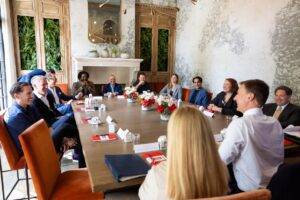
During Hunt’s visit, part of a government push to turn the UK into what it calls a “science and technology superpower”, he met a suite of heavyweight players from the industry to discuss increasing investment in the UK.
They included representatives of Andreessen Horowitz, the venture capital firm, Universal Music and Warner Studios, as well as Satya Nadella, chief executive of Microsoft, Ruth Porat, chief financial officer at Alphabet, and Andy Jassy, chief executive of Amazon.
Hunt said: “When I was responsible for technology ten years ago we had real problems. If I started saying ‘we want the next Google to be British’, people would laugh you out of court. Now we have 160 unicorns [privately held start-up companies valued at more than a billion dollars]. Quite serious stuff is starting to happen and that’s what makes a trip like this exciting.”
He said that the “tide is turning” when it comes to the UK’s tech industry, compared with when he was in charge of the sector as culture secretary.
On Thursday, Warner Brothers Discovery announced it was expanding its UK studios with the addition of ten new sound stages and an extra 400,000 square feet of production space in Hertfordshire.
“The entertainment industry has become a technology business over the last decade,” the chancellor said. “Everyone in Hollywood thinks they’re in the technology business. That’s why yesterday’s announcement of the increase of 50 per cent of the Warner Bros studio space in Leavesden is so significant. Our studio space in the UK has gone up by two thirds in just three years. Netflix spent $6 billion alone [on content over four years].
“There’s something quite exciting happening, which is why there’s been a lot of interest from investors and from venture capitalists, from all the big names in the tech industry.”
Read more:
Jeremy Hunt calls for London to be the place tech companies choose to raise capital

