

The higher cost of borrowing is weighing heavily on bank lending in a sign that the UK economy may be facing a recession due to the Bank of England’s interest rate hikes.
Both mortgage lending and consumer lending dropped in September as the interest rates on bank loans continued rising, according to new data from the Bank of England.
Mortgage approvals fell to 43,300, the lowest level since January this year while approvals for remortgaging fell to the lowest level since January 1999.
Mortgage approvals are an indicator of future borrowing. The data showed that the effective interest rate paid on new mortgages climbed by 19 basis points in September to 5.01 per cent.
With effective interest rates continuing to rise, Ashley Webb, UK economist at Capital Economics, said: “We suspect that further weakness in housing activity and prices lies ahead.”
New loans for consumer borrowing meanwhile were also hit by the higher cost of borrowing. Consumer credit borrowing fell to £1.4bn in September from £1.7bn in August due to a decrease in personal loans and motor finance.
Net borrowing on credit cards also fell from £700m in August to £600m in September.
Webb said that the fall in new lending was “consistent with our view that a mild recession may already be underway”.
Although households continued withdrawing deposits from banks and building societies in September, inflows into National Savings and Investment (NS&I) ISAs meant that total household liquid assets increased in the month.
Households withdrew £9bn from sight deposit accounts, which was partly offset by net inflows of £5.3bn into interest-bearing time accounts.
A further £7.7bn flowed into NS&I ISAs, the highest level since August 2020, partly reflecting the market-leading rates on offer in those products.
“Households added the most to their liquid assets in September since midway through 2020, likely in an attempt to rebuild savings buffers which have taken a hit over the past couple of years,” Gabriella Dickens, senior UK economist at Pantheon Macroeconomics said.
The effective interest rate paid on new time deposits rose by nine basis points and now sits at 5.21 per cent.
Read more:
Drop in bank lending adds to fears that UK recession already underway
Month: October 2023
UK can become a “pioneer of responsible AI innovation” but must bo …

Government urged to prioritise the development of industry ethical frameworks to boost business confidence and make the UK a global pioneer in responsible AI innovation – ahead of the inaugural UK AI Safety Summit
Nearly half of SMEs do not plan to innovate with AI in the next year, largely because of a lack of confidence among business owners in the safeguards in place to protect society — according to new research by the UK’s data and marketing industry trade body.
Ahead of the inaugural UK AI Safety Summit, which will run from 1-2 November, the UK Government has been urged by industry to grasp its unique opportunity to become a global pioneer in responsible AI innovation.
Of those SMEs who do plan to innovate with AI within the next 12 months, 40% believe current regulation does not offer sufficient safeguards for its development. Just under a fifth are in a position where they plan to innovate and believe current regulation is sufficient.
These findings come from the Data & Marketing Association’s (DMA UK) new report: ‘Data Horizons: How UK SMEs and Consumers View the Future of Privacy Regulation’. Exploring the viewpoints of SME business owners and the UK public on key issues at the heart of the evolving digital economy, it revealed strong demand among SMEs for responsible AI innovation and safeguards to protect society.
“The inaugural Global AI Summit has laid the foundations for the UK to become a pioneer in how to drive responsible AI innovation”, said Rachel Aldighieri, MD of the DMA. “To achieve this, industry leaders and government must first work together to build industry ethical frameworks founded on core values such as accountability, transparency, and public safety and trust, to ensure AI’s development remains a force for good and businesses become more confident to innovate in this space.”
Over three quarters of SME business owners believe the UK Government should introduce regulation to mitigate the ethical risks of AI.
“The DMA supports the UK Government’s proposals to build on existing regulatory expertise and legislation, to establish a set of core principles to guide regulators across their respective sectors. Regulation will always have an important role to play to deter rogue organisations, but it must supplement an industry-led governance initiative,” added Aldighieri. “A stringent regulation-first approach could stifle innovation and show mistrust to businesses when most have genuine intentions for AI’s development — they just need more direction, support, and structure from industry leaders and regulators to help them to use AI effectively and responsibly.”
AI’s key benefits and threats
For SMEs and consumers, the main perceived benefit of AI technologies is that it will improve training and development. Over a quarter of SME owners and nearly a fifth of consumers stated this.
Alarmingly, just 15% of SME owners stated it will be a boost to the UK economy as a key benefit, which suggests government must work with industry bodies to help upskill and educate businesses on the opportunities gained from AI innovation.
The main concern consumers have around AI is the reduction of jobs, with more than a third stating this; followed by privacy and information, societal detriment, and national security. Surprisingly, a fifth have no concerns around AI.
Despite these range of concerns, there is high consumer confidence in UK regulatory bodies’ ability to keep up with emerging technology.
“It is encouraging to see high levels of confidence among the UK public in our regulators, as the importance of regulation can never be underestimated. However, to supercharge the potential economic and societal benefits associated with responsible AI innovation, government must now facilitate a values-driven, agile approach through ethical industry frameworks,” concluded Aldighieri. “The DMA community believes the human-AI team is our best future, with AI operating as a tool that humans use to assist and enhance our own abilities. This will certainly alter job opportunities among the public, but it must not diminish them. Ultimately, we must never forget the people AI is intended to serve.”
Read more:
UK can become a “pioneer of responsible AI innovation” but must boost business uptake and confidence, new research reveals
Almost half of workers would turn down a job if flexible working wasnâ …

A lack of flexible working options is driving almost half of UK workers to reject jobs at a time when employers are increasingly concerned about talent attraction and retention.
That’s according to new research by specialist recruitment firm Robert Half.
The firm’s 2024 Salary Guide – which analyses and reports on market salaries, hiring trends, and skills requirements across the UK – revealed that while pay remains a key driver of job moves – with 63% of workers citing salary as a reason to reject an offer – flexible working and development opportunities are also significant motivators. Almost half of the workforce would reject a new job if the company didn’t offer flexible working. A further 43% would do so if career development opportunities weren’t suitable.
The report also revealed that 75% of employers are very or somewhat concerned about staff attraction and retention, with almost a third of workers indicating that they are apprehensive about the impact of heavy and increased workloads on peer retention.
Kris Harris, Regional Director – UK Technology Solutions, at Robert Half, commented: “It’s an incredibly complex hiring landscape at the moment and while salaries remain a significant driver of career moves, candidates are looking for a broader package that gives them more than just a good pay packet. As the debate around flexible working grows and news reports continue to highlight those brands that are enforcing office returns, the fact that almost half of workers would turn down a job due to a lack of flexible working options is a concern.
“With such a significant proportion of the UK’s employers concerned about their ability to recruit and retain talent, what candidates want needs to take precedence over what employers would prefer to some degree at least. Inflated salaries aren’t feasible long term – indeed the study also showed that 22% of businesses don’t plan to offer pay increases – but flexible working is. Although the recruitment market is slowing, with the labour market data from the Office for National Statistics showing sustained falls in jobs over recent months, skills shortages still remain. In this environment, candidates continue to be able to command more, and right now that includes flexibility.
“The figures around excessive workloads are also an issue if firms are to retain the key talent that has been so difficult to attract. Burnout is a real issue in the workforce and these latest statistics suggest this isn’t going to go away on its own. While there does need to be a longer-term solution to excessive workloads, in the interim, the flexible labour market can play a significant role in managing workloads and employers should seriously consider where it may be best to invest in contract staff to retain full time employees.”
Read more:
Almost half of workers would turn down a job if flexible working wasn’t offered
Cash-strapped Britons turn away from online shopping

Online retail sales have contracted at the sharpest pace on record this month, dragged lower by people cutting back on their spending because of higher interest rates and an uncertain economic outlook.
Monthly internet sales dropped to a weighted balance of -78 per cent in the year to October, the biggest decline since 2009 and down steeply from September’s balance of -3 per cent, according to the CBI, the employers’ lobby group.
The fall is a marked turnaround from when households flocked to online retail platforms in response to Covid-19 lockdowns closing off high streets.
Overall retail sales fell to a balance of -36 per cent annually in the year to October, the joint worst reading for that specific month since the CBI started measuring the data in the 1980s and down from -14 per cent in the previous month.
The numbers echo downbeat official estimates of retail sales published by the Office for National Statistics last week, which were lower than City analysts’ expectations at -0.9 per cent in September. Consumer-facing companies also signalled that they expected retail sales, which have been negative for six months in a row, according to the CBI, to continue to contract over the winter months. Normally, this is when much of the sector generates most of its income.
Martin Sartorius, principal economist at the CBI, said: “As the festive period approaches, the retail sector remains in a perilous position. Sales volumes have been falling year-on-year for six months in a row, as cost of living concerns and higher interest rates weigh on consumer spending. While slowing inflation should help to bolster households’ income in the coming months, retailers will continue to face headwinds from higher energy and borrowing costs.”
Inflation has slowed from a peak of 11.1 per cent to 6.7 per cent, but household finances are still catching up with a steep rise in prices that has lasted for nearly two years.
Wages are now accelerating faster than prices, up by about 8 per cent, according to figures from the ONS, which economists expect to stir consumer spending and economic growth.
Read more:
Cash-strapped Britons turn away from online shopping
Digital bank Monzo in talks to sell new £300m stake

Monzo is in talks about a £300m-plus fundraising that would underpin its status as the most highly valued digital bank in Britain.
It is understood that Monzo, which was founded in 2015 and now boasts 8.5m customers, is in detailed talks with a pack of blue-chip investment funds about a share sale expected to value it at more than £3.5bn.
The talks are yet to be concluded, and the identity of any new investors has yet to be determined by the company’s board, insiders said on Thursday evening.
The company is expected to finalise the details of the stake sale by the end of the year.
Insiders said the fundraising would be conducted at a premium to the £3.5bn at which it secured capital from Abu Dhabi Growth Fund in late 2021.
That would be a rarity in technology funding markets which have forced many companies to raise capital at steeply discounted valuations.
Rivals include Starling Bank, which is currently seeking a new permanent chief executive.
Revolut, which was valued at $33bn in a funding round in 2021, has yet to receive a UK banking licence despite months of talks with regulators.
Monzo has recovered spectacularly from a difficult period two years ago, when it emerged that the City watchdog was investigating potential breaches of anti-money laundering and financial crime rules.
Although it remains loss-making, reporting a loss of £116m in the year to the end of February, it is expected to be profitable this year – a major milestone for a standalone digital bank.
Its latest fundraising is likely to be viewed as the final round before Monzo unveils an initial public offering, in which it would sell shares to the public.
Existing Monzo investors include the Chinese group Tencent, Passion Capital, Accel and General Catalyst.
Some of the bank’s current shareholders are said to be keen to invest more money at the new, higher valuation.
Sky News reported during the summer that Monzo was revamping its corporate structure as it pursues an international expansion strategy that will serve as the prelude to a multibillion-pound stock market listing.
Monzo Bank Holding Group was established to avoid the company facing punitive capital treatment by British regulators as it launches in new overseas markets.
It is now the UK’s seventh-biggest bank by customer numbers, and has a small presence in the US.
Monzo’s rapid growth is being fuelled by new product development, including the recent launch of an investment service through a partnership with BlackRock, the world’s biggest asset manager.
One person close to the fundraising effort said the raise was opportunistic in that the new capital would be used to accelerate its growth.
“The company does not need the money other than to build the business faster,” they said.
Monzo is run by TS Anil, its chief executive, and chaired by Gary Hoffman, one of Britain’s most prominent bank executives.
Read more:
Digital bank Monzo in talks to sell new £300m stake
Huge expansion of Wimbledon tennis grounds gets closer after planning …

A “once in a lifetime” expansion of Wimbledon’s tennis facilities took a significant step towards fruition last night after a vital planning decision.
The All England Lawn Tennis Club has been given the OK by Merton Council to add 38 new courts, including a new 8,000-capacity show court, with plans for the development submitted in 2021.
Now Wimbledon bosses will have to wait for a similar planning decision from Wandsworth Council in the coming weeks.
One of the largest areas of private land in London, a golf course abutting Wimbledon Park, will be turned into a new 23-acre public park that is free for everyone all year round.
The new project is set to bring £38m to the London economy, including 250 new jobs.
Local residents had been putting up a fight against the proposals, though the All England had long ago secured the backing of golf club members with a £64m fund distributed amongst the golfers.
Stephen Hammond, Conservative MP for Wimbledon, told the PA news agency that building on the park “pretty much contravenes every recommendation” on Metropolitan Open Land – a form of protection that treats green spaces in London in a similar way to the green belt.
He said: “If you read the officers’ report, there’s a whole chunk of it which effectively says this offends every planning policy and then says because there are very special circumstances we’re going to let it through.”
In a 450-page report, Merton Council’s planning officers concluded that the development would be “inappropriate” and cause “physical harm” to the Metropolitan Open Land, but said this was outweighed by the “very substantial public benefits” of the proposal and that these benefits constituted “very special circumstances” justifying development on protected land.
The so-called masterplan was announced in 2013.
Sally Bolton, Chief Executive of the All England Club, said: “We are delighted that the London Borough of Merton has resolved to approve our plans for the AELTC Wimbledon Park Project.
“Our proposals will both secure the future of The Championships for generations to come by bringing Qualifying to SW19 and provide a transformation in community amenities – including a new 23-acre park for everyone to enjoy on land which has been inaccessible to the public for over 100 years.”
The chief executive added: “We now look forward to the decision of Wandsworth Council’s Planning Committee in the coming weeks.”
Read more:
Huge expansion of Wimbledon tennis grounds gets closer after planning victory
Sunak says UK shouldn’t ‘rush to regulate’ AI
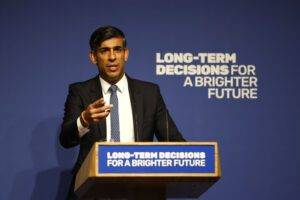
Rishi Sunak has said the UK “shouldn’t be in a rush to regulate” the development of artificial intelligence (AI) despite a dossier of potential dangers laid out by the government.
The Prime Minister made a speech on the risks and rewards of the new technology at the Royal Society this morning ahead of the UK’s AI Safety Summit at Bletchley Park next week.
Asked about regulation, Sunak said: “I think we shouldn’t be in a rush to regulate for a couple of reasons.”
He said the UK’s approach of encouraging innovation has “historically” been the right one, and stressed it was “hard to regulate something if you don’t fully understand it”.
Sunak said “We as a country tend to get this right. We tend to take a principles-based, proportionate approach to regulation that protects the things that we need to protect, whilst allowing the maximum amount of innovation to happen here.
“That is the hallmark of the UK – that’s why we have such successful innovative sectors like technology, life sciences and financial services.
“We need to not lose that as we think about AI and that’s why I think our approach is absolutely the right one for the country.”
The Prime Minister also said mitigating the extinction risk from AI should be a global priority alongside pandemics and nuclear war and said he wanted to be “honest” with the public.
It came after the government revealed a dossier of warnings about how AI could develop until 2030, and said it is unable to rule out it posing an “existential threat” to humanity.
Potential dangers cited were cyberattacks; terror groups developing bioweapons, rising unemployment; increased poverty; scams, fraud and fake news; election interference; trade secrets being stolen and “societal unrest” as people “fall victim to organised crime”.
An AI Safety Institute – based on the work of the AI Safety Taskforce – is part of the government’s plan to address these potential threats.
Sunak added: “As we understand what the risks are – if they manifest themselves – then we’ll be in a far better place to figure out what is the appropriate action to take at that moment.
“When you’re dealing with something so fast moving and not fully understood even by the people who are developing the tech themselves it’s hard to say ‘this is the best way to regulate’.
“I think first build the understanding and we can maintain our pro-innovation approach.
“Then move to something more practical down the line when we know exactly what we’re dealing with.”
Peter Kyle, Labour’s shadow science and technology secretary, said: “AI is already having huge benefits for Britain, and the potential of this next generation of AI could be endless, but it poses risks as well.
“Safety must come first to prevent this technology getting out of control. Rishi Sunak should back up his words with action and publish the next steps on how we can ensure the public is protected.
“We are still yet to see concrete proposals on how the government is going to regulate the most powerful AI models.”
Read more:
Sunak says UK shouldn’t ‘rush to regulate’ AI
Ex-NatWest chief breached Nigel Farage’s privacy, ICO rules

The former NatWest chief executive breached data protection laws when she spoke to a BBC journalist about the planned closure of Nigel Farage’s bank accounts, the UK’s information watchdog has ruled.
An Information Commissioner’s Office (ICO) report has said that Alison Rose broke rules on two counts: first by revealing that Farage had a banking relationship with its private bank, Coutts; and secondly by providing “misleading information” that led the BBC to believe the bank was closing his accounts for purely commercial reasons, linked to his wealth.
“Mr Farage’s rights were infringed because of this,” the ICO report said.
Documents obtained by Farage in July showed that while Coutts had considered the fact that he had fallen below the bank’s multimillion-pound account thresholds, the bank also decided to close his accounts due to concerns over his political views, which it said did not align with the bank’s. The Coutts documents showed the bank believed that his alleged “xenophobic, chauvinistic and racist views” posed a reputational risk to the bank.
ICO said it did not plan to take any further action, given that NatWest – which is 38.5% owned by the taxpayer – had already launched an investigation into the incident and Rose had stepped down over the scandal.
In July, Rose admitted to discussing the matter with a BBC journalist, in an alleged breach of client confidentiality that raised concerns in government and eventually led to her resignation.
An ICO spokesperson said: “Following a thorough review of the complaint raised with us, we have concluded our investigation. We upheld two parts of the complaint – namely, we found that an individual employed by NatWest shared information when they should not have done, and that by doing so they infringed the complainant’s data protection rights.
“We have been clear with the bank that these actions were unacceptable and should not happen again.”
The ICO ruling, which was first reported by the Financial Times, was issued in response to complaints filed by Farage this summer. It also comes days before NatWest’s own investigation is due to conclude, at the end of October.
That investigation, which is being conducted by the law firm Travers Smith, could result in Rose losing millions of pounds in pay. NatWest confirmed last month that she is still likely to collect £2.4m as she serves out her 12-month notice period.
Farage said: “The ICO report confirms that Dame Alison Rose was in breach of data rules, of the FCA rulebook, and oversaw a culture of deep political prejudice within the NatWest Group. She must not be rewarded for failure.”
A spokesperson for Farage told media that the former Ukip leader had not ruled out taking the matter to court.
NatWest bosses, including the outgoing chair, Howard Davies, are likely to face pressure over the ICO ruling when the bank releases its third-quarter earnings on Friday morning.
A NatWest spokesperson said: “We fully cooperate with the ICO in its assessment of any customer complaint, but it would not be appropriate for us to comment on this individual case.”
A spokesperson for Rose said: “Alison Rose was not aware of the ICO investigation, did not receive any questions from the ICO, has not seen its ruling and cannot comment on it.”
Read more:
Ex-NatWest chief breached Nigel Farage’s privacy, ICO rules
Investec and OakNorth embroiled in row over COVID taxpayer loan guaran …

Two British banks are embroiled in a dispute over a COVID loan which could leave taxpayers on the hook for a six-figure sum.
It is understood that OakNorth, the banking group founded by entrepreneur Rishi Khosla, is in talks over a £20m loan it made to a real estate joint venture between Newmark Properties and Investec Bank UK.
Part of the debt consisted of a Coronavirus Business Interruption Loan (CBIL) worth close to £300,000, according to insiders.
The joint venture is understood to be in default on its repayments, and the two banks are now said by people close to the situation to be at loggerheads over a resolution.
A failure to reach agreement could result in the joint venture being placed into administration and the taxpayer guarantee on the CBILS loan being triggered, according to one insider.
In a statement, an OakNorth spokesperson said: “OakNorth has been seeking, and continues to seek, a constructive solution with Investec, with a fully solvent outcome.
“Investec has not provided a proposal which would avoid loss to the taxpayer which is consistent with the underlying loan and CBILS documentation.”
A spokesperson for Investec said: “We are in confidential discussions with various parties, details of which cannot be disclosed.
“Investec is fully committed to paying the CBIL liability in full and strongly refutes any suggestion otherwise.
“We continue our discussions with the relevant parties to ensure this takes place.”
Further details of the discussions between them were unclear on Thursday.
Under the terms of the CBILS scheme, taxpayers underwrote 80% of the value of the loans issued by banks.
The dispute between OakNorth and Investec is one example of the continuing fallout from the emergency loan schemes set up in the early months of the pandemic to ensure that British companies were able to withstand the series of COVID lockdowns.
Tens of billions of pounds were borrowed under CBILS and its larger and smaller counterparts.
It subsequently emerged, however, that the schemes had been targeted by fraudsters, with billions of pounds of taxpayers’ money squandered.
Read more:
Investec and OakNorth embroiled in row over COVID taxpayer loan guarantee

