

October 2023 – Page 4 – AbellMoney

London house prices fell by 1.4 per cent in August

House prices in the capital fell further in August, according to the government’s latest house price index, as higher interest rates continued to weigh on the market.
Data released by the Office for National Statistics on Wednesday showed the region’s house prices fell by 1.4 per cent in August year-on-year.
London’s average house prices remained the most expensive of any region in the UK, with a figure of £536,000, down from £553,000 last August.

Meanwhile, nationwide house prices rose by 0.2 per cent in the 12 months to August, down from 0.7 per cent in July.
The average price increased to £291,000, which is little changed from last August but £9,000 more than the recent low point in March.
Prices in London have fallen 4.8 per cent over the last year, the biggest decrease of any region in cash terms at an average of £26,514, according to the Halifax House Price Index.
“These numbers reflect what was happening in August, and while we would expect a lull in the summer months with low activity, we’ve found that the housing market is not as exciting this autumn as it was in the spring,” said Alex Lyle, director of Richmond estate agency Antony Roberts.
“Buyers are waiting to see what happens with mortgages and if interest rates are held again next month, it will be viewed as a little pigeon step in the right direction.”

Mark Harris, chief executive of mortgage broker SPF Private Clients, added: “Swap rates, which underpin the pricing of fixed-rate mortgages, have risen on the back of the latest inflation data, with five-year Swaps rising to 4.68 per cent this morning from 4.57 per cent yesterday.
“While another base rate rise could still be on the cards, it is looking as though it is close to its peak, which will be welcomed for hard-pressed borrowers, with lenders continuing to reduce their fixed-rate mortgage pricing.
“There is a strong argument for the Bank of England to hold rates again next month in order to let the dust settle and the full effect of so many increases to filter through.”
The National Association Of Property Buyers warned today that house prices could keep falling for at least the next six months, with spokesman Jonathan Rolande expecting to see around 0.5% come off prices each month.


Read more:
London house prices fell by 1.4 per cent in August
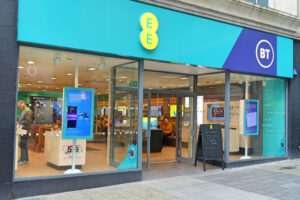
BT set to sell fridges and subscriptions in push for more customers

BT is branching out from its telco business into household appliances and a subscription service in a rebranding effort to accelerate customer growth.
EE, BT’s mobile and retail division, will diversify its offerings by introducing household electronic goods, such as smart fridges and coffee machines, as soon as next year.
The company is also set to expand into subscription services, with a digital platform called ‘EE ID’, a suite of products and services including payments, gaming and insurance.
EE chief Marc Allera, said the move will “transform” customer experience beyond mere connectivity offerings.
“With an EE ID, customers nationwide will be able to access a wide range of exciting new products, services and experiences across new sectors – easily and conveniently, in one place.”
Allera said telcos are more irrelevant than they once were. “People are not thinking about their network provider…we are worried about it and want to do something different,” he told the Financial Times prior to the launch today.
BT is currently on a cost-cutting drive to reinvigorate its performance, as the company grapples with a 25 per cent drop in share price over the past six months.
“This is a significant moment for BT, the new EE, Marc Allera and UK consumers,” said Paolo Pescatore, leading media analyst and founder of PP Foresight.
“Consumer behavioural patterns have changed, and it is about time telcos evolve. This latest revolutionary move represents a radical and fundamental shift in thinking and approach in the way a telco operates.
“Strategically, this puts the new EE in pole position compared to its traditional telco rivals. Others have their own challenges and will fall further adrift given the need to be more flexible and agile in a radically converged and cut-throat marketplace.
“This will force them to accelerate their own efforts, platforms, mindset, and strategic vision,” Pescatore explained.
Allison Kirkby is poised to take the reins as BT chief executive, after Philip Jansen announced in July he will step down “at an appropriate moment” within the next year.
Read more:
BT set to sell fridges and subscriptions in push for more customers

X begins charging new users $1 a year

Elon Musk’s X, formerly known as Twitter, has started charging new users in New Zealand and the Philippines $1 (£0.82) a year to access key features, as part of a new trial.
They include the ability to tweet, retweet, like posts and reply to posts.
Those who opt out of the subscription fee will only be able to read posts, watch videos and follow accounts.
The social media platform said that the aim is to “reduce spam, manipulation of our platform and bot activity”.
New accounts will also be required to verify their phone number, though Mr Musk has said that it will still be free to create “read only” accounts, which do not have key features. .
Last month, the boss of X, Tesla and SpaceX suggested that all X users may have to pay for access.
Since Mr Musk bought Twitter for $44bn last year, it has seen a continuous revenue decline.
While there is a clear financial interest for the company to charge users, the controversial billionaire has said that getting people to pay for the service is aimed at tackling bots.
He has previously said that a bot costs “a fraction of a penny” to make. “But if somebody even has to pay a few dollars or something, some minor amount, the effective cost to bots is very high”.
Paid subscribers of an enhanced service, called X Premium, now pay for more features like longer posts and increased visibility on the platform.
X Premium currently costs £6.99 a month in the UK. The price differs depending on which country a subscriber resides in, while other users can still use X for free.
One risk of putting X behind a paywall is that the platform may lose a large chunk of its users. That in turn, could drive down advertising revenue, which currently accounts for the vast majority of the company’s income.
In recent weeks, the company has been investigated by the European Unionfor the possible spread of terrorist and violent content and hate speech, after Hamas’s attack on Israel.
It has also been fined by Australia’s internet safety watchdog for failing to cooperate with a probe into anti-child abuse practices.
Read more:
X begins charging new users $1 a year

Avalara Expands Partnership with Oracle NetSuite to Deliver Integrated …

Avalara, Inc., a leading provider of cloud-based tax compliance automation for organizations of all sizes, has announced that it is partnering with Oracle NetSuite to help customers to streamline invoicing even more within NetSuite.
NetSuite Electronic Invoicing, which is powered by Avalara, will allow organizations to increase efficiency, reduce costs, and address compliance with global e-invoicing mandates.
More than 60 countries worldwide have announced or already have mandates for e-invoicing, a number that could more than double by 2030. Additionally, a growing number of countries have introduced other digital reporting requirements, including live reporting of invoice data and e-reporting of international sales and purchases. As the number of mandates for e-invoicing and other digital reporting requirements increases, it would have become more challenging and expensive for NetSuite customers to address compliance without a centralized approach that this new solution offers.
“E-Invoicing is no longer just a local compliance issue and cannot be solved without technology, it is a global phenomenon that is fast becoming a business continuity risk that requires a strategic and scalable solution,” said Meg Higgins, SVP of Global Partners at Avalara. “We enable NetSuite to bring leading e-invoicing technology to its customers and help ensure they remain compliant as mandates continue to evolve.”
With this new solution, customers will be able to; Quickly support e-invoicing models by country or region. NetSuite will connect to Avalara’s global API to fulfill e-invoicing mandates, including digital signatures, QR codes, and tax authority clearance and approvals.
The solution would also facilitate easily access e-invoice exchange networks and government platforms. Organizations can connect to national and international networks, like Peppol, as well as government e-invoicing platforms directly from within NetSuite.
“Staying ahead of regulations across the globe can be a fulltime job and e-invoicing compliance is often outsourced to local vendors, which adds cost and complexity,” said Scott Derksen, Senior Director of Business Development, Oracle NetSuite. “With NetSuite E-invoicing, which is powered by Avalara, our customers can eliminate inefficient processes and automate compliance with local e-invoicing regulations to improve operations, reduce costs and mitigate risk while expanding into new markets.”
Read more:
Avalara Expands Partnership with Oracle NetSuite to Deliver Integrated E-Invoicing Solution  

Oracle NetSuite unveils AI additions to help businesses do more with l …

Oracle NetSuite today announced a series of new product innovations to help organisations reduce costs and run more efficiently so they can grow their top and bottom lines.
The latest NetSuite innovations include both traditional and generative AI-powered capabilities across the entire suite; new field service management and enterprise performance management (EPM) solutions; and new capabilities that help finance and customer experience professionals improve the speed and accuracy of business processes. 
“Over the past 25 years, our mission has stayed the same: deliver a unified suite of cloud applications that enable customers to do more with less and grow their businesses,” said Evan Goldberg, founder and EVP, Oracle NetSuite. “We continue to extend the capabilities of NetSuite to support this mission and help our more than 37,000 customers benefit from the latest cloud and AI innovations. Our new updates include traditional and generative AI capabilities embedded throughout the suite to help increase user productivity, reduce costs, and improve overall business efficiency.”
NetSuite has introduced new generative AI-powered capabilities across the entire suite and added new traditional AI capabilities to help customers enhance planning and budgeting, reduce manual data entry, and expand business insights. New AI-powered capabilities include: 

NetSuite Text Enhance: New generative AI-powered capabilities help users create contextual and personalized content for any text area in NetSuite based on a few starter words that describe intent. Supported by the Oracle Cloud Infrastructure (OCI) generative AI service, NetSuite Text Enhance helps finance and accounting, HR, supply chain and operations, sales and marketing, and customer support teams improve productivity by leveraging AI to produce relevant drafts that they can quickly and easily review, edit, and approve. To learn more about NetSuite Text Enhance, please visit: Oracle NetSuite Embeds Generative AI Throughout the Suite to Help Organizations Boost Productivity

NetSuite Planning and Budgeting: New AI-powered capabilities in NetSuite Planning and Budgeting help organizations automate data analysis to improve and accelerate decision making. With predictive algorithms that continually monitor and analyze plans, forecasts, and variances, customers can quickly and easily uncover and highlight trends, anomalies, and correlations.
NetSuite Bill Capture: New AI-powered capabilities help organizations intelligently capture and categorize expenses based on historical data. With NetSuite Bill Capture, customers can reduce manual bill entry to help increase the productivity of accounting teams.  
NetSuite Analytics Warehouse: AI-powered capabilities in NetSuite Analytics Warehouse consolidate and centralize data from a multitude of sources and help organizations accelerate access to data visualizations and reporting. With increased visibility and deeper understanding of transaction-level activity, customers can spot patterns and gain faster insights for better decision making. To learn more about NetSuite Analytics Warehouse, please visit: NetSuite Extends Analytics Warehouse to Help Customers Gain Greater and Faster Value from Data

Read more:
Oracle NetSuite unveils AI additions to help businesses do more with less

Gove in a fresh bid to scrap green housebuilding rules calling Labour …

Communities Secretary Michael Gove has signalled the Government will make a fresh bid to scrap environmental rules to boost housebuilding.
The House of Lords last month defeated an attempt by ministers to scrap EU-era rules that force developers to mitigate the impact new homes have on river health.
Earlier in the month it was reported that activity in the UK’s construction sector decreased at the fastest rate since May 2020 as housebuilding rapidly declined.
Last week during Labour’s party conference, Labour leader Keir Starmer called himself a ‘Yimby’, or Yes in My Back Yard, as he announced a new housebuilding policy, to create new towns and cities, if he was to become the prime minister.
Conservative MP Andrew Lewer (Northampton South) said: “When the department tried to change the nutrient neutrality rules the Labour Party fell at the first hurdle in showing that they’ve changed with their claims to be the party of housebuilding. They blocked it, so will ministers commit to pushing through these essential changes afresh?”
Gove replied “absolutely” before criticising Labour for making a “crude, nimbyist appeal” to voters in Mid Bedfordshire ahead of a by-election just a week after Labour leader Sir Keir Starmer said he was “in favour of the builders not the blockers”.
Gove added: “But who could be surprised when… we put forward legislation for 100,000 new homes, Labour blocked it. It is unbelievable that that crew of gangsters there are peddling the same nonsense week in, week out.”
Commons Speaker Sir Lindsay Hoyle advised Gove to “moderate” his language, with the minister later saying he withdrew “gangster” and he should have said “huckster” instead.
Read more:
Gove in a fresh bid to scrap green housebuilding rules calling Labour’s ‘crude, nimbyist appeal’

Innovative UK SMEs spend half of turnover on tech to boost productivit …

UK SMEs are investing nearly half of their annual turnover on technology to counteract rising costs and retain competitiveness.
That is the findings of the latest Barclays Business Barometer  and according to the bank’s research, the most innovative SMEs in the UK are spending 48% of annual revenue on technology, with 45% doing so to increase productivity and 44% to future-proof their business.
Barclays said that 57% of the SMEs it monitors reported an increase in revenue in the latest financial quarter, which is the most for 18 months. The bank also said research of its credit card and debit card transactions showed an increase of just over 1% in the volume of transactions to SMEs in the second quarter of this year compared with the same period last year.
Colin O’Flaherty, head of SME at Barclaycard payments, said: “It’s promising to see that SMEs are feeling more optimistic about revenue growth and are eager to invest in cutting-edge technology to future-proof their companies.”
Retailers in the are confident about growth over the next year, with 85% reporting a positive outlook, according to Barclay’s barometer. It also revealed that 66% of retailers are open to embracing new technology. Dedicated IT teams have been set up by 41% of the SMEs surveyed by Barclays, with an average of 13 people in these teams.
“Retail SMEs in particular have displayed a remarkable agility in adapting to evolving consumer behaviours by adopting emerging technologies – setting the stage for a brighter year ahead,” said Barclays.
Separate Barclays research revealed the importance of retail SMEs using technology to reach customers. It found that 70% of consumers use the internet to inform how they shop and make savings, with online grocery websites seeing an increase of 54% in online traffic, with traffic to non-grocery up by 42%.
It also revealed that 93% of retailers believe that harnessing data is key to their future success.
The past year has seen retailers actively investing in cutting-edge technologies to enhance operations – 18% of the SME retailers surveyed have invested in data analytics, and 12% in artificial intelligence and machine learning.
According to a recent report from SME-focused fintech SumUp, UK SMEs take the lead in Europe when it comes to adopting the latest technologies. For example, 90% of UK SMEs now accept near-field communications (NFC)-based card payments, compared with 85% in Switzerland, 78% in Italy, 68% in France and 67% in Germany.
Nina Etienne, global vice-president of marketing at SumUp, said UK SMEs have taken strides in embracing innovation. “The uptake of digital payment tech highlighted in this data demonstrates the adaptability that puts UK SMEs at the forefront in terms of using technology to improve user experience,” she said.
“While the economic landscape has created difficulties for small businesses, these statistics offer some insight both into the resilience of SMEs, as they find new ways to improve their business, and an increased trust in digital payments amongst the public, as more transactions take place through contactless methods.”
Read more:
Innovative UK SMEs spend half of turnover on tech to boost productivity

Electric cars drive UK MG sales to more than £1bn

MG Motors has said it is in a “very strong position to take advantage” of the shift to electric cars as it posted UK sales worth more than £1bn for 2022.
The brand, owned by Chinese company SAIC Motor Corp, said its sales volumes more than doubled thanks to demand for its electric and hybrid vehicles.
It posted bumper pre-tax profits in the UK of £54.2m for 2022, compared with £4.3m the year before.
The results come as China threatens to corner the market in electric cars.
Fuelled by state subsides, Chinese firms have ramped up production of batteries, with several new car companies emerging. A growing number of vehicles, including MG cars, are shipped from Shanghai across the world.
MG Rover was the last UK-owned volume car maker before it collapsed in 2005.
SAIC, a state-controlled company and China’s largest car manufacturer, bought much of the brand, with rival Nanjing Automobile Group acquiring the rest. The two companies merged in 2007.
Production of MG vehicles, which has roots dating back over a century, was moved to Shanghai in 2016, ending manufacturing at the UK’s Longbridge plant.
But the brand has been reinvigorated by its owners, who said in its latest financial results release on Saturday that the company was in a “very strong position to take advantage of the increasing consumer moves into electric cars” in the next 10 to 15 years.
It added its UK latest sales were boosted thanks to the MG ZS, MG 5, and HS PHEV models and added it had more cars in the pipeline for 2024.
“MG are turning a lot of heads – they’ve benefited from having good stock availability and being affordable,” said Ian Plummer, commercial director of car selling site Auto Trader.
“They’re quietly outselling the likes of Polestar and Tesla, so they are one to watch.”
The MG ZS is among the cheapest electric cars available in the UK, and was one of five most popular cars last month, according to car trade industry body the Society of Motor Manufacturers and Traders (SMMT).
“We have seen an increasing number of Chinese brands – and cars made in China from other marques – enter the UK new car market in recent years with considerable success,” said Mike Hawes, SMMT chief executive, said.
“These models, which are often electrified, are finding strong demand in a market that is fiercely competitive.”
China exported more than a million vehicles across the globe in the first three months of 2023, according to official figures, taking over Japan as the world’s biggest exporter of cars.
As well as demand for electric cars rising, exports from China have also been boosted by sales to Russia, with many Western countries imposing sanctions on Moscow after the invasion of Ukraine.
As well as exports, Mr Hawes said China was also in the top five export destinations for UK-built vehicles, adding the UK needed to “ensure trade is free and fair, with strong engagement to ensure the UK can equally take advantage of fast growing Asian markets”.
Latest figures from the SMMT showed sales of new electric cars to private buyers in the UK fell sharply in September compared with the same period a year ago.
Last month, Prime Minister Rishi Sunak confirmed a ban on new petrol and diesel car sales was being pushed back five years from 2030 to 2035.
The announcement was met with a mixed response from car makers, many of which have begun investing heavily in electric vehicle production.
But despite the delay in the ban, firms will still be forced to meet strict quotas for selling electric cars from January, with just over a fifth of vehicles sold having to be electric.
Read more:
Electric cars drive UK MG sales to more than £1bn

UK house prices rise at slowest post-summer rate since 2008 crash

UK house prices are rising at the slowest rate for this time of year since the 2008 financial crash, according to new data that highlights the impact on the housing market of higher interest rates.
The average new asking price rose by 0.5% in the month to 7 October to £368,231, but it was the smallest post-summer bump since the 2008 crisis, according to property website Rightmove.
House prices dropped by 0.8% in the 12 months to early October as the lower activity fed through, Rightmove said, while the number of agreed house sales fell by 17% compared with a year earlier.
Separate figures from Halifax bank earlier this month showed the fastest fall in annual house prices in 14 years in September.
The Bank of England had raised interest rates at 14 consecutive rate-setting meetings up until last month as it tried to tame inflation. In September, its monetary policy committee finally voted to hold its key rate at 5.25%, but that is still the highest rate since the financial crisis of 2008.
Tim Bannister, who studies property data for Rightmove, said asking prices usually rise after the end of the summer holidays, but that the increase this year was “much more subdued” as sellers adjusted to the weaker market.
He said that estate agents were describing the market as “the most price-sensitive ever”. The number of people enquiring about each property advertised on its website was still up by 8% on 2019, before the Covid-19 pandemic.
Renters are being squeezed as landlords try to pass on their higher mortgage costs, amid a continued shortage in housing across much of the country. Separate data from estate agent Hamptons showed that the average rent in Great Britain rose to £1,325 per month in September, up from £1,186 a year earlier.
The steepest rent increases were in outer London, where prices rose by 16.2% on average, compared with 5.2% in Wales, the region with the slowest rental price growth. Overall, rents in Great Britain rose by an average of 11.7%.
Mortgage interest costs for landlords rose by 40% in the year to August, to £15bn a year, according to Hamptons analysis of data from lobby group UK Finance and the Bank of England. The company said interest costs could hit £20bn a year within the next two years, as more and more landlords come to the end of their fixed-rate deals.
Aneisha Beveridge, Hamptons’s head of research, said: “Even if there are no further rate hikes by the Bank of England, we could see the amount of mortgage interest paid by landlords exceed £20bn over the next two years. This has the potential to eat up just over half the amount mortgaged landlords receive in rent.”
Read more:
UK house prices rise at slowest post-summer rate since 2008 crash