
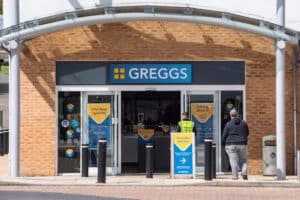
Greggs has revealed its sales have gone up by more than a fifth in a quarter and said cost inflation had eased across the business.
The bakery chain, which opened its first shop in Newcastle in 1951, said it had gained 82 new shops so far in 2023.
It said that took it to having a total of 2,410 outlets across the UK.
The company told shareholders total sales increased by 20.8% for the 13 weeks to 30 September, compared with the same period last year.
It said it had opened 144 new stores and closed 62 others in the last 12 months, and expected to open between 135 and 145 new shops throughout the whole of 2023.
Greggs said it had been continuing to expand its evening operation, saying sales after 16:00 now accounted for 8.8% of all its trade.
It said it had also gained more customers who were ordering through its app and through its partnership with Just Eat and now Uber Eats.
Greggs chief executive Roisin Currie told the PA news agency there was still inflation in the group’s supply chain despite it easing, and it would continue to review its pricing.
“When you think about the current pressure on disposable income, people are thinking about how to get the best value,” she said.
“When someone is driving around thinking about where to pick up breakfast, we think people are coming to us because they are aware of the value on offer.”
The bakery announced in March plans to open 150 shops and extend opening hours.
It said earlier this year it was increasingly targeting busy commuter areas, with new shops opening in London’s Canary Wharf station and Cardiff and Glasgow airports.
Read more:
Greggs says sales up by more than fifth in latest quarter
Month: October 2023
Over 10,000 SME owners apply for £25,000 Business Boost grant

Over 10,000 SME owners, self-employed and budding entrepreneurs have applied for a single £25,000 Business Boost grant from insurer Simply Business, as the current economic climate takes a toll on small businesses.
This milestone comes as the UK is facing the biggest rise in small business vacancies in at least eight years, with a loss of 1,915 bricks and mortar stores in the first half of this year1. In light of this, the Business Boost grant is designed to give UK small businesses a significant helping hand in the face of wider economic challenges – including the cost of living rising at an alarming rate, energy bill increases, inflation and supply challenges.
The recent SME Insights Report from Simply Business delves deeper into the impact the cost-of-living crisis continues to have on UK SMEs, alongside the wider effects of the current economic climate. More than a quarter of small business owners in the UK believe that they will be forced to cease trading if the outlook for their business does not improve – a potentially detrimental blow to the UK economy.
SME owners are further strained by a backlog of late payments, reaching a staggering £32.1 billion and 25% of small business owners admit they may have to dip into personal savings to sustain their businesses. Moreover, 26% of SMEs are already grappling with monthly energy expenses which are up to 40% higher than the previous year, with some reporting an astonishing 150% surge in monthly energy costs.
A panel of expert judges, from the world of business including Simply Business’s Small Business Ambassador Baroness Karren Brady, the founder and CEO of SliderCuts, Mark Maciver and the winner of BBC’s the Apprentice 2022 and co-founder of Oh So Yum, Hapreet Kaur joins the panel again this year among others who will decide on the final winner of the grant.
Small business owners can still apply for the fourth annual Business Boost grant here. Applications are open until Wednesday 11th October and the winner will be announced on 7th December.
Alan Thomas, UK CEO at Simply Business, comments: “We’re astounded by the sheer number of applications we’ve received for our Business Boost grant and it shows the level of impact the cost-of-living crisis and soaring energy bills have had on SMEs financially.
“We want to make a genuine transformational impact to one owner’s life. This is why we’re giving away £25,000 to one entrepreneur, to start or revive their business, and provide a financial boost in economically challenging times.
“Small businesses play a vital role in our communities and contribute enormously to our economy. It only felt right to continue with our Business Boost grant for the fourth year, having witnessed its positive impact on three deserving small businesses in previous years.”
Read more:
Over 10,000 SME owners apply for £25,000 Business Boost grant
VC firm offers childcare help for ‘mum entrepreneurs’

Ada Ventures, the VC firm which backs breakthrough ideas, is set to become the first investor in Europe to directly support founders in their portfolio with the cost of childcare.
The decision was sparked by a Treasury-led review into female entrepreneurship led by Dame Alison Rose. It found that primary care responsibilities remained the biggest barrier for female founders, with 46 per cent of “mum entrepreneurs” identifying it as a “very important” or “important” barrier, compared with 33 per cent of fathers with businesses.
The two-year pilot scheme by the firm will offer working parents up to 40 hours of free back-up childcare a year and will cover the cost of a range of services from babysitting to holiday clubs provided by Bubble, one of its portfolio companies.
According to a recent survey, 67% of mothers felt childcare duties in the past decade had cost them progress at work. During 2022, only 1% of VC capital was raised by women-only teams, with 87% going to all-male founding teams.
After an investigation into the venture capital market, the Commons’ Treasury select committee reported in July that the lack of investment in businesses with all-female founders was a “concern” and that they had received only 2 per cent of all venture capital funding in 2021.
The numbers exposed a long-running problem in the venture capital industry, which has been striving to increase female representation. The MPs’ committee criticised the industry for failing to invest in businesses led by women and ethnic minorities, as well as in companies outside London and southeast England.
It recommended that funds should provide statistics around the diversity of their own employees and their funding decisions as a condition of receiving access to taxpayer-funded schemes.
Harriett Baldwin, the Conservative MP who chairs the committee, spoke to a group of European female venture capitalists yesterday. “Recently, someone told me about investing in a kitchenware company,” she said. “Everyone making the decision to invest was a man. In the real world, women make 80 per cent of the decisions on kitchenware. Replicating this disparity across investments in life sciences, renewable energy or AI shows what VCs are missing out on.”
The debate around venture capital investment has intensified because it is critical to turbocharge businesses in their early stages, is a way of picking winners, and gives access to the funds and networks founders needed to become successful.
Read more:
VC firm offers childcare help for ‘mum entrepreneurs’
John Lewis Boss, Dame Sharon White, announces resignation amidst chall …
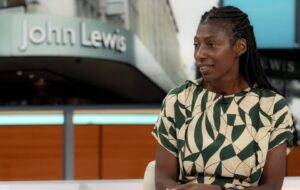
In a surprising turn of events, Dame Sharon White, the CEO of John Lewis, has announced her resignation from the company.
After just three years at the helm, Dame Sharon has decided to step down, leaving behind a legacy of notable achievements and a company facing unprecedented challenges.
Dame Sharon White‘s tenure at John Lewis was marked by her determination to navigate the retail giant through a rapidly changing landscape. She took on the role in 2019, becoming the first woman and the first outsider to lead the company in its 156-year history. Her appointment was seen as a bold move to bring a fresh perspective and drive transformation in the business.
During her time as CEO, Dame Sharon implemented several key initiatives aimed at revitalising the brand and adapting to the digital era. She spearheaded the expansion of John Lewis’ online presence, focusing on e-commerce and improving the company’s digital capabilities. Under her leadership, the company successfully launched a new website, enhanced its mobile app, and introduced personalized shopping experiences for customers.
Despite these efforts, John Lewis faced numerous challenges during Dame Sharon’s tenure. The rise of online retail and the increasing dominance of e-commerce giants presented significant hurdles for the company. Additionally, the economic impact of the COVID-19 pandemic further strained the retail sector, leading to store closures, reduced footfall, and a decline in consumer spending.
In a statement, Dame Sharon White expressed her gratitude for the opportunity to lead John Lewis but acknowledged the immense challenges facing the company. She emphasized the need for fresh leadership to navigate the uncertain future ahead and ensure the long-term success of the business.
The resignation of Dame Sharon White has sparked speculation about the future direction of John Lewis and the wider retail industry. With her departure, the company now faces the task of finding a suitable successor who can lead the brand through these unprecedented times. The incoming CEO will need to possess a deep understanding of both traditional retail and digital innovation, as well as the ability to drive change and adapt to evolving consumer preferences.
This news has sent shockwaves through the industry, as John Lewis has long been regarded as a stalwart of the British retail scene. The company’s success and commitment to quality have made it a household name, and its future will undoubtedly impact the broader retail landscape.
As the search for a new CEO begins, industry experts and stakeholders will closely monitor John Lewis’ next move. The company’s ability to adapt to the digital age while staying true to its core values will be crucial in determining its future success.
Read more:
John Lewis Boss, Dame Sharon White, announces resignation amidst challenging times
Key Points from Jeremy Hunt’s Conservative Party Conference speech
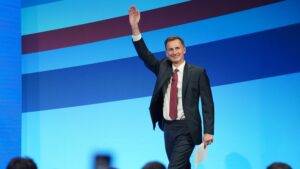
In a speech to the Conservative party conference in Manchester Jeremy Hunt has laid out his key themes for the coming year.
Firstly he said he wanted to reduce the number of officials working in government by 66,000, saving a billion pounds a year.
Hunt said it was part of a wider productivity drive and civil service reform plan to reduce the size of the state and improve efficiency.
“We have the best civil servants in the world and they saved many lives in the pandemic by working night and day,” Hunt said.
“But even after that pandemic is over we still have 66,000 more civil servants than before.
“New policies should not always mean new people. So today I’m freezing the expansion of the civil service and putting in place a plan to reduce its numbers to pre-pandemic levels.”
Hunt said that voters would face an “elemental choice” at the next election between “sound money under the Conservatives or run out of money under Labour”.
He highlighted Labour plans to borrow £28 billion to invest in the transition to net zero, arguing it would lead to higher taxes in the long term.
“Borrowing on that scale risks fuelling inflation and keeping interest rates higher,” he said.
TV & Film production
Hunt, a former culture secretary, said he wants to see Margot Robbie draped in a Union Jack for the Barbie sequel as he talked up the strength of the country’s film and TV sector
The chancellor — who told delegates that Britain is a global leader in sectors of the future such as offshore wind — noted the role of the UK in Greta Gerwig’s fantasy comedy which is estimated to have grossed $1.34 billion worldwide.
“We are Europe’s biggest film and TV production centre,” Hunt said to applause from the floor. “Next time I want to see Barbie wearing a Union Jack because that too was filmed in Britain.”
Hunt, who ran the culture department for more than two years from 2010, used his spring budget to improve the tax breaks available to studios such as Barbie producer Warner Bros Discovery if they produce their films in the UK.
Benefit claimant crackdown
Hunt said it was unfair that someone who “refuses” to look for work “gets the same as someone trying their best”.
The government will crack down on those claiming benefits who do not actively seek work, said Hunt.
He also announced the government would replace the existing Work Capability Assessment and the sanctions regime.
He claimed 100,000 people leave the workforce every year to live on benefits.
The chancellor spoke of his pride about living in a country with “a ladder everyone can climb, but also a safety net below which no one falls”.
He added this safety net was part of a “social contract” dependent on “fairness to those in work alongside compassion to those who aren’t”.
“From last year for the first time ever you can earn £1,000 a month without paying a penny of tax or national insurance,” he added.
Labour government ‘will increase debt’
A Labour government will lead to higher taxes and higher inflation, the chancellor said.
Opposition plans to borrow £28 billion to invest in the transition to net zero will increase government debt, Hunt added.
“That means higher taxes, higher mortgages and higher inflation for families. That’s not an economic policy. It’s an economic illusion.”
Hunt said public spending was growing faster than the economy.
“We need a more productive state, not a bigger state,” he said.
Hunt suggested the UK could stabilise government spending as a proportion of GDP if public sector productivity increased by 0.5 per cent every year.
John Glen, the chief secretary to the Treasury, will review how this can be done, he added.
Minimum Wage rise
Hunt also confirmed the government will accept advice to raise the living wage to at least £11 pounds an hour up from £10.42. The change will come into effect in April 2024.
Speaking to the conference, the chancellor said: “That is a pay rise for nearly two million workers and [will make] the wages of the lowest paid over £9,000 higher than they were in 2010 because if you work hard, a Conservative government will always have your back.
“We promised in our manifesto to raise the national living wage to two thirds of median income, ending low pay in this country.”
Jeremy Hunt, who last spoke to the conference five years ago as foreign secretary, started his speech with a joke that Rishi Sunak was doing a good job at “getting the over-50s back into work”.
The chancellor followed this up with recently revised ONS growth figures showing the UK had been one of the best-performing European economies since the pandemic — previous figures had shown the UK at the bottom of the list.
Hunt said he and Sunak aim to make the UK the world’s next Silicon Valley and praised the tech industry as well as successes with Covid vaccines.
Speaking about the chancellors speech, Rain Newton-Smith, CBI Chief Executive, said: “The Chancellor is right to highlight the sound fundamentals of the UK economy and to set out a positive vision for the UK on a global stage. Amidst fierce competition for investment, we need to be bold in championing the UK’s pro-enterprise credentials and commitment to research and innovation.
“With limited fiscal firepower at its disposal, the Government must focus on stability and predictability to tip the balance for investors. Instead of mixed messages, we have to press ahead with delivering our net zero commitments to unlock serious levels of business investment.
“Tackling inflation might remain the number one priority, but there’s more to do to get the economy firing again. Government and business need to pull in the same direction on tax, investment and big growth opportunities to break the low growth cycle and deliver prosperity for all.”
Read more:
Key Points from Jeremy Hunt’s Conservative Party Conference speech
Northern leg of HS2 to Manchester is set to be scrapped

The northern leg of the HS2 line is set to be scrapped the government are about to formally announce.
Rumours had been circling for weeks that the high-speed rail line between Birmingham and Manchester was going to be axed by the prime minister and chancellor due to soaring costs.
But even the reports led to a huge backlash from all sides of the political spectrum with Labour mayors urging its retention. and former prime ministers Boris Johnson and Theresa May also voiced their concern over the cancellation speculation.
The first indications that the leg to Manchester could be scrapped came after the Independent reported that ministers were considering shelving the northern phase amid concerns about spiralling costs and severe delays.
The newspaper said a cost estimate revealed that the government has already spent £2.3bn on stage two of the railway from Birmingham to Manchester, but that ditching the northern phase could save up to £34bn.
Speaking about the news, Clive Wratten, CEO of the Business Travel Association (BTA) says: “Scrapping the Manchester to London leg of HS2 is a deplorable act of carelessness on behalf of the Government. Cancelling the key northern hub makes a mockery of the levelling-up agenda.
Once again, connected business travel across the UK is sacrificed by those in power negligent of the needs of those outside London.
We are on the verge of a climate crisis. Car hire is 22% up. Domestic air travel has increased. Rail is no longer the first choice. Continuous capacity challenges are forcing up costs, with service issues a consistent kick in the teeth to business travellers.
All rail infrastructure projects must be protected through investment. Travellers need a reliable and efficient alternative. We challenge you: without HS2, what will that alternative be?”
Read more:
Northern leg of HS2 to Manchester is set to be scrapped

