

Wilko could be making a comeback as a retail boss has revealed plans to reopen nearly 300 branches of the high street chain across the UK – with three set to reopen before Christmas.
Billionaire founder of The Range Chris Dawson is reportedly working on deals which are ‘with the lawyers’ to get 50 shops reopened and he plans to expand further.
Wilko branding and intellectual property was acquired by CDS Superstores (which trades as The Range) for a reported £5million after it went bust in August this year – forcing the closure of more than 400 stores and leaving thousands out of a job.
The first three Wilko stores will open in early December in Plymouth and Exeter, both in Devon, and Luton, Bedfordshire the retail firm revealed.
Visiting the Plymouth branch last week ahead of its December 1 opening date, chief executive Alex Simpkin told PlymouthLive there were ‘about 50 Wilkos opening’ as well as the three with scheduled dates.
He said those were ‘with the lawyers’ before adding that 300 stores will eventually be opened ‘more or less where there were, in most cases, ex-Wilko stores’.
Where will the new Wilko shops open and when?
Plymouth, Devon
Armada Centre
Opening date: December 1
Exeter, Devon
Guildhall Shopping Centre
Opening date: December 1
Luton, Bedfordshire
Arndale Centre
Opening date: December 8
Mr Simpkin added that he does not know how long it will take.
Poundland owners Pepco agreed to buy 71 Wilko sites, with 64 former stores pledged to reopen under the Poundland name by the end of the year. B&M also had the opportunity to buy as many as 51 ex-Wilko stores.
This comes after he ex-Wilko boss Lisa Wilkinson yesterday denied her greed bankrupted the much-loved chain, as she told MPs it ‘ran out of cash’ before it could be salvaged.
Ms Wilkinson, the granddaughter of the firm’s founder JK Wilkinson, said she was ‘devastated’ by the demise of the business as she was quizzed by a House of Commons committee.
She offered an apology to the 12,000 people who lost their jobs as part of the collapse of the 93-year-old chain, which also left a £50million shortfall in its pension fund.
‘I don’t know how to put into words how sad I am that we have let down all our team members, all our customers, our suppliers, and our advisers,’ Ms Wilkinson told MPs.
Her grilling by the Commons’ Business and Trade Committee followed severe criticism of Wilko bosses for shelling out £77million to its owners and former shareholders in the decade before its collapse.
The Wilkinson family are reported to have received £9million in dividends since 2019.
She partly blamed the ‘mini-Budget’ of ex-prime minister Liz Truss in September last year, which was accompanied by financial markets meltdown, for Wilko’s collapse.
Ms Wilkinson said the company was in the middle of negotiating a new loan arrangement when interest rates began to soar.
‘We were about to enter into secured lending arrangements with Macquarie when the 2022 mini-Budget happened,’ she said.
‘Literally we were in the midst of that, and at that point the interest terms on that loan were hiked massively and that became infeasible. So, that was a contributor.’
Read more:
Retail boss reveals plans to re-open 50 Wilko branches of the high street chain – including three before Christmas
Month: November 2023
Amazon latest tech giant to announce AI chatbot

Amazon has become the latest tech giant to announce a chatbot powered by artificial intelligence (AI).
It said that the bot, called Q, would help businesses to do things like summarise long documents or group chats and would increase productivity.
It comes a year after OpenAI’s bot ChatGPT shook the market, sparking a rush among tech firms to adopt them.
Amazon also said it would protect companies from copyright issues arising from the use of its bot.
It follows high-profile lawsuits brought against ChatGPT-maker OpenAI, over claims that firms’ copyright was infringed to train the system.
Amazon will hope that Q, which will gradually be rolled out across it main business applications, will entice more companies to use its cloud computing services.
The bot can also answer customer queries, generate charts, analyse data and help businesses with their coding needs.
The race between tech giants to innovate in AI has been heating up, with Microsoft considered to be leading the field after its big investment in ChatGPT.
In September, Amazon said it would invest “up to $4bn [£3.2bn]” in Anthropic, an AI firm set up by ex-OpenAI staff members. It also owns Mechanical Turk, a service which crowdsources training of AI models.
Copyright fears
As it launches Q, the company promised to protect businesses from copyright claims, such as the lawsuit brought by comedian Sarah Silverman against OpenAI and Facebook-owner Meta in July.
Ms Silverman, along with two other authors, claimed their books had been “ingested and used to train ChatGPT”, and that Meta’s Llama AI system was also using their work.
In November, a judge in the US dismissed much of Silverman’s lawsuit.
However, other authors including Margaret Atwood and Philip Pullman have also called on AI companies to compensate them for using their work.
Read more:
Amazon latest tech giant to announce AI chatbot
Rising rental costs and lack of choice forcing families to smaller hom …

Thousands more families are renting smaller homes than they were three years ago.
Renters aged over 30 are more likely to move to cheaper areas as the cost of renting has soared and availability squeezed, Dataloft figures also show.
The consultancy said trade-offs were needed so people could stay in budget.
The National Housing Federation suggested more older people faced insecure, expensive tenancies.
The body, which represents housing associations, said older people’s health and wellbeing were suffering, and called for an increase in social housing.
Downsizing trend
Rents have been rising at a rapid rate, increasing at more than 10% in a year for new tenancies in some areas. Demand is high and the number of available homes has dropped as some landlords sell up.
As well as young, single people finding it hard to start out, families and older tenants have been affected.
Dataloft estimates suggest almost half of new tenancies taken on by families earning £30,000 to £70,000 in the first six months of this year were for one or two-bed homes.
In the first half of 2020, during the period covered by the first national lockdown, 57% of new tenancies signed by families on £30,000 to £70,000 a year were for homes with at least three bedrooms, according to Dataloft.
In the same period of 2023, that figure had fallen to less than 51%. That means thousands more families a year taking on smaller properties than in 2020.
Sandra Jones, managing director of Dataloft, said: “We believe these reductions in renters’ standard of living to be the direct result of the severe supply constraint that has driven up rents.
“When affordability is stretched, as it is for so many today, people make trade-offs in order to stay within a budget.”
The data also showed renters over 30 years old were more likely to move to a cheaper area than a higher value one when they changed home.
About a fifth of people aged 30 to 39 would move to a higher priced area while more than a quarter would move somewhere cheaper. Among the under 30s, it was the other way around with just under a third moving to a higher rent location in the previous 12 months.
Property portal Zoopla said a lack of availability of private rented homes was adding to the trend of families taking on smaller properties.
Executive director Richard Donnell said the slower buying and selling market meant greater demand in lettings, so people “can only find or rent what is available”.
According to the 2021 census, four in 10 people who rent through a private landlord or agency are in two-bedroom homes.
The National Housing Federation (NHF) said the number of people aged over 55 who were renting privately in England had soared.
Its survey of about 2,000 of these older tenants suggested that 42% of those asked regularly struggled to cover their basic living costs such as buying food and clothes or heating their homes.
The NHF has warned of a “huge spike” in the number of people entering their pension years who were living in private rental homes they could not afford. An extensive building programme of social homes was required, it said.
Greg Tsuman, president of ARLA Propertymark which represents letting agents, said landlords needed more incentives to stay in the sector and raise the number of private rental properties, such as changing the tax system.
“Fundamentally, the problem is that landlords are exiting the market when demand for rental properties continues to rise. Landlords are making a loss when rents are rising, and we need to address the root causes if we’re to solve this,” he said.
A spokesman for the Department for Levelling up, Housing and Communities said the Renters Reform Bill which is going through Parliament would deliver “a fairer, more secure, and higher quality private rented sector”.
He said ministers were committed to “increasing the supply of social rented homes”.
In the Autumn Statement, Chancellor Jeremy Hunt ended the freeze on the Local Housing Allowance, which has been in place since 2020. It determines how much help people who rent privately get towards the cost through housing benefit or universal credit. It will now be worth 30% of local market rents.
Angela Rayner, Labour deputy leader, said they had a housing recovery plan to “jump-start housebuilding” and “make renting fairer and more secure”.
Read more:
Rising rental costs and lack of choice forcing families to smaller homes
Secrets of Success: Dr Ed Gladman, CEO Adlington Retirement Living

Future proofing people’s retirements and high quality way of life is paramount
More than a retirement property, Dr Ed Gladman ensures that Adlington Retirement Living builds communities that centre around happiness, safety and physical wellbeing. He shares the journey of the family owned and run company with Business Matters …
What is the main problem you solve for your customers?
Our retirement communities are designed to empower the older generation to live a long, happy and healthy life in a safe and secure environment with activities, communal facilities and beautiful private gardens. They’re about much more than the bricks and mortar of our apartments.
Although we focus on the quality of our facilities, we know that the most important things that make our customers really feel at home, are having a good circle of friends, connections with like-minded neighbours and a sense of belonging.
As we all get older, many people start to struggle with aspects of their family home such as managing the stairs, organising repairs and maintenance, or staying on top of garden maintenance. I think a lot of people also want to future-proof their retirement. Many of our homeowners are fit and healthy but feel reassured knowing that help is on hand if they ever need it, 24 hours a day, 365 days a year. It also gives peace of mind to their families.
When required, we can put in place optional personal care packages for everything from short-term support after an operation, to more regular, long-term tailored personal care. Our on-site teams work with a local care partner to find the best solution to suit each individual.
What made you move into the business?
Prior to joining Adlington Retirement Living in 2017, I worked in the NHS as a hospital doctor specialising in anaesthetics. I’d never planned to join the family business and wanted to do something different, unrelated to property, which is why I went into medicine.
Working as a doctor was in many ways a wonderful career. When it goes well you can have such a profoundly positive impact upon someone’s life. I was however beginning to find the NHS a dehumanising environment in which to work and decided that a change was needed.
Joining the family business was too good an opportunity to overlook. It afforded me the chance to work with my dad with whom I have a great relationship. It also gives me a high degree of autonomy and the ability to change things where I see improvements can be made.
Fundamentally though, the main reason for joining Adlington was that I see the development of Integrated Retirement Communities as a life-changing product for our customers. The huge difference it can make to a homeowner’s life is a great reason to go to work in the morning.
What are your brand values?
Our core brand values are to be:
COLLABORATIVE: Collaboration is at the heart of our organisation. For our customers and for their families. With our business partners and for all our employees.
EMPATHETIC: We care deeply about the challenges associated with growing old and strive to provide a safe, secure and happy environment for all our homeowners.
PROGRESSIVE: We constantly refine, adapt and invest in our build and interior design solutions to deliver high quality homes and create welcoming retirement communities.
OPEN: Building on the family values of our founding partners, we promote a culture of openness and a considerate work ethic, through transparent communication at every level.
Is team culture integral to your business?
Organisational culture is integral to the success of any business. We have always been a family business and at the heart of our culture is trying to be fair and decent to our customers and team. We have incredibly low staff turnover because we pay well and give our staff a high degree of autonomy and ownership of their work.
The challenge we face is that we are now approaching a headcount of 300 and this makes keeping the feel of a small family business a huge challenge, particularly with many of the sales, operational and construction teams working nationwide.
Having the senior management team fully bought into the core values that define our business helps us to continue to provide an interesting and worthwhile place to work for our team.
If team culture is integral to your business, what do you do to go the extra mile to to show your team you appreciate them?
Fundamentally we do our utmost to treat everyone fairly and as we would wish to be treated. I think one of the key factors is that we do not have an HR department. HR decisions are made by the board directors and often by me, to ensure that all situations are looked at fairly and holistically not simply by following a policy.
We have an incredibly flexible working policy for our office-based staff and do our utmost to be flexible in allowing people to work in a manner that fits their lives. We also pay the team well.
An often-overlooked element of culture is paying suppliers and subcontractors on time. Some in the construction industry have a poor reputation for not paying suppliers on time. We pay on time and don’t use retentions with our subcontractors. This means we have decent relationships with our supply chain, and we can ask them for a favour when required, as they can of us.
We have a well defined wellbeing program that ensures a happy and healthy team. As part of that, we have several fully trained Mental Health First Aiders and a qualified in-house trainer delivering regular Mental Health Awareness courses.
Regular funded social events are arranged together with the promotion of healthy living activities such as a cycle to work initiative, charity fun runs, healthy eating club and walking competitions.
Our in-house Management Company Adlington Management Services (AMS) has a very comprehensive and in-depth training programme and each of our retirement community’s links with local authorities to provide mental capacity and safeguarding training for the benefit of our homeowners.
In terms of your messaging do you think you talk directly to your consumers in a clear fashion?
Education on Integrated Retirement Communities (IRCs) is at the forefront of our media interviews and marketing campaigns so that older people understand the choice of housing available to them. We regularly interview homeowners and share their stories through our own channels and the wider media.
IRCs are a relatively new concept in the UK, unlike the US, Canada and New Zealand, where they are well established. In the UK, there’s confusion around the difference between an IRC and a care home. Sadly, people often think of an ‘old people’s home’ when they imagine a retirement community.
Many people live in accommodation which becomes increasingly less appropriate for them in later life, as their health and social needs change. This often leads to a crisis point where they are forced to move because home is no longer safe, following a fall or illness.
IRCs offer people a way to retain their independence for as long as possible, choosing where they want to live with the safety net of care options being readily available if they are needed in the future. They also keep older people engaged with wider society which is key to tackling loneliness and isolation in later years.
Our advertising campaigns are clear and concise, with full transparency of information on our website. As members of the Associated Retirement Community Operators (ARCO), which is a body representing operators of IRCs, we undertake a thorough annual review of all our marketing communications, as well as the service levels at each of our communities.
What’s your take on inflation and interest rates – are you going to pass that on to your customers or let your margins take a hit and reward customer loyalty in these tougher times?
The current economic conditions are very challenging for the real estate sector. Our costs to build and borrow money have both risen steeply and we are currently in a tricky sales environment. Thankfully our product is close to unique in the UK and genuinely life changing for our homeowners and as such demand remains strong.
We have very much shared the pain with our potential customers. We have increased prices and accepted a lower margin on the development. However, as a business our focus is very much on the long income generated so this hasn’t hugely impacted our business plan.
Is tech playing a much larger part in your day-to-day running of your company?
Our design and development team use the leading software in the industry with all projects designed in REVIT. It’s fantastic and makes it much easier for the Senior Management team to review each new development.
However, on the operational side we are relatively low tech. We believe in first class hospitality and customer service. I am approached by tech companies constantly however what they are offering is usually expensive and not of huge value and would ultimately drive-up costs too much.
Our customers are tech savvy and all own smartphones, iPads etc. so the last thing they want is us providing an added layer of complexity with inferior tech. As a community develops, WhatsApp groups, Facebook communities etc. naturally develop as they do in any new group. The tech available to the general public has never been better and our communities benefit hugely from this.
What is your attitude to your competitors?
Interestingly, we rarely encounter significant competition. There are several really high-quality IRC developers in the UK. However, there are far more towns to go at than there are developers. On the odd occasion where we have local competition it can actually be beneficial. When a strong competitor enters the market, they often educate the local population about retirement communities, making our sales process easier. We at Adlington embrace healthy competition as it contributes to market awareness and ultimately facilitates sales.
The growth potential in this sector is immense. We are driven by the positive impact we can create. Moreover, the sector offers significant financial opportunities, making it a lucrative venture. With such a combination of social importance, profitability, and tremendous growth potential, we are excited about the future possibilities.
As members of ARCO, I maintain good relationships with the leaders of our competitors as we are of the view a collegiate sector is far preferable to an adversarial operating environment as experienced in so many sectors.
Do you have any advice for anyone starting out in business?
I never set out to be a businessperson and indeed by becoming a doctor took active steps against it. However, circumstances change, and I have found myself in a wonderful role as CEO of Adlington.
In my view the most important thing is to find something that is personally fulfilling to you. We are all motivated by hugely different things, so the key is to find an industry that ticks the boxes you need it to tick to have a happy and worthwhile career.
It can be a lonely and pressured place to be as the lead decision maker of the business. What do you do to relax, recharge and hone your focus?
I have three small children who keep me busy. Whether they relax, recharge and hone my focus is debatable.
What is your company’s eco strategy?
The UK has a huge shortfall of housing and as such new homes need to be built. However, construction as an industry is inherently poor from an environmental perspective. This is a dichotomy with which I am constantly wrestling.
The positive environmental impact of our communities is that our homeowners almost all move from a home with at least two, often three or four unused bedrooms. They then move into a much smaller home which is well built, well insulated and much more efficient to run. This process frees up a large property for a family to move into and provides our homeowners with a beautiful home and community.
We also do an excellent job of looking after our homeowners and as such their hospital visits, GP appointments etc., decrease. Healthcare has an enormous carbon footprint so by decreasing its use we also help.
Finally living as part of a community is much more efficient. For example, there is a chef who cooks in the restaurant, shared trips into town, carers don’t have to drive between jobs. These benefits also drastically decrease the carbon footprint generated by our homeowners.
What three things do you hope to have in place within the next 12 months?
The three things I hope to have place in the next 12 months are land, land and land. The land and planning environment is incredibly challenging, and we are on the lookout for more sites.
We will look anywhere in England and need to be able to build retirement communities with 60 plus apartments on the site so if you’ve got good quality land to sell in affluent market towns or areas of cities please get in touch.
Read more:
Secrets of Success: Dr Ed Gladman, CEO Adlington Retirement Living
Appeal decision finds Haribo’s gummy bear figurative trade mark dist …

The Fourth Board of Appeal of the European Union Intellectual Property Office (EUIPO) has reversed the refusal of Haribo’s figurative trade mark consisting of an image of its ‘Goldbear’ gummy bear on the basis that the mark does satisfy the minimum degree of distinctiveness.
Rigo Trading S.A, a holding company for Haribo, the well-known German confectionery company, filed an application for an international registration designating the EU for a figurative mark of its HARIBO ‘Goldbear’ for a range of non-edible goods in Classes 9, 14, 16, 18, 20, 21, 24, 25, 26, 27 and 28 including amongst other things clothing, jewellery and games.
Emily Roberts, partner in the Intellectual Property team at independent UK law firm Burges Salmon explains that the mark was refused for the majority of the goods in the application on the basis that it was considered to be devoid of distinctive character.
The examiner found that the appearance of the mark was already commonly used for decorative, artistic and aesthetic purposes for the contested goods. In support of its reasoning, the examiner provided various examples of other gummy bear shaped products and goods bearing gummy bear decoration on the market within the same classes as those applied for, including gummy bear shaped hairclips, a gummy bear shaped coin purse and a bag with a gummy bear decoration.
The examiner considered that the mark would be perceived as a commonplace depiction of a gummy bear as either a decorative element, the shape of the goods themselves or of their packaging, and as a result the mark did not meet the minimum degree of distinctive character necessary to function as a trade mark.
Board of Appeal decision
Haribo appealed the refusal and it came before the Fourth Board of Appeal of the EUIPO.
Overturning the refusal, the Board confirmed that a trade mark is considered to possess sufficient distinctive character if it is capable of enabling the relevant public to identify the origin of the goods which it covers and to distinguish them from those of other undertakings.
The Board considered that the sign, a gummy bear or a characterised figure of an animal, had no connection with the contested goods. Further, that the sign conveyed an overall impression that is unrelated to the likely or customary appearance of these goods. The mere fact that some of the contested goods may take the shape of a gummy bear is not in itself sufficient to establish that the mark consists a representation of the shape of the goods at issue.
In reviewing the examples of gummy bear shaped/decorated products provided by the examiner, the Board determined that the examples were not sufficient to demonstrate that it was an established practice of the relevant market sectors of the contested goods to offer gummy bear shaped items, or that the relevant public would perceive a gummy bear as a common motif.
The Board considered that the sign was not excessively simple and banal but included distinct characteristics, such as the positioning of the ears and the smile, which would create a visual impact on the relevant consumers. The Board also emphasised that originality and novelty are not relevant when considering the distinctive character of a mark.
As a result, the Board reversed the examiner’s decision and held that the sign had at least the minimum degree of distinctive character necessary to be protected as a trade mark in the European Union.
Key takeaways
The decision will be welcomed by brand owners. It confirms that when assessing the distinctiveness of a figurative mark, it is not necessary for a sign to be novel or original. Further, even if there are instances of decorative use or product shapes which are similar to a sign, this is not sufficient in itself to support a finding of non-distinctiveness. If a sign enables consumers to distinguish those goods from others on the marketplace, that is sufficient.
Read more:
Appeal decision finds Haribo’s gummy bear figurative trade mark distinctive
Eurostar Amsterdam-to-London services to be suspended for six months
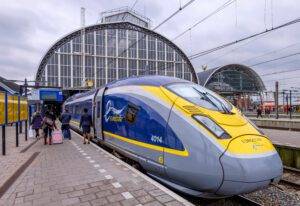
Eurostar services from the Netherlands to London will be suspended for six months from June next year.
Renovation work in Amsterdam means officials will be unable to process cross-Channel passengers until 2025.
Passengers from Amsterdam and Rotterdam to London will be required to change trains in Brussels.
Outbound travel from London to the Netherlands will continue, according to Eurostar.
Negotiations between the Dutch government, the local railways operator and Eurostar over renovations at Amsterdam’s central station failed to reach an agreement which would allow services to continue.
Four trains operate daily between London and Amsterdam, stopping at Brussels and Rotterdam on the way.
The London-Amsterdam connection launched in full in October 2020.
The period of disruption is shorter than initially expected, at six months instead of 12, Eurostar said in a statement.
The link between the Netherlands and the UK is the latest Eurostar connection to be suspended as the company grapples with growing challenges, including post-Brexit border checks and staff shortages.
Direct services to Disneyland Paris ended this summer, while connections between London and Marseille via Lyon were axed during the pandemic.
Trains linking the UK to continental Europe have not stopped at two stations in Kent since 2020 – Ashford and Ebbsfleet.
In January, chief executive Gwendoline Cazenave said the company was carrying a third fewer passengers on its flagship London to Paris route.
Read more:
Eurostar Amsterdam-to-London services to be suspended for six months
HSBC glitch hits Customers and businesses on one of the business shopp …

Customers and businesses who bank with HSBC UK are facing disruption on one of the busiest days for online purchases after the lender’s mobile and digital services were hit by an outage.
The group said it was investigating the situation “as a matter of urgency” after thousands of customers complained of problems with online banking.
The disruption is a blow because it has coincided with the annual Black Friday shopping event, when consumers flock online for deals before Christmas. According to Downdetector, a service that tracks outages afflicting web services, more than 4,000 people had reported problems with HSBC UK’s online services.
The problems started just after 8am on Friday and HSBC could not say how many customers had been affected.
A spokeswoman for the bank said the problem had been caused by “an internal system issue” and that the disruption was to customers of its HSBC UK arm, rather than its First Direct brand or its M&S Bank joint venture.
HSBC UK also apologised to customers on Twitter/X for the problems and said: “We’re working hard to restore mobile and online banking service, and the authorising of online card purchases via the app. We’re really sorry for the inconvenience.”
Customers took to the platform to vent their frustration with the bank. “Pay day and I can’t pay my bills and organise my money,” one user wrote.
Sam Richardson, deputy editor of Which? Money, said: “This HSBC outage will cause a real headache for a lot of its customers. In the worst cases it could prevent people making essential payments such as rent and bills, but it also falls on Black Friday, one of the busiest shopping days of the year, where many people will be looking to make significant savings on big-ticket items.
“We strongly advise customers that have been left out of pocket to keep evidence of extra expenses they may have incurred as a result of the outage, so they can be claimed back from HSBC.
“People want a bank they can depend on, and if IT outages become a regular occurrence, consumers could be tempted to vote with their feet and switch to an alternative provider – particularly with a lot of tempting switching incentives on offer at the moment.”
Protecting digital services from outages caused by glitches or cyberattacks has become a priority for banks and other companies as services across the economy have increasingly moved online. Ensuring the so-called “operational resilience” of key services run by banks and building societies is a significant focus for regulators at the Bank of England.
The FTSE 100 bank, which is based in London, is Europe’s biggest bank by assets.
Read more:
HSBC glitch hits Customers and businesses on one of the business shopping days of the year
Made Smarter national roll-out to turbo charge Scotland’s SME manufa …

MADE Smarter, a programme helping SME manufacturers access technology and digital skills, is to be rolled out to Scotland.
The Government has committed to expanding the Made Smarter Adoption Programme to all nine English regions in 2025-26 before working with Scotland, Wales, and Northern Ireland from 2026-27.
The announcement by HM Treasury, on Friday November 17, means hundreds of thousands more SME manufacturers will get access to technology advice, leadership, and skills training, as well as grant funding for digital internships and technology projects.
The commitment, alongside plans for £4.5 billion in funding for British manufacturing, will also boost productivity, growth, and decarbonisation for SME manufacturers across the country.
Launched in the North West in 2019, the Made Smarter has engaged with 2,500 manufacturers and funded 334 technology projects, which are forecast to create 1,550 jobs, upskill 2,772 existing roles, and increase North West GVA by £242m.
The successful blueprint has since inspired Made Smarter adoption programmes in the North East, Yorkshire and the Humber, the West Midlands, East Midlands, and West of England.
The announcement coincides with the publication of a new report by Made Smarter. ‘Delivering Impact: How Made Smarter Inspires Digital Transformation‘ outlines the impact of the adoption model and proposes ways to make it even better.
Brian Holliday, Co-Chair of the Made Smarter Commission and MD of Siemens Digital Industries, said: “This announcement by the Treasury clearly demonstrates that UK manufacturing matters. It represents a tremendous investment boost for our makers that will enable the confidence to invest in innovation, productivity, and sustainability.
“Key sectors benefit but so does the long tail of small and medium firms which is really important to directly address our recent challenges of weak overall productivity and investment.
“I believe the business benefits of digitalisation are now clear, while being an enabler for industrial decarbonisation too – the package of measures announced in bolstering Made Smarter, targeted regulatory reform and sector support, along with our world-class Catapults and Universities now makes the UK one of the best countries on the planet to sustainably design, make and export goods.”
Donna Edwards, Director of Made Smarter’s North West adoption programme, said: “I am delighted that the Government has recognised the extraordinary impact that Made Smarter’s adoption programme is having on digitalisation of SME businesses.
“Over the last four years we have worked tirelessly to help North West makers to start their digital journey by providing them with specialist advice to help them select the right approach, level of investment and tools for their business. The programme has proven the value technology and digital skills can bring to the manufacturing sector.
“While we await further details on the funding package, the commitment to a national roll-out is a huge vote of confidence in the contribution SMEs make to UK manufacturing. It will undoubtedly turbo charge the digital transformation of the sector.”
Juergen Maier, Industrialist and author of the Made Smarter Review, added: “I am delighted that the Made Smarter programme, kicked off by the manufacturing review I had the privilege to lead in 2017, is now being expanded England-wide and with promised continuity to 2030.
“It is exactly this sort of policy continuity that our manufacturing sector is looking for and I know it will stimulate investment and productivity.”
Read more:
Made Smarter national roll-out to turbo charge Scotland’s SME manufacturers
More businesses closing than starting for the first time in 12 years

More businesses are shutting down than starting up for the first time in 12 years, official data shows.
The number of businesses closing down jumped by 5 per cent year-on-year to hit 345,000 last year, pushing the so-called “business death rate” to a 12-year high.
11.8 per cent of all active businesses closed down in 2022, according to the Office for National Statistics (ONS). The rate was up from 11.2pc in 2021 and the highest since 2009, when businesses were hammered by the global financial crisis. Then, the death rate was also 11.8 per cent.
Transport and storage businesses were the worst hit, with nearly a quarter of all companies in the sector closing down. 13.6 per cent of tech businesses shut down as rising interest rates made it harder for many start-ups to raise money.
The number of new businesses created fell by 7 per cent to 337,000 last year, meaning more businesses were shut down than were created. It marked the first time this has happened since 2010.
The business birth rate across 2022 equaled the low seen in 2020, when the country was grappling with the worst of the pandemic and its successive lockdowns. Before 2020, the last time the birth rate was so low was in 2012 during the eurozone debt crisis and the aftermath of the global financial crisis.
Soaring energy prices last year meant businesses were hammered by high power bills last year, just as high inflation hit consumer spending and prompted slower sales for many companies.
At the same time, many businesses were forced to put up their wages to attract workers in a tight labour market.
The combined increase in costs at a time of squeezed demand proved too much for many businesses.
Challenges have remained this year. While energy costs have eased, the Bank of England has increased interest rates to 5.25 per cent, meaning the cost of servicing debt has soared.
In some sectors, high interest rates have also impacted customer demand. Housebuilders, for example, have been hammered by plunging demand for new homes following massive jumps in mortgage rates.
In April this year, the government also raised the headline corporation tax rate from 19 per cent to 2 per cent.
Read more:
More businesses closing than starting for the first time in 12 years

