
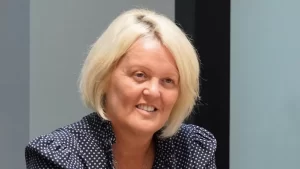
The UK data watchdog has apologised to former NatWest head Dame Alison Rose for suggesting she breached privacy laws following a probe into the closure of Nigel Farage’s bank account.
Dame Alison resigned in July after admitting she had made a mistake in speaking about Mr Farage’s account.
The Information Commissioner’s Office said its comments last month suggested it had been investigating Dame Alison.
However, it said its probe was into NatWest’s actions as a data controller.
“Our comments gave the impression that we had investigated the actions of Alison Rose, the former CEO of NatWest Group. This was incorrect,” the ICO said.
“We confirm that we did not investigate Ms Rose’s actions, given that NatWest was the data controller under investigation.”
Mr Farage, a prominent Brexiteer, said earlier this year that Coutts, the prestigious private bank for the wealthy and owned by NatWest, planned to shut down his account and that he had not been given a reason.
In July, it was reported that his account was being closed because he no longer met the wealth threshold for Coutts, citing a source familiar with the matter.
However, Mr Farage later obtained a report from the bank which indicated his political views were also considered.
The fallout led to Dame Alison resigning as NatWest’s chief executive after admitting she had made a mistake in speaking about Mr Farage’s relationship with the bank.
Mr Farage said in July he was filing a complaint with the ICO.
In its latest statement the ICO said: “We accept that it would have been appropriate in the specific circumstances for us to have given Ms Rose an opportunity to comment on any findings in relation to her role and regret not doing so.
“We apologise to Ms Rose for suggesting that we had made a finding that she breached the UK GDPR in respect of Mr Farage when we had not investigated her.
“Our investigation did not find that Ms Rose breached data protection law and we regret that our statement gave the impression that she did.”
Read more:
ICO apologises to former NatWest boss Alison Rose over Farage inquiry
Month: November 2023
WH Smith launches buy-back scheme for secondhand books

WH Smith has launched a buy-back service for used books, offering readers vouchers in exchange for their secondhand volumes.
Through the BookCycle scheme, launched on Tuesday, readers register their books online, take them to a branch and receive an e-voucher to spend in store or online. The books will be “passed on for another reader to enjoy or will be responsibly recycled”, according to the WH Smith website.
Users will register a book using the ISBN number before being given a price, which is based on “criteria such as its condition, the popularity of the title and its demand in the market”. A paperback version of Richard Osman’s The Thursday Murder Club is valued at 30p, while a hardback copy of Britney Spears’ newly released memoir is valued at £3.10.
The scheme is one of several launched in recent years that claim to address the environmental impact of the book publishing industry, which includes deforestation, paper milling, printing, packaging and transport. In 2021, the Publishers Association launched a sustainability pledge called Publishing Declares; it now has 162 signatories, including Penguin Random House UK, Simon & Schuster UK and HarperCollins. In April, the Society of Authors launched Tree to Me, a campaign aimed at encouraging publishers to reduce their environmental impact.
“It makes great sense for our customers and our business to support a circular economy for books, as we aim to minimise our impact on the environment and support our local communities,” said WH Smith group commercial development director Ian Sanders.
The retailer is running the scheme in partnership with Zeercle, a company that offers buy-back services. On the WH Smith website, it says that “the majority of the books” will find “new homes through Zeercle’s resale channels which offer secondhand books at reduced prices”.
Chris Edwards, who owns independent secondhand bookshop Skoob Books, said that though the scheme will help readers get rid of unwanted items, he believes it may operate more like a “recycling service” than a bookselling one. He is doubtful that the scheme is “anything to do with the secondhand book trade” because there is “no evidence to suggest there’s an increase in secondhand sales” of the types of popular books that the scheme is likely to attract. Prior to Brexit, booksellers would sell excess book stock to Europe, but this now rarely happens due to sales being subject to 20% VAT, Edwards explained.
Edwards also wondered how it will be financially viable for WH Smith and Zeercle to recycle books, given that the UK is “not a favourable recycling environment since Brexit”. WH Smith may instead be launching the scheme to increase footfall or to encourage people to sign up to an online account, he said.
“This sounds rather too good to be true with used books already flooding [the] market here,” sustainability organisation Sussed in the Forest stated in a post on X.
Zeercle CEO Eric Gagnaire said that “our business is not recycling books but reselling books in the UK” through online marketplaces including Amazon and eBay.
Authors will not be compensated through the scheme. “While we are keen to see books reused from a sustainability point of view, this initiative could be detrimental to author incomes,” said Nicola Solomon, CEO of the Society of Authors. “Most authors receive full royalties on books sold by high-street bookshops,” but “rarely receive royalties or other payments from sales of secondhand books”.
Gagnaire said that if the scheme is a “success”, the company will “study” solutions such as AuthorSHARE – a scheme launched in 2021 that allows authors to be compensated for books sold through large online secondhand bookseller World of Books.
“We’re committed to helping our customers with the cost of living and encouraging reading across all sections of the community,” a WH Smith spokesperson told the Guardian. “Our partnership with Zeercle delivers both, helping customers by giving them money back for books sitting on shelves at home, and enabling them to redeem that money for new books in our stores.”
Read more:
WH Smith launches buy-back scheme for secondhand books
Record sales drive Jaguar Land Rover into fast lane

Jaguar Land Rover has hauled itself into the black and raised its full-year outlook after record sales in the first six months of the year.
Britain’s largest carmaker posted revenues of £13.8 billion between April and September, generating a profit before tax of £877 million compared with a loss of more than £500 million in the same period last year. Sales were up by almost one third year on year to 190,070 units.
The company, based in Warwickshire, has lifted expectations for its profit margin from a previously indicated 6 per cent to “around 8 per cent” for the full year.
The performance is the fourth consecutive quarter of growth and marks a dramatic reversal of fortunes for the company, which is owned by India’s Tata Motors.
Tata struggled with heavy losses amid snarled global supply chains in the aftermath of the pandemic.
It expects supply constraints to continue to ease, allowing production and wholesale volumes to gradually increase throughout the year: Range Rover, Range Rover Sport and Land Rover Defender models make up more than three quarters of the 168,000-strong order book.
Adrian Mardell, 62, its chief executive, said: “These results demonstrate the huge desirability of our modern luxury product portfolio and the skill of our hardworking teams, who have increased production to ensure we can satisfy the substantial demand for our cars more quickly.”
The firm has announced it intends to pump £15 billion into its Reimagine transformation programme, with plans to build a £4 billion battery gigafactory in Somerset, creating 4,000 jobs. It is also investing more than £1.4 billion to prepare its Halewood and Solihull plants to produce electric vehicles.
While only producing one zero-emissions vehicle, the Jaguar I-Pace, it expects to start deliveries of its first electric Range Rover, built in Solihull, towards the end of next year, with a target of battery-electric vehicles reaching 70 per cent of all sales in 2027.
It generates about two thirds of the earnings of its parent company, the shares of which have risen more than 64 per cent so far this year. They closed up 1.5 per cent at 637.5 rupees (£6.27) on the Mumbai stock exchange yesterday.
Read more:
Record sales drive Jaguar Land Rover into fast lane
Small businesses lose out on over £43k a year from doing favours for …

When it comes to running a business, every minute and penny counts towards its success.
However, new research from Capital on Tap shows that over two-fifths of UK business owners work for free, and are asked to work at discounted rates an average of 75 times per year.
The research conducted by Capital on Tap involved surveying 250 small business owners across 15 industries in the UK to uncover what it’s costing business owners to do favours for friends and family. A financial expert from the company also shared advice for business owners chasing up payments from those closest to us.
Survey reveals business owners in the healthcare industry are asked for ‘mates rates’ the most (98 times a year), meaning they could lose out on over £42k per year in revenue
The business owners we surveyed in the healthcare industry offer an average discount rate of £428.80, leading them to lose over £42k a year in revenue. Over a third of the surveyed business owners in this sector admitted to using gaps in their schedule to offer ‘mates rates’, even though more than a quarter confessed they hate it when their friends and family ask.
In the field of property management and development, survey participants revealed that they provide discounts worth an average of £315.40 and are set to lose over £11.5k a year in revenue. They revealed they do discounted work three times a month, with almost two in five offering ‘mates rates’ to help build their confidence.
The respondents from the business equipment and services industry can expect to lose over £21.5k a year. While one in every six admit to always offering ‘mates rates’, almost two in five do so to build a client base.
Small business owners in Newcastle are the least likely to offer family and friends discounts, with two in five (40%) going out of their way to avoid offering ‘mates rates’
Two in five business owners we surveyed from Newcastle are unlikely to do work for free, offer mates rates, or provide free advice. They said they only work for free once a month, with two in five admitting to avoiding offering mates rates where possible.
Almost two-thirds of business owners in Manchester are likely to work for free, and half are likely to work at a discounted rate. The Mancunian business owners admitted to doing work for free twice a week, with almost two in five explaining that they do so to start word-of-mouth advertising.
Over two-fifths of the surveyed London business owners are most likely to offer discounts, offering ‘mates rates’ to family and friends six times per month. Nearly a quarter reveal they do it to build confidence.
Alex Miles, UK Managing Director and small business expert at Capital on Tap comments: “Asking for money and chasing up invoices won’t be anything new to small business owners but it’s not always easy when it comes to friends and family. It’s no surprise that over one in six of the surveyed business owners find it awkward saying no to them.
“Setting clear expectations from the start and making sure that friends and family understand the terms of your services from the moment you agree to do work for them can help make it easier. It might help to treat your friend or family member like you would any other customer or client. That means keeping records of communication and creating professional invoices.
“If you’re one of the nearly one in five looking to start word-of-mouth advertising, it might seem like they’re doing you the favour. Should this be the case, remember that you’ve provided them with a service and that your business depends more on revenue than it does on marketing efforts.
“If you do end up having to chase them, don’t hesitate to give them a friendly nudge. It just might be that they’ve forgotten or think the payment is due on another date.”
Read more:
Small businesses lose out on over £43k a year from doing favours for family and friends
Bletchley park outcomes: AI biggest threat to humanity

The global AI safety summit unveiled huge concerns highlighting that the technology poses a potentially catastrophic risk to humanity as worries around highly advanced forms of AI, with as-yet unknown capabilities, are put forward under a landmark declaration from countries including the UK, US, EU and China.
Discussions addressed the apprehension that, for the first time ever, AI presents itself as something that is far smarter than humans and how we are able to control this emerging piece of technology to ensure it is used in a safe and ethical way is unclear.
The event brings together over 100 world leaders, tech bosses and academics including Elon Musk, co-founder of the ChatGPT developer OpenAI and Tesla chief executive, Mustafa Suleyman, the co-founder of DeepMind, Michelle Donelan, The UK technology secretary, Věra Jourová, The European Commission’s vice-president for values and transparency and King Charles, all of which gave their view on the roadmap forward.
Potential risks that were discussed included breaches to privacy, cyberattacks and the displacement of jobs while investing more in AI risk management was highlighted to be a priority by the UK government. The Bletchley Declaration, signed by 28 countries, calls for global cooperation on tackling the risks and says AI must be kept safe, trustworthy and responsible.
What the experts said:
Margo Waldorf, Founder at Change Awards, commented:“Road mapping the future of AI is essential for people and businesses, and it is essential that world leaders collaborate on the best route forward to both maximise AI’s potential while encouraging its safe development. AI is demanding change in the workplace and organisations must consider vital questions such as ‘How are we going to adopt AI?’ and ‘What do our employees need to do differently?’ in order to lead effective change management. We cannot forget about the human side of AI adoption, balancing how we can make AI work hand in hand with staff to maximise productivity.”
Tom Dunning, CEO of Ad Signal, commented: “Industry has been treating AI as the solution for every problem, adopting it into applications that don’t actually rely on AI to be efficient. Not only does this create the issue of regulation and control dominating the Bletchley Park Summit, but it also creates great danger for the environment. AI training, in particular, is causing significant environmental damage as it is by far the most power and cooling hungry aspect of AI, with estimates that a single AI model can emit over 284 tonnes of carbon dioxide. Sustainability and climate impact have to bear weight as part of global AI discussions.”
John Kirk, Deputy CEO for Inspired Thinking Group, commented: “The Bletchley Park AI Safety Summit is a positive step to planning the future of AI for businesses and we’d hope to see progress made towards its safe development and evolution. Generative AI, in particular, can support creative teams to produce a higher volume of content through asset creation and digital asset management, freeing marketers up to do what they love – be creative. Platforms such as Storyteq’s BrandCore can provide brands with an innovative AI-driven engine that provides marketers with secure, controllable AI that ensures brand compliance.“
Michelle Donelan, The UK technology secretary, said: “I really do think we need to change the conversation when it comes to jobs … What AI has the potential to do is actually reduce some of those tedious administrative part of our jobs, which is particularly impactful for doctors, our police force, our teachers.”
Elon Musk, Tesla chief executive, said: “I mean, for the first time, we have a situation where there’s something that is going to be far smarter than the smartest human. So, you know, we’re not stronger or faster than other creatures, but we are more intelligent. And here we are, for the first time really in human history, with something that’s going to be far more intelligent than us.”
Read more:
Bletchley park outcomes: AI biggest threat to humanity
Jamie Klingler, Co-founder of campaign for women’s safety and police …

The co-founder of the ‘Reclaim These Streets campaign, Jamie Klingler, has revealed that her decision to invest in herself, after years of heavy drinking and partying, is the most valuable step she’s taken, despite it making her poorer.
Klingler is a guest on ‘Status Update’ the new podcast from influencer marketing agency Disrupt and features some of the world’s best-known creatives.
The activist, writer, and Tedx speaker says the Covid pandemic “gave me the opportunity to change everything” and she credits that action with enabling her creativity.
The podcast, hosted by former Made in Chelsea star Stevie Johnson and co-host ‘voice of Gen Z’ Jake Crabb, was launched on October 27th and is available on Apple and Spotify. It has been designed for listeners with an interest in the future of social and digital content.
On the third episode of the podcast, Klingler describes how in London, in March 2021, the abduction, rape and murder of Sarah Everard by serving policeman Wayne Cousins prompted her to use social media to organise a vigil, along with two local councillors.
When the police banned the vigil and threatened individuals with heavy personal fines, Klingler used Twitter, now renamed X, to raise £600,000 to take the Met to the High Court for infringing their human right to freedom of speech and assembly, and won.
She told the podcast: “For me, coming off a long history of (my) drinking way too much and partying way too much and getting home unscathed, Sarah had done everything right… Had the police let us hold the vigil legally we’d have gone back to our lives on the Sunday.”
Describing herself as an ‘accidental activist’, Klingler’s background in creating social content and events management meant she was able to utilise those skills to co-found the ‘Reclaim These Streets’ campaign. She says she feels “a huge responsibility to speak for women who can’t fight back.”
The campaigner tells the podcast that what she has learned from the wider issue of police reform has ‘radicalised’ her and given her focus.
“Waking up with purpose, I don’t have a hangover, and caring about everything…Having a moral code is a lot more complicated and now I don’t wake up with any shame…So having good habits, liking myself more, has made the creative process a lot easier,” she says.
Klingler tells ‘Status Update’ that she’s lived her life very publicly on social media for 17 years. She says in creative terms: “We all need the freedom to make mistakes and to screw up. We all need to fail.”
Her background in creating social content gave her the space to do that: “All kinds of kids flourish by causing a little mayhem.”
She argues that creatives need to “lean into their weird” to develop their ideas and says inspiration and collaboration are an important part of that journey. She advises creatives: “Know your strengths. Find those partnerships that you spark off and use them.”
Stevie Johnson, Status Update co-host and managing director of Disrupt says: “Jamie Klingler is a force for inspiration. We’re delighted that she’s joined us to share her experience.
“Status Update is the podcast that shows how powerful social media and digital creatives can be. Jamie demonstrates that and is passionate in her encouragement of others to develop their own creative digital content.
“In the series, we hear from all sorts of inspirational social creators, activists, authors, poets and comedians. Come and join us on Status Update because, as you’ll hear each week, the future is undeniably creator-led.”
Read more:
Jamie Klingler, Co-founder of campaign for women’s safety and police reform says she feels responsibility to speak for women who can’t fight back
New research highlights increasing threat of US-style litigation cultu …

The American taste for litigation is spreading beyond its borders, and it is coming for British small businesses next – this is the key finding of new research by Fair Civil Justice.
Fair Civil Justice (FCJ) commissioned quantitative and qualitative research to better understand legal actions against British SMEs and to inform recommendations that mitigate the risk of predatory claims.
Our research, derived from in-depth interviews highlight how SME decision makers experience wide-ranging and often very severe impacts from legal action, often entirely disproportionate to the purported wrongdoing. Key findings include:
In total, 15% of UK SMEs have faced legal action or the threat of it in the last five years – estimated to represent a total of around 120,000 businesses.
By contrast, only 8% of SMEs have had proceedings initiated against them via an ombudsman and only 7% have had an alternative dispute resolution (ADR) procedure brought against them in the past five years.
The vast majority (90%) of SMEs who have been subject to legal action or the threat of it claim to have experienced at least one impact – while 41% of SMEs who have not themselves been subject to legal action or the threat of it in the past five years nonetheless claim to have been impacted in some way.
A majority of SMEs (62%) have some form of complaint resolution mechanism in place already.
There is also a clear sense that the legal process is weighted against SMEs defending a claim, leading many to settle, and a lack of support and guidance for SMEs facing legal action for the first time.
Seema Kennedy, Executive Director of FCJ, said: This timely research shows how the litigation culture developing in the UK is felt by SMEs and the personal impact it has on entrepreneurs who are an essential part of our communities. Everyone who wants to see economic growth should read the findings and recommendations and take action to protect small businesses from the effects of speculative legal action.
Read more:
New research highlights increasing threat of US-style litigation culture to British business SMEs
Christmas planning starts today, John Lewis says

The 12 days of Christmas have stretched to more like 45, according to research into the nation’s changing festive habits that also suggests outdoor lights are becoming the norm while – for a third of homes – one tree is no longer enough.
Unlike the Christmas carol, which describes 12 days of festivities, a fifth of people – mostly women – begin planning for the holiday at the start of November, according to the John Lewis festive traditions tracker report, which is based on analysis of its sales as well as YouGov polling.
Kathleen Mitchell, its commercial director, said the longer timeframe was explained by customers getting excited for Christmas but also planning ahead to spread the cost.
“While we see a spike in searches for Christmas trees immediately after the summer holidays, people begin shopping in earnest on 10 November – a 45-day run-up to the big event,” she said.
Britons are expected to buy fewer and cheaper items this Christmas as the cost of living crisis forces many to rein in the celebrations. While total spending will rise by 3.4% to almost £110bn in the final three months of 2023, according to retail analysts at GlobalData, higher prices mean household budgets are under huge pressure.
However, after a tough year John Lewis said shoppers were looking forward to the holiday and getting organised even earlier than usual, with sales of its Christmas ranges 10% higher in October than in the same month last year. The number of visitors to its dedicated departments was also up 13%.
Researchers found more thought going into gifts, with homemade presents “one of the biggest trends for 2023”, illustrated by a big increase in demand for candle-, soap- and pottery-making kits.
Established traditions like sending Christmas cards are in decline – the rising cost of postage has resulted in almost a third of people posting fewer of them – but the research found six in 10 plan to buy decorations for the outside of their homes.
The emphasis is on creating a “Chic-mas” scene – think grazing stag not flashing Santa – with the department store chain’s sales of outdoor decorations almost double last year’s level.
Britons are keeping light show costs down with energy-efficient bulbs but the extra cost incurred is deemed “worth it to dazzle neighbours and passersby”.
Decorating the Christmas tree is still the No 1 tradition for many households and many Britons now have two or more to dress. A third of us put up a second “show tree” for the hallway or home office, a figure that rises to almost 40% for households with children.
However, after the huge lifestyle changes ushered in by the pandemic, the nation has been left suffering a fashion crisis at Christmas.
While 43% of people say it is a time for “sparkles, bright colours and bold clothing”, younger Britons do not agree. More than half of the 25-34-year-olds surveyed plan to wear comfy casuals while a third of 18-24-year-olds intended to stay in pyjamas all day.
But after the long buildup, once the presents have been opened and the turkey eaten, even Christmas lovers are eager to dispense with paraphernalia. The tradition of waiting until the Twelfth Night – 6 January – to take down decorations is now ignored by one in three, with almost a fifth taking them down between Christmas and New Year’s Day.
Read more:
Christmas planning starts today, John Lewis says
WeWork could be filing for bankruptcy within days
Troubled office-sharing firm WeWork may file for bankruptcy as early as next week, according to US media reports.
The firm was once seen as the future of the office. But it has been plagued by problems, including a disastrous attempt in 2019 to sell shares to the public and the exit of its co-founder.
The company was also hit hard by the pandemic, as more people started working from home.
WeWork is considering filing for bankruptcy in New Jersey, according to the Wall Street Journal, which first reported the story.
The Reuters news agency also reported the story, citing a source familiar with the matter.
In response to the reports a WeWork spokesperson said: “We do not comment on speculation.”
Earlier on Tuesday, the company told the US financial regulator it had agreed with creditors to temporarily postpone payments for some of its debt.
WeWork shares fell by more than 40% in after-hours in New York trading on Tuesday.
Jane Sydenham, investment director at Rathbones, said that WeWork had been “a great idea” when it started out.
“We all know that flexible working and being able to use offices on an ad-hoc basis is a helpful opportunity to have,” she said.
“But I think the problem with WeWork was it over-expanded, borrowed too much money, took on too many sites too quickly, didn’t really put in place all the checks and balances and controls that a company needs to have.”
Ms Sydenham added that WeWork had also been hit by the rise in interest rates, which made borrowing more expensive.
The New York-based firm has been struggling since its initial attempt to sell shares on the stock market collapsed in 2019 due to concerns about its debts, losses and management.
A week before the company confirmed that its share sale had been scrapped founder Adam Neumann stepped down as chief executive.
Scrutiny of his leadership had “become a significant distraction,” the firm said.
A few months after the listing debacle, the pandemic hit, sparking a revolution in remote work and exposing WeWork to blistering public criticism from tenants looking to escape their leases.
But the company kept operating, as executives sold off ancillary businesses, cut jobs and cancelled or modified hundreds of leases, trying to stem the firm’s losses before it ran out of money.
WeWork finally listed on the New York Stock Exchange in 2021 with a much lower valuation.
The Japanese conglomerate SoftBank has pumped tens of billions of dollars into WeWork as it continued to lose money.
The firm, which was valued at roughly $47bn (£38.7bn) at its height in early 2019, has lost almost 98% of its stock market valuation in the last year.
In August, WeWork raised “substantial doubt” about its ability to continue operations.
At the time, the company said in a statement that it faced challenges including softer demand and a “difficult” operating environment.
It has also seen the exit of several top executives this year, including chief executive and chairman Sandeep Mathrani.
As of the end of June WeWork had 777 locations in 39 countries around the world, according to the company.
Read more:
WeWork could be filing for bankruptcy within days

