

The European Union has formally announced it suspects X, previously known as Twitter, of breaching its rules in areas including countering illegal content and disinformation.
Digital commissioner Thierry Breton set out the alleged infringements in a post on the social media platform.
He said X, which is owned by Elon Musk, was also suspected of breaching its obligations on transparency.
X said it was “co-operating with the regulatory process”.
In a statement the firm said it was “important that this process remains free of political influence and follows the law”.
“X is focused on creating a safe and inclusive environment for all users on our platform, while protecting freedom of expression, and we will continue to work tirelessly towards this goal,” it added.
In October the EU said it was investigating X over the possible spread of terrorist and violent content, and hate speech, after Hamas’ attack on Israel.
X said then that it had removed hundreds of Hamas-affiliated accounts from the platform.
The investigation was the first under the EU’s new tech rules.
Under a piece of legislation introduced in August, the Digital Services Act (DSA), big tech firms operating in the EU have beefed up obligations to protect users.
Breaches can result in huge fines or services being suspended.
Read more:
EU takes action against Elon Musk’s X over disinformation
Month: December 2023
A New Chapter in Transparency? Companies House’s New Powers to Tackl …

The Economic Crime and Corporate Transparency (ECCT) Act was passed in late October after years of public consultation on tackling economic crime, spurred on by Russia’s invasion of Ukraine.
The Act contains measures to stop criminals forming companies in the UK and using them for illegal purposes. It also gives new powers to Companies House in the fight against money laundering and fraud.
The ECCT Act represents a major shift in Companies House’s role. It changes it from a passive curator of the public Companies Register to an active watchman. It now has powers to police the Register to prevent inaccurate information from entering it and force those who control companies to formally identify themselves.
How effective the new laws will be in fighting economic crime will depend on how the government chooses to put them into action via secondary legislation. Much will also depend on how Companies House proceeds with the necessary systems development, process changes, recruitment and awareness-raising to allow it all to run smoothly.
John Korchak, Managing Director, Inform Direct a company secretarial and formation specialist explains parts of the Act that will most directly affect UK companies and how they are likely to work in practice.
Identity verification
When this is fully in force it will be built into the company formation process so as to make it impossible to incorporate (form a company) without formally identifying its company officers and PSCs (persons with significant control).
Identity verification will be carried out directly with Companies House or through a new type of intermediary called an Authorised Company Services Provider (ACSP). Both routes will carry an equal level of assurance because ACSPs will be agents such as company formations, tax, legal or accounting professionals who already conduct due diligence checks on clients as part of their duties. They will themselves be identity checked and registered with a supervisory body for anti-money laundering (AML).
Verification will take place through a third party provider of identity document validation technology such as the ones already in use in banks and other financial institutions.
As far as possible, the government aims to make identity verification a one-off event for each individual director or PSC. In theory at least, once a person gains verified status they can occupy positions in various companies without having to be ID checked separately for each appointment.
Existing companies’ officers and PSCs will have to go through this process too, or risk having an ‘unverified’ flag against their company on the public register. Identity verification is also likely to be extended to limited liability partnerships (LLPs).
Changes to Companies House accounts filing
Small and micro-entity companies will have to file fuller accounts. In the consultation phase leading up to the ECCT Act, it was argued that the minimal amount of financial information these companies are currently required to expose on the public register does not justify the benefits of limited liability. To earn that right, small companies including micro-entities will soon have to file a profit and loss account as well as a balance sheet. This makes it harder for money launderers to conceal the flow of funds through their companies. However, it will also cause concern among law-abiding companies because it means disclosing their turnover and profitability, commercially sensitive figures that many small businesses are not used to revealing.
Companies House is also committed to moving to software-only accounts filing. This means that many small and micro companies will have to source accounting software that meets certain requirements, such as full iXBRL tagging. Other existing routes for filing accounts, such as Companies House’s online service (WebFiling) and paper filing, will be phased out in favour of software packages. These accounts filing changes will take many months to come into force, which does leave time to find suitable software.
More information required about shareholders
The Act will require companies to record more information about their shareholders. The register of members, where shareholder information is recorded, will have to include full names (full first names rather than initials) and service addresses. It will also be required (eventually, likely via secondary legislation) to disclose whether any shareholders are acting as nominees for the real shareholders. This is intended to make it harder to remain anonymous by hiding behind nominees.
New ‘failure to prevent fraud’ offence
A new ‘failure to prevent fraud’ offence is designed to stop companies benefitting from fraud committed by their officers or employees. The company will be held to account where specified fraud offences are committed by anyone in the company and where adequate fraud prevention measures were not in place. It will not be necessary for prosecutors to prove that the directors knew about it. This is aimed at producing a shift in corporate culture whereby bosses stop turning a blind eye to fraudulent activity within their companies.
Registered email and office addresses
Companies will have to supply a registered office address where Companies House can reliably contact them and expect a reply. PO boxes are banned. Companies will have to supply a statement that their registered office address is ‘appropriate’ in that correspondence sent to it would be expected to come to the attention of company officers. The company also has a duty to ensure that the delivery of documents there is capable of being recorded by the obtaining of an acknowledgement of delivery.
A company email address will be required along similar lines to the office address: one where emails can be expected to be received and acknowledged by company representatives. Like much of the Act, how this will work in practice is in the process of being established.
Restrictions on corporate directors
Finally (there is more in the Act but we are talking about things that will most directly affect the day-to-day running of companies), existing restrictions on corporate directors will be brought into force. These are aimed at curbing the use of obscure chains of company ownership for economic crime. Under the new rules, only entities with ‘legal personality’ (registered incorporated limited companies) can be directors of other companies. Trusts and other non-incorporated entities cannot. This tightens up traceability of ownership and influence.
Furthermore, chains of faceless corporate directors will be curbed by a new rule. Company A can be a director of Company B, but only if all of Company A’s directors are natural persons and have had their identities verified. Company A must also be UK-registered.
This long-awaited partial ban on corporate directors and the other measures described in this article are intended to usher in a new era of corporate accountability. This legislation is a balancing act between imposing additional administrative burdens on companies and helping them to operate in a more transparent and crime-free corporate environment.
Read more:
A New Chapter in Transparency? Companies House’s New Powers to Tackle Economic Crime
Only a quarter of companies expect staff in office full time

Only one in four companies expect their staff to be in the office full time in the coming years, research suggests.
A survey of more than a thousand businesses indicates that about one in six believe that their employees will mainly work remotely.
The study, by the British Chambers of Commerce (BCC) and the technology firm Cisco, found a clear divide between sectors, with those such as finance and legal more likely to expect remote working.
Jane Gratton of the BCC said: “Our data shows that hybrid working is now part of the fabric of the modern workplace. For millions of people, logging in remotely for at least part of the working week is now routine. This flexibility is valued by employers and their teams. Less than 30 per cent of firms expect staff to be working fully in person over the next five years.
“Flexible working makes good business sense. In a tight labour market where employers are competing for skilled workers, hybrid working and flexible working more generally has become an important part of staff benefit packages.
“As well as boosting recruitment and retention, it can help employers unlock new and diverse talent pools. Employers still value regular face-to-face contact with staff, however, and our findings show only 8 per cent of businesses expect staff to be completely remote.”
Aine Rogers of Cisco added: “We know employees thrive in a hybrid working environment, as it enhances their wellbeing, work-life balance and performance.”
Read more:
Only a quarter of companies expect staff in office full time
Shipping firms pause Red Sea journeys over attacks

Danish shipping company Maersk has said it is pausing all journeys through the Red Sea.
The decision comes after a spate of attacks on vessels launched from a part of Yemen controlled by the Houthis – an Iran-backed rebel movement.
The group has declared its support for Hamas and say it is targeting ships travelling to Israel.
The Red Sea is one the world’s most important routes for oil and fuel shipments.
“The recent attacks on commercial vessels in the area are alarming and pose a significant threat to the safety and security of seafarers,” Maersk, one of the world’s biggest shipping companies, wrote in a statement sent to the BBC.
“Following the near-miss incident involving Maersk Gibraltar yesterday and yet another attack on a container vessel today, we have instructed all Maersk vessels in the area bound to pass through the Bab al-Mandab Strait to pause their journey until further notice,” it added.
German transport company Hapag-Lloyd later said it was making a similar move.
The firm owns a ship that recently came under attack, and confirmed later on Friday it was also suspending operations in the area until Monday.
The Bab al-Mandab strait – also known as the Gate of Tears – is a channel 20 miles (32km) wide, and known for being perilous to navigate.
It sits between Yemen on the Arabian Peninsula and Djibouti and Eritrea on the African coast.
It is the route by which ships can reach the Suez Canal from the south – itself a major shipping lane. Avoiding it means vessels must take much longer routes, for example navigating around southern Africa.
About 17,000 ships and 10% of global trade pass through it every year. Any ship passing through Suez to or from the Indian Ocean has to come this way.
Maersk pausing its Red Sea shipping journeys “could not come at a more difficult time”, director general at the Institute of Export & International Trade Marco Forgione said.
“This impacts every link in the supply chain… and will only increase the chances of critical products not making their destinations in time for Christmas,” he added.
At least two other cargo ships in the strait came under attack on Friday. The US says one was hit with a drone and another by missiles, blaming the Houthis for both attacks.
The Houthis did not confirm the drone strike, but said they did fire missiles at two boats.
The group has controlled parts of Yemen since seizing power from the country’s government in 2014, triggering an ongoing civil war.
Speaking before the announcements by Maersk and Hapag-Lloyd, US national security adviser Jake Sullivan – who is on a trip to the Middle East – said the Houthis were threatening freedom of navigation in the Red Sea, which is vital for oil and goods shipments.
“The United States is working with the international community, with partners from the region and from all over the world to deal with this threat,” he said.
Earlier this month, a US warship shot down three drones fired from Houthi-controlled territory in Yemen after three commercial vessels came under attack in the Red Sea.
Just days before that incident, the US said another warship had captured armed men who had earlier seized an Israeli-linked tanker off Yemen’s coast.
Last month, the Houthis released video footage showing armed men dropping from a helicopter and seizing a cargo ship in the southern Red Sea.
Read more:
Shipping firms pause Red Sea journeys over attacks
Parcel firm Evri admits it deserves poor reputation
Evri has admitted that it has “earned” its poor reputation for customer service, but claims it is turning things around.
The parcel delivery firm was forced to apologise last Christmas after people complained of delays or not receiving their packages at all.
Evri is also consistently ranked near or at the bottom of customer satisfaction league tables.
But the firm said it had invested £40m in improving services this Christmas.
Evri’s chief customer officer, Chris Ashworth, said: “We’ve obviously earned that reputation and we’ve got to work hard to turn it around.”
The company expects to deliver around 90 million parcels over this year’s festive period, up from 84 million last year when it was beset by problems.
“Last year was an unprecedented situation,” said Mr Ashworth. “The Royal Mail strike was announced eight weeks before Christmas.
“It takes 12 to 18 months meticulous planning to step-up an operation like this and double in time for Christmas. Mistakes were made.”
Since then, he said that Evri had taken on 6,500 extra staff with the majority concentrating on the final mile of delivering parcels.
Mr Ashworth also said the company had doubled its UK-based customer service representatives and invested in phone lines and chatbots which he said run “24/7”.
However, one viewer got in touch with the BBC to say it was still impossible to speak to someone at Evri to resolve their problems while others complained of a lack of consistency across the country.
“I wouldn’t recognise that, no,” said Mr Ashworth, though he added: “Having said that, we aren’t perfect and we do get the odd thing wrong but consistent localised problems are not something we recognise.
“I’d urge any customers that are seeing those things to contact us – we’re now very easy to contact.”
Over the past three years, Citizens Advice has drawn up a league table of parcel delivery firms, where it surveys customers on issues such as customer service and delivery problems.
While none of the companies such as Royal Mail or Amazon scored particularly highly, Evri was bottom in 2021 and 2022. For 2023, it was ranked joint bottom with Yodel.
Last week, Ofcom, the communications regulator, published its latest Post Monitoring Report which found that Evri was ranked the lowest in terms of customer satisfaction.
In surveys conducted in January and July, 46% of those questioned said they were dissatisfied with being able to make contact with Evri while 26% said they were satisfied.
But Ofcom noted that since then “Evri recently introduced a phone service, in October 2023, which should make it easier for parcel recipients to contact it in future”.
Mr Ashworth said: “It is no longer difficult to get hold of us.
“We do use automation and we do that because when you look at an operation of this scale we don’t want to leave the customer hanging on. A customer can leave a message, we will investigate and we will get back to that customer.”
Read more:
Parcel firm Evri admits it deserves poor reputation
Currys boss says government does not ‘care’ about retail
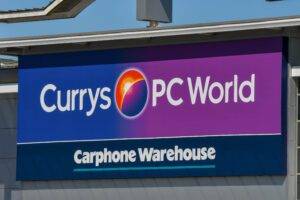
The boss of Currys has accused the government of failing to understand or care about UK retailers by pushing through a “big hike” in the UK’s minimum wage.
Alex Baldock’s comments come weeks after the chancellor, Jeremy Hunt, announced plans to increase the legal minimum wage for the UK’s lowest paid workers to £11.44 an hour, representing a rise of almost 10%, from April 2024. The move will force employers to pay full-time workers about £1,800 more per year.
Nevertheless, the boss of the electrical retailer said this would put significant pressure on high street retailers like Currys, which are also preparing for a surge in business rates – the property-based tax levied by local councils from businesses such as retailers, pubs and offices.
“We believe we are paying our colleagues well and we certainly intend to continue to,” Baldock told reporters on Thursday morning. “That said, for the retail industry as a whole, having a big hike in the ‘national living wage’ at the same time as an expected half a billion pound increase in the rates bill just shows how little the government appears to understand or care about this industry.
“There are 3m jobs at stake in UK retail, and loading more costs on to an already overburdened sector is irresponsible, and we call for a change of heart on it.”
High street shops are preparing for a collective £1.95bn inflation-linked increase in local taxes next year. Hunt froze business rates last year for companies in retail, leisure and hospitality, and granted a 75% discount worth up to £110,000 per business. Those discounts are set to expire in March 2024.
Baldock’s criticism came as Currys reported a 4% drop in like-for-like sales over the six months to October, as the cost of living crisis left consumer spending subdued.
The chief executive said there were a mix of factors at play. “On the one hand, the consumer is hard pressed and confidence is pretty bumpy. Interest rates have been rising … and consumers are cautious about their spending. But on the other hand, real wages have continued to climb, employment has stayed high, people have retained savings and customers are treating themselves.”
He said consumers were more likely to buy products on credit offered by the company, which allowed consumers to spread the cost of their purchases over a number of months.
But Baldock stressed that the company was being responsible with its lending, and wanted to “stay a mile away from any reputational damage that comes with lending money to people who can’t afford to pay it back”.
Read more:
Currys boss says government does not ‘care’ about retail
Your survival guide to the office Christmas party

With Shakin’ Stevens back on our radios for the first time in 12 months, and a shipment of mince pies large enough to feed a small army having arrived at your local supermarket, it’s certainly beginning to look a lot like Christmas wherever you go.
The festive period’s arrival portends many things – the absolute hammering your credit card will soon be subjected to for one, not to mention familial squabbles at the dinner table that even Jerry Springer would struggle to resolve. Besides this and much else, it also signifies that the office Christmas party is just around the corner.
Eagerly awaited and dreaded in equal measure, this annual event serves as a chance to let your hair down with colleagues and reflect on what you’ve collectively achieved over the course of the year. However, the thought of spending an evening of music, dancing and small talk with your co-workers may strike terror into your heart – particularly if your festive energy is more akin to that of the Grinch than Buddy the elf. In reality though, provided you take note of the “do’s and don’ts”, the Christmas party can actually be a lot of fun.
With that in mind, Michael Doolin, the Group Managing Director of Clover HR discusses the three most important things to do when celebrating with colleagues. to help even the biggest workplace Scrooge survive the office Christmas party, and get swept away in the spirit of the season.
Enjoy responsibly
We’ve all heard the alcohol-related horror stories surrounding the office Christmas party. Those unfortunate individuals who’ve gone a little too heavy on the complimentary drinks and ended up making a drunken pass at a colleague, or even gone so far as to challenge their manager to a fistfight (did somebody ask Santa for a P45?).
While such tales may have gone down in legend among office workers up and down the country, they’re hardly shining examples of how to conduct yourself at the Christmas party. I don’t want to sound like a party pooper – on the contrary, those who enjoy a drink should feel free to do so – but you need to remember where you are. While people are generally more relaxed at the Christmas party than they are in the office, bear in mind that you’re not on a night out with the lads, or a prosecco and cocktail-fuelled binge with the girls. Your bosses are present, and probably keeping a close eye on you – even if they don’t appear to be.
So, by all means, raise a glass in celebration, but just make sure not to have as many as you might on a typical Saturday night. Eat plenty beforehand, avoid mixing your drinks, take your time, and have a glass of water if you feel like you’re reaching your limit. Stick to these principles, and you should manage to get through the night without doing or saying anything you might live to regret!
Don’t sit it out
If you’re the kind who’d happily strike the entire festive period off your calendar, you might be considering sacking off the office Christmas party altogether. You certainly wouldn’t be alone if this is the case, with a survey commissioned by Reward Gateway revealing that a massive 54% of employees dread the occasion.
While you may be tempted to pull a sickie or claim that you’ve already got a prior engagement to attend – we both know you’d just spend the evening curled up on the sofa watching Love Actually and eating all your advent calendar chocolate early – you should really make an effort to join in. Attendance may be optional, but showing your willingness to spend time with colleagues outside the confines of the office can help to demonstrate that you’re a team player; someone who doesn’t work purely to pick up a paycheque. On top of this, it can be a great opportunity to get to know your co-workers better, helping to bring you closer together as team.
By conquering your fears and throwing yourself into the festivities, who knows, you just might end up actually having a good time!
Avoid controversial talking points
After a year jam packed with more deadlines and boring team meetings than you care to remember, it’s totally understandable that you won’t want to spend your evening talking to colleagues about work, and all the stuff you need to pick back up when you return in the New Year.
In this sense, steering clear of work-related conversations is a shrewd move, but that’s not to suggest that this isn’t the only topic that should be left alone. Offices tend to bring together people with a broad range of ages, ethnicities, sexual orientations, etc., so it’s likely that co-workers will have different ways of viewing the world due to their diverging experiences. As such, some areas of debate – such as politics and religion – are likely to be controversial with colleagues, especially if their opinion is diametrically opposed to your own.
You might find some certain subjects particularly interesting, but if you know they’re likely to stir up some controversy, you should try to keep your opinions yourself and stick to the tried and test topics – what you’ve been watching on Netflix, your plans for Christmas, etc. They might not be quite as riveting, but they’re much less likely to spark yet another argument over the festive period.
Don’t forget to have fun
Hopefully, you’re now feeling a bit more prepared to face your office Christmas party. With various do’s and don’ts, it can be easy to get bogged down in etiquette, but you shouldn’t obsess over getting things right to the point where you actually forget to enjoy yourself, which is the most important thing of all. After all, you and your colleagues have worked hard throughout the year, and have earned the right to kick back a little and have some fun.
So, be sure to have a great time at your office Christmas party, and make it a night to remember – but for all the right reasons!
Read more:
Your survival guide to the office Christmas party
Can Do Better!

As 2023 draws to a close and we stand on the threshold of 2024, it’s a natural time for reflection on both our achievements and unfulfilled aspirations.
The transformative impact of the post-COVID work landscape is evident as a substantial portion of the workforce continues to navigate a hybrid work model.
The shift towards this new normal underscores the evolving dynamics of professional life, where adaptability is key.
In this evolving professional landscape, there is a growing recognition among managers of the significance of Emotional Intelligence (EQ) in tandem with traditional Intelligence Quotient (IQ) skills. The acknowledgment of this dual importance suggests a positive shift towards a more empathetic and holistic approach to leadership. If this perspective gains wider acceptance and employees are genuinely appreciated for their contributions, it could mark a significant departure from mere glimpses of progress to a sustained positive change.
An encouraging trend to note is the diminishing stigma around acknowledging and addressing stress in the workplace. Progress is evident when efforts to cultivate a healthy workplace culture become commonplace, signifying a collective step in the right direction.
A Commitment to Wellbeing
I find it heartening to observe that Health and Safety (H&S) professionals are now taking a comprehensive approach by considering the well-being of the entire individual across both personal and professional spheres. Having had the privilege of addressing various H&S audiences over the past year, I see a commitment to promoting a holistic understanding of employee health.
Personal Responsibility
Acknowledging stress as an inherent aspect of our lives, it’s imperative for individuals to assume personal responsibility for their well-being and develop effective stress management strategies. Recognising that there is no one-size-fits-all solution, each person must identify what works best for them and actively incorporate those practices into their lives.
Continuous Growth
While the concept of self-improvement may sound straightforward, the reality often involves ongoing efforts and a commitment to continuous growth. As we approach the close of 2023, it prompts introspection – how many of us reading this can honestly say, “I did that, but I can do better”?
Let’s embrace honesty in our self-assessment. We all have the capacity to improve. As we eagerly anticipate the advent of 2024, it becomes an opportunity to envision and strive for a version of ourselves that embodies continuous improvement.
Here’s to the promise of “doing better” and the exciting journey that lies ahead in the coming year.
Read more:
Can Do Better!
Royal Mail ‘considering £430m swoop for Czech rival’

The owner of Royal Mail is reportedly considering a bid for Czech parcel giant Packeta before the latest round of bids is revealed on Friday.
International Distributions Services is said to be considering going in for the company which operations in central and eastern Europe, according to a report in The Times.
This comes after Royal Mail’s owner IDS has been blighted by widening losses, heavy strike action and reputational damage.
service obligation after trebling losses to £319m in the first half of the year, as reported last month.
According to the Times, Packeta operates in Slovakia, Poland, Hungary, Romania and Germany in addition to the Czech Republic, and was put up for sale in May.
The potential swoop comes as Royal Mail’s debts swell to around £1.5bn, meaning further expansion could prove controversial.
Last month, IDS said it is working to improve quality after profits plunged amid a torrid year of strikes and customer let-downs.
IDS chief executive Martin Seidenberg said his number one goal is to improve the quality of the group’s services.
“From experience,” he said, “I know that quality is key for customer satisfaction and sustainable growth, so we are pulling out all the stops to deliver Christmas for our customers.”
A spokesman for International Distributions Services said: “We never comment on rumour or speculation.”
Read more:
Royal Mail ‘considering £430m swoop for Czech rival’

