
December 2023 – Page 6 – AbellMoney

Secrets of Success: Mark Sinjakli, Founder and MD of My Baker

This lockdown concept has since grown their nationwide success
When Mark Sinjakli, took over My Baker it was a platform of 80 bakers, mostly London and Birmingham. Today is has over 200 bakers, based in the majority of UK cities, providing artisanal cakes for customers, made by talented independent bakers, often at short notice.
Mark takes some time out of his day to speak to Business Matters …
What is the main problem you solve for your customers?
Providing a quality, reliable, cake delivery service at short notice. By carefully vetting bakers and only accepting those that meet our high standards, the customer is assured of a lovely cake, without the potentially “hit and miss” approach of contacting local bakers directly.
As independent bakers are frequently run by a single individual, they may lack the bandwidth to respond promptly to a customer enquiry, not have the capacity for a certain order, not be able to make a certain style of cake, or be able to adhere to a certain dietary requirement.
By aggregating the services of over 200 talented bakers, we can get the customer the right baker for their specific needs, and at short notice.
It is also great for the bakers – they take the orders they can do, when they need them most, with no obligation if they are too busy.
We opened our first physical bakery in Hendon, North West London, in November 2022, which gives our offering even greater brand presence.
What made you start your business – did you want to rock the status quo, was it a gap in the marketplace that you could fill?
We acquired the business in June 2020, when the country was in lockdown, it was already established but needed some TLC. The business exists because it fulfils the needs of both of its key sets of stakeholders – customers and bakers.  There was a real gap in the market for a cake provider that offered cakes nationwide, guaranteed quality, and speed of service.
As our reputation has grown, we now receive applications from several bakers a week looking to join our books.
What are My Baker’s brand values?

A commitment to high quality and excellent service: My Baker is synonymous with convenience and quality;
Our bakers work with us, not for us: each one is a valued partner, and many have become friends. We pay them well, and we have on occasion paid out early to help them through financial hardship. We get them a range of supplier discounts, and we offer them orders at no cost to them and with flexibility to choose. Being small and without layers of hierarchy to wade through, we can make these decisions quickly and considerately.  We are a family-owned and run business.
Honesty. This is absolutely critical. To give an example, on the rare occasions we have a complaint, we assess it carefully and absolutely on its merits.  We hear from the customer, and the baker, and take all the facts into consideration before deciding on the appropriate approach. At my former firm, AlixPartners, one of the core values is “candour with compassion”, and I think that’s a very good approach.

Do your values define your decision making process?
Absolutely.  All of our bakers have to meet the required standards and be fully complaint with food hygiene legislation before they work with us – no exceptions. At the same time, we have been a supportive ear to many of them.
One incident I am particularly proud of is when one of our bakers faced a tough (and in many ways unreasonable) complaint.  It wasn’t even on one of our cakes, it was one they had made directly to a customer.  But I was able to talk them through how we deal with complaints, help them process the emotion, take everything into account, and reach a fair settlement with the customer. Some months later they said to me that just talking to me had helped them “step back from the edge”, and must admit I felt very emotional when I heard that.
Is team culture integral to My Baker?
It is vital. We are a small team and work closely together. By necessity everyone in the team has to perform to a high standard if we are to thrive.
At the same time, we are humans, not robots, and there needs to be an acceptance of mistakes, of “off-days”, of life outside of work, and of people’s genuine limits in terms of skill sets and working hours.
I think we all give our best because we all believe in this project and like each other.
How do you go the extra mile to to show your team you appreciate them?
Some very tangible things in terms of paying well and for exceptional employees there is a share scheme, so they get to participate financially in the success of the company.
But based on my experience as a junior employee and then coming through the ranks, it can be small things, like acknowledging when great work has been done publicly, and never taking credit for what someone else has done.
In terms of your messaging do you think you talk directly to your consumers in a clear fashion?
We like to think so. We are available on the phone and live chat seven days a week, and having recently overhauled the website one of the big focal points was improving the customer journey.
However, there is always room for improvement. Automated order confirmation emails, for example, have sometimes confused customers and we’re striving to get that right.
Our strapline which is repeated across all our branding, and on our signage at the bakery, is “My Baker – Cake to your Door”.  We wanted something that explained what we did succinctly and we think we’ve found it!
What’s your take on inflation and interest rates – are you going to pass that on to your customers or let your margins take a hit and reward customer loyalty in these tougher times?
I think inevitably it’s a bit of a compromise. The price of butter, flour, and sugar have all gone up substantially, plus fuel for deliveries. Our two key stakeholder groups are our customers and our bakers, and we have to do right by both groups.
What we didn’t want to do was to keep nudging prices up.  Therefore we made substantial price increases over the summer, but now we don’t plan any more for the foreseeable future. The attitude was, “do it once, do it properly, give customers and bakers certainty”.
We recognise that things are hard financially for our customers, and have a range of discounts and offers, our semi-naked classic and classic ranges, and free delivery on larger orders, to ensure our offer remains reasonably priced and to offer something for most budgets.
How often do you assess the data you pull in and address your KPIs and why?
Some weekly and some fortnightly. We have a very scaleable platform here, and the aim on one level is quite simple: growth, through more sales and more talented bakers.
Data such as website traffic, search engine rankings, CTR and ROAS on paid ads, and press coverage is therefore critical and monitored weekly.
We have a great digital marketing partner (Lead Genera) and terrific PR Agency (Rochester PR) and we discuss these metrics with them frequently.
Is tech playing a much larger part in your day-to-day running of your company?
My Baker has always been a tech business, from its inception. The initial investment was used to build a tech platform capable of accepting orders, locating the nearest bakers, filtering them for relevant skill sets, and assigning the orders. There was nothing off the shelf that could do this, so a custom-built system was required.
What is your attitude to your competitors?
We’re conscious that we didn’t invent cake! There are some longstanding companies, some exciting new kids on the block, and some great offerings out there. We respect and learn from what others do.
However, we don’t fall into the trap of becoming obsessed by our competitors. It is more important and a better use of head space to have a clear vision and implement it, than to seek to mimic the approach of others.
Do you have any advice for anyone starting out in business?
Get some experience working for someone else before going out on your own.
Many people see starting their own business as a route to freedom, but It’s not for everyone so think carefully as to whether you are wired for it. As far as is possible, make sure you have a financial cushion in place, and try to obtain third party funding as well as putting your own money in.
My own journey has been to get experience in my 20s and 30s, where I trained as a chartered accountant and had a career in corporate restructuring, before becoming an entrepreneur in my 40s. I don’t think I would have been a very good entrepreneur in my 20s, I learnt so much from others (including their mistakes) in my first career.
This is probably the number one point though: figure out what it is that you are really good at and enjoy doing.  Do that, well.  And then surround yourself with people who are good at the stuff you aren’t good at / don’t want to do. I am incredibly lucky that in our small, nimble team, we all bring something entirely different to the table.  You wouldn’t want me baking and decorating cakes (Mel) or crafting our brand identity (Shane)!
It can be a lonely and pressured place to be as the lead decision maker of the business. What do you do to relax, recharge and hone your focus?
I’d love to say that I’m in training to climb Mount Kilimanjaro for charity and doing an Iron Man, but that’s just not me! I obsess about the business and it leads little headspace for other pursuits.
I think the things that keep me grounded are the fact that I have a great team, the bakers (many of whom have become close friends), a superb set of friends and family, and some fantastic advisers –  so I am never short of a sounding board.
One recent addition to our lives has been our cute Pomeranian, Marley, who needs regular walking and gives us a lot of affection. He does allow me to genuinely switch off!
Do you believe in the 12 week work method or do you make much longer planning strategies? 
I don’t think there is a “one-size-fits-all” answer to this question. From my years in the City, I came to realise that you need a combination of approaches.
On the one hand, you need long-term planning. You need to define your goals and strategy, and implement processes and best practice to achieve that.
At the same time, you never know when and where your next big opportunity is going to arise, or what macro-economic factors might be at play. For example, when we bought the business, everyone bar essential workers was working from home, so there was little point in courting the corporate office market.  But now, we do really well there, with WeWork in particular a fantastic client for us.
So you need to be reactive and nimble. One of the great advantages of being a small company is that we have very simple, flat and non-hierarchical decision-making processes.
What is your company’s eco strategy?
Our model is intrinsically eco-friendly, since we are a national network of local independent bakers. This means that our cakes are delivered to the customer’s door over short delivery distances, normally about one – three miles.
Coupled with this, we insist that our bakers only use recyclable packaging and free range eggs.
What three things do you hope to have in place within the next 12 months?

We are launching our “5 by 77” programme in January – we aim to have 5 talented bakers in each of the 77 cities of the UK by December 2023;
Our new bakery is a fantastic space – as well as serving the public with cakes to take away and cake consultations for future events, we plan to make it a place for content generation and baker collaboration;
Last but not least – we’re looking to bring our incredible service to even more customers, which may require an injection of capital, and potentially the support of a strategic investor and / or a crowdfunding campaign– so watch this space!

Read more:
Secrets of Success: Mark Sinjakli, Founder and MD of My Baker

UK entrepreneurism is being threatened by online scams

Retail scams across the UK are threatening the entrepreneurial spirit of the nation, according to new research out today which reveals millions of consumers are shunning small and independent businesses due to misguided lack of trust.
The research commissioned by  F-Secure, a global leader in cybersecurity, found that more than half of Britons, a significant 56%, have avoided shopping with small and independent businesses; expressing a preference for shopping with better-known and established brands which highlights a misperceived sense of security when shopping with recognised retailers.
F-Secure’s research reveals that over the past year, 13 million Britons have fallen victim to an online shopping scam, costing the nation a staggering £1.4 billion. Of those who have been scammed, a fifth said they would never shop with smaller or independent online retailers.
However, the reality is that retail scams are not confined to a single type of shopping platform with larger retailers and well-known brands, still being targeted by cyber criminals. Of those who reported being scammed last year, small independents accounted for 27%, only marginally more than large online platforms, which accounted for 23%. Large high street retailers accounted for 21%.
In a bid to help SMEs and reassure consumers, F-Secure’s experts are helping Britons to spot the warning signs of fraudulent activity across all online retailers as shopping scams are expected to surge over the next two months during the festive season, which could cost the nation over £800 million in Christmas shopping alone.
Tom Gaffney, F-Secure, says: “SMEs are the lifeblood of the UK economy and so it’s alarming to hear that over a third of UK consumers, who have experienced scams (35%), will only shop with well-known brands that they feel are more reputable and 14% said they are no longer confident shopping online.
“Our research shows, the perception remains that SMEs pose a greater risk but actually no retail type is immune from  cybercrime. Better education is needed here to help consumers spot when something is amiss which could prevent fraud and still allow legitimate small retail businesses to survive.”
Read more:
UK entrepreneurism is being threatened by online scams

Pay inflation peaks as labour market cools, but skills crisis likely t …

The pay inflation that the UK’s workforce has experienced over the last year may have peaked, with economists predicting a stagnant picture for economic growth in 2024. However, staff confidence remains high amid the growing skills crisis.
That’s according to the latest Robert Half Jobs Confidence Index (JCI) – an economic confidence tracker produced in partnership with the Centre for Economics and Business Research (Cebr).
The latest iteration of the report reveals that more than half (58.4%) of workers feel confident in their job security for the next six months amidst low unemployment, high vacancies and nominal wage growth outpacing inflation. This is a long-standing trend as employees see skills shortages as a reason to feel secure in their jobs, with the JCI’s job security confidence pillar the strongest positive driver for the Index overall score for eight consecutive quarters.
Although this optimism is at odds with the UK’s economic slowdown, the overall picture of confidence remaining strong is in line with Cebr projections for the labour market over the next six months. Unemployment is expected to tick up slightly as high interest rates continue to push down on consumer and business demand, feeding through to employment, yet the labour market will remain tight by historical standards. Given this picture, the 5.5% increase in job search confidence to 47.4% in Q3 2023 is surprising and may exacerbate the labour challenges for firms in the New Year if workers are highly confident about their ability to progress.
In line with the JCI, Robert Half’s 2024 Salary Guide also reveals that while 69% of businesses feel confident in their growth prospects for 2024 and 47% plan to increase permanent headcount next year, a staggering 75% are already concerned about their ability to attract and retain skilled talent.
As Matt Weston, Senior Managing Director UK & Ireland, at Robert Half, explained, this scenario could hinder business growth and stability in 2024: “We’re starting to see signs that pay inflation has peaked, although the good news for workers is wage growth is expected to remain above inflation in the coming months. Nevertheless, while the current economic uncertainty is a top concern for businesses, the workforce isn’t showing the signs of diminishing confidence as we would usually see at this time. The health of the labour market and that of the wider economy have often been linked, yet at present they are less synced than anticipated.
“Today’s labour market snapshot is the culmination of factors from the last few years, including Brexit, the Great Resignation and the pandemic. Things have changed and access to the skilled talent businesses need to remain competitive is becoming ever more challenging. Increased post-pandemic economic inactivity, innovation outpacing traditional learning routes and limited social mobility have the potential to further weaken the labour market’s ability to match jobs with skilled workers.
“Our research shows job and business growth confidence are on the rise, yet the widespread skills shortages and economic inactivity will take much longer to tackle. Employers are less likely to be in the driving seat in 2024 and being agile with their talent strategies and workforce models will be key.”
Read more:
Pay inflation peaks as labour market cools, but skills crisis likely to intensify

Unlocking Potential: How jobcentres are driving small business growth …

Today is Small Business Saturday. A day to celebrate the thousands of businesses and entrepreneurs across the country who are the backbone of our economy.
We use small businesses all the time. Whether it’s your local coffee shop, hairdresser, or family bakery, they are the beating heart of our high streets and a huge part of our economy. Nearly 10 million people across the UK work in companies with fewer than 50 employees. And standing behind these organisations is our network of over 630 Jobcentres.
This week I visited Arapina Bakery, a small business in South London, which has directly benefited from the support our Jobcentres offer. The local Employment Adviser, Liam told me about his work with the bakery owner, Michaela, to identify their business needs and implement a bespoke business plan. Through this partnership, the local Jobcentre helped Michaela to recruit five new members of staff which helped the business grow. The baked goods were amazing and we spoke about how, without much time to spare from the day job, Liam helped to select, sift and recruit staff.
This is just one of many ways local Jobcentres can help small business owners. Employer Advisors work with local businesses to source job opportunities and promote these vacancies to work ready jobseekers.
Whether helping draft job adverts, navigating the hiring process, or tapping into the local labour market and upskilling jobseekers, DWP Jobcentres are here to help at every stage of the recruitment journey.  Offering someone a chance can truly change a life and Jobcentres can work with you to help grow your team.
At this time of year, small businesses really do shine. It’s so important we back the businesses in our local communities who contribute so much to our vibrant, festive high streets and town centres.
I truly appreciate the dedication, adaptability and sheer resilience needed to succeed in business. As the new Minister for Employment, I am delighted to be advocating for small businesses at the heart of government, highlighting their value and ensuring they have the support they need.
Collaboration between small businesses and local Jobcentres is a recipe for success. Small enterprises gain access to a support network that understands their unique challenges and a pool of motivated, local jobseekers. But this partnership is about more than just filling vacancies; it’s a partnership that helps businesses and communities grow together.
This small business Saturday, I urge entrepreneurs and small business owners to explore the array of DWP services on offer, to tap into the expertise of employment advisors in Jobcentres and discover the wealth of opportunities that come with investing in local talent.
Read more:
Unlocking Potential: How jobcentres are driving small business growth 

Microsoft’s new £2.5bn data centres are ‘turning point’ for AI …

Microsoft will invest £2.5 billion in Britain over the next three years to double its data centre capacity and provide computing power to help to drive the expansion of artificial intelligence.
The investment has been hailed by Rishi Sunak as “a turning point for the future of AI infrastructure and development in the UK”.
The American technology company plans to bring more than 20,000 advanced graphics processing units to Britain by 2026. It plans to expand sites in London and Cardiff and is looking at a “potential expansion into northern England”.
Business briefing Morning and midday updates on financial and economic news from our award-winning business team. Sign up with one click
It said the investment would help with training “more than one million people for the AI economy”, while it also pledged also to support AI safety and research efforts.
Brad Smith, Microsoft’s vice-chairman and president, said: “Microsoft is committed as a company to ensuring that the UK as a country has world-leading AI infrastructure, easy access to the skills people need and broad protections for safety and security.”
The warm words about the UK as a business destination stand in contrast to comments made earlier this year, when the competition watchdog blocked Microsoft’s $69 billion takeover of Activision Blizzard, the games developer. The veto was lifted after Microsoft came back with changes.
Smith, 64, was speaking on a visit to Microsoft’s newest and largest data centre, which is under construction in Acton, west London. It is run fully on renewable energy and, in response to concerns over data centres’ large power usage, Microsoft has invested in the local energy grid. It is also looking at how it can share energy, heat and water from its facility with the local community.
Brad Smith, the Microsoft president, left, speaks with Jeremy Hunt, the chancellor, during the visit to Microsoft’s data centre construction site in Acton
The Microsoft executive also called attention to Britain’s commitment to global collaboration on AI after the inaugural Safety Summit hosted by the government at Bletchley Park at the start of November, which was attended by 27 countries, including China.
He previously has raised concerns about the threats from Chinese AI, revealing in an interview in May that Microsoft had uncovered evidence of Chinese state-sponsored espionage. Smith said at the time: “We should absolutely assume that certain nation states will use AI to launch cyberattacks.”
On Thursday, however, he responded positively to questions about whether the UK was right to invite China to the AI summit table: “I think that the world needs to have a global conversation and every country should have a shared interest in ensuring that AI remains under human control with the right kinds of safety standards.”
Read more:
Microsoft’s new £2.5bn data centres are ‘turning point’ for AI in Britain

Former TalkTalk CEO Dido Harding to become first female head of the Jo …

Baroness Harding of Winscombe, the former chief executive of TalkTalk, is poised to saddle up as the first woman to become senior steward of the Jockey Club in its 273-year history.
Harding, whose role would be equivalent to chairwoman, was chairwoman of NHS Improvement until October 2021, overseeing the initial phases of the Test and Trace programme after the pandemic.
Before taking charge at the telecoms group, the talented amateur jockey was previously an executive at J Sainsbury and Tesco, the supermarket chains. She was elected to its board of stewards six years ago.
The Jockey Club is governed by Royal Charter — Elizabeth II was a patron — and owns 14 racecourses, including Cheltenham, Epsom, the home of the Derby, and Aintree, the host of the Grand National.
Harding, 56, whose role will be non-executive and unpaid, will replace Sandy Dudgeon, 66, the senior steward since July 2019.
Harding’s racing interests have included more than 25 career wins as an amateur jockey and owning Cool Dawn, the winner of the 1998 Cheltenham Gold Cup. She was appointed a member of the Jockey Club in 2004.
Read more:
Former TalkTalk CEO Dido Harding to become first female head of the Jockey Club

Customer service? Quick and clear communication with a trained profess …

Make sure you incorporate the following data into your 2024 plans …
Knowing how to deliver good customer service is essential for the ongoing success of your business. Salesforce research found that 80% of customers now consider the experience a company provides to be as important as its products and services, so the importance of getting this right for your business cannot be understated.
From phone calls and email to web chats and social media, it’s harder for businesses to know which channels to prioritise for customers. Now, new research from the leading technology-based provider of communications services across Europe, Gamma Communications, suggests that voice calls should be a priority for businesses despite the increasing number of digital communication options.
According to the new research, well over a third of Brits (38%) say direct phone calls are their preferred method of communication with businesses over other channels such as emails, web chats, social media and video calls. A further 69% of consumers are likely to contact via phone call first before trying other methods when seeking assistance from a business.
With the vast majority (91%) considering it important to be able to easily call a business customer service line when they need assistance, phone calls evidently have a significant impact on the customer experience. To further underscore this, 80% of consumers say they would continue shopping with an SME that offers superior customer service over the phone, suggesting an impact on customer loyalty as well.
Chris Wade, Chief Marketing and Product Officer at Gamma Communications commented on the findings:
‘When customers need support, it’s evident that businesses must understand exactly how their customers want to communicate.
Even in today’s increasingly digital world, human connection is vital.
Telephone calls have withstood the test of time for being one of the best ways to achieve that interpersonal bond.
All businesses can use this to harness the, sometimes underrated, value of telephone calls to offer quality customer service and retain customers.
Whether you’re a tradesman or a financial advisor, your voice has the power to yield customer loyalty.’
In the finance industry alone, evidence is clear on just how important customer support accessibility is to British consumers. The Financial Conduct Authority (FCA) reported finance firms had 1.8M open complaints (a 5% increase from 2022) in the first half of 2023 showing that customers will always, and increasingly, need business support. It’s how fast and easy they receive that support that leaves a lasting impression which can make or break a business’s reputation.
The research suggests the value of voice calls can be attributed to human connection. Almost half of Brits (46%) value phone calls because they feel better understood when communicating verbally. The same number (46%) find phone calls quicker and easier to use, while 45% believe that the support and customer service they receive over the phone is of higher quality in comparison to other contact methods.
Essentially though:

69% of Brits will contact a business via phone call first before trying other methods when seeking assistance
Direct phone calls are the preferred method of communication for well over a third (38%) of British consumers when seeking support from a business

These are facts that just can’t be ignored.
Similarly, the biggest frustrations Brits face when contacting customer support are automated responses or the inability to speak with a human (49%), being subjected to long hold times (47%) and having no phone number to call or the phone number being hard to find (31%).
Gamma Communication’s research shows the ability to voice call a business is a necessity for customers and this is also seen across the UK regions, upon further breakdown of the data:

More than half (52%) of customers in the East of England value phone calls with businesses as they feel better understood when speaking over the phone.
Nearly half of Yorkshire customers (48%) value phone calls as they believe they are more likely to get an issue resolved faster over the phone.
Nearly half of South Western customers (48%) value phone calls with businesses because it’s more personal than digital or automated messaging.

At a time in the year when plans are being made for the year ahead, it’s a good reminder to remember that customer retention often comes down to excellent forms of clear and consistent communication.
Read more:
Customer service? Quick and clear communication with a trained professional wins

EU forms backup plan to lessen impact of 10% Brexit tariff on EVs

The European Commission has hatched a confidential Plan B proposal to “cushion” the impact of a looming 10% tariff on imports and exports of electric vehicles.
The proposal was presented to member states on Monday in response to pressure from carmakers to amend some of the conditions imposed when the UK left the EU in January 2021.
The commission is concerned that any decision to lift the tariff, even temporarily, would constitute a breach of the Brexit trade and cooperation agreement (TCA) and therefore require reopening the deal itself, to which it is vehemently opposed.
Under the plan, presented by the working party on the UK, a series of “cushioning measures” would be brought in to mitigate the impact of the 10% tariff, due to enter into force on 1 January 2024.
The main proposal is to extend the validity of the 2023 official “statements of the origin” – that need to be submitted when exporting cars – into 2024. This would guarantee that any electric vehicle ordered in 2023 but delivered in 2024 would be compliant with 2023 rules – when a tariff did not apply.
With lead times of up to six months for electric vehicles, the extension could give manufacturers some breathing space.
But the car industry, which asked for the tariff to be suspended as far back as March, is still lobbying for a three-year suspension of the tariff.
Under the Brexit trade agreement, from 1 January any electric vehicle exported from the EU to the UK or vice versa must be at least 45% made in either the EU or the UK or it will be subjected to a tariff. Because most of the cost of an electric vehicle comes from the battery, and most batteries are imported from China, manufacturers are racing to build the capacity to make batteries inside the EU so as to avoid these tariffs.
Carmakers in Britain and across the rest of Europe, including Stellantis, Ford, BMW JLR, Volkswagen, Volvo, and Mercedes-Benz, have all called for the tariff to be suspended for three years to allow time for new battery factories and their associated supply chains to get up and running.
Luca de Meo, group chief executive of Renault, who is also the president of the European Automobile Manufacturers’ Association, ACEA, said on Wednesday that failure to lift the tariff could cost the industry “billions of euros”.
Germany and other countries with a significant car manufacturing base support the suspension of the tariff, but France has been arguing that this would involve re-opening the TCA and require support from 27 member states.
De Meo said efforts to persuade France that doing a deal on tariffs would not mean reopening the trade agreement had gone “very high in the hierarchy” because it was a “very important topic”.
One car industry source said: “We need a decision now. Everything vis a vis the relationship between the EU and the UK is completely last minute. It’s the end of November. It is last minute now and we are super worried.”
The commission proposal has so far been presented only orally, and member states are expected to respond once it becomes a written proposal. It is understood that some fear the commission’s “cushioning measures” could be legally challenged.
Read more:
EU forms backup plan to lessen impact of 10% Brexit tariff on EVs

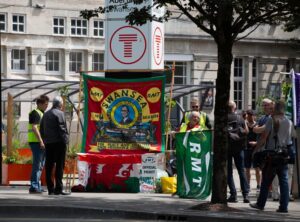
RMT union votes to end rail strikes until at least spring

Rail workers have voted to accept a pay deal, ending their involvement in a long-running series of strikes.
Members of the RMT union agreed to an offer from train companies which included a backdated pay rise of 5% for 2022-23 as well as job security guarantees.
It means that RMT members will no longer be involved in industrial action until at least the spring of next year.
However, train drivers represented by the union Aslef will still strike.
Read more:
RMT union votes to end rail strikes until at least spring