

Billionaire retail mogul Mohsin Issa, former CEO and co-owner of Asda, has made his first major investment since stepping down from the supermarket giant, putting £10 million into Liverpool-based sports supplements company, Applied Nutrition. The company is preparing to go public on the London Stock Exchange.
Issa’s investment in Applied Nutrition comes through his investment vehicle, Boulder Investco Limited, and marks his initial foray into new ventures following his departure from Asda’s leadership in September. His exit followed a dip in sales that was publicly criticised by Asda’s chairman, Lord Rose. Despite stepping down as CEO, Issa remains a co-owner of Asda with a 22.5% stake and holds a seat on the board.
This investment also signals a shift in Mohsin Issa’s business trajectory as he and his brother, Zuber Issa, untangle their joint business interests. The brothers, who are worth an estimated £5 billion, have built a vast empire, including petrol station operator Euro Garages, which became a launchpad for their £6.8 billion takeover of Asda in 2021 alongside private equity firm TDR Capital.
In recent months, the Issa brothers have divided their interests, with Zuber selling his 22.5% stake in Asda to TDR Capital in June. Zuber also stepped down as co-CEO of their forecourt business, EG Group, after acquiring the UK operations for £228 million, which he now runs independently. Despite the split, Mohsin has downplayed any rumours of a rift, maintaining that the brothers “get on exceptionally well.”
Applied Nutrition, which produces protein supplements and other sports nutrition products, is chaired by Andy Bell, founder of investment platform AJ Bell. The company has set the price range for its initial public offering (IPO) at between 136p and 160p per share, giving it an estimated valuation of between £340 million and £400 million.
Mohsin Issa joins a group of four prominent North West entrepreneurs backing the IPO, including Home Bargains founder Tom Morris and Liverpool property developer George Downing. Together, the investors are expected to hold up to 7% of the company following the IPO.
Applied Nutrition’s growth and upcoming stock market listing are further bolstered by a significant 32% stake from JD Sports, the Bury-based retail giant. Existing shareholders plan to sell approximately 137 million shares, valued at between £186 million and £220 million.
This investment marks another step in Issa’s post-Asda ventures, as he continues to focus on backing successful entrepreneurs and UK businesses. In a joint statement with his brother, Mohsin Issa said: “Our passion is backing great entrepreneurs and helping them to build strong UK businesses that drive growth and create jobs.”
Applied Nutrition did not comment directly on Issa’s involvement but is expected to benefit from his significant retail and entrepreneurial experience as it moves closer to its public listing.
Read more:
Former Asda boss Mohsin Issa invests £10m in sports supplement firm ahead of London IPO
Month: October 2024
IMF urges Rachel Reeves to raise taxes and rein in spending to stabili …

The International Monetary Fund (IMF) has called on Chancellor Rachel Reeves to introduce tax increases and tighten government spending in the upcoming budget, warning that delaying such measures could exacerbate the UK’s public finance problems.
In a pre-released section of its *Fiscal Monitor* report, the Washington-based organisation highlighted the UK and the United States as countries where borrowing rates have surged beyond pre-pandemic levels, raising concerns about the sustainability of their national debts.
“With debt risks elevated in most countries and debt growing at a faster pace than in the pre-pandemic years in large countries (United Kingdom, United States), postponing adjustments would only make the required correction larger,” the IMF warned.
Reeves is expected to announce a series of tax hikes during her first budget on 30 October, with potential changes such as subjecting employers’ pension contributions to national insurance and raising capital gains tax rates. Both she and Labour leader Sir Keir Starmer have emphasised the need for “tough decisions” to bring the public finances under control, although they have also committed to increasing public sector investment to drive economic growth.
Labour claims to have inherited a £22 billion shortfall in public finances from the previous Conservative administration, a figure compounded by existing fiscal plans set by former chancellor Jeremy Hunt. These plans include £20 billion in real-terms budget cuts for unprotected government departments.
According to estimates from the Institute for Fiscal Studies (IFS), taxes need to rise by £25 billion annually to avoid a return to austerity, which Labour has pledged to prevent.
The IMF estimates that global debt is set to exceed $100 trillion (93% of global GDP) this year, criticising governments for failing to take control of their public finances. It highlighted that fiscal policies have increasingly leaned towards higher government spending, contributing to greater fiscal policy uncertainty and more entrenched political resistance to tax increases.
Labour, in its election manifesto, ruled out raising key revenue-generating taxes like income tax, national insurance, and VAT, which together account for 75% of public income. However, the IMF pointed to rising spending pressures from the green transition, an ageing population, and security needs as growing challenges for governments worldwide.
This call from the IMF comes as developed nations, including the US and France, grapple with ballooning deficits. The US is projected to run a $1.8 trillion deficit this year, partly due to subsidies from the Inflation Reduction Act. France, which faces a deficit of around 6% of GDP, recently introduced a budget featuring £60 billion in tax hikes and spending cuts to tackle its debt.
The IMF stressed that there is a strong case for fiscal policies to focus on debt sustainability and rebuilding fiscal buffers “now rather than later.”
In response to the IMF’s warning, a Treasury spokesperson said: “The government has been honest about the scale of the challenge we have inherited from the previous administration, including a £22 billion black hole in the public finances. The budget will be built on the rock of economic stability, including robust fiscal rules that were set out in the manifesto. This includes moving the current budget into balance, so that day-to-day costs are met by revenues, and debt falling as a share of the economy by the fifth year.”
With Reeves’ budget looming, it is clear that the balancing act between addressing the fiscal challenges and stimulating growth will shape the direction of the UK’s economic policy in the months and years ahead.
Read more:
IMF urges Rachel Reeves to raise taxes and rein in spending to stabilise UK public finances
Starmer hints at employer national insurance rise but pledges to keep …

Sir Keir Starmer has left the door open for an increase in employers’ national insurance contributions, despite Labour’s election pledge not to raise taxes on working people.
The prime minister confirmed that “tough” decisions would need to be made in the upcoming budget, but stressed Labour’s commitment to its manifesto promises.
During the election campaign, Labour vowed not to increase national insurance. However, while Starmer and Chancellor Rachel Reeves have reiterated that this pledge covers taxes on workers, they have stopped short of ruling out an increase in the portion paid by employers.
Reeves warned businesses that taxes would need to rise to ensure economic and fiscal stability. She argued that businesses are more concerned about political stability than tax levels, and promised a “business tax roadmap” to provide certainty for investors in the years ahead.
She said that employers’ contributions were “not in the manifesto”, arguing: “We were really clear in our manifesto that we weren’t going to increase the key taxes paid by working people.”
Labour’s manifesto stated: “Labour will not increase taxes on working people, which is why we will not increase national insurance, the basic, higher, or additional rates of income tax, or VAT.”
Laura Trott, the shadow chief secretary to the Treasury, said: “Regardless of what they say, it’s obvious to all that hiking employer national insurance is a clear breach of Labour’s manifesto.”
However, Labour sources pointed out that Trott had criticised Reeves during the campaign for “conspicuously” refusing to rule out increasing employer contributions.
The potential rise in employer national insurance contributions has drawn criticism from some business leaders, who argue that taxing employers risks stifling jobs and enterprise. The Federation of Small Businesses cautioned that such a move could place undue pressure on small employers.
Read more:
Starmer hints at employer national insurance rise but pledges to keep tax promises for workers
International Investment Summit delivers £63bn boost and 38,000 jobs …
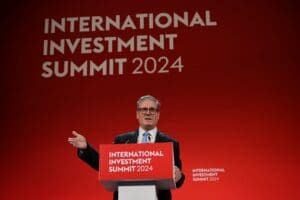
The UK is set to create nearly 38,000 jobs and attract £63 billion in investment following the International Investment Summit, which focused on infrastructure, technology, and net zero initiatives.
This year’s record-breaking total more than doubles the £29.5 billion secured at last year’s Global Investment Summit.
The government attributed the surge in investment to planning reforms, expansion of AI and data centre infrastructure, and increased funding for renewable energy projects.
Among the major announcements, Blackstone committed £10 billion to build one of Europe’s largest data centres in Blyth, Northumberland, creating 4,000 jobs. Meanwhile, Octopus Energy pledged £2 billion to build four new solar farms and a battery in Cheshire, supporting green energy generation for 80,000 homes.
Imperial College London revealed a £150 million investment to develop a new research campus as part of its DeepTech ecosystem in West London. Additionally, CCUS giants Eni, BP, and Equinor secured £8 billion in private investment to launch carbon capture projects, supporting 50,000 jobs in the long term.
CyrusOne, CloudHQ, and CoreWeave announced significant data centre investments, collectively amounting to billions, while SeAH Wind expanded its Teesside operations with £225 million for wind manufacturing, creating 750 jobs.
In the healthcare and life sciences sectors, Eli Lilly announced a £279 million partnership with the government to address obesity and launch its innovation accelerator for early-stage life sciences companies in Europe.
Holtec, a US-based nuclear engineering firm, will invest £325 million in a South Yorkshire factory to support the civil and defence sectors, creating 1,200 engineering jobs over two decades.
Business and Trade Secretary Jonathan Reynolds called the investment a “major vote of confidence in the UK,” highlighting the forthcoming Industrial Strategy as a framework for sustained growth. Chancellor Rachel Reeves echoed this optimism, stating that the investments secured at the summit reflect confidence in the UK economy and will drive job creation across industries.
Read more:
International Investment Summit delivers £63bn boost and 38,000 jobs for the UK
Majority of Britons back increased tax on online gambling as calls for …

New polling suggests that over half of Britons (52%) support increasing taxes on online gambling, with many prioritising a hike in gambling duties over other taxes such as income tax, VAT, and fuel duties.
This comes as the Social Market Foundation (SMF) releases a report advocating for a significant increase in Remote Gaming Duty from 21% to 42%, which could generate up to £900 million for the Treasury.
Online gambling, particularly casino gaming, has been linked to higher rates of harm, with fiscal costs estimated at over £1 billion. The SMF report, authored by Dr James Noyes and Dr Aveek Bhattacharya, argues that the sector is currently undertaxed and highlights that UK operators are paying higher taxes in other countries.
With the UK facing a £22 billion fiscal shortfall, the report urges the government to capitalise on this opportunity, restructuring the outdated tax system and addressing the social costs associated with gambling.
Read more:
Majority of Britons back increased tax on online gambling as calls for reform grow ahead of Autumn Budget
A guide to the new Employment Rights Bill: What businesses need to kno …

Following the general election, the new Government committed to publishing its proposals for employment law reform within 100 days. With a few days to spare, the highly anticipated Employment Rights Bill was published on 10 October 2024.
It is described as the biggest upgrade to rights at work for a generation, and here is an overview of the key proposals.
Unfair dismissal
The proposal to confer day-one unfair dismissal rights has been controversial. Currently, two years of service is required.
There will be a new statutory probation period. This will give employers time to assess someone’s suitability properly. During that period, employers will be able to adopt a “lighter-touch and less onerous approach” when dismissing someone who is not right for the job.
The Government prefers a nine-month statutory probation period and will consult on this during 2025. However, the reform of unfair dismissal will not be before autumn 2026.
In certain circumstances, there is already extensive protection from unfair dismissal from day one, such as dismissals relating to whistleblowing or for health and safety reasons.
Zero-hours workers
It is reported that 84% of zero-hours workers would rather have guaranteed hours. If someone works regular hours over a defined period, they will have a right to a guaranteed-hours contract, but workers can remain on zero-hours contracts if they prefer. They will also have the right to reasonable notice of a shift and the right to payment for cancelling a shift or changing it at short notice.
Fire and re-hire
The Government has said that “ending unscrupulous employment practices is a priority”. This includes ending firing and rehiring on new terms and conditions, often less favourable. It will be automatically unfair to dismiss someone who refuses to agree to a variation of their contract except in certain circumstances. For instance, if the variation ensures the business can continue as a going concern where there is “genuinely no alternative”. This could be difficult to evidence in many cases.
Supporting working families
Flexible working will be the default for all workers unless the employer can show it was reasonable to reject a request on specified business grounds. Currently, there is a right to parental bereavement leave, and there will be a new general right to bereavement leave. There will also be improved protection for pregnant women and new mothers returning to work. Finally, parental leave and paternity leave will become a day-one right. Currently, one year’s service and 26 weeks’ service, respectively, are needed.
Statutory sick pay
The lower earnings limit and current waiting period of three days before SSP is paid will be removed so that SSP is available from the first day of sickness absence.
Protection from harassment
We have written about the new duty that comes into force on 26 October 2024, which requires employers to take reasonable steps to prevent sexual harassment of their workers.
The Bill extends this so that employers will be obliged to take all reasonable steps. Future legislation may also specify what constitutes reasonable steps, such as publishing plans or policies.
Protection from third-party harassment, which was removed from the Equality Act 2010 in 2013, will be reinstated.
Finally, sexual harassment disclosures will count as “qualifying disclosures” for whistleblowing purposes.
Collective redundancy
The obligation to collectively consult arises when 20 or more employees are dismissed “at one establishment.” The Bill makes it clear that the obligation will apply when the threshold is reached across the whole organisation, not at a particular establishment.
Equality at work
Large employers (over 250 employees) will be required to produce action plans on how to address their gender pay gaps and how they will support employees going through the menopause.
Industrial relations
The Bill contains numerous provisions, including an obligation on employers to provide workers with a written statement about their right to join a trade union. The Government will also repeal the previous Government’s trade union legislation, including the controversial (and never used) provisions relating to minimum service levels.
Enforcement
Currently, multiple enforcement bodies report to different Government departments, but a new Fair Work Agency will combine these.
What happens next?
The Bill did not refer to topics such as the right to “switch off” or ethnicity and disability pay gap reporting. These were mentioned in a separate document published on the same day that outlines the government’s longer-term plans.
The Bill’s second reading takes place on 21 October 2024. Various consultation exercises will take place throughout 2025, and we can expect a great deal of scrutiny of the Bill in the months ahead.
Read more:
A guide to the new Employment Rights Bill: What businesses need to know
Britain relies on just 1M top earners for £124bn in income tax

New data reveals that the UK is increasingly reliant on a small number of top-rate taxpayers to generate a significant portion of its income tax revenue.
According to HM Revenue and Customs (HMRC), the 1.13 million individuals paying the 45p rate are expected to contribute £124 billion this year, which represents more than 40% of all income tax collected by the Treasury.
This figure surpasses the total revenue generated by corporation tax, fuel duties, council tax, and business rates combined. By comparison, the 29.5 million basic-rate taxpayers will contribute £82.8 billion, or 28% of income tax revenues, while 6.3 million higher-rate taxpayers will pay £93.7 billion, or 31%.
Labour’s Rachel Reeves is facing pressure to reassess her planned tax increases on non-doms and higher earners after Treasury officials warned that targeting a small group of top earners could yield less revenue than anticipated. Carl Emmerson, deputy director of the Institute for Fiscal Studies (IFS), cautioned that heavily taxing a small group of individuals could prompt changes in their behaviour, making it a “riskier strategy.”
With income tax generating £300 billion for the government this year, Sir Keir Starmer has emphasised that those with the “broadest shoulders” must bear the heaviest burden as Labour prepares for a “painful” budget on October 30.
Read more:
Britain relies on just 1M top earners for £124bn in income tax
London City Airport Secures £130m Lifeline Amid Business Travel Decli …

London City Airport’s owners have injected £130 million in new equity to stabilise the airport’s finances amid a prolonged downturn in business travel.
The move comes as the airport struggles to recover from the pandemic, with passenger numbers still trailing pre-Covid levels.
The fresh capital has been provided by a consortium of Canadian pension funds — AIMCo, OMERS, and Ontario Teachers’ Pension Plan — and Kuwait’s Wren House. The funds are being used to cut debt, pay interest, and strengthen cash reserves, giving the airport breathing space as it prepares for refinancing talks on over £700 million of loans due in March 2026.
London City, which relies heavily on corporate travel, has lagged behind larger airports like Heathrow in its recovery. In 2023, London City welcomed 3.4 million passengers, down from 5.1 million in 2019. Despite an expected rise to 4 million passengers in 2024, this is still 20% below pre-pandemic levels.
The airport’s efforts to increase passenger numbers were also hampered by the government’s decision to block the expansion of weekend services, despite raising the annual passenger cap from 6.5 million to 9 million. Reaching this new limit is expected to be challenging without additional weekend flights.
A London City spokesperson said: “Since the pandemic, we have seen year-on-year passenger growth, with leisure travel now representing closer to 60% of the passengers through our airport. London City is a profitable company with supportive, long-term shareholders.”
This injection of funds marks another chapter in the airport’s ownership, which has included a sale by Irish property tycoon Dermot Desmond and a subsequent £2 billion acquisition by a Canadian-led consortium in 2016.
Read more:
London City Airport Secures £130m Lifeline Amid Business Travel Decline
Lobby group urges Rachel Reeves to rethink non-dom tax hike to prevent …

Chancellor Rachel Reeves is facing pressure from lobbyists representing the UK’s 74,000 non-domiciled residents (non-doms) to scale back her planned tax changes, ahead of her upcoming budget.
The newly formed group, Foreign Investors for Britain, is set to meet with government officials this week to urge a reconsideration of Reeves’s proposed overhaul of the non-dom tax regime, which could include levying inheritance tax on foreign assets.
Non-doms, who are UK residents but are considered domiciled overseas for tax purposes, are currently exempt from paying UK taxes on their overseas income. However, Reeves’s proposed changes have sparked fears that wealthy non-doms will leave the UK, potentially causing a net loss in tax revenues rather than boosting the Exchequer. In 2022-23, non-doms contributed £8.9 billion to UK tax revenues.
The lobby group, which formed in June and has already met with Treasury officials, is proposing an alternative tiered tax system. This would see non-doms paying a fixed annual sum, scaled to their wealth, for a period of 15 years. Under the plan, someone with up to £100 million in personal wealth would pay an annual charge of £200,000, with those worth more than £500 million contributing £2 million annually. Currently, non-doms pay up to £60,000 a year.
Leslie MacLeod-Miller, a spokesperson for Foreign Investors for Britain, said: “We’re pleased the government is listening because this is a real issue. Britain is turning into a departure lounge, and without changes, we risk losing valuable investment and tax revenue.”
The government has so far defended the proposed changes. A Treasury spokesman said: “We are addressing unfairness in the tax system to raise revenue for rebuilding public services. The outdated non-dom tax regime will be replaced with a new residence-based regime focused on attracting the best talent and investment to the UK.”
The non-dom debate comes amid broader concerns about Reeves’s first budget, which is expected to include significant tax reforms as Labour seeks to rebuild the nation’s finances.
Read more:
Lobby group urges Rachel Reeves to rethink non-dom tax hike to prevent exodus of wealthy residents

