
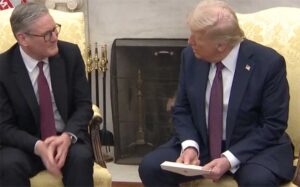
British officials have begun classifying sensitive trade documents as “secret” and “top secret” in a bid to shield key information from American counterparts, as relations between London and Washington strain under President Trump’s tariff war, Business Matters has learned.
The move marks a significant shift in internal government protocols, underscoring concerns over the potential misuse or interception of UK economic data during ongoing trade discussions with the US. Sources confirmed that updated guidance has been issued across departments involved in negotiating the UK’s post-Brexit trade relationships, with stricter rules on digital sharing and document access—particularly relating to sensitive sectors such as automotive and pharmaceuticals.
The shift comes as Trump’s White House continues to rattle global markets with sweeping tariffs on trading partners. The UK has been hit with 10% tariffs on all exports to the US and a punitive 25% rate on cars and steel, prompting mounting unease in Whitehall.
In a marked departure from the transparency seen during negotiations with the Biden administration, the UK’s Department for Business and Trade has elevated the classification of many documents. Previously labelled as “Official – sensitive (UK eyes only)”, many are now subject to restrictions typically reserved for high-level security materials.
A senior source close to the matter said: “The reclassification isn’t about severing ties with the US, but reflects the increased volatility and unpredictability of current US policy under Trump. With industries exposed to retaliatory tariffs, ministers and officials are being cautious about who sees what.”
Despite this, Downing Street has avoided direct confrontation. Prime Minister Keir Starmer has declined to retaliate against Trump’s trade actions, instead offering concessions in areas like digital taxation and agricultural standards, while continuing to prioritise a long-term trade deal with the US.
In a bid to smooth over tensions, US Vice President JD Vance said on Tuesday that a “great agreement” was still possible, and praised the cultural alignment between the two countries. “We’re certainly working very hard with Keir Starmer’s government,” Vance said. “There’s a real cultural affinity.”
Yet behind the scenes, many UK policymakers and business leaders are concerned about the broader implications of Trump’s “America First” strategy. The reclassification of trade documents is part of a broader tightening of security, with large UK-based multinationals—particularly pharmaceutical firms—being advised to adopt stricter communication protocols when interacting with government departments.
The developments reflect broader international apprehension. Reports from Brussels suggest the European Commission has begun issuing burner phones to staff visiting the US and is rethinking its document-handling policies to avoid American surveillance.
While the UK and US have traditionally enjoyed close ties—particularly in defence and intelligence, where shared material is often marked “UK/US only” or classified under the “Five Eyes” alliance—trade policy now appears to be diverging from that intimacy.
Trump’s aggressive tariff strategy is seen as a bid to reindustrialise key sectors of the US economy, including automotive and pharmaceutical manufacturing, often at the expense of long-standing allies. He has defended the moves, acknowledging the “transition costs” but insisting they are necessary for national renewal.
Meanwhile, the fallout continues. US tariffs on Chinese goods have soared to 145%, prompting retaliatory tariffs from Beijing of up to 125%. China has warned that it may resort to alternative countermeasures, and urged the EU to resist what it described as Trump’s “bullying”.
While Trump recently agreed to delay further tariffs on some nations for 90 days, the UK continues to face duties on core exports. The uncertainty is also contributing to instability in global financial markets, prompting questions about the long-term viability of traditional alliances in a shifting trade environment.
As Starmer’s government walks the tightrope between diplomacy and national interest, the reclassification of trade documentation marks a new era in Britain’s handling of sensitive negotiations—and signals that trust, even among allies, is no longer assumed.
Read more:
UK classifies trade documents as ‘secret’ to shield from US amid escalating Trump tariff tensions
Month: April 2025
Labour market data highlights urgent need for action on older workers, …

The government must show greater ambition and urgency in addressing the employment prospects of older workers if it hopes to meet its goal of an 80% employment rate, according to the 50+ Employment Taskforce.
Responding to the latest figures from the Office for National Statistics, which reveal a significant employment gap between younger and older workers, the Taskforce is calling on the government to adopt specific targets: raising the employment rate of 50–59-year-olds to 80%, and that of 60–66-year-olds to 55% over the next decade.
Current labour market data shows employment among 50–64-year-olds at 71.6%, trailing significantly behind the 85.7% rate for 35–49-year-olds. The employment gap between these age groups has widened post-pandemic to 14.1 percentage points, compared to 13.1 pre-2020. There are now nearly one million more older workers classed as economically inactive than before Covid-19.
The Taskforce – a coalition of leading organisations including the Centre for Ageing Better, the Learning and Work Institute, the Health Foundation and Age UK – warns that with the state pension age rising to 67 next year, around 900,000 people aged 50–66 who are unemployed or inactive but still keen to work risk being left behind. Reintegrating just half of this group could be enough to help the government meet its 80% employment target.
Dr Emily Andrews, Deputy Director for Work at the Centre for Ageing Better, said:
“We urgently need greater ambition from government to keep older people in the workforce. Many in their 60s are already facing severe financial pressure. Poverty among 60–64-year-olds is the highest of any adult group over 25, and the last time the pension age rose, poverty rates doubled for those on the brink of eligibility.”
The UK lags behind comparable nations when it comes to older worker employment. While employment rates for those aged 25–54 match other high-performing economies like Switzerland, the Netherlands and Iceland, the UK is 16 percentage points behind Iceland for 55–64-year-olds.
Christopher Rocks, lead economist at the Health Foundation, stressed that good work is essential not just for economic productivity, but also for health in later life.
“If the government wants to sustainably raise the State Pension age, it must support flexible, secure, and well-designed jobs that accommodate health needs and caregiving responsibilities,” he said.
Alice Martin of the Work Foundation at Lancaster University added that without structural changes, older workers risk being excluded from the labour market just when the economy needs them most.
“Rising pension ages and sector-wide labour shortages make it essential to support older workers. Millions risk being pushed out of the workforce unless we provide jobs that accommodate care, health and later-life realities.”
Patrick Thompson of Phoenix Insights pointed out the retirement savings gap: “Most people with defined contribution pensions are likely to retire with less than they need. Enabling older workers to stay employed longer is critical—not only for their future financial security, but also for their wellbeing today.”
Stephen Evans, Chief Executive of the Learning and Work Institute, said joined-up work, health and skills services were needed, along with changes to recruitment practices.
“Employers must look seriously at job design and support systems that allow older people to continue working. We must unlock the full potential of this experienced and skilled workforce.”
Caroline Abrahams, Charity Director at Age UK, reinforced that older workers face unique barriers—from health conditions and caring duties to pervasive ageism.
“We need urgent policy action to ensure that older people can either remain with current employers or find new, meaningful work. With the right support, we can unlock a huge, underused talent pool.”
The Taskforce has called for coordinated efforts from central and regional governments, employers and civil society to deliver policies that help older workers access good jobs, remain productive, and support the UK’s economic growth ambitions.
Read more:
Labour market data highlights urgent need for action on older workers, say leading think tanks
Rolls-Royce’s 1970s rescue offers a blueprint for British Steel’s …

A strategically vital British manufacturer teetering on the brink, thousands of jobs in jeopardy, and a government reluctant to intervene. It may sound like the story of British Steel in 2025—but more than fifty years ago, the same narrative played out with another great British name: Rolls-Royce.
In the early 1970s, the luxury car and aerospace firm—then one of Britain’s largest employers—was facing financial collapse, largely due to cost overruns on the RB211 engine contract with US aerospace firm Lockheed. Despite knowing that the project’s schedule and budget were unrealistic, the company pushed forward, encouraged by the then technology minister Tony Benn.
By early 1971, with development costs nearly double the original estimates and government support drying up, Rolls-Royce entered receivership. The Conservative government under Edward Heath, just months into office and ideologically opposed to state interference, was forced to act. It nationalised the engine-making part of the company to prevent the collapse of a business deemed essential to the UK’s defence, exports, and prestige.
Newspapers at the time praised the government’s pragmatism: “A new government has not been blooded until it has discovered that the national interest is more important than its own political preference or prestige.”
That sentiment rings true again today, as Sir Keir Starmer’s government takes emergency action to keep British Steel’s Scunthorpe plant running. But if ministers are looking for a precedent that shows nationalisation can work—if done with discipline and strategic foresight—they could do worse than study the Rolls-Royce playbook.
Heath’s rescue was not a doctrinaire nationalisation. Rolls-Royce (1971) was structured as a private company, slimmed down and positioned for re-privatisation. As Heath later reflected in his memoirs:
“The government’s actions had avoided a massive wave of redundancies, safeguarded our defence and international interests, and put the company on a secure long-term footing.”
Support even came from an unlikely ally—President Nixon. Aware of the implications for the global supply chain, he persuaded the US Congress to refinance the Lockheed contract, recognising the importance of preserving Anglo-American industrial cooperation.
A key part of the turnaround was the return of legendary engineer Sir Stanley Hooker, who revived the troubled RB211 engine project. Whether newly appointed interim executives Allan Bell and Lisa Coulson can replicate such a feat at British Steel remains to be seen.
Of course, the parallels have limits. Rolls-Royce in 1971 was a technological leader and a major defence supplier. British Steel, by contrast, has been plagued by years of underinvestment, volatile commodity pricing, and crippling energy costs—compounded now by President Trump’s aggressive tariffs on imported steel.
But the core question remains the same: when a strategically important industry is in freefall, can a targeted form of nationalisation stabilise and ultimately renew it?
There are reasons to be cautious. The Department for Business and Trade, now tasked with oversight, has little recent track record in managing nationalised assets beyond the smaller Sheffield Forgemasters, acquired in 2021 to protect naval supply chains. British Steel is a far more complex undertaking—larger, costlier, and more politically sensitive.
Energy costs remain one of the thorniest issues. Unless the government addresses the systemic pricing disadvantage faced by UK heavy industry compared to its European and global peers, any rescue risks being little more than a short-term fix.
Yet there is more than British Steel’s future riding on this decision. Calls are growing louder for other failing utilities—most notably Thames Water—to be brought into public ownership. If the British Steel intervention falters, the case for wider strategic nationalisations could be irreparably damaged.
The story of Rolls-Royce reminds us that nationalisation need not be a dead end. With a clear structure, skilled leadership, and international collaboration, a failing company can be turned around. The lesson for Starmer’s government is that the success of such interventions rests not on ideology, but execution.
Read more:
Rolls-Royce’s 1970s rescue offers a blueprint for British Steel’s survival
China accuses UK politicians of ‘arrogance’ amid British Steel own …

China has launched a scathing attack on British politicians, accusing them of “arrogance, ignorance and a twisted mindset” over criticism of British Steel’s Chinese owner, Jingye, and the firm’s recent threat to shut down its Scunthorpe blast furnaces.
In a strongly worded statement published on Wednesday, Beijing’s embassy in London condemned what it described as unfounded “slander” against both the Chinese government and Chinese businesses operating in the UK. The rare public rebuke follows remarks by UK business secretary Jonathan Reynolds, who accused Jingye of failing to act in good faith and placing thousands of British jobs at risk.
The dispute centres on the future of British Steel’s Scunthorpe site, where Jingye had warned it would close the blast furnaces — a move that would have cost 2,700 jobs. In response, the government stepped in over the weekend with emergency legislation to temporarily take control of the company and keep the site operational.
While the government’s intervention averted an immediate crisis, it has triggered a diplomatic flashpoint between the UK and China, threatening to undermine already strained relations at a time when the Labour government is actively courting foreign investment — including from Chinese businesses.
In an unusual question-and-answer post on its website, the Chinese embassy hit back at criticism from British politicians, stating: “The anti-China rhetoric of some individual British politicians is extremely absurd, reflecting their arrogance, ignorance and twisted mindset.”
Jingye, which rescued British Steel in 2020 after the collapse of its former owner Greybull Capital, has said it plans to close the outdated blast furnaces, arguing that the decision is commercially justified. The company had rejected a £500 million offer of government support to transition the site to more environmentally friendly electric arc furnace technology — a decision that inflamed political tensions.
Reynolds, in an interview on Sunday, voiced regret over previous governments’ openness to Chinese investment in critical sectors such as steel. “I wouldn’t personally bring a Chinese company into our steel sector,” he said, citing concerns over the influence of the Chinese state on nominally private businesses.
However, the Labour government’s stance on China remains ambivalent. Chancellor Rachel Reeves visited China in January to encourage investment, and Reynolds is scheduled to travel to the country later this year, despite his recent criticisms.
The embassy warned that such mixed messages and politicisation of commercial decisions could deter future Chinese investment. “Any words or deeds that politicise or maliciously hype up business issues will undermine the confidence of Chinese business investors in the UK and damage China-UK economic and trade cooperation,” it said.
It also contrasted the UK’s vocal criticism of China with what it described as a lack of opposition to US protectionism, referencing Donald Trump’s escalating tariffs on Chinese goods. “What on earth are they up to?” the embassy asked rhetorically.
Jingye maintains that it has already contributed significantly to the British economy by saving British Steel in 2020 and retaining thousands of jobs. It now insists the closure of the Scunthorpe blast furnaces is a “normal decision” made in the face of continued financial losses — over £350 million since the acquisition.
The situation underscores the broader dilemma facing the UK government: how to balance economic pragmatism with geopolitical caution in its dealings with China. As Britain reassesses its industrial strategy and seeks to decarbonise the steel industry, the question of who owns and operates critical infrastructure has never been more politically charged.
The Department for Business and Trade has been approached for comment. For now, the British Steel saga continues — not only as an industrial and economic issue, but increasingly as a diplomatic one too.
Read more:
China accuses UK politicians of ‘arrogance’ amid British Steel ownership row
Google faces £5bn UK lawsuit over claims it shut out rivals and overc …

Google is facing a landmark £5 billion legal challenge in the UK, accused of abusing its dominance in internet search to stifle competition and inflate the cost of advertising for businesses.
The class action lawsuit, filed on Tuesday at the Competition Appeal Tribunal, alleges that Google unlawfully shut out rival search engines and leveraged its market power to charge British businesses significantly more for digital ads than they would in a competitive market.
Brought by competition law expert Dr Or Brook on behalf of thousands of UK businesses, the claim centres on the tech giant’s alleged manipulation of the search ecosystem — including contracts with Android phone manufacturers and Apple — to cement its control over both search results and the highly lucrative advertising space that surrounds them.
The case accuses Google, part of US-based Alphabet Inc, of paying Apple billions to remain the default search engine on iPhones, while simultaneously requiring Android device makers to pre-install Google’s search app and Chrome browser as a condition of using its operating system. According to the filing, this dual strategy eliminated viable alternatives and forced advertisers to rely almost exclusively on Google’s platform.
“This is about fairness in digital markets,” said Brook. “Businesses in the UK have had little choice but to rely on Google Ads to be seen. In doing so, many have paid more than they should have in a truly open and competitive environment. Google has been leveraging its dominance in general search and search advertising to overcharge advertisers, harming businesses and ultimately consumers.”
Google has rejected the allegations, calling the case “speculative and opportunistic”.
A spokesperson for the company said: “Consumers and advertisers use Google because it is helpful, not because they have no choice. We will vigorously defend ourselves against this baseless claim.”
The legal challenge comes as the Competition and Markets Authority (CMA) continues its own investigation into Google’s search and advertising practices. That probe, launched in January, is looking into how Google’s search dominance — accounting for around 90 per cent of all UK internet searches — affects competition in digital markets.
The CMA has previously highlighted concerns over market distortion, with more than 200,000 British businesses currently relying on Google services to advertise online. Critics argue that the dominance of a single platform limits visibility and pricing transparency for advertisers, creating an uneven playing field.
Brook’s case echoes a wider global reckoning for Big Tech, as regulators in the US, EU, and UK step up scrutiny of dominant digital platforms and their impact on competition and innovation. It also signals a growing willingness in the UK to pursue large-scale collective actions on behalf of businesses harmed by anti-competitive behaviour.
If successful, the lawsuit could pave the way for thousands of British businesses — particularly small and medium-sized enterprises — to claim compensation for years of inflated advertising costs. The case will hinge on whether the tribunal agrees that Google’s conduct breached UK competition law and whether it led to measurable financial harm.
For now, the spotlight remains firmly on the search giant as regulators and courts weigh the balance of power in the digital economy. As Brook put it: “When a single company controls the gateway to online visibility, fairness becomes more than a principle — it becomes a legal imperative.”
Read more:
Google faces £5bn UK lawsuit over claims it shut out rivals and overcharged advertisers
China’s economy beats forecasts but faces looming tariff shock under …

China’s economy grew faster than expected in the first quarter of the year, with a 5.4 per cent expansion driven by robust industrial output and domestic consumption — a performance that economists warn may prove short-lived as US tariffs begin to bite.
The stronger-than-forecast GDP figures, released by Beijing on Tuesday, showed that the world’s second-largest economy continued to defy global headwinds in the January-March period. Analysts had expected 5.1 per cent growth, making the actual outturn a welcome surprise. However, it came just weeks before a 145 per cent US tariff on Chinese goods took effect, as President Donald Trump intensifies a trade war that many fear could trigger a wider global slowdown.
The quarterly growth figure matched that of the final quarter of 2024, suggesting China had maintained economic momentum despite persistent deflationary pressures and concerns over unemployment. A rush of exports ahead of tariff deadlines contributed to the resilience, as manufacturers expedited shipments to beat the US levies.
Retail sales — a key barometer of domestic consumption — rose 5.9 per cent year-on-year in March, accelerating from 4.8 per cent across January and February. Meanwhile, industrial output surged 7.7 per cent in March, up from 5.9 per cent in the first two months, as production ramped up in anticipation of new trade barriers.
“Before the tariff storms hit, China’s GDP growth likely eased but remained solid, thanks to the recovery in domestic demand,” said analysts at Societe Generale. “Overall, the GDP report should show that stimulus is working, but the support will not stop here with bigger tariff challenges ahead. The policy put is on.”
Still, there is growing concern that the pace of growth will slow through the remainder of 2025. UBS has downgraded its full-year GDP forecast for China to 3.4 per cent, down from 4 per cent, citing the impact of sustained US trade tariffs and the likelihood of further internal economic adjustments.
“We think the tariff shock poses unprecedented challenges to China’s exports and will set forth major adjustment in the domestic economy as well,” UBS economists said in a note to clients.
Beijing has already announced retaliatory measures on US imports, fuelling fears of a prolonged and destabilising tit-for-tat dispute between the world’s two largest economies. Economists warn that while short-term stimulus is cushioning the blow, sustained trade tension could stall China’s recovery and lead to a more subdued investment environment.
The Chinese government has set a GDP growth target of around 5 per cent for 2025, which now looks increasingly ambitious. Despite ongoing state support and efforts to bolster infrastructure and manufacturing, external pressures are mounting.
Persistent deflation has also become a concern, with falling producer prices suggesting weakening demand across key sectors. At the same time, youth unemployment remains elevated, further dampening consumer confidence and threatening broader economic stability.
“China has the policy tools to respond to shocks,” said one senior economist in Shanghai, “but the combination of global trade volatility, domestic demand fragility, and deflation means there’s no room for complacency.”
As the US election cycle heats up, with President Trump reaffirming his protectionist stance, few expect an immediate easing in tensions. For China, the road ahead is likely to require careful balancing of short-term stimulus with long-term structural reform — while bracing for whatever trade salvos Washington fires next.
Read more:
China’s economy beats forecasts but faces looming tariff shock under Trump
UK business confidence sinks to two-year low amid tax hikes and global …

UK business confidence has fallen to its lowest level in over two years, according to new data from the Institute of Chartered Accountants in England and Wales (ICAEW), as rising tax pressures and escalating global trade tensions take their toll on corporate sentiment.
In its latest quarterly survey of 1,000 chartered accountants, the ICAEW reported that its Business Confidence Index dropped to -3 for the first quarter of 2025—down from 0.2 in the final quarter of last year, and the weakest reading since late 2022. The findings reflect mounting anxiety over operating costs, slowing sales, and the economic fallout from President Donald Trump’s tariff-led trade war.
“These figures suggest that this year has so far been a pretty harrowing one for the UK economy,” said Suren Thiru, Economics Director at the ICAEW. “Accelerating anxiety over future sales performance, April’s eye-watering tax hike and US tariffs helped push business sentiment into ominous territory.”
The survey revealed a significant shift in business priorities, with 56 per cent of respondents citing rising taxes—particularly the increase in employer National Insurance contributions (NICs) introduced by Chancellor Rachel Reeves—as a growing concern. That marks the highest level of tax-related anxiety recorded since the survey began in 2004.
Reeves’s £40 billion tax-raising Autumn Budget, which came into force on 6 April, has fuelled fears that increased costs will curb investment, hiring and consumer confidence.
Trade tensions and policy uncertainty weigh on outlook
Businesses are also growing increasingly uneasy about the wider global context. Trump’s latest round of tariffs, introduced in March, have raised concerns that products destined for the US may be redirected to markets like the UK, undercutting domestic suppliers and denting exports. Analysts warn that such trade disruptions could drag UK GDP growth close to zero in the coming year, according to the National Institute of Economic and Social Research (NIESR).
Although the UK economy surprised on the upside in February with 0.5 per cent monthly growth, official data shows resilience in consumer and business spending despite the bleak outlook from forward-looking surveys. However, employment indicators are flashing red, with some surveys suggesting job losses at the fastest rate since the 2008 financial crisis—even though official labour market data has so far presented a more stable picture. The next set of jobs data is due on Tuesday, followed by inflation figures on Wednesday.
Businesses are also scaling back expectations for domestic growth, with sales forecasts now at their weakest since Q3 2022. This slowing momentum, combined with persistent cost pressures, is expected to intensify calls for the Bank of England to act. Many in the market now anticipate a rate cut on 8 May, despite inflation still hovering above the Bank’s 2 per cent target.
“The mood music on the economy is turning increasingly sour,” added Thiru. “With forward-looking indicators of sales and employment activity weakening, things may get worse before they get better.”
As businesses continue to grapple with rising overheads and external shocks, confidence will likely remain fragile—placing even greater importance on policy clarity, fiscal support and trade stability in the months ahead.
Read more:
UK business confidence sinks to two-year low amid tax hikes and global trade tensions
Carmakers rally as Trump hints at tariff relief for vehicle imports
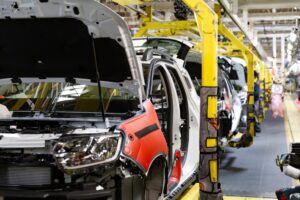
Shares in major car manufacturers around the world surged on Monday after President Trump signalled that he may offer temporary exemptions to the steep new tariffs imposed on imported vehicles and parts.
Speaking to reporters, Trump said he was “looking at something to help car companies”, noting that manufacturers needed “a little bit of time” to relocate production to the United States. While he gave no specifics on what product exclusions might be introduced, or for how long, the remarks were enough to lift investor confidence across the auto sector.
The president’s comments come just weeks after his administration announced a 25 per cent tariff on imported fully built vehicles, which came into effect on 3 April, with duties on imported car parts expected to follow by 3 May. Trump had initially insisted the measures would be permanent, with no carve-outs for foreign producers.
In Japan, shares in Toyota climbed by 3.7 per cent, while Honda rose by 3.6 per cent. European carmakers also enjoyed a boost: Stellantis rose by 5.6 per cent to €8.26, Volkswagen by 3.3 per cent to €90.26, and Mercedes-Benz added 2.9 per cent, reaching €50.70. French automotive supplier Valeo was up by 4.3 per cent.
In the UK, luxury carmaker Aston Martin Lagonda rose to the top of the FTSE 250, gaining 68¾p or 4.9 per cent in morning trading. The company, which does not manufacture in the US but counts America as nearly a third of its sales market, recently announced plans to raise £125 million to help navigate the impact of the tariffs.
The Society of Motor Manufacturers and Traders (SMMT) has warned that the US tariff regime poses a serious threat to Britain’s automotive exports. The US is the second-largest export market for UK-built cars, accounting for 16.9 per cent of vehicle exports last year—around 100,000 vehicles.
In response to the uncertainty, Jaguar Land Rover earlier this month paused all US-bound shipments for at least four weeks as it reassessed its strategy under the new trade conditions.
Although Trump’s remarks stopped short of confirming any formal policy shift, markets interpreted them as a softening of the previously hard-line stance. Any delay or exemption could offer a crucial window for manufacturers to adjust supply chains and production planning amid rising geopolitical and trade tension.
Industry leaders and investors will now be watching closely for further details on any proposed exclusions as the deadline for auto parts tariffs draws near.
Read more:
Carmakers rally as Trump hints at tariff relief for vehicle imports
Retailers call for crackdown on Chinese fast-fashion imports amid fear …

Britain’s leading retailers are calling on the government to urgently review import tax rules that allow ultra-cheap goods from Chinese e-commerce giants such as Shein and Temu to enter the UK duty-free—warning that the country could face a surge in low-cost imports rerouted from the US following the introduction of sweeping tariffs by President Trump.
Retailers including Sainsbury’s, Currys, and other major players in fashion, electronics, toys and homeware are said to have raised concerns directly with the British Retail Consortium (BRC), which is now lobbying ministers to scrap or reform the UK’s “de minimis” tax exemption.
Under current rules, goods imported from overseas and valued under £135 are not subject to import duties—a policy that allows fast-fashion and discount marketplaces to ship cheap items to UK consumers without incurring the same tax burdens as domestic retailers. In contrast, larger shipments or those above the £135 threshold can attract customs duties of up to 25 per cent.
Now, amid rising geopolitical tensions and following the US’s decision to remove its own de minimis exemption for low-value imports from China, Canada and Mexico, UK retailers fear that diverted stock originally intended for the American market could instead flood into the UK, undercutting domestic businesses and sidestepping product safety and ethical standards.
Helen Dickinson, Chief Executive of the BRC, said: “Retailers are very concerned that goods originally destined for the US may be redirected to the UK under existing low-value import rules. That brings up serious questions around product safety, consumer standards, and fair competition.”
The BRC held a meeting on Friday with representatives from several major UK retailers to discuss the implications of the US tariffs, and the growing threat of “product dumping”—the mass shipment of cheap goods to new markets—as Chinese suppliers look for alternative destinations for their stock.
The British Home Enhancement Trade Association has gone further, lobbying the government to lower the de minimis threshold from £135 to under £40 to protect UK businesses and consumers.
Dickinson added: “A lot of goods coming in under the current rules aren’t necessarily held to the same product safety, ethical, or environmental standards that UK consumers expect. The government now has a real opportunity to modernise our trade rules and ensure a level playing field.”
Retailers argue that reform is needed to not only uphold consumer safety and sustainability but to support fair competition as UK high streets continue to recover from inflationary pressures and changing consumer habits.
The issue has also raised questions around the future of Shein, which is said to be considering a UK IPO. Analysts suggest that removing the de minimis exemption could be a major blow to its low-cost business model in Britain.
In response, a Shein spokeswoman said: “Shein’s success comes from our ability to produce fashionable products efficiently through an on-demand business model and flexible supply chain. This reduces waste and allows us to pass savings on to our customers. Our growth is not driven by tax exemptions. We are committed to working with policy makers and peers to review and improve current frameworks.”
Temu and Sainsbury’s declined to comment.
Read more:
Retailers call for crackdown on Chinese fast-fashion imports amid fears of market flooding

