
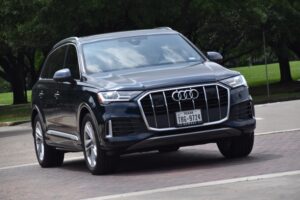
Volkswagen has taken the dramatic step of halting all vehicle imports into the US, as the world’s second-largest carmaker grapples with the fallout from President Donald Trump’s sweeping 25% tariff on foreign-made cars.
Thousands of vehicles — including many from its luxury brand Audi — are currently being held at American ports, caught in limbo after arriving on the same day Trump’s tariff announcement was made. The German giant has since paused all US-bound shipments and is weighing up its next steps, as auto industry leaders scramble to assess the impact of the escalating trade tensions.
Executives at VW are reportedly hoping for either a policy reversal or the opportunity to negotiate more favourable terms. In the meantime, the company said it will begin including a new “import fee” on affected models, which will be listed alongside existing charges such as VAT, delivery costs, and extras like heated seats or panoramic roofs.
The announcement underscores the growing disruption to global automotive supply chains — with Audi particularly vulnerable. Its top-selling Q5 SUV is assembled in Mexico, while most of the brand’s other models are shipped from Europe, placing nearly its entire line-up squarely in the tariff’s crosshairs.
Speaking at the company’s headquarters in Wolfsburg last month, Volkswagen CEO Oliver Blume addressed the mounting uncertainty. In a statement to DailyMail.com, the firm said: “We share the assessment of most experts that US tariffs and any counter-tariffs will have negative consequences for growth and prosperity in the US and other economic areas.”
Although no immediate showroom shortages are expected — Volkswagen has 37,000 vehicles in US inventory, which should last dealers around two months — the company warned of potential disruption ahead if the standoff continues.
“The entire automotive industry, global supply chains and customers will bear the negative consequences,” a spokesperson added, noting that VW has invested over $14 billion in US production facilities, including its Chattanooga, Tennessee plant, which builds the Atlas, Atlas Cross, and electric ID.4 models.
Despite this local footprint, VW remains heavily reliant on imported vehicles. That exposure places it among the most at-risk carmakers as the Trump administration intensifies its protectionist trade stance.
Insiders say communication with dealers is ongoing. “We want to be transparent about navigating this period of uncertainty,” said a VW source. “Our messaging can change daily based on circumstances, but our focus remains on supporting our dealer network and customers.”
The move follows similar steps by rival manufacturers. Jaguar Land Rover has also paused US-bound shipments, while Stellantis — owner of Jeep, Dodge, and Chrysler — has furloughed 900 staff and paused production at several plants. Ford is attempting to offset losses by offering discounts, and GM is accelerating US production of its high-margin trucks.
Toyota and Mercedes-Benz have so far resisted price changes, but analysts warn that industry-wide adjustments are inevitable if tariffs remain in place.
President Trump, defending his stance, has insisted that the tariffs are intended to pressure foreign carmakers to manufacture more vehicles in the US. “They charge us 39 percent, we’re going to charge 20 percent,” he said of European tariffs. “So we’re charging them essentially half.”
However, trade experts have questioned those figures. According to the World Trade Organisation, the average EU tariff on US products stands at just 4.8%. In 2023, the bloc reportedly collected $3 billion in tariffs on US goods, compared to $7 billion collected by America.
As the situation evolves, manufacturers, dealers and consumers alike are bracing for a turbulent second quarter, with the global automotive industry once again caught in the crossfire of geopolitical policy shifts.
Read more:
Volkswagen halts all US car imports as tariffs spark industry-wide turmoil
Month: April 2025
Farmers hope for rain as dry spell stalls spring crops across the sout …

While many have been soaking up the spring sunshine, farmers across southern England are facing growing concern over the impact of an extended dry spell on their crops.
With little rain forecast in the coming days, many fields are struggling, as crops sown earlier this spring fail to germinate in increasingly parched soil. For farmers like Colin Rayner, who runs Stubbings Farm in Maidenhead, the situation is already having a serious effect on yield potential.
Rayner said the spring barley he planted several weeks ago has “hardly germinated”, leaving him hoping for rain by the weekend. “We had a very wet winter,” he told BBC Radio Berkshire. “I think we had 90 days of rain from November to the end of February. Then it just stopped.”
“The ground’s dried out very quickly. We’ve had cold temperatures but then very hot lunchtimes,” he added. “In the morning, I’ve got two jumpers on and by lunchtime I’ve got my shorts and T-shirt on. By 3pm, the jumper’s back on again.”
Rayner, who has been farming for 50 years, says the weather has changed “dramatically” in that time. “We seem to get periods of extreme wet and then periods of extreme hot and dry.”
His concerns are echoed across the region. In Newbury, farmer George Brown is also battling uneven crop development. “A lot of the crops that were planted early are coming through, but we’ve got large chunks – especially on top of the hills – where it’s absolutely barren. They’re just sitting there, waiting in rows to germinate,” he said.
Last autumn, many farmers were unable to plant winter crops at all due to persistent rainfall and waterlogged fields. Now, the challenge has flipped, with rapidly drying ground and limited rainfall putting spring sowings at risk.
Dr Paola Tosi, an expert in crop science at the University of Reading, said the shift in seasonal patterns is making farm planning increasingly difficult. “Agriculture really depends on seasonal weather patterns, and those have clearly changed a lot,” she said. “It’s very difficult for farmers to decide what to drill and where to plant their crops.”
However, she pointed out that improvements in mid-range forecasting are offering growers more flexibility. “Farmers can increasingly adjust their plans as forecasts improve – but that doesn’t help when the weather extremes are so unpredictable.”
With margins tight and planting windows narrow, farmers say they are increasingly reliant on favourable weather patterns – and right now, many are simply praying for rain.
Read more:
Farmers hope for rain as dry spell stalls spring crops across the south
Starmer eases green rules to shield UK carmakers from Trump tariffs

Prime Minister Sir Keir Starmer has announced a relaxation of key green policies in a bid to shield the UK automotive industry from the impact of President Donald Trump’s 25% tariffs on car exports to the United States.
Delivering his first formal response to the tariffs during a visit to the West Midlands, Starmer will say that British industry must accept that “the world has fundamentally changed” and adapt accordingly. He warned that the tariffs, part of Trump’s wider “Liberation Day” trade strategy, were “not a phase” and would require urgent long-term action.
One of the most significant changes is a relaxation of the UK’s Zero Emissions Vehicle (ZEV) mandate. The fine for non-compliance will be reduced from £15,000 to £12,000 per car, easing the burden on manufacturers already grappling with export barriers and inflationary pressures.
Under the current ZEV framework, 28% of all new cars sold in the UK this year must be electric, rising to 80% by 2030 and 100% by 2035. But Starmer confirmed that hybrid vehicles — including non-plug-in models — will be permitted until 2035, pushing back Labour’s previous commitment to end the sale of all new combustion engine vehicles by 2030.
Manufacturers will also be allowed more flexibility in how they meet annual EV targets. Instead of incurring fines or buying credits from fully electric competitors like Tesla or China’s BYD, they will now be able to “bank” and “borrow” EV sales across multiple years until 2030 to meet compliance requirements.
“No British-based manufacturers should have to pay a fine — or pay foreign firms for EV credits,” Starmer said.
The changes come amid increasing concern from the UK car industry. Jaguar Land Rover (JLR) announced over over the weekend that they had suspended vehicle exports to the US, citing the severe impact of Trump’s 25% auto tariff. With over 9,000 staff employed at its Solihull plant alone, the implications for the regional and national economy are considerable.
To encourage EV adoption and reassure consumers, Starmer confirmed £2.3 billion in tax incentives and investment in charging infrastructure.
“One public charging point pops up every half an hour,” he wrote in an op-ed, aiming to counter concerns about the higher upfront cost of electric vehicles.
According to the Society of Motor Manufacturers and Traders (SMMT), EV sales in March rose by 43% year-on-year, totalling 69,313 new electric cars sold. But the charging industry has warned that policy instability could put the brakes on further progress.
Vicky Read, CEO of ChargeUK, welcomed confirmation of the 2030 petrol and diesel ban but criticised what she described as “back door amendments” to the ZEV mandate.
“The ZEV mandate has been weakened, creating uncertainty for investment in EV charging infrastructure,” she said, adding;“Without supportive measures, we risk confining the UK to the slow lane.”
Read reiterated the sector’s pledge to invest £6 billion in UK charging infrastructure by 2030, but warned that confidence depended on regulatory clarity.
Meanwhile, Chancellor Rachel Reeves is expected to intensify international trade talks this week, including discussions with Indian ministers on a long-anticipated trade deal. A new agreement with Australia is also in the pipeline.
Tensions between London and Washington remain unresolved. While Starmer has not spoken to President Trump since the tariffs were announced, the Prime Minister dismissed the US leader’s claim that the UK was “very happy” with the baseline 10% tariff.
“Nobody is pretending that tariffs are good news,” Starmer said bluntly.
On Sunday, Starmer held calls with Canadian Prime Minister Mark Carney, European Commission President Ursula von der Leyen, and German leaders Olaf Scholz and Friedrich Merz, stressing the need for coordinated diplomacy to stabilise global trade.
Despite early signs of internal division in Washington — with Commerce Secretary Howard Lutnick defending even the tariffs on uninhabited islands, and Elon Musk, now part of Trump’s government efficiency department, calling for zero tariffs — Starmer has made clear that his trade strategy will be governed by national interest, not political spectacle.
“I will only sign deals, with the US or anyone else, that are in our national interests,” he said.
As the dust settles on the latest volley in the global trade war, the Prime Minister’s recalibrated green strategy seeks to balance environmental ambition with industrial pragmatism, ensuring that Britain’s transition to electric vehicles is both commercially viable and globally competitive.
Read more:
Starmer eases green rules to shield UK carmakers from Trump tariffs
US threatens to double tax rates on UK firms under obscure 91-year-old …
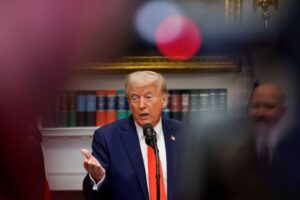
The Trump administration is preparing to escalate its trade dispute with the UK by considering the use of a 91-year-old tax rule that would double tax rates on British firms operating in the United States — a move that experts warn could have a more severe impact than tariffs.
Known as Section 891 of the US Internal Revenue Code, the rule was introduced in 1934 and gives the president sweeping powers to raise taxes on US subsidiaries of foreign companies if their home governments are deemed to be discriminating against American businesses.
Though never before used, the Trump administration is now actively exploring the measure. On the first day of his second term, President Trump ordered officials to investigate which countries impose “discriminatory” taxes on US firms. That review has now been completed — and the UK is believed to be among the nations on the list, along with other OECD countries.
The warning comes just a week after the White House triggered a global trade shock with the announcement of up to 49% tariffs on dozens of countries, including a 10% blanket tariff on British goods. But tax specialists say the next front in the trade war could be even more damaging.
“That’s the next battle in the [trade] war, and potentially affects the UK much more than the tariffs,” said Tim Sarson, head of tax policy at KPMG UK. “We’re a services economy and this obviously affects service transactions as well.”
At the heart of the White House’s concerns are UK tax policies perceived to unfairly target American firms, particularly large tech companies. The UK’s Digital Services Tax, introduced in 2020, levies a 2% tax on UK revenues of tech firms generating more than £500 million globally. Many of the biggest firms caught by the tax are US-based.
Also under scrutiny is the UK’s undertaxed profits rule, part of the global OECD tax framework. This allows HMRC to apply a “top-up” tax on companies based in low-tax jurisdictions — including some US states — if they fall below the global 15% minimum tax rate.
In addition, the UK’s Diverted Profits Tax — often referred to as the “Google Tax”, introduced under former chancellor George Osborne — is seen as another sticking point. The measure targets firms that shift profits to low-tax countries despite having significant operations in the UK.
One senior US tax adviser with knowledge of the administration’s discussions said: “If any country was going to end up on the list, it was going to be the UK.”
The administration is also considering an additional measure — Section 899 — which would raise taxes incrementally by 5% each year, rather than doubling the rate immediately. While this is seen as less dramatic, its cumulative impact would still be significant for foreign firms operating in the US.
However, there remains legal uncertainty about whether these measures can be enforced unilaterally. The UK and US have existing tax treaties and trade arrangements that could override Sections 891 and 899. These agreements may offer protections against sudden increases in tax rates, though this could ultimately become a matter of legal interpretation and international diplomacy.
For UK-based businesses with substantial US operations — particularly in technology, finance and professional services — the threat of punitive taxation adds a fresh layer of uncertainty at a time when markets are already rattled by tariffs and rising geopolitical tensions.
If invoked, Section 891 would mark a significant escalation in the UK–US economic relationship, shifting the focus from goods trade to cross-border taxation of services and intellectual property.
As the situation evolves, business leaders and trade associations are likely to press the UK government to engage with Washington diplomatically — not only to avoid retaliatory taxes but to uphold investor confidence in UK firms operating abroad.
Read more:
US threatens to double tax rates on UK firms under obscure 91-year-old rule
iPhone prices could triple under Trump’s tariffs as Apple faces Chin …

The cost of an iPhone could more than triple in the US market following President Donald Trump’s sweeping new trade tariffs, analysts have warned — a move likely to reverberate through global supply chains and consumer tech markets.
Apple, which assembles the vast majority of its devices in China, now faces a staggering 54% tariff on Chinese imports under Trump’s newly announced ‘Liberation Day’ tariff strategy. The price of producing the next-generation iPhone 16 Pro could rise from $580 to $850, according to TechInsights analyst Wayne Lam.
In turn, Wedbush Securities analyst Dan Ives estimates that the retail price of a 256GB iPhone 16 Pro could soar from $1,100 to as much as $3,500, if Apple passes those costs directly on to consumers.
Trump’s protectionist policy aims to reshore manufacturing to the United States by making foreign-made goods significantly more expensive. However, industry experts argue that Apple lacks a commercially viable path to US-based production, particularly at scale.
“It’s not clear you can make a competitively priced smartphone here,” said Barton Crockett, senior analyst at Rosenblatt Securities, speaking to The Wall Street Journal.
Currently, assembling an iPhone in China costs Apple about $30 per unit — a cost that would be expected to increase tenfold if shifted to the US, Lam noted.
Apple declined to comment on the potential impact of the new tariffs, or whether it plans to raise prices or restructure its supply chain in response.
Trump’s ‘Liberation Day’ declaration framed foreign trade practices as a national emergency, and introduced a new baseline of 10% tariffs on all imports to the US, effective from this Saturday.
In addition, more than 90 countries — including traditional US allies — are facing bespoke ‘reciprocal tariffs’, designed to eliminate bilateral trade deficits. These rates are calculated individually and are significantly higher for countries with larger US trade surpluses, such as China, Germany, and Vietnam.
In response, China has announced a 34% retaliatory tariff on all American imports, effective 10 April — mirroring the rate imposed on its own goods by the Trump administration. The move escalates the brewing trade tensions between the world’s two largest economies.
“China’s new tariffs stop short of full-blown trade war, but they mark a clear escalation,” said Craig Singleton, senior China fellow at the Foundation for Defense of Democracies.
“They match Trump blow-for-blow and signal that Xi Jinping won’t sit back under pressure.”
Trump’s trade stance is already rattling markets and raising serious concerns among global technology firms, who rely heavily on international supply chains for production and distribution. Apple, one of the most exposed companies in this conflict, is under mounting pressure to evaluate its long-term supply strategy — but experts say relocating its hardware production to the US is not feasible in the near term.
The tariffs come at a time of intensifying geopolitical and economic friction, and further strain an already delicate trade relationship between Washington and Beijing. Analysts warn that a prolonged standoff could trigger inflationary pressures, reduced global demand, and slower economic growth, while undermining investor confidence.
“The longer this drags, the harder it becomes for either side to deescalate without losing face,” Singleton noted.
Read more:
iPhone prices could triple under Trump’s tariffs as Apple faces China tax blow
Wrexham’s Hollywood owners seek new investors to back Premier League …

The Hollywood owners of Wrexham AFC, Ryan Reynolds and Rob McElhenney, are on the hunt for new investors as they continue their ambitious push to take the North Wales football club into the Premier League.
Despite on-pitch success and soaring international interest — fuelled in part by the hit docuseries Welcome to Wrexham — the club remains a loss-making venture for its celebrity co-chairmen. The pair, who acquired the club in 2021, have now opened the door to additional backers willing to inject capital in exchange for a shareholding, as they eye further promotions.
The League One club is currently well-positioned for a move into the Championship, and the owners have made no secret of their desire to eventually compete with top-flight giants such as Manchester City, Liverpool and Chelsea.
Their stewardship has already transformed Wrexham’s fortunes. Since the takeover, the club has secured two successive promotions, rebuilt its global brand, and dramatically increased revenues — particularly from sponsorship and international fan engagement.
In the 2022/23 season, Wrexham generated £26 million in revenue, up from £10 million the previous year. Sponsorship and advertising income alone rose from £2 million to £13 million, with more than half of total turnover now coming from overseas markets.
However, costs have risen sharply too. The club’s wage bill increased to £11 million, up from £7 million, contributing to a £2.7 million loss last year, following a £5 million loss the year before.
Recognising the challenge of sustaining growth in lower-league football, Reynolds and McElhenney took their first step towards external funding in October 2023, when they sold a minority stake to the Allyn family of New York, best known for their former ownership of the medical device firm Welch Allyn.
Now, the door is open for “further partners” to join the ownership group and help propel Wrexham further up the football pyramid.
McElhenney, who first had the idea of buying a club during the pandemic, previously said he was drawn to Wrexham because it reminded him of his working-class hometown of Philadelphia. His aim was to “bring hope” to the town by reinvigorating the club, and he persuaded Reynolds, star of Deadpool, to join the project.
Their investment has already yielded results, both financially and in global recognition. The club’s international following has grown exponentially, thanks to the Welcome to Wrexham series and the novelty of celebrity ownership. The story has captured the imagination of fans across the US and beyond, turning Wrexham into a global football brand — albeit one still climbing the professional tiers.
Wrexham AFC declined to comment further on the investor search, but sources suggest that any new backers would need to align with the club’s long-term vision and demonstrate a commitment to community-driven values as well as commercial growth.
For would-be investors, it may be a unique opportunity: a chance to gain equity in a rapidly rising club, rub shoulders with Hollywood royalty, and play a part in one of the most remarkable business turnarounds in British sport.
Read more:
Wrexham’s Hollywood owners seek new investors to back Premier League dream
Jaguar Land Rover halts US shipments as Trump’s tariffs bite placing …

Jaguar Land Rover has announced a temporary pause on all vehicle shipments to the United States, as the British carmaker scrambles to navigate the new trading terms imposed under President Donald Trump’s global tariff regime.
The company confirmed it is taking short-term action in April while it works with business partners to assess the impact of the tariffs and formulate mid- to long-term plans. The decision follows the US imposition of a 25% levy on foreign-made cars, which came into effect on Thursday, alongside a baseline 10% tariff on all imported goods, rolled out globally from Saturday.
“The USA is an important market for JLR’s luxury brands,” the company said in a statement. “As we work to address the new trading terms with our business partners, we are taking some short-term actions including a shipment pause in April.”
The move has raised alarm in the UK automotive sector, particularly in Solihull, home to one of JLR’s five manufacturing plants, employing over 9,000 workers. The town has been a historic hub for British automotive engineering, but Trump’s tariffs have cast uncertainty over its economic future.
Robert Mills, a former automotive consultant and long-time Solihull resident, fears the tariffs could decimate local employment.
“I’m appalled. It will kill Jaguar Land Rover here in the town,” he said. “There could potentially be job losses because JLR export enormously to America. The knock-on effect is going to be enormous.”
Trump’s policy shift has stunned markets, with global equities sliding and major indices posting their worst day of trading since the pandemic. The FTSE 100 closed down 4.95% on Friday, wiping nearly 420 points in a single session, while Wall Street’s Dow Jones plunged 5.5%. The tariff package includes a 20% levy on EU goods and 34% on Chinese imports, prompting Beijing to retaliate with matching tariffs on US products starting 10 April.
The UK automotive industry, already under strain due to slowing domestic demand and the transition to electric vehicles, is expected to suffer considerably. Mike Hawes, chief executive of the Society of Motor Manufacturers and Traders (SMMT), said: “The industry is already facing multiple headwinds and this announcement comes at the worst possible time.”
In 2023, UK car production slumped by 13.9% to 779,584 vehicles, with over 77% of that output destined for export. The US is Britain’s single largest market for vehicle exports, with an estimated £8.3 billion worth of cars shipped across the Atlantic in the 12 months to September 2024.
To soften the immediate blow, UK carmakers had reportedly stockpiled vehicles in the US prior to the tariffs taking effect. But Jaguar Land Rover, which does not manufacture any vehicles in the US, is particularly exposed. A report from GlobalData confirms it is the most at-risk car brand in the American market due to its full reliance on overseas production.
Tony Rhea, 77, a retired electrical engineer who spent decades working with Land Rover, said the effects of a prolonged export disruption would ripple through the local economy.
“Everyone is affected. Right down to the cafe where they eat, the people who wash their overalls and even the people that maintain the robots — that’s all local.”
Prime Minister Keir Starmer has so far resisted retaliating against Trump’s tariffs, stating that the UK will “calmly continue with our preparatory work” and seek a deal that protects British interests. However, the government has set a 1 May deadline for consultations on possible reciprocal measures, warning that “all options are on the table”.
Trump, however, struck a different tone, bizarrely claiming that Starmer was “very happy” with the tariffs and maintaining that “the markets are going to boom”. He added: “They’ve taken advantage of us for many, many years. I think it’s going to be unbelievable.”
Economists disagree. The Office for Budget Responsibility has already cut its UK growth forecast from 2% to 1%, not including the effects of the tariff shock. Thomas Pugh, economist at RSM UK, warned that Britain faces “another year of stagnation at best,” noting the likely impact on interest rates and fiscal flexibility.
“We wouldn’t go as far as to say this has wiped out the £10 billion Rachel Reeves just rebuilt, but it’s probably not far off.”
The full fallout remains to be seen, but with UK exports to the US valued at over £60 billion annually, and estimates suggesting that up to 70% of those exports could be affected, the pressure on Downing Street to act is growing.
As global leaders, including the prime ministers of Australia and Italy, express shared concern over a looming trade war, Starmer is expected to spend the weekend holding calls with counterparts to coordinate a response.
Read more:
Jaguar Land Rover halts US shipments as Trump’s tariffs bite placing 9,000 jobs at risk
Trump extends TikTok sale deadline amid ongoing talks with buyers and …
US President Donald Trump has announced a 75-day extension to the deadline for TikTok’s sale or divestment, postponing a potential ban of the social media platform in the United States.
The move, confirmed via a statement on Truth Social, marks the second time the president has delayed enforcement of legislation passed by Congress last year that mandates TikTok’s Chinese owner ByteDance to sell its US operations or face a ban. “The TikTok deal requires more work to ensure all necessary approvals are signed,” Trump posted on Friday.
The original deadline for a ban or forced sale was 19 January, but it was initially postponed to 5 April through an executive order signed by Trump on his first day back in office. The new extension means the deadline will now fall in mid-June.
TikTok, which has 170 million users in the US, has drawn intense scrutiny from lawmakers over concerns about data security and potential manipulation by its Chinese parent company. While negotiations are ongoing, ByteDance reiterated that no agreement has been finalised and that any potential transaction remains subject to Chinese government approval. “ByteDance has been in discussion with the U.S. Government regarding a potential solution for TikTok U.S. An agreement has not been executed. There are key matters to be resolved,” the company said in a statement.
Several high-profile bidders are said to be in the running to acquire TikTok’s US operations. Among them are a consortium led by Oracle, retail giants Amazon and Walmart, asset manager Blackstone, billionaire Frank McCourt, a crypto foundation, and even the founder of adult site OnlyFans.
Despite the mounting interest, ByteDance has consistently argued that divesting TikTok is unfeasible, citing legal, commercial and technological challenges. In previous court filings, the company described a forced sale as “simply not possible”.
The political dynamics of the potential sale are also being shaped by broader trade tensions. Just days after unveiling sweeping tariffs on 60 countries, Trump hinted that tariff relief for China — now facing a 54% tariff on goods exported to the US — might be leveraged in negotiations over TikTok’s future. “We have a situation with TikTok where China will probably say we’ll approve a deal, but will you do something on the tariffs,” Trump said aboard Air Force One. “The tariffs give us great power to negotiate.”
In his follow-up statement on Friday, the president struck a more conciliatory tone, saying: “We hope to continue working in Good Faith with China, who I understand are not very happy about our Reciprocal Tariffs. We do not want TikTok to ‘go dark.’ We look forward to working with TikTok and China to close the Deal.”
While the future of TikTok in the US remains uncertain, the platform’s value as a social media and e-commerce powerhouse, combined with its highly coveted algorithm, continues to attract strong interest from corporate bidders and investors alike.
A final decision is now expected by mid-June, setting the stage for a potentially high-stakes geopolitical and commercial showdown over one of the most influential apps in the world.
Read more:
Trump extends TikTok sale deadline amid ongoing talks with buyers and China
‘Everyone is affected’: Solihull reacts to Trump’s 25% tariff on …

From rugged mountains to urban streets, Land Rovers are a familiar sight across the world. But for decades, many of those iconic vehicles bore the name of Solihull, the West Midlands town that has long been central to the UK’s car manufacturing heritage.
Now, Jaguar Land Rover’s flagship Solihull plant, which employs more than 9,000 workers, finds itself at the centre of a global trade dispute after US President Donald Trump imposed a 25% tariff on UK car exports to the United States.
The announcement — made on what Trump branded “Liberation Day” — forms part of a sweeping round of tariffs hitting 60 countries. For Solihull, the consequences could be far-reaching.
“I’m appalled. It will kill Jaguar Land Rover here in the town,” said Robert Mills, 70, a former automotive consultant. “There could potentially be job losses because JLR export enormously to America. The knock-on effect is going to be enormous.”
The West Midlands was once synonymous with Britain’s industrial might, particularly in automotive manufacturing. Mills recalls a time when the region was criss-crossed with supply chains and component factories.
“When I left school, you couldn’t go around the West Midlands without stumbling across either the supply chain or a manufacturing plant,” he said. Now, he fears the area could suffer a second wave of industrial decline.
Mills believes Trump’s strategy is based on a misplaced confidence that the US can simply re-establish its own car part production.
“Trump may think he can manufacture all the parts again in America. But I’ve seen the closed factories around Detroit. They’re not there. It’s all gone.”
Despite Prime Minister Keir Starmer’s recent efforts to strengthen diplomatic ties — including offering Trump a second state visit — the US has gone ahead with broad tariffs, imposing a blanket 10% duty on all UK goods, but a significantly higher 25% rate specifically on UK-made cars. This contrasts with 20% tariffs on the EU, 34% on China, and a steep 46% on Vietnam.
“Negotiation. Try and reason with an unreasonable man,” Mills offered as advice for the government — though other locals are sceptical that Trump’s position can be swayed.
“I don’t think anyone’s going to be able to persuade him either way,” said Lynda Rhea, 75, who watched Canada’s more defiant stance against the US president unfold in recent weeks.
“The Canadians stood up to him a bit, didn’t they? Is it a good thing to stand up to him? Or is it best to just sit back and wait?”
Her husband, Tony Rhea, 77, who spent his career as an electrical mechanical engineer at JLR, sees the wider picture.
“Everyone is affected. Right down to the cafe where they eat, the people who wash their overalls, and even the people that maintain the robots — that’s all local.”
The sudden nature of the tariffs has added to the anxiety in the town.
“This has come out of the blue,” said Thomas Newman, 86. “If we had five or 10 years then we could have probably planned better, but it’s immediate.”
While he disagrees with the tariffs, Newman does understand the domestic political appeal for the US president.
“I can understand his concern for the American public, but I think it’s going to cause a lot of problems in the stock market and in employment around the world.”
The broader context for Britain’s carmakers is already challenging. In 2024, UK car production fell to its lowest level in 70 years, excluding the pandemic period, due to a combination of weak demand and the global shift toward electric vehicles. Meanwhile, China now commands 76% of the global EV market, with lower-priced vehicles making it increasingly difficult for UK firms to compete.
Newman believes the UK government must do more to support domestic automotive businesses in the face of both international tariffs and stiff global competition.
“We’ve got to give concessions to the UK automotive industry to make it more attractive than the American industry. Chinese electric vehicles can be bought for half the price. We’ve got to be making something that the rest of the world really wants.”
As Solihull grapples with the fallout from Trump’s tariff announcement, the mood is one of concern but not resignation. For a town where the car industry still defines livelihoods, the hope is that clear policy and strong negotiation can protect its economic future — before the engine stops running altogether.
Read more:
‘Everyone is affected’: Solihull reacts to Trump’s 25% tariff on UK car exports

