

Aston Martin is set to restart car exports to the United States next week after a three-month pause triggered by President Trump’s shock “liberation day” tariffs, with its chief executive warning that political inconsistency is wreaking havoc across the automotive industry.
Adrian Hallmark, who took over as CEO of the London-listed luxury carmaker earlier this year, confirmed the company would resume shipments to its crucial US market after the UK and US agreed a revised trade deal that locks in a 10 per cent tariff rate. While this is still four times higher than the pre-tariff level of 2.5 per cent, it provides certainty that was missing under the looming threat of 27.5 per cent duties.
“We anticipated a period of turmoil and shipped extra stock in Q1,” Hallmark told delegates at the Society of Motor Manufacturers and Traders (SMMT) conference. “Now, with the deal done, we can invoice built-up inventory. Demand has remained strong.”
The temporary halt in US shipments — a market that accounts for a significant share of Aston Martin’s sales — was a calculated risk, Hallmark said, likening it to “losing a third of your salary for three months. Not catastrophic, but slightly uncomfortable.”
The trade agreement, due to take effect on Monday, eases pressure on Aston Martin after months of uncertainty. Shares in the company, which had slumped to a record low of under 60p following the tariff threats in April, have since rallied by more than a third. They closed down slightly on Tuesday at 80p.
Hallmark, who was poached from Bentley last year to lead a turnaround of the debt-laden and lossmaking British marque, has won early backing from investors for his strategic approach. But speaking in London, he warned that long-term business planning is increasingly at the mercy of political inconsistency and regulatory fragmentation across global markets.
“Post-Covid, we were hoping for a return to normal. What we’ve seen instead is reverse globalisation and rapid market fragmentation,” he said. “We’re facing diverging emissions rules, safety standards, and tech regulations — China has its own, the US has another, and Europe has a third.”
He stressed that while major car manufacturers may have the resources to juggle differing standards, smaller companies like Aston Martin face disproportionate costs in adapting their vehicles to meet multiple, shifting compliance regimes.
Closer to home, Hallmark singled out the UK government’s shifting policies on vehicle emissions as a prime example of how inconsistency can derail long-term investment.
“We’ve had ICE bans for 2030, then 2035, back to 2030 again — then hybrids allowed, and now the zero-emissions mandate. These changes happened within two years. Our product development cycle is five,” he said.
Hallmark’s remarks come as Aston Martin continues its push to transform the brand’s fortunes with a new range of electrified vehicles. The company has committed to launching its first fully electric car in 2026, but its broader plans — and those of the UK automotive sector more widely — depend on a stable regulatory and trading environment.
Aston Martin’s resumption of transatlantic exports offers a short-term win, but the wider message from Hallmark was clear: if Britain wants to remain a hub for high-value car manufacturing, politicians at home and abroad must offer clarity, consistency and a long-term vision that businesses can plan around.
Read more:
Aston Martin resumes US exports after Trump tariffs lifted
Month: June 2025
Skoda overtakes Tesla in Europe as EV buyers turn to cheaper alternati …
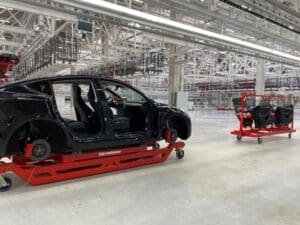
Tesla has been knocked off its perch in the European electric vehicle (EV) market, with Skoda outselling the US giant in May amid growing consumer demand for more affordable alternatives and a backlash against Elon Musk.
According to market researchers at DataForce, the Czech carmaker — long the butt of automotive jokes but now a serious contender under Volkswagen ownership — sold 14,920 electric cars across Europe last month, eclipsing Tesla’s 14,055.
Much of Skoda’s success was fuelled by strong demand for its new all-electric Elroq SUV, which starts at £31,000 and accounted for 9,250 of those sales.
Tesla’s slump — a 28% year-on-year drop — marks the fifth consecutive month of declining European sales. Industry analysts say the fall comes amid growing protests over Musk’s political alignment with President Trump, which has alienated some European buyers.
Separate data from the European Automobile Manufacturers’ Association shows Tesla’s decline stands in stark contrast to the broader EV market, which surged 25% in May, with battery-electric vehicle registrations across the EU hitting 142,776. Plug-in hybrid sales also soared, jumping nearly 47% to 87,301 units.
Volkswagen Group, which owns Skoda, enjoyed a 3.4% rise in overall sales, while BMW registrations rose by 5.6%.
Germany maintained its position as the EU’s biggest electric car market, registering 43,060 new battery-electric vehicles in May — a 44.9% increase on last year. France, by contrast, recorded a 19% drop in EV registrations, down to 19,414.
Chinese automakers continued their advance in the European market. SAIC Motor saw sales climb to 18,716 units in May, up from 13,562 last year, giving it a 2% market share. Rival BYD also made gains, recording 3,025 European sales for the month, outperforming SAIC for a second consecutive month according to the Society of Motor Manufacturers and Traders.
However, BYD is reportedly facing its own challenges. Reuters reports the company has scaled back production and cancelled night shifts at some Chinese factories due to excess inventory, cutting output by at least a third.
Hybrid-electric vehicles continue to dominate the EU market, taking a 35.1% share in the first five months of the year. Petrol vehicles, once dominant, dropped to 28.6%, down sharply from 35.6% last year.
Tesla’s troubles were reflected on Wall Street, where its shares fell 4.5% to $325.13 in lunchtime trading on Friday.
As European consumers tighten their belts and seek value in the EV market, legacy carmakers like Skoda — once mocked, now ascendant — are capitalising on the shift. For Tesla, long seen as the EV frontrunner, the message from Europe is clear: the race is far from over.
Read more:
Skoda overtakes Tesla in Europe as EV buyers turn to cheaper alternatives
Mone and Barrowman ‘plotting fresh start in Miami’ amid ongoing PP …

Baroness Michelle Mone and her husband Doug Barrowman are selling off UK properties and scaling back their presence in Britain, amid reports they are planning a new life in Miami.
The couple — at the centre of an ongoing High Court case over a controversial PPE contract during the Covid-19 pandemic — have offloaded several high-profile assets in recent months, fuelling speculation they are preparing to relocate to Florida.
Among the disposals are two grand townhouses in Glasgow’s Park Circus area, which have reportedly been sold or let to celebrity friends. One buyer is understood to be the photographer Nick Haddow, known for shooting many of Mone’s publicity images. Another is a prominent Scottish musician.
They have also sold a Chelsea mews property linked to a company owned by Mone’s son Declan, their £19 million townhouse in London, and their luxury yacht, the Lady M, which had been listed for £6.8 million.
Sources close to the couple told the Mail on Sunday that they are seeking a “fresh start” in Miami, though neither Mone nor Barrowman have publicly commented on the speculation.
The reported move follows a turbulent period in which the couple have faced intense scrutiny over their links to PPE Medpro, the company at the heart of a £203 million government contract awarded during the pandemic.
Barrowman, who led the company, was able to access the government’s so-called “VIP lane” for fast-track PPE procurement, following a referral from Baroness Mone. The couple deny any wrongdoing, but the National Crime Agency has since frozen £75 million of their assets as part of its investigation.
The High Court is currently considering a civil case brought by the Department of Health and Social Care (DHSC) over the PPE Medpro contract. Mone and Barrowman have maintained their innocence throughout and say they are confident of clearing their names.
While the legal process continues in London, reports suggest the couple are eager to start anew in the US, far from the glare of British media and the growing political fallout. Their luxury lifestyle — previously characterised by lavish parties, superyachts, and high-profile business ventures — now appears to be in transition.
For Mone, once celebrated as a self-made lingerie tycoon and Conservative peer, a potential departure from Britain marks a striking shift — and raises further questions about the future of her political and business legacy.
Read more:
Mone and Barrowman ‘plotting fresh start in Miami’ amid ongoing PPE probe
UK services sector shows signs of ‘fragile recovery’ despite job c …

The UK’s services sector returned to modest growth in June, defying broader economic concerns and offering a glimmer of hope amid a backdrop of rising taxes, falling employment and geopolitical instability.
According to S&P Global’s latest flash purchasing managers’ index (PMI), business activity reached a three-month high, with the composite index rising to 50.7 from 50.3 in May. Any figure above 50 indicates expansion.
While the numbers suggest some resilience following a turbulent spring – marked by President Trump’s global tariff hikes and Chancellor Rachel Reeves’ sweeping tax rises – economists warned the recovery remains fragile and uneven.
Service providers reported a rise in client demand, marking the first monthly increase since November last year. However, firms remain reluctant to hire, with private sector employment falling for the ninth consecutive month – and at a faster rate than in May.
The latest data shows that while new business orders edged up domestically, foreign demand fell for the eighth month in a row, suggesting continued unease in global markets since Trump’s so-called “Liberation Day” trade announcements.
Prices also rose at their slowest rate in over four years, a sign that inflationary pressure within the private sector may be easing.
Chris Williamson, chief economist at S&P Global Market Intelligence, said the figures reflect an economy struggling to gain momentum: “UK growth remains disappointingly lacklustre. Second-quarter GDP is now expected to rise just 0.1 per cent, with business confidence subdued compared to a year ago.”
He added: “Employment continues to be cut as firms navigate a tough environment of higher staffing costs, weaker demand, and mounting global uncertainty.”
The weak labour market trend comes as firms deal with higher employer national insurance contributions and reduced investment thresholds, part of Reeves’ efforts to rebalance the tax system. The increase in labour costs appears to be weighing on staffing decisions even as demand recovers slightly.
Tensions in the Middle East, rising oil prices, and ongoing doubts about global trade are adding to the cautious sentiment, particularly among manufacturers, who remain vulnerable to external shocks.
Pantheon Macroeconomics’ Elliott Jordan-Doak said the PMI data hints at a tentative rebound after a sharp slowdown in April, when official figures showed GDP shrank by as much as 0.3 per cent in a single month.
“The PMI suggests that business confidence is staging a fragile recovery after being battered by tariff threats and tax increases,” he said. “That said, rising geopolitical stress is likely to be added to the growing list of worries facing businesses, particularly in manufacturing, where oil price fluctuations can be damaging.”
While the modest uptick in services activity offers a welcome boost, analysts warn that the UK’s growth path remains vulnerable to derailment from both domestic policy pressures and international volatility. The challenge for policymakers will be to nurture this fragile recovery without undermining it through further fiscal tightening or regulatory shocks.
Read more:
UK services sector shows signs of ‘fragile recovery’ despite job cuts and weak growth
Farmers seek judicial review over inheritance tax clampdown

A group of farmers and family business owners is challenging the government’s controversial inheritance tax reform in court, claiming ministers failed to properly consult before announcing sweeping changes in the Autumn Budget.
The legal claim, served on Tuesday to Chancellor Rachel Reeves and HMRC, calls for a judicial review of the government’s decision to cap long-standing tax reliefs for farmland and family businesses without a full public consultation.
The challenge targets changes to Agricultural Property Relief (APR) and Business Property Relief (BPR) — two key tax exemptions that have, for decades, allowed farms and small businesses to pass down assets without incurring inheritance tax. Under new rules set to come into force in April 2026, the combined value of assets protected by the reliefs will be capped at £1 million, a move ministers say is necessary to tackle tax avoidance among the ultra-wealthy.
The claimants, represented by law firm Collyer Bristow, argue that the government has a legal obligation to conduct proper consultation on significant tax changes — something they say was denied to the sectors most affected.
“This claim does not seek to overturn the government’s decision to amend APR or BPR,” said James Austen, a partner at Collyer Bristow. “It simply asks that affected individuals and groups can contribute to a proper consultation process to ensure the government has the best possible evidence when developing tax policy for UK farms and businesses.”
The inheritance tax shake-up has sparked uproar among farmers, who have dubbed the reforms a “family farm tax”, warning it could jeopardise generational handovers and force the sale of farmland to cover tax bills.
Family Business UK, which represents family-run firms, has also condemned the move. It estimates the changes could put 200,000 jobs at risk, as small and medium-sized businesses divert cash from investment to meet looming liabilities.
Rachel Reeves has defended the changes as a fair and necessary modernisation of the tax system, claiming that the reliefs were being exploited by wealthy landowners and investors to sidestep inheritance tax altogether. The Treasury insists that the majority of ordinary farms and businesses will still be protected by existing exemptions — such as spousal relief and the ability to pay tax bills in instalments over a decade.
However, critics argue that the government’s limited engagement with the sectors affected — restricted to a narrow technical feedback process — falls short of proper consultation.
The judicial review request says the decision to bypass a full consultation “risks flawed legislation” and could undermine the long-term viability of farming and family enterprises.
The legal action follows a similar challenge over the imposition of VAT on private school fees, which was dismissed earlier this month. While the High Court acknowledged the policy could infringe some students’ rights, it found these were outweighed by the wider public benefit of increased state school funding.
While the judicial review does not seek to overturn the tax changes outright, it adds to growing pressure on the Treasury to revisit how it engages with key sectors on major tax reforms.
Industry leaders argue that poor consultation risks undermining trust in the government’s policymaking process — and could ultimately damage vital parts of the UK economy.
The Treasury did not immediately respond to a request for comment.
Read more:
Farmers seek judicial review over inheritance tax clampdown
Redundancy gone wrong: A case that reminds employers what not to do

A recent decision by the Employment Appeal Tribunal (EAT) serves as a timely warning to employers, particularly small to medium-sized enterprises (SMEs), about the potential pitfalls of redundancy processes.
In Hendy Group Ltd v Kennedy [2024], a long-serving employee won his unfair dismissal claim despite accepting both the need for redundancies and the fairness of his selection. The issue? His employer failed to provide active support in finding a suitable alternative role within the company.
This case shows that ticking the right boxes isn’t enough. Even when redundancies are unavoidable, the way an employer handles redeployment can significantly impact the fairness of the overall process, with potentially costly consequences.
What happened in this case?
Mr Kennedy had worked for Hendy Group, a car dealership, for more than 30 years. During a restructuring triggered by the pandemic, his training role was placed at risk of redundancy. He accepted that redundancies were necessary and that he’d been fairly selected.
Although numerous internal vacancies existed during Mr Kennedy’s notice period, he argued that Hendy had failed in its duty to explore suitable alternative jobs within the business. The Employment Tribunal agreed – and when Hendy appealed, the EAT upheld that decision.
Despite several vacancies being available during his notice period, Mr Kennedy was treated like an external applicant. He was given no priority access or support. His access to the company’s intranet and email was cut off early on, and HR failed to inform hiring managers that he was at risk of redundancy. A senior manager even discouraged his applications, citing concerns about his motivation, despite clear evidence that he wanted to stay.
Ultimately, the Employment Tribunal found that Mr Kennedy had actively sought redeployment, but the company had not met its duty to help him. The result? Hendy was ordered to pay him £19,566.73 in compensation.
The legal principle
Under the Employment Rights Act 1996, even when redundancy is genuine and the selection process is fair, a dismissal can still be deemed unfair if the employer fails to take reasonable steps to consider suitable alternative employment.
The EAT’s decision reaffirms that employers must do more than signpost. They have a positive obligation to support staff in finding suitable alternative roles where these exist.
What employers can learn
For SMEs, especially those without large HR teams, redundancy processes can feel like a legal and logistical headache. This case illustrates that practical missteps can have unintended consequences.
Here are the key lessons:
Support, don’t just inform
If you have other suitable jobs available, you need to help at-risk staff access them. That means more than pointing them to a list. Can they apply internally with priority? Are hiring managers aware of their status? Are they getting help to apply?
Keep systems access in place
Cutting off access to emails, the staff intranet, or vacancy portals may be standard when someone leaves, but not when they’re still in the business and trying to apply for another role. Ensure staff can apply for roles before it’s too late.
Considering redeployment is an essential part of the process
Thinking about alternative jobs shouldn’t be a bolt-on after the redundancy letter is sent. There should be meaningful discussions about redeployment during the consultation process.
Be careful when judging motivation
Avoid assumptions about an employee’s commitment or mindset unless there’s strong evidence. Mr Kennedy’s case showed how easily an employer can be perceived as closing doors unfairly. Employment Tribunals are wary of subjective opinions being used to block someone from staying.
Keep a clear record
Employers should be able to demonstrate the steps they took to help redeploy an individual. Were they sent internal vacancies? Were they given support? Was there evidence they applied and were considered? A paper trail matters especially where multiple vacancies exist.
What you should do now
If you’re managing a redundancy process – or think you might need to – now is a good time to review your internal approach. Ask yourself:
Do we have a clear and fair process for identifying suitable alternative roles?
Are HR and line managers actively supporting staff to stay in the business?
Are we giving at-risk employees a genuine chance to redeploy?
Can we show that we’ve done this in writing?
Redundancies are often unavoidable, but subsequent unfair dismissal claims – and the reputational and financial damage they bring – don’t have to be. This case is a sharp reminder that when it comes to redundancy, how you treat people on the way out matters just as much as why they’re going.
Read more:
Redundancy gone wrong: A case that reminds employers what not to do
UK slips behind France in race for renewable energy investment as gree …

Britain has lost its crown as Europe’s top destination for foreign investment in renewable energy and utility projects, as a sharp fall in new developments sees France take the lead, according to new figures from EY.
The number of green energy and utilities projects backed by overseas investors in the UK dropped by 57 per cent in 2023, falling from 93 to just 39 in a single year. That slump saw the UK overtaken by France, which grew its foreign-backed projects to 74, up from 65 in the previous year.
EY’s annual UK Attractiveness Survey found that the downturn in clean energy investment led to a 70 per cent drop in new jobs, from 4,819 in 2022 to 1,452 last year, despite a broader surge in renewables investment across Europe.
Lee Downham, EY’s UK energy and resources lead, warned that unless urgent action is taken to streamline planning and grid connection, the country’s net-zero targets and energy security goals will be at risk.
“The UK must continue to attract a strong pipeline of renewable investments if it’s to achieve its energy security ambitions,” he said. “While investors have traditionally viewed the UK as an appealing destination for clean energy, lengthy planning procedures, slow grid connectivity, and uncertainty over future pricing have been seen as drags on UK attractiveness.”
The analysis comes at a politically sensitive time, as the Labour government seeks to rebuild Britain’s green industrial base, while grappling with an energy system still heavily reliant on international gas markets.
Investment projects tracked in the report included solar farms, energy storage sites, hydrogen facilities, as well as infrastructure like R&D hubs, new HQs, manufacturing plants and maintenance centres.
The UK’s 39 new green and utilities projects in 2023 represented a collapse in inward investment in a sector central to the country’s decarbonisation and reindustrialisation plans. In contrast, France has seen a surge in support, backed by aggressive domestic incentives and streamlined permitting processes.
Germany and Spain ranked third and fourth, respectively, in EY’s European rankings. Across the continent as a whole, foreign direct investment (FDI) into the utilities and energy sector fell 21 per cent year-on-year, reflecting broader concerns about inflation, supply chain disruption and the complexity of energy regulation.
The report also highlights ongoing investor unease about the UK government’s review of the wholesale electricity market, with proposals to move to locational pricing by region. Critics argue this would create investment uncertainty and potentially penalise projects in parts of the country with weaker grid infrastructure.
While some of the UK’s high-profile clean energy projects — including large-scale offshore wind farms — are yet to progress due to planning delays and cost inflation, France has capitalised on stronger state support and faster permitting.
With global competition for clean tech investment intensifying, EY’s findings will likely fuel calls for bolder industrial policy and regulatory reform to ensure the UK can regain its leadership position in renewables — and deliver on its promise of a cleaner, more secure energy future.
Read more:
UK slips behind France in race for renewable energy investment as green projects plunge
1.8 million tune in as emergency Iran episodes of The Rest Is Politics …

More than 1.8 million people streamed, viewed, or downloaded The Rest Is Politics and The Rest Is Politics: US in under 24 hours, after both shows released emergency episodes in response to the US bombing of Iran over the weekend.
In a sign of just how central podcasts have become during global breaking news events, over 1.1 million views were recorded on YouTube alone, with 685,000 audio streams across platforms such as Spotify and Apple Podcasts. Peak live audience numbers surpassed 50,000 viewers, many of whom tuned in via smart TVs — further blurring the line between podcasting and traditional broadcast.
More than 1.8 million people streamed, viewed, or downloaded The Rest Is Politics and The Rest Is Politics: US in under 24 hours.
The UK edition, hosted by Rory Stewart and Alastair Campbell, offered instant reaction and analysis to the US entering Israel’s war with Iran, asking whether the strikes could spark a wider regional or global conflict. Simultaneously, the US version, fronted by Katty Kay and Anthony Scaramucci, dug into Donald Trump’s motivations, the implications for his base, and what this latest intervention means for US foreign policy.
Tony Pastor, co-founder of Goalhanger – the podcast production company behind both shows – said the response underlined how audiences increasingly seek clarity and commentary from podcasts in moments of geopolitical tension.
“Once again, we’re seeing that in moments of fast-breaking news, audiences turn to podcasts for explanation and analysis,” Pastor said. “What’s particularly striking is how many people chose to watch these episodes on their television. The line between podcast and TV show is blurring – and it’s happening faster than ever.”
The episodes’ success follows recent findings from the Reuters Institute Digital News Report 2025, which confirmed The Rest Is Politics as the UK’s most popular news podcast and named Goalhanger the country’s top-ranked news podcast producer – ahead of BBC Sounds and Global. The podcast is also now the most-mentioned news show in the UK.
Pastor added: “These numbers show not just the trust that listeners place in our hosts, but the agility of the format. We were able to respond to a major global event in real time — and reach an audience on the scale of a primetime broadcast.”
The emergency episodes are available now on YouTube, Spotify, Apple Podcasts, and other major platforms.
Read more:
1.8 million tune in as emergency Iran episodes of The Rest Is Politics in 24 just hours
Petition launched as 4 in 5 UK businesses face soaring energy bills wi …

UK businesses are calling on the government to introduce a business energy price cap after nearly four in five firms reported steep increases in energy bills over the past year, new research reveals.
The findings, compiled by energy broker Utility Bidder, show that businesses across England, Scotland and Wales are facing mounting pressure from unregulated energy markets, with many owners calling for urgent government intervention. Unlike households, commercial users have no protection from price caps, leaving them exposed to volatile and often unaffordable rates.
In response, Utility Bidder has launched an official parliamentary petition urging ministers to implement a price cap and provide direct support for small and medium-sized enterprises (SMEs).
“Nearly 80% of businesses have seen their energy bills increase in just the past year, and yet there’s still no cap in place to protect them,” said Chris Shaw, CEO of Utility Bidder.
“For too long, British businesses — especially small and independent ones — have been left exposed to unstable energy prices without the safety nets that domestic consumers have.”
The situation is dire in regions like the North East, where 100% of surveyed business owners reported an increase in energy costs, followed closely by 92.9% in the West Midlands, 87.5% in Wales, and 84.6% in Scotland.
The survey, which included over 500 business owners and their carers, found that:
80.6% said energy prices are one of the biggest financial challenges they face.
22% now pay more than £6,000 annually on energy, compared to just 14.1% who pay under £1,000.
Female-owned businesses are less likely to receive government support, with 47.7% saying they receive none — compared to 28.3% of men.
The cost of energy is also hitting smaller and lower-income businesses hardest, with two-thirds of businesses earning under £10,000 paying between £1,000 and £1,500 annually, despite operating from modest premises.
According to Shaw, many businesses are tightening budgets, delaying investments, or even considering closure as a result of unsustainable energy bills. He warned that unless the government steps in, the UK risks widespread economic damage.
“We’ve launched an official Parliament petition to help make this happen. If you believe businesses deserve fairer treatment, we’d urge you to add your name, share the petition, and show your support. Together, we can send a clear message that this can’t wait.”
Regional disparities and call for reform
Energy costs are disproportionately higher in some areas. In Scotland, 38.5% of businesses pay more than £6,000 per year — the highest in the UK — followed by 33.3% in the North East and 29.6% in London. Meanwhile, 37.5% of businesses in the East Midlands spend less than £1,000 annually, suggesting stark regional inequalities.
The research also found that:
61.2% of business owners want immediate implementation of an energy price cap or tougher regulation.
52.9% would like direct government subsidies or grants.
47.6% support tax breaks or energy efficiency incentives.
40.5% want long-term investment in renewables, rather than short-term fixes.
The broader context includes the government’s legally binding Net Zero commitment by 2050, which will require UK businesses to shift away from fossil fuels. However, some business owners voiced frustration, arguing they are being burdened with costs they can’t afford without adequate support.
A business owner from the South East, whose bills have risen to £2,000, urged the government to “stop Net Zero”, highlighting the growing tension between climate targets and economic reality for small firms.
Government support not enough, businesses say
Only 18.1% of business owners said the support they’re receiving is making a meaningful difference. In the East Midlands, almost two-thirds (62.5%) said they receive no financial help. Even in the best-performing regions, such as the North East, just a third of businesses feel adequately supported.
With unemployment rising, job postings stagnating, and the broader economy still fragile, business groups say now is the time for the government to step up.
Utility Bidder’s petition calls for the government to level the playing field between domestic and commercial energy users by capping business energy prices and offering targeted support to protect SMEs.
As Shaw put it: “British businesses are the backbone of our economy. It’s time to give them the same protections and stability that households receive.”
To view or sign the petition, visit: UK Parliament Petitions Site
Read more:
Petition launched as 4 in 5 UK businesses face soaring energy bills without price cap

