
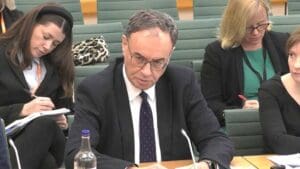
Andrew Bailey, the governor of the Bank of England, has warned Chancellor Rachel Reeves that her government’s plans to roll back banking regulations could destabilise the UK’s financial system and risk triggering a future financial crisis.
Appearing before the Treasury select committee on Tuesday, Bailey said it would not be “a sensible” time to unwind safeguards such as bank ringfencing, which was introduced after the 2008 global crash to separate riskier investment banking from retail operations. The comments came in stark contrast to Reeves’ Mansion House speech, where she described the current regime as a “boot on the neck” of business.
Bailey, who now also chairs the Financial Stability Board, acknowledged that some policymakers may believe “the financial crisis is now way in the past” but stressed that from his perspective, “there remains a live threat to financial stability” that justifies retaining robust safeguards.
“For those of us who were veterans of sorting the problems of [the financial crisis] out, the risk is very much still there,” Bailey warned.
His comments came as new figures from the Office for National Statistics (ONS) revealed that UK government interest payments on debt surged to £16.4 billion in June, the second-highest figure for that month on record. The UK also borrowed £20 billion in June, outpacing forecasts from the Office for Budget Responsibility, and adding pressure on the Chancellor ahead of the autumn budget.
Despite the spike in borrowing costs, Bailey downplayed the UK-specific risk, saying it was part of a wider global trend driven by market volatility, geopolitical uncertainty, and higher deficit spending across major economies.
“We’ve seen an increase in term premiums and steeper yield curves across the board,” Bailey said. “This is a global phenomenon—not unique to the UK.”
The yield on the 30-year gilt has climbed to 5.43%, up from 4.67% a year ago, while the US equivalent has also risen sharply to 4.93%.
Bailey also pointed to President Donald Trump’s renewed trade war and “reciprocal tariffs” policy as a key driver of market volatility, saying that investors were reducing their exposure to dollar-denominated assets in response.
“The most crowded trade in the market at the moment is short dollar,” Bailey said, citing conversations with major institutional investors.
The dollar index has fallen by nearly 10% since January, while a breakdown in long-established market correlations has created significant uncertainty across asset classes.
“Since Trump first floated his tariffs in April, we’ve seen breakdowns in established correlations,” Bailey said. “Markets are rebalancing in response.”
Although stock markets initially slumped, they have since rallied sharply. The FTSE 100 this week closed at an all-time high above 9,000, buoyed by global tech stocks and investor hopes of monetary easing later this year.
Reeves’ plan to review and potentially dismantle the ringfencing regime—a central pillar of post-2008 banking reform—has drawn criticism from financial experts and former regulators including Sir John Vickers, who designed the original framework.
While the Chancellor argues that deregulation is essential to reviving Britain’s sluggish economy, critics fear the move could expose the public to the same systemic risks that triggered the last banking crisis.
Bailey stopped short of directly criticising Reeves but made it clear he would not have used language that described regulation as “a boot on the neck of business.”
As the Labour government pushes forward with its pro-growth reform agenda, Bailey’s warning stands as a stark reminder that financial stability and long-term risk management remain a delicate balancing act—especially at a time of elevated borrowing costs and global market disruption.
Read more:
Andrew Bailey warns Rachel Reeves that City deregulation could reignite financial crisis
Month: July 2025
Alibaba.com and Kickstarter join forces for $1M CoCreate Pitch to back …
In a landmark collaboration between two entrepreneurial powerhouses, Alibaba.com has announced Kickstarter as the official Crowdfunding Partner of CoCreate Pitch 2025—a $1 million global competition designed to help product-based startups launch, scale, and succeed.
The partnership blends Kickstarter’s creative funding ecosystem—which has helped 23 million backers pledge more than $8.5 billion to innovative ideas—with Alibaba.com’s extensive global B2B platform, spanning 50 million business buyers and 200,000 suppliers across 200+ countries.
Together, they aim to provide founders with the tools, funding, and infrastructure to go from prototype to production at scale.
“This partnership creates a stronger bridge between idea and execution,” said Kuo Zhang, President of Alibaba.com. “Through CoCreate Pitch, we’re supporting a new generation of founders with not just funding, but also the tools, expertise and infrastructure to help them grow and compete globally.”
CoCreate Pitch, launched as part of Alibaba.com’s flagship CoCreate event series, is set to become the world’s largest pitch competition for product-based entrepreneurs.
The format includes:
• $1 million in total prizes
• 100 semi-finalists: 70 pitching live in Las Vegas (Sept 4–5, 2025) and 30 in London (Nov 14, 2025)
• 2 Grand Prize winners: Each to receive $200,000 (split equally between cash and Alibaba.com sourcing credits)
• 20 additional winners: Up to $40,000 each
• All finalists: Free access to Alibaba.com’s sourcing tools, supplier network, and global B2B platform
Kickstarter’s involvement brings an extra layer of support for entrepreneurs looking to validate their products through community-backed funding. Finalists who launch campaigns on Kickstarter within 12 months of their pitch will receive:
• Homepage placement on Kickstarter.com
• Newsletter features
• 1:1 coaching from Kickstarter experts
• Marketing and promotional support across both Alibaba.com and Kickstarter platforms
“We’ve seen again and again how a single idea can grow into something extraordinary when supported by a passionate community,” said Everette Taylor, CEO of Kickstarter. “We’re proud to join CoCreate Pitch and help more entrepreneurs bring their visions to life.”
Taylor will also serve as a judge at CoCreate Pitch and lead a featured panel discussion on alternative funding models at the events.
How to apply
Entrepreneurs can submit entries by:
• Uploading a 30-second video pitch on Instagram or TikTok using #CoCreatePitch and tagging @Alibaba.com_official, or
• Completing an application form at pitch.alibabacocreate.com
Deadlines:
• Las Vegas event: Applications close August 15, 2025
• London event: Applications close October 15, 2025
Submissions will be judged on innovation, feasibility, and market potential by a panel of experienced investors, ecommerce leaders, and global business experts.
In addition to the pitch competition, Alibaba.com and Kickstarter will launch co-branded digital portals on their respective websites to provide educational content, resources, and entry pathways to participants.
By uniting crowdfunding validation with global supply chain execution, the collaboration positions CoCreate Pitch as a new model for empowering next-generation founders—particularly those who want to test ideas, raise funds, and scale efficiently.
As global entrepreneurship continues to evolve, this partnership offers a powerful new route to market—where passion meets platform, and ideas meet infrastructure.
Read more:
Alibaba.com and Kickstarter join forces for $1M CoCreate Pitch to back global entrepreneurs
Chippie owner hit with ‘devastating’ £40,000 fine for alleged ill …

A Surrey fish and chip shop owner has been hit with a £40,000 fine by the Home Office for hiring a man who allegedly forged his identity—despite the business following standard hiring processes and paying the employee through HMRC’s PAYE system.
Mark Sullivan, who runs Big Fry Fish & Chips in Egham, described the penalty as “devastating” and warned it could spell the end for his small business. The case has fuelled growing calls from business groups to reform civil penalty rules that treat large corporations and small independents alike, with no sliding scale for size or intent.
The fine was issued after a March 2024 raid by immigration officers, who removed an employee alleged to have used another person’s identity, including a forged passport. When the man was hired in early 2023, he provided a national insurance number, student loan repayment records, and housing benefit receipts. The only clerical error, Sullivan says, was not seeing the original passport.
“We owned up when we found out,” said Sullivan. “We told them what happened, but we were given no right to defend ourselves.”
A lawyer warned him that appealing the fine could double it to £80,000, so he opted to pay the reduced £28,000 within 21 days, though he maintains the hire was made in good faith.
According to Home Office correspondence, only original ID documentation—such as a genuine passport—is considered valid for right-to-work checks. Other paperwork like NI numbers or housing benefit letters are not sufficient proof of legal employment status.
Despite cooperating fully and receiving a £5,000 discount, Sullivan was told he could have received a further £5,000 off if he had reported his suspicions to the UK Visas and Immigration hotline. However, Sullivan says there were no red flags at the time.
“He had a bank account, a university education, housing benefit, a student loan. Where were the red flags for us?” Sullivan asked. “He was already working when he came to us.”
The Federation of Small Businesses (FSB) has called the penalty structure “disproportionate” and warned that many small businesses live in fear of accidentally falling foul of complex and rigid immigration rules.
“This is a case of an honest mistake met with inflexible punishment,” said Craig Beaumont, FSB Executive Director. “Small employers are not immigration officers. They need a system that recognises genuine intent and treats them accordingly—not one that issues crushing fines that could threaten their survival.”
From July 2023 to March 2024, the Home Office issued 1,508 civil penalty notices, each potentially as high as £45,000 per illegal worker, following last year’s increase from the previous £15,000 ceiling. The policy applies uniformly, regardless of business size or turnover.
The case comes amid a broader crackdown on illegal working. Prime Minister Keir Starmer has vowed to pursue enforcement “on a completely unprecedented scale”, following deals with France over small boat crossings. In recent weeks, the UK’s largest food delivery firms have also been pressured to step up identity checks.
A government spokesperson said: “Employers are responsible for carrying out right to work checks and there is comprehensive guidance and support on how to do this. The checks are free and take minutes to complete, with businesses able to utilise digital ID verification technology.”
Yet many small businesses argue that the system still leaves them vulnerable to unintentional breaches—with high-stakes consequences and little room for explanation.
Sullivan’s case has now become a lightning rod for the debate over how immigration enforcement is balanced against the operational reality of running a small business.
“I’ve employed people all my life,” Sullivan said. “I’ve never employed anyone illegally on purpose. This is just an honest mistake that could cost me everything.”
Read more:
Chippie owner hit with ‘devastating’ £40,000 fine for alleged illegal hire amid crackdown
Trump’s first six months in office spark surge in Bitcoin millionair …

The number of Bitcoin millionaires has jumped by more than 15,000 in the first six months of Donald Trump’s second term as President, with new research linking the rise directly to favourable policy shifts and growing market confidence.
According to data from Finbold Research, 15,841 new Bitcoin wallet addresses reached millionaire status between 20 January and 20 July 2025, bringing the total to 192,205—up 9 per cent in just half a year. That equates to an average of 88 new Bitcoin millionaires created every day.
The sharpest increase was recorded in the highest value tier: wallets holding over $10 million in BTC surged by more than 16 per cent, suggesting that institutional investors and long-term holders are ramping up their positions.
The timing of the surge aligns closely with Trump’s re-election and his administration’s active pivot towards supporting the cryptocurrency sector. On November 6, 2024—the day after his victory—there were 132,842 Bitcoin millionaire addresses. Less than nine months later, that figure has grown by nearly 60,000.
The trend gained further momentum earlier this month when Trump signed the GENIUS Act into law. The bill, hailed as a landmark piece of crypto legislation, delivers long-awaited regulatory clarity around taxation, stablecoins, and institutional custody—three areas long seen as obstacles to mainstream adoption.
Markets responded quickly. The total cryptocurrency market cap soared past $4 trillion, a new all-time high, in the days following the bill’s passage through the House of Representatives and its signing at a White House ceremony on 18 July.
The Trump administration has made clear its ambition to make the United States the world’s leading hub for digital assets. Supporters argue that clearer rules and friendlier rhetoric from the White House are finally creating the conditions for meaningful institutional involvement—and wealth generation.
“With regulatory certainty and a bullish market, we’re entering a new phase of adoption,” said a spokesperson from Finbold. “The rise in Bitcoin millionaire addresses isn’t just a vanity metric—it’s a sign of renewed investor confidence and structural maturity.”
The combination of surging wallet wealth, landmark legislation, and the President’s public support for Bitcoin points to a potentially longer-term shift in both sentiment and strategy across the digital asset ecosystem.
Read more:
Trump’s first six months in office spark surge in Bitcoin millionaires, new research reveals
Luxury Lodge Estates censured over misleading investment claims in Sun …

The Advertising Standards Authority (ASA) has upheld four separate complaints against an advert placed by Barry Hurley’s Luxury Lodge Estates Company.
The ruling has said that the promotion—published in the Sunday Times Magazine—was misleading and breached multiple sections of the UK advertising code.
The advert, which ran on 17 June 2024, invited readers to “own a luxury coastal lodge” and “invest from £295,000,” promising a return of “up to £83,454 over two years guaranteed return based on historical success.” It also touted “guaranteed returns” through a subletting plan, without outlining any associated risks, fees or conditions.
The ASA investigated four specific concerns raised by a former Seasons Holidays timeshare owner, all of which were upheld:
Misleading financial claims – The claim of “guaranteed” returns was found to be misleading, particularly as the ad itself stated they were “based on historical success,” which undermines the promise of a true guarantee.
Failure to highlight investment risks – The advert omitted any reference to the potential risks involved, a significant breach when promoting a high-value financial commitment.
Unclear explanation of income versus investment return – The ASA found that the ad failed to make clear that the advertised “return” related to subletting rental income, not capital growth or investment value.
Lack of transparency on fees and charges – It also did not disclose that additional fees and charges applied, which could significantly impact the actual return.
In its ruling, the ASA described the advert as “ambiguous,” “misleading,” and repeatedly stated that key elements “were not made sufficiently clear.” The phrase “breached the Code” appeared three times in its detailed multi-page assessment.
The ASA concluded that the advert should not appear again in its current form and issued a raft of correctional instructions to Luxury Lodge Estates.
A pattern of controversy
Luxury Lodge Estates Company Ltd was founded in 2015 and operates in the high-end holiday park sector. Its sole director, Barry Thomas Hurley (pictured), is also behind Seasons Holidays PLC—a timeshare firm previously accused in national media reports of forcibly removing long-term owners from properties such as Slaley Hall in Northumberland. These same lodges have since been remarketed as luxury properties through Luxury Lodge Estates.
Both companies have faced ongoing allegations regarding questionable contracts and sales methods, echoing historic criticisms of the timeshare industry.
Industry reaction
Greg Wilson, CEO of European Consumer Claims (ECC)—a leading organisation in consumer rights for the lodge and timeshare sectors—strongly backed the ASA’s findings.
“Our experts at the Holiday Park Advice Centre fully agree with the ASA’s ruling,” he said. “Advertising that is unclear, misleading, and code-breaching—especially when it involves hundreds of thousands of pounds—is completely unacceptable.”
Wilson warned that the holiday park sector is “rapidly gaining the same toxic reputation that plagued the timeshare industry for decades,” adding: “Park operators can charge more than timeshare vendors, yet face far less regulation. That’s a problem for consumers.”
What this means for buyers
The ruling raises serious concerns about the transparency of lodge and holiday park investments, especially those presented as property-backed or income-generating opportunities.
Potential buyers are urged to exercise caution and seek independent legal or financial advice before committing to high-value investments in leisure properties.
Anyone who believes they’ve been misled or mis-sold by a holiday park or lodge company may be entitled to compensation. According to ECC, skilled legal professionals are increasingly successful in helping clients recover funds from misleading or unfair sales practices.
Read more:
Luxury Lodge Estates censured over misleading investment claims in Sunday Times advert
Defence sector confident of job surge as firms await MoD contracts

Defence industry leaders say they are “confident” that hundreds of new jobs are on the way, as the UK government increases its military spending and prepares to finalise major procurement contracts.
More than 44,000 people across the South West of England are already employed in the defence sector, with over 130 firms depending heavily on Ministry of Defence (MoD) contracts. But many are now poised for growth—provided the government follows through on its spending pledges.
Speaking at the Royal International Air Tattoo (RIAT) in Gloucestershire, the world’s largest military air show, executives from across the industry expressed cautious optimism about the pipeline of future work.
Emma Baker, policy lead at trade body ADS, said: “We are anticipating a lot more work. It’s clear from government that a lot needs to be done to increase industrial capacity—not just in the UK, but across Europe, where defence budgets are also rising.”
One of the biggest deals currently on the table is a £1 billion order for more than 20 helicopters from Leonardo Helicopters’ Somerset factory in Yeovil, where over 3,000 people work. Though the company remains the sole bidder, the final decision is tied up in the government’s ongoing defence review.
According to Leonardo, the deal would create or safeguard 3,000 jobs across the country. In the meantime, the firm is continuing to invest in the future, recruiting apprentices and digital engineers to help meet future demand.
Among them is 20-year-old AJ McKenzie, a Yeovil native who joined the apprenticeship scheme a year ago and now works on the gearboxes used by the Royal Navy and RAF. “I absolutely love it,” he said. “Taking things apart and putting them back together—it’s so satisfying.”
Long-serving employee Chrissy Smith, who has spent 36 years with the company, now works on the ‘Digital Twin’ simulator, helping train pilots in a safe, virtual environment. “Every day is different,” she said. “I’m proud to be part of something that protects and secures the nation.”
While the Yeovil helicopter factory is the most visible face of the industry, dozens of smaller firms are equally reliant on MoD procurement. One of them is Broadway Group, a precision engineering firm tucked away on a trading estate in East Bristol.
Chief executive Seb Greene said defence contracts kept the business afloat during the pandemic. “Commercial orders just fell off a cliff. Everyone stopped flying. But defence work carried on, crucially,” he said.
Broadway has grown from 80 to 180 staff in recent years, thanks to military orders. It now hires four apprentices and one graduate annually and is expanding its digital and commercial teams.
Nanditha Gampala, who joined Broadway after completing a master’s degree in business, is keen to promote the variety of roles available in the aerospace sector. “Aerospace has something for people with different backgrounds and qualifications,” she said. “So don’t pigeonhole yourself—there really is something for everyone here.”
Despite the optimism, companies remain in a holding pattern as they await the MoD’s next round of orders. Greene is hopeful but realistic. “These things do take time,” he said. “But we’re confident the contracts will come. And when they do, we’ll invest in more technology—and crucially, more people.”
As defence spending rises and international tensions remain high, firms supplying the UK armed forces are preparing for a new era of growth. For many, the only thing missing is clarity from Whitehall.
Read more:
Defence sector confident of job surge as firms await MoD contracts
Colbert gets cancelled – and with him, satire itself

The cancellation of The Late Show with Stephen Colbert is not, as CBS executives would desperately like us to believe, a “purely financial decision.” It is, quite transparently, the ceremonial sacrifice of satire on the altar of political appeasement and corporate consolidation.
Yes, late-night ratings have slipped. Yes, ad revenue is tighter than an intern’s skinny jeans at a Soho House party. But let’s not pretend Colbert was dead wood. His was the highest-rated late-night show in its slot. Emmy-winning. Critically lauded. Socially vital. And very much still watched — I know, because I watch it religiously. Not sure I’ve missed an episode in over a year. Hell, I even went to a taping the last time I was in New York.
I even went to a taping the last time I was in New York
In a year when American networks have spent billions on bloated reboots no one asked for and IP cash-ins so lazy they make Love Island look like Shakespeare, we’re supposed to believe that the network couldn’t find the budget for one of the most popular talk shows on American television?
No. That’s not how this works. That’s not how any of this works.
What happened?
Paramount, CBS’s parent company, was trying to finalise a merger with Skydance Media. But the Federal Communications Commission, chaired by a Trump appointee, had the deal under review. A spurious Trump lawsuit against CBS was hanging over everything like a fart in a lift. So they paid up. $16 million to the president and, coincidentally, soon-to-be-founder of the Trump Presidential Library & Golf Superstore. The lawsuit was laughable — claiming a 60 Minutes interview with Kamala Harris had been maliciously edited. Spoiler: it hadn’t. But CBS paid anyway.
That’s not metaphor. That’s the scent of compromise disguised as corporate prudence. Trump wanted money. The FCC, chaired by Trump’s man Brendan Carr, was delaying Paramount’s merger with Skydance Media. And then, as if by magic, a deal was struck, the FCC smiled, and Colbert — that cheeky, persistent thorn in the Trumpian posterior — was told he’d be off the air come May.
How wonderfully coincidental.
And Donald, never one to let subtlety get in the way of smugness, took to his rickety digital pulpit on Truth Social:
“I absolutely love that Colbert got fired. His talent was even less than his ratings.”
“I hear Jimmy Kimmel is next. Has even less talent than Colbert!”
He wasn’t done.
“Greg Gutfeld is better than all of them combined, including the Moron on NBC who ruined the once great Tonight Show,” referring to Jimmy Fallon, who must be nervously counting down his own commercial breaks now.
The president of the United States is openly celebrating the removal of his political critics from network television. No nuance, no shame. Just straight-up banana republic behaviour. And CBS is letting it happen.
Colbert himself saw it coming. Three days before CBS dropped the axe, he went after the $16 million settlement live on air. “As someone who has always been a proud employee of this network, I am offended,” he said. “I don’t know if anything – anything – will repair my trust in this company. But, just taking a stab at it, I’d say $16m would help.”
The crowd laughed. CBS board members did not.
Senators Elizabeth Warren and Bernie Sanders weren’t laughing either. Warren posted, “CBS canceled Colbert’s show just THREE DAYS after Colbert called out CBS parent company Paramount for its $16M settlement with Trump – a deal that looks like bribery.” Sanders was blunter: “Do I think this is a coincidence? NO.”
Stephen Colbert with two of his three current Emmy’s with another nomination announced just 24 hours before the announcement of the shows cancellation
Let’s not forget, satire has always been uncomfortable — it’s meant to be. But in Britain, we understand that discomfort was part of a healthy democracy.
Did Margaret Thatcher, no fan of dissent, ever phone the BBC and demand that Ben Elton be pulled off the air for his relentless “Mrs Thatch” tirades on Friday Night Live? No. She rolled her eyes and got on with it.
Did John Major ask for Spitting Image to melt down his dead-eyed puppet with the greying underpants? No. He probably winced, but understood that being lampooned is part of the job. If you can’t take a latex satire to the chin, you’re in the wrong line of work.
But Trump? Trump doesn’t do satire. He doesn’t even do irony. His skin is thinner than a Ryanair seat cushion and twice as easy to tear. And so, rather than rolling with the punches, he’s throwing elbows — at networks, at comedians, at newspapers, at anyone who doesn’t flatter his ego.
And with Colbert off-air, who’s next?
This isn’t just the end of a show. This is the end of an era. Colbert didn’t just fill a chair behind a desk — he held a mirror to power, to hypocrisy, to puffed-up politics and the empty suits who manipulate them. He took the absurd and made it art. He made you laugh while making you think, which is increasingly dangerous currency in a world dominated by clickbait, culture wars, and billionaires with fragile egos.
Colbert began in satire — not the fluffy late-night banter of falling asleep with Fallon but the hard stuff: The Colbert Report, his creation of a right-wing pundit who was somehow more believable than the real ones. He gave us “truthiness” before we knew how badly we’d need it. And when he moved to The Late Show, he didn’t neuter himself — he sharpened the blade.
So yes, this is personal. Not just for the 200 staffers soon out of a job. Not just for viewers like me, who tuned in for comfort and clarity and cleverness. But for anyone who still believes journalism — in whatever format — should punch up, not shut up.
What’s next? More of Trump’s wish list being fulfilled under the guise of economic restructuring? Will Jon Stewart be next for the guillotine? (“Shameful,” he said of the settlement.) Will NPR be shuttered because Trump doesn’t like vowels?
And now, as the stage lights dim and the applause fades, the future of satire feels uncertain.
Or does it?
Because while the suits in broadcast boardrooms pretend this is about balance sheets, over on YouTube — where the only approval required is a “Like” button — audiences are flocking. In fact, someone else has already made the leap: Piers Morgan, that perennial marmite of British broadcasting, has quietly – well it was a quiet as Morgan gets – shifted his Uncensored show from linear TV to YouTube, where it reaches more people, with less interference, and no need to pander to a regulator or advertiser with cold feet.
It’s ironic, isn’t it? Trump — the man who cut his teeth on reality TV, who turned CNN into a hate-watch for the MAGA faithful — may have just accelerated the future of television. By bullying broadcasters into silence, he’s made online freedom more attractive, more necessary.
Late-night satire might be dying on CBS, but it’s thriving elsewhere. Jon Stewart. Hasan Minhaj. Sarah Cooper. Even amateur YouTubers with a microphone and a sense of decency are picking up the mantle. The audience hasn’t disappeared — it’s migrated.
So maybe The Late Show is ending. But the idea of the late show — the honest, punch-up political comedy show — might just be evolving.
And as for Colbert? Don’t bet against him. The man once played a right-wing pundit in character for nine years without breaking once. He’s not afraid of a fight. He’s just lost his stage. For now.
So here’s my suggestion, Mr Colbert: light up a YouTube channel, Dust off all the covid-era tech. Call it The Even Later Show. Stream it straight from your living room. No censors. No FCC. No overlords with shareholder nerves. Just you, your writers, your desk — and your audience, who are very much still here, very much still watching. Plus if Morgan is believed you might even earn more!
And this time, the only cancellation that matters is the one your subscribers can control.
Read more:
Colbert gets cancelled – and with him, satire itself
Company insolvencies fall in England and Wales, but experts warn chall …

The number of UK companies falling into insolvency dropped sharply in June, offering a moment of respite for businesses after months of economic turbulence.
But experts have warned that the decline may be only temporary, with ongoing pressures threatening a renewed wave of financial distress later this year.
According to the Insolvency Service, there were 2,043 registered company insolvencies in England and Wales in June 2025, down 8% from May (2,230) and 16% lower than June 2024 (2,430).
The drop in insolvencies may ease some concerns over the health of the UK economy, which continues to grapple with rising inflation, tax pressures, and a fragile global backdrop. But figures for the first half of 2025 show that insolvencies remain slightly higher than the second half of 2024, despite being below the 30-year annual high recorded in 2023.
In June, the breakdown of insolvency types included 1,585 creditors’ voluntary liquidations (CVLs), 332 compulsory liquidations, 111 administrations, and 15 company voluntary arrangements (CVAs). There were no receivership appointments.
Paul Williams, Restructuring Partner at PKF Littlejohn, said the fall in June should be welcomed, but it doesn’t paint a full picture.
“With global and domestic markets still navigating instability—driven by international conflict and economic disruption—the UK economy remains under significant pressure,” Williams said.
“While the insolvency figures show a decline in June, the first half of 2025 saw an overall rise compared to the second half of last year.”
He cited ongoing disruptions to supply chains, US tariff policy volatility, inflationary cost pressures, and changes to employer National Insurance contributions as continued headwinds for businesses.
Williams added that while the drop in insolvencies is encouraging, it is still “far from a clean bill of health for UK plc,” urging firms to remain agile, manage risk proactively, and maintain strong financial discipline.
The broader economic outlook remains uncertain. Inflation rose unexpectedly in June to 3.6%, raising questions about the resilience of consumer demand and squeezing already tight profit margins, particularly in retail and hospitality.
Meanwhile, GDP grew by 0.7% in Q2, and employment levels have risen—offering potential signs of green shoots. Chancellor Rachel Reeves, in her recent Mansion House speech, reaffirmed the government’s commitment to reforms aimed at boosting growth, reducing red tape, and encouraging investment.
However, critics remain sceptical. Many businesses are still facing “tough times”, according to David Hudson, restructuring advisory partner at FRP.
“The slight fall in insolvencies offers a glimmer of relief—especially for hospitality and retail, which are now benefiting from record summer weather,” said Hudson.
“But this could be just a pause. Consumer confidence is still low, growth remains weak, and inflation continues to erode margins.”
Hudson warned that many businesses may have only survived by dramatically cutting costs, and without a sustained recovery in demand or a drop in input costs, the reprieve may be short-lived.
As the government approaches the next fiscal cycle and firms continue to digest the effects of tax policy changes, analysts say the business community will need to remain vigilant.
While the fall in insolvencies for June offers welcome news, experts agree that the pressures on businesses are far from over—and for many, the path to stability will depend on staying ahead of challenges before they escalate.
For now, companies are being advised to closely manage cash flow, review supplier relationships, and seek early guidance from advisers to avoid sliding toward insolvency in what remains a precarious economic environment.
Read more:
Company insolvencies fall in England and Wales, but experts warn challenges remain
Netflix turns to generative AI for visual effects in original series T …

Netflix has used generative artificial intelligence to create visual effects in one of its original TV shows for the first time, as part of a wider strategy to reduce production costs and accelerate timelines.
The streaming giant revealed that AI technology was used to produce a complex scene in its new Argentine sci-fi drama The Eternauts, featuring the collapse of a building in Buenos Aires. The sequence marks the first use of final AI-generated footage in a Netflix original film or series.
Co-chief executive Ted Sarandos said the decision to use generative AI—software capable of creating images and video based on text prompts—enabled the production team to deliver the effects ten times faster than through traditional VFX method “The cost of it just wouldn’t have been feasible for a show in that budget,” Sarandos said. “That sequence is the very first generative AI final footage to appear on screen in a Netflix original series or film. The creators were thrilled with the result.”
The announcement comes as Netflix posted a 16% year-on-year increase in revenue, reaching $11 billion (£8.25 billion) for the quarter ending June 30. Profits surged from $2.1 billion to $3.1 billion, buoyed by the release of the third and final season of Squid Game, which has drawn over 122 million views to date.
While Netflix’s use of AI has drawn praise for its innovation and cost-efficiency, the move also reopens debate about AI’s role in creative industries. Critics argue that generative AI often learns from existing artistic works without the consent of their creators, and that increasing use of automation could displace human artists and technicians.
Concerns over AI were central to the Hollywood strikes of 2023, during which the Screen Actors Guild–American Federation of Television and Radio Artists (SAG-AFTRA) called for stricter regulation around AI’s use in film and television.
Netflix, however, has positioned its deployment of AI as a tool to democratise access to advanced visual effects—especially for lower-budget productions.
“It’s about enabling storytelling that otherwise wouldn’t be possible,” Sarandos added. “We’re not talking about replacing creativity, but enhancing it with the right technology.”
The integration of generative AI into Netflix’s pipeline signals a potential shift in how streaming giants balance production ambition with economic discipline. With increasing pressure to produce blockbuster content at scale, AI could become a core part of the toolkit for mid-tier and international series.
As studios face rising costs, tighter profit margins, and evolving viewer expectations, the question is no longer whether AI will reshape entertainment—but how far, how fast, and on whose terms.
Read more:
Netflix turns to generative AI for visual effects in original series The Eternauts

