

British autonomous driving start-up Wayve is in early talks with Microsoft and SoftBank over a potential $2 billion funding round, in a deal that would value the London-based AI firm at $8 billion, according to The Financial Times.
Founded in 2017 by Cambridge PhD students Alex Kendall and Amar Shah, Wayve has developed a breakthrough approach to self-driving cars, using machine learning and computer vision to teach vehicles how to drive through real-world video and data—rather than relying on pre-programmed rules.
The fast-growing company is already backed by an elite roster of investors, including SoftBank, Nvidia, Microsoft, Ilya Sutskever (OpenAI co-founder), and Yann LeCun (Meta’s Chief AI Scientist). Last year, SoftBank led a $1 billion round, with Nvidia adding another $500 million in September during CEO Jensen Huang’s high-profile visit to London with President Trump.
Wayve’s AI-powered software is designed to make any car hands-free. It is currently being trialled with retail and logistics partners including Asda, Ocado, and Uber, with UK road tests set for next spring. The company has also signed a landmark deal with Nissan, aiming to integrate its technology into Nissan vehicles by 2027.
From humble beginnings in a garage, Wayve now employs over 800 staff across six countries, making it one of the UK’s most internationally ambitious AI ventures. The planned investment—if finalised—would signal continued confidence in Britain’s AI innovation sector, at a time of intensifying global competition in autonomous driving and artificial general intelligence.
A key benefit of Wayve’s approach is its ability to handle unpredictable scenarios—such as pedestrians stepping into the road or sudden swerves from other vehicles—making it a strong contender in the race to scale safe and adaptable self-driving solutions.
Industry experts hope the rollout of driverless cars will dramatically reduce road accidents by removing human error, drunk driving, and road rage from the equation.
Wayve declined to comment on the fundraising talks.
Read more:
Wayve wheels in Microsoft and Softbank for $2bn cash injection
Month: October 2025
Patchworks raises £5m to power US expansion and future-proof retail t …

Retail technology platform Patchworks has secured £5 million in new funding to accelerate its expansion into the United States and scale its next generation of AI-powered integration tools for enterprise retailers.
The round, led by existing backer Gresham House Ventures with growth lending from Palatine Growth Credit, comes as the company reports a 41 per cent year-on-year increase in annual recurring revenue and deepening adoption across ecommerce and omnichannel retail.
The latest investment will be used to expand sales and marketing in North America, enhance product innovation, and embed new AI capabilities into its integration platform. Patchworks helps retailers connect and automate systems across ecommerce, ERP, POS, CRM, PIM and fulfilment channels — a critical layer for businesses managing complex, multi-system operations.
Many retailers still rely on disconnected legacy systems that cannot share information in real time, resulting in overselling, delayed orders, and costly manual processes. Failures in integration have been linked to some of retail’s biggest collapses, including Target Canada, Debenhams, and BHS, where poor data flow contributed to stock and fulfilment crises.
Patchworks’ platform aims to remove that friction by offering retailers a single, scalable integration layer. Its software connects core systems in days rather than months, giving merchants faster access to accurate data, smoother customer experiences and reduced operational risk.
The company said the new investment would help retailers “future-proof their infrastructure” and respond to fast-changing consumer behaviour.
By layering AI into its system, Patchworks plans to introduce smarter automation tools and enable large language models to query retail data directly, helping teams identify insights, streamline fulfilment, and eliminate repetitive manual tasks.
“Retailers and brands need flexible, future-proof infrastructure to stay competitive,” said Jim Herbert, chief executive of Patchworks. “This follow-on investment is a huge vote of confidence in our platform and our strategy. We’re doubling down on the US market, scaling our partner ecosystem, and continuing to enhance the platform with AI so our customers can connect, adapt and grow faster.”
Patchworks’ momentum has been driven by what the company calls its “partner flywheel” — a model that incentivises digital agencies and technology providers to deliver the platform at scale. This partner-first approach has helped it achieve global delivery coverage and maintain close alignment with the evolving needs of the retail tech ecosystem.
Caroline Tulloch, Investment Director at Gresham House Ventures, said: “Patchworks has gone from strength to strength since our first investment in 2021. The business has built strong fundamentals and a clear path to scale. This additional funding will accelerate growth, particularly in North America, and we are excited to continue supporting Jim and the team.”
William Chappel, Managing Partner at Palatine Growth Credit, added: “Patchworks sits at the heart of the modern commerce ecosystem, helping retailers unlock efficiencies and innovation. We are delighted to back its expansion strategy as it captures more market share in the fast-growing iPaaS segment.”
Patchworks has emerged as a key player in the shift toward composable and MACH-based retail technology stacks, which allow brands to assemble best-in-class tools rather than rely on monolithic systems.
The platform’s ability to integrate these modular systems has made it a go-to choice for enterprise retailers seeking agility and resilience. The company already counts several global brands among its clients and continues to strengthen its presence through partnerships with major digital agencies.
With sustainability-focused backers and a strategy aligned to long-term digital transformation, Patchworks is positioning itself as a critical enabler of retail’s next phase — one defined by connected data, automation, and adaptive infrastructure.
Herbert said: “Our mission is simple — to help retailers stay connected in a fragmented world. The commerce ecosystem is evolving fast, and our platform ensures our customers are always one step ahead.”
Eversheds Sutherland advised on the deal.
Read more:
Patchworks raises £5m to power US expansion and future-proof retail technology
The Open University and NatWest launch £50,000 ‘Open Business Creat …

The Open University (OU) has joined forces with NatWest and the Department for Work and Pensions (DWP) to relaunch the Open Business Creators Fund, a nationwide initiative offering early-stage women entrepreneurs financial support, mentoring, and access to training resources.
Launched in a video message by Baroness Martha Lane Fox, Chancellor of The Open University, the competition offers individual grants of up to £2,500, backed by £50,000 in sponsorship from NatWest.
The fund is open to women and those who identify as women aged 16 and over living anywhere in the UK, and is aimed at supporting those in the idea or early stages of starting a business.
“This is more than a competition – it’s a launchpad for women entrepreneurs,” said Chaitali Patel, Head of Prospects at The Open University. “With the support of our Validate platform, every applicant leaves with a stronger, clearer business concept and the confidence to take it forward.”
A learning-led approach to entrepreneurship
What sets this initiative apart is that every applicant is guided through the OU’s Validate business development platform — an interactive tool that helps users refine and test their business ideas.
Validate walks participants through identifying customer needs, developing value propositions, understanding key partners and resources, and producing a professional business portfolio. The completed portfolio then forms part of the fund application, meaning even those who don’t secure a grant gain practical skills and a tangible business plan.
The initiative builds on The Open University’s long-standing commitment to inclusive, accessible entrepreneurship, helping remove the barriers often faced by women, people of colour, and those from lower-income backgrounds when starting out in business.
Alongside the funding competition, the OU and NatWest will host a three-part webinar series across October and November — free and open to all — designed to inspire and equip new founders with practical skills.
The series, themed around Confidence, Capabilities, and Connections, features high-profile entrepreneurs, academics, and industry mentors:
Webinar 1: Confidence – Tuesday, 21 October (12:00–13:00)
Mags Byrne, Entrepreneur in Residence at The Open University, and Stef Genesis, a pioneer in the esports industry, will share their journeys. OU Business School’s Liz Moody will lead a hands-on workshop to help participants refine and strengthen business ideas.
Webinar 2: Capabilities – Wednesday, 5 November (12:00–13:00)
Ronke Maye, founder of Ronke Maye Ltd, will discuss audience engagement and relationship-building, followed by NatWest experts on managing costs and projecting revenue.
Webinar 3: Connections – Tuesday, 18 November (19:00–20:00)
A dynamic panel featuring Soyna Barlow, Justice Williams, Claudine Reid MBE, and OU Entrepreneur in Residence Russell Dalgleish will explore networking, visibility, and collaboration.
Anyone can register for the webinars through the Open Business Creators website.
Applications open until 21 November
To apply, participants must complete their Validate portfolio and submit it via the Open Business Creators entry formby midnight on Friday, 21 November 2025. Winners will be announced on 19 December 2025.
The competition provides more than just funding — it’s designed to foster a sense of community among new founders, connecting them with role models and professional networks through NatWest’s Enterprise team and The Open University’s entrepreneurship ecosystem.
Patel added that the initiative represents a broader push to democratise access to entrepreneurship: “Everyone should have the chance to turn an idea into a viable business — not just those with existing networks or resources. This fund is about levelling the playing field.”
The fund’s return comes at a time of rising interest in female entrepreneurship, with women starting businesses at faster rates than ever before but still facing significant disparities in funding access.
By combining NatWest’s business expertise with the OU’s education and mentoring framework, the partnership aims to support women from all backgrounds to build sustainable, scalable ventures — and, in turn, boost the UK’s entrepreneurial landscape.
To learn more and apply, visit: Open Business Creators Fund
Read more:
The Open University and NatWest launch £50,000 ‘Open Business Creators Fund’ to empower women entrepreneurs
Fujitsu boss gets 50% pay rise despite Horizon scandal fallout
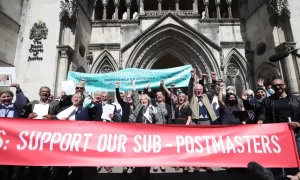
The UK head of Fujitsu Services Limited, the company behind the Post Office’s disastrous Horizon IT system, has received a 50% pay rise — despite the firm still refusing to quantify compensation for hundreds of wrongly convicted sub-postmasters.
The Japan-owned technology giant handed its best-paid UK executive — believed to be Anwen Owen, Fujitsu’s UK chief — £591,000 in total pay for the year to March 2025, up from £388,000 the previous year.
Corporate filings show that Owen, who joined the board in 2022, was previously a senior government official, serving as head of engagement at HM Treasury between 2010 and 2012.
The revelation comes as Fujitsu continues to face widespread criticism for its role in what has been described as the biggest miscarriage of justice in British corporate history.
Fujitsu’s annual report, filed last week, also reveals the company faces a £4 million claim for damages brought by a sub-postmaster on 10 July 2025 — believed to be Lee Castleton, a former postmaster from Bridlington who was portrayed in ITV’s Mr Bates vs The Post Office, the BAFTA-winning dramatisation that reignited public outrage over the scandal.
The company stated that “it is not yet possible to predict the outcome” of the case.
The Horizon IT inquiry, led by Sir Wyn Williams, continues to investigate the Post Office’s use of Fujitsu’s flawed accounting software, which led to more than 900 wrongful prosecutions between 1999 and 2015.
Of those, over 230 sub-postmasters were jailed, and at least 13 are believed to have taken their own lives after being accused of theft or fraud that they did not commit.
Despite the ongoing scandal, Fujitsu’s UK business remains highly profitable. The company generated over £1 billion in revenue last year, primarily through government contracts.
The firm has paused bidding for new public sector work while the Horizon inquiry continues but remains a major supplier to UK departments.
In total, the company’s annual wage bill reached £500 million for its 5,800 employees, with average salaries rising 4.2% to £84,135.
Fujitsu’s Japanese parent company injected a further £80 million of capital into its UK arm last year, following a £200 million cash injection the year before, underscoring the scale of financial pressure amid mounting legal and reputational challenges.
Lord James Arbuthnot, the former Conservative MP who has long campaigned on behalf of wronged sub-postmasters, condemned the pay increase as “bizarre” and “deeply inappropriate.”
“The management of Fujitsu in the UK has been absolutely disastrous for Fujitsu itself and for Japanese business in general,” he said.
“It has shown itself to be unethical, dishonest, and completely uncaring about the disaster it has brought to the sub-postmasters and the cost to the taxpayer.
For some reason, which I cannot understand, the government still continues to think that it is a fit and proper organisation with which to do business. It is not — and it ought not to have any government contracts at all.”
His comments add to growing pressure on the government to ban Fujitsu from future procurement processes until its financial contribution to the compensation scheme is confirmed.
The government has said it will pursue Fujitsu for its share of compensation costs, which could total hundreds of millions of pounds once final settlements are reached.
A Fujitsu spokeswoman declined to comment on executive pay or ongoing legal cases.
She said: “We remain committed to providing our full co-operation to the inquiry as Sir Wyn Williams prepares his final report.
We continue to engage with the UK Government regarding Fujitsu’s contribution to compensation.”
The company insists it has already implemented internal reforms and strengthened governance processes, but critics argue its leadership has yet to demonstrate genuine accountability for the systemic failures that destroyed lives.
The Horizon case remains one of the darkest chapters in modern British business history — exposing the devastating human impact of digital failure, and prompting questions about corporate ethics, state procurement, and oversight of technology suppliers.
As Fujitsu’s top executive enjoys a near £600,000 salary, the long road to justice — and adequate compensation for those wrongfully accused — continues.
Read more:
Fujitsu boss gets 50% pay rise despite Horizon scandal fallout
PPE Medpro consortium signals willingness to settle as spotlight turns …

The consortium behind PPE Medpro has announced its readiness to enter discussions with the company’s administrators to explore a possible settlement with the government, following the High Court’s ruling that the firm must repay £121.9 million for breaching its PPE contract with the Department of Health and Social Care (DHSC).
In a statement shared with Business Matters, a spokesperson for the consortium said: “The consortium partners of PPE Medpro are prepared to enter into a dialogue with the administrators of the company to discuss a possible settlement with the government.”
The announcement follows nearly five years of legal proceedings and mounting political pressure, with PPE Medpro having spent £4.3 million defending its position in court — and consistently maintaining that it delivered all 25 million gowns required by the £122 million contract.
Throughout the process, PPE Medpro offered to settle on a no-fault basis, including proposals to either remake the entire 25 million gown order or pay a £23 million cash equivalent. These offers, made repeatedly before, during, and even after the trial, were rejected by the DHSC.
By contrast, a separate £135 million claim the DHSC brought against Primerdesign Ltd was settled quietly for £5 million, on a no-fault basis, just weeks before trial.
Critics now argue that the government’s handling of the Medpro dispute has been inconsistent and politically charged, particularly as the gowns supplied by PPE Medpro — although found not to meet sterility requirements under a technical clause — were never suitable for NHS frontline use due to being single-bagged, a feature the DHSC reportedly failed to specify across all gown contracts at the time.
“This case has become a distraction from the real issue: the government’s inability to manage PPE procurement, usage, or resale,” said one industry observer.
An £85 million missed opportunity?
Significantly, PPE Medpro has long argued that the gowns — while not deployed by the NHS — were viable for use in non-sterile environments, and could have been resold internationally.
An independent expert valuation found the gowns could have been worth £85 million on the global market at the end of 2020. Yet the government made no attempt to resell or repurpose them, despite sitting on a decade’s worth of surplus gown stock and ultimately writing off nearly £10 billion of pandemic PPE.
Had the DHSC chosen to act, the net financial difference between contract cost and resale value would have been just £37 million — a fraction of the claim pursued in court.
On 2 October, Mrs Justice Cockerill ruled that PPE Medpro breached the contract by failing to prove that the gowns had undergone a validated sterilisation process, despite providing all delivery documentation and post-sterilisation test certificates.
The judge noted that the required documentation for radiation dose mapping — which the company later obtained after sending investigators to China — was not provided in time for trial. The failure, she ruled, constituted a technical breach of contract, and PPE Medpro was ordered to repay the full contract value.
Barrowman and Mone have slammed the ruling as a “travesty of justice” and accused the government of scapegoating them to deflect attention from its wider pandemic procurement failures.
PPE Medpro is now in administration, and it remains to be seen whether the consortium’s willingness to re-engage with the government will lead to a negotiated resolution — or further legal wrangling.
But as calls grow for transparency over the government’s own procurement decisions, the PPE Medpro saga is no longer just a legal dispute — it has become a symbol of the political and financial fallout of the UK’s Covid-era spending spree.
Read more:
PPE Medpro consortium signals willingness to settle as spotlight turns to government’s £85m missed resale opportunity
Government urged to get tough with EU over new steel tariffs

A senior industry figure has called on the Government to take robust retaliatory action against the European Union’s new trade restrictions on British steel, warning that they could devastate the UK’s manufacturing base.
Simon Boyd, managing director of Dorset-based structural steel company REIDsteel, urged ministers to impose reciprocal tariffs to protect UK producers, manufacturers and supply chains after Brussels announced plans to slash tariff-free quotas for British steel exports.
The EU’s new measures will halve the UK’s tariff-free quota for structural steel exports and impose a 50% tariff on all shipments exceeding that limit, as part of a wider package designed to curb imports of Chinese steel.
“The total EU market for structural steel is eight million tonnes per annum, of which the UK is currently granted a tariff-free quota of 108,000 tonnes — less than 2% of the market,” Boyd said.
“Conversely, the UK market is 800,000 tonnes per annum while EU producers enjoy a tariff-free quota of 680,000 tonnes, equivalent to 85% of the UK market. Hardly fair trade.”
Boyd, who earlier this year campaigned to save British Steel’s blast furnaces at Scunthorpe, said the proposed changes would leave British exporters “virtually shut out” of the European market while allowing EU producers near-unrestricted access to the UK.
“All UK producers will be impacted by this change in policy,” he said. “Not only will exports be hit, but we could see a flood of imported steel if we don’t tighten our own trading measures.”
He called for the Government to “react boldly” by either negotiating an exemption from the EU’s anti-dumping measures or threatening equivalent counter-tariffs to restore balance.
“The EU may need to prop up its own ailing steel sector and fight off Chinese dumping, but this cannot be at the expense of the UK,” he warned. “There is no time to lose.”
According to industry body UK Steel, the sector directly employs 36,800 workers and supports a further 46,000 jobs in its supply chain. It contributes £1.7 billion directly to the economy, £2.2 billion through its supply network, and adds £3.1 billion to the UK’s balance of trade.
Industry leaders fear that without decisive action, the EU’s new tariffs could accelerate the decline of Britain’s heavy industry and undermine the Government’s ambition to rebuild domestic manufacturing.
Read more:
Government urged to get tough with EU over new steel tariffs
Google could be forced to change search operations in the UK

Google may be required to overhaul the way its search engine operates in the UK after the Competition and Markets Authority (CMA) confirmed it has granted the tech giant “strategic market status” (SMS) under the country’s new Digital Markets, Competition and Consumers Act (DMCCA).
The landmark decision, announced on Friday, gives the CMA sweeping new powers to impose legally binding rules on Google’s search and advertising businesses — which together account for over 90% of all online searches in the UK.
While the designation is not a finding of wrongdoing, it allows regulators to step in later this year with potential measures aimed at increasing competition in digital markets.
Under its new status, Google could be required to offer users alternative search engines via “choice screens”, introduce greater transparency in how results are ranked, and provide publishers with more control over how their content is displayed or monetised online.
Will Hayter, who leads the CMA’s digital markets unit, said the move reflected the company’s long-established dominance.
“Google maintains a strategic position in the search and search advertising sector, with more than 90 per cent of searches in the UK taking place on its platform,” Hayter said.
“Having taken into account feedback following our proposed decision, we have today designated Google’s search services with strategic market status.”
The CMA said its goal is to ensure “fairer competition and more choice for consumers”, while fostering innovation and reducing barriers for rivals to compete in the UK’s £20 billion online advertising market.
In response, Google said it would cooperate with the regulator but warned that heavy-handed or unclear rules could have the opposite effect, slowing innovation and harming UK competitiveness.
Oliver Bethell, Google’s senior director for competition, said: “UK businesses and consumers have been amongst the first to benefit from Google’s innovations, often months before their European counterparts.
“Many of the ideas for interventions raised in this process would inhibit UK innovation and growth, potentially slowing product launches at a time of profound AI-based innovation.”
Sources told Business Matters that Google executives have grown increasingly frustrated by the lack of clarity over what interventions may follow. The company is concerned that sweeping or unpredictable rules could make it harder to invest and roll out new AI-driven features in the UK — a concern shared by other major tech firms observing the new regime.
The CMA will now consult on possible remedies, with proposals expected to be published later in 2025. These could include new transparency obligations for search ranking algorithms, restrictions on how data is shared across Google’s vast advertising ecosystem, and new oversight of how it integrates AI into its products.
Officials insist the purpose of the new regime is not to punish successful firms, but to ensure open digital markets that benefit both consumers and competitors.
“Our role is to promote competition and innovation, not to stifle it,” a CMA spokesperson said.
The move comes as the UK seeks to establish its own post-Brexit framework for Big Tech oversight, diverging from both the EU’s Digital Markets Act (DMA) and the US Department of Justice’s more litigious approach.
With Google the first major company to be formally designated under the UK’s new rules, the outcome of the CMA’s next steps will be closely watched by global tech firms — including Meta, Amazon, and Apple — as Britain tests its new powers to rein in digital giants.
Read more:
Google could be forced to change search operations in the UK
UK falling behind in AI adoption, warns Google Europe chief

The UK risks losing ground in the global race to harness artificial intelligence, with small businesses in particular falling behind their American counterparts, according to Debbie Weinstein, President of Google Europe.
Weinstein, who previously led Google’s UK and Ireland operations, said that while Britain remains an innovation hub, its small and medium-sized enterprises (SMEs) are slower to adopt AI — a gap that could limit productivity growth and wider economic gains.
“The biggest gap in terms of productivity-led growth is with the US,” Weinstein said. “If you look at what’s driven the US relative to the UK over the last ten years, a lot of the unlock that is missing in this country comes down to productivity.”
Research from Google suggests that AI-powered tools could increase productivity among UK SMEs by up to 20%, effectively giving employees an extra working day each week.
The company’s analysis estimates that AI adoption could unlock £200 billion in additional economic value for UK small businesses by the end of the decade.
SME leaders surveyed by Google believe the technology could boost revenues by an average of 30%, with the greatest benefits expected in customer service automation, marketing, and administrative tasks.
“Small and medium-sized businesses are really the lifeblood of the UK economy,” Weinstein said. “Whenever you talk to a small business owner they always tell you the one thing they struggle with is time.”
But she warned that businesses that fail to adapt risk being left behind.
“My biggest worry is that there’s this potential for growth — for each of these individual small businesses and for the economy overall — that isn’t realised because people don’t have the tools or the skills to take advantage of this opportunity.”
To help close the adoption gap, Google has launched the AI Works for Business programme in partnership with the Department for Business & Trade and NatWest.
The initiative will deliver a series of free in-person workshops across Manchester, Leeds, Edinburgh and Cardiff over the next two months. Around 1,000 small business owners have already registered.
Peter Kyle, Secretary of State for Business and Trade, said the collaboration would help small firms gain vital practical skills.
“AI is transforming the way we work,” Kyle said. “This partnership with Google will give small businesses hands-on experience of how to capitalise on the many benefits of AI to innovate, grow, and compete on the global stage.”
Weinstein added that the workshops build on pilot programmes run earlier this year, where short training sessions significantly increased AI use among participants.
“What we found in those trainings is that a few hours of hands-on experience made all the difference,” she said. “When we did a couple of hours of training and went back, there was a doubling of the daily usage of AI.”
Google introduced Gemini, its generative AI chatbot, into its suite of productivity apps in February 2024, giving businesses access to AI-driven writing, data analysis and planning tools directly through Google Workspace.
However, while large corporations have integrated AI rapidly into operations, smaller firms have been slower to follow — often due to lack of awareness, cost barriers, or uncertainty about regulation.
Weinstein’s comments add to a growing debate over how Britain can close its AI productivity gap. Economists warn that while the technology could transform efficiency across industries, the benefits will only be realised if businesses adopt early and invest in digital skills.
“This isn’t about hype,” Weinstein said. “It’s about ensuring that small businesses — which make up the backbone of the UK economy — have the opportunity, confidence and support to use AI to their advantage.”
Read more:
UK falling behind in AI adoption, warns Google Europe chief
Nigel Farage to meet Ineos tycoon Sir Jim Ratcliffe as Reform UK court …

Nigel Farage is expected to meet Sir Jim Ratcliffe, the billionaire industrialist and founder of Ineos, before Christmas as Reform UK accelerates efforts to build relationships with major British business figures.
Ratcliffe, who co-owns Manchester United and is among the UK’s richest individuals with an estimated fortune of £23.5 billion, confirmed that Farage had requested the meeting during an interview for The Business, a new podcast by The Times.
The Ineos chairman, known for his outspoken views on energy policy, has been one of the most vocal critics of Britain’s net zero targets, describing plans to eliminate fossil fuels from the electricity grid by 2030 as “absurd”.
He warned that the combined impact of high energy costs, carbon taxes, and cheap Chinese imports was “crippling” Europe’s chemical industry and putting up to one million direct jobs at risk.
“You could probably multiply that by ten if you look at all the indirect jobs in services — it’s probably ten million jobs in Europe and three-quarters of a trillion euros in value,” Ratcliffe said.
Ratcliffe’s comments come after Ineos announced a series of plant closures and job losses across Europe.
On Tuesday, the company cut 60 jobs — a fifth of its workforce — at its Hull acetyls plant, citing energy costs and the flood of low-cost, carbon-heavy imports from China.
Just a day earlier, Ineos confirmed the closure of two chemicals facilities in Germany, affecting 175 staff. In April, it shut the Grangemouth oil refinery in Scotland, though the site’s chemicals operations remain active.
Ratcliffe said high operating costs were undermining competitiveness: “Grangemouth is a good facility, but it hasn’t made money for two or three years. We’re spending about £130 million a year extra on high energy costs and carbon taxes. Over ten years that’s £1.3 billion — money that should be going into investment.”
Ratcliffe said he had also met Conservative leader Kemi Badenoch, but confirmed that Farage had been the one to reach out directly. Both Reform UK and the Conservatives have signalled their intention to scrap or delay elements of the UK’s net zero targets if elected.
Asked about his political stance, Ratcliffe said he remained “neutral”, but believed many voters were drawn to Farage’s focus on tax, crime, and the economy.
“I think most people would support him if he could sort those things,” Ratcliffe said. “But I’ve always been neutral on political parties. I just want one that runs the country well. I can’t see myself paying for policies.”
The Ineos founder added that Britain had become a “high tax, high immigration, high crime” country, and compared the current political mood to the one that helped Donald Trump win in the US.
He described the prime minister as a “reasonable bloke” but questioned whether he was “too nice” to make the “tough decisions” needed to address structural economic challenges.
Reform UK declined to comment on the forthcoming meeting.
Farage’s outreach to Ratcliffe comes amid growing efforts by Reform UK to position itself as a pro-business party and attract industrial leaders frustrated by high taxes, regulatory pressures, and energy policy uncertainty.
For Ratcliffe — whose company employs 24,000 people worldwide — the discussion will likely centre on the future of British manufacturing competitiveness, energy security, and trade policy in a post-Brexit Europe.
With the UK’s chemical sector warning of shrinking margins and offshoring risk, the meeting could mark the start of a deeper political dialogue between Britain’s industrial base and the emerging Reform movement.
Read more:
Nigel Farage to meet Ineos tycoon Sir Jim Ratcliffe as Reform UK courts business leaders

