

The West End’s post-pandemic revival has delivered a multimillion-pound boost to one of Britain’s biggest theatre groups, with the return of Oliver! helping Sir Cameron Mackintosh’s company rebound to, and surpass, pre-Covid trading levels.
Cameron Mackintosh Limited reported an 18 per cent jump in revenues to £234 million last year, overtaking its 2019 performance as audiences returned in force and demand for major productions recovered.
The strong financial year paved the way for a £10.2 million pay packet for Mackintosh, 79, who had taken no salary between 2020 and 2023 as the business weathered the pandemic shutdown of theatres.
Like much of the live entertainment sector, the company endured a brutal period during Covid-19, when lockdowns forced venues to close and turnover collapsed from £207 million to just £94 million in the year to March 2021. The latest results mark a decisive turnaround, reflecting a broader recovery across the West End.
Cameron Mackintosh Limited generates income through both producing and staging major shows, alongside owning and operating eight West End theatres, including the Prince of Wales Theatre and the Noël Coward Theatre.
The most recent financial year was buoyed by the high-profile return of Oliver! at the Gielgud Theatre, one of the group’s flagship venues, as well as celebrations marking the 40th anniversary of Les Misérables, one of the most successful musicals in theatrical history.
Mackintosh’s business empire also includes long-running global productions such as The Phantom of the Opera and Mary Poppins, the latter a collaboration with Disney that has enjoyed sustained international success.
Having started his career as a West End stagehand, Mackintosh rose to become one of the most influential figures in global theatre, shaping the modern musical industry through hits including Cats, Les Misérables and The Phantom of the Opera.
The latest figures underline not only the resilience of the West End but also the speed of its recovery, as audiences return to theatres in numbers comparable to, and now exceeding, those seen before the pandemic.
Read more:
West End rebound delivers £10m payday for Cameron Mackintosh
Month: January 2026
UK unemployment could hit 11-year high in 2026 as growth stalls, econo …

UK unemployment is expected to climb to its highest level in more than a decade in 2026, as economists warn that weak growth, rising employment costs and subdued private sector confidence continue to weigh on the labour market.
According to The Times’ annual Economists Survey of 48 leading economists, more than two-thirds believe the unemployment rate will end 2026 between 5% and 5.5%, up from its current level of 5.1%. If the upper end of that range is reached, it would mark the highest jobless rate since 2015.
The survey paints a downbeat picture of an economy increasingly reliant on government spending, with private sector hiring constrained by higher taxes, rising wages and ongoing uncertainty following the Chancellor’s autumn Budget.
Economists point to Rachel Reeves’s £25bn increase in employer National Insurance contributions, alongside higher minimum wages and forthcoming changes under the Employment Rights Bill, as key drags on hiring intentions.
Fhaheen Khan, senior economist at Make UK, said businesses are being hit “from multiple directions” when it comes to employment costs, making recruitment and workforce expansion increasingly difficult.
Nina Skero, chief executive of the Centre for Economics and Business Research, added that hiring will remain “suppressed” as firms grapple with weak demand, higher payroll taxes and what she described as an “exceptionally high” minimum wage in some sectors.
For small and medium-sized businesses, these pressures are already translating into more cautious staffing decisions, delayed recruitment and greater reliance on automation and productivity improvements rather than headcount growth.
A majority of economists surveyed expect UK GDP growth to sit between 1% and 2% in 2026 — broadly in line with recent performance but far from the levels needed to materially improve living standards or business confidence.
Several economists warned that much of that growth will be driven by public spending rather than private investment.
Alpesh Paleja, deputy chief economist at the CBI, said the public sector is likely to do “more heavy lifting” than at any point since the 2010s, while Paul Dales, chief UK economist at Capital Economics, estimated that as much as 80% of growth in 2026 could come from government activity.
Jagjit Chadha, professor of economics at the University of Cambridge, summed up the outlook bluntly, describing the UK’s performance as “moribund”.
More than 80% of economists believe the Bank of England will cut interest rates at least twice in 2026, with some forecasting rates could fall from 3.75% to as low as 2.5%.
While lower borrowing costs may provide some relief to households and businesses, economists cautioned that rate cuts alone are unlikely to trigger a strong rebound in private sector investment or hiring.
James Smith, developed markets economist at ING, said concerns over inflation were “overblown”, suggesting there is room for monetary easing. However, others warned that unless confidence improves and employment costs stabilise, businesses may remain reluctant to expand.
Nearly three quarters of economists expect UK inflation to fall close to the Bank of England’s 2% target by the end of 2026, helped by lower energy bills and slower wage growth as the labour market cools.
Globally, economists were more optimistic. A majority expect world growth of between 2% and 3%, with the US economy forecast to outperform the UK and eurozone. However, most expect China to miss its 5% growth target next year.
For business owners, particularly SMEs, the survey reinforces expectations of a challenging year ahead: slower demand, cautious consumers and a tougher employment environment.
While interest rate cuts may ease pressure on borrowing, economists warn that without a meaningful improvement in productivity, private investment and business confidence, the labour market is likely to remain fragile through 2026.
Read more:
UK unemployment could hit 11-year high in 2026 as growth stalls, economists warn
It’s Dragons’ Den for the TikTok generation as Britain’s biggest …

A group of Britain’s most recognisable cultural figures has launched what insiders describe as a “cool, creator-led” alternative to Dragons’ Den, aiming to uncover and back the next generation of young entrepreneurs through TikTok and social platforms.
The new venture, The Artists Collective, brings together Maya Jama, Jack Whitehall, Roman Kemp, Daniel Kaluuya and Tom Grennan, who have pooled their personal capital to invest in early-stage UK and European businesses.
Rather than pitching in boardrooms, founders will be discovered online, with TikTok expected to play a central role in sourcing and spotlighting talent. The aim is to connect high-growth startups with both funding and cultural reach, a combination the group believes is more powerful than traditional finance alone.
The Artists Collective typically invests between £50,000 and £300,000 at Seed and Series A stage, focusing on sectors including AI, B2B software, cybersecurity, fintech, healthtech and media.
Unlike traditional angel syndicates, the model pairs capital with access to audiences, partnerships and commercial introductions. Participating artists support portfolio companies through their networks rather than short-term promotional endorsements.
An industry source said: “This is business investment for the TikTok generation, less suits and spreadsheets, more cultural relevance. For the right founder, having a household name attached can unlock doors money alone can’t.”
While the public launch is new, the collective has already quietly backed around 20 early-stage technology businesses. The group is understood to be finalising further investments worth up to £300,000 per company.
One of its early deals saw Whitehall become the public face of Seat Unique, a premium ticketing platform, illustrating how celebrity involvement can be used selectively to accelerate growth.
The structure has drawn comparisons with US artist- and athlete-led investing, where figures such as Serena Williams and LeBron James have built substantial wealth by backing startups early and staying closely involved.
The Artists Collective was established by Fergus and Ruari Bell, founders of The Players Fund, which already works with elite athletes on venture investing. The collective sits within that wider ecosystem, investing alongside a network of sports and entertainment figures.
Ruari Bell, managing partner at The Artists Collective, said: “Artists want a trusted home to invest together, learn together and support founders where it actually counts. This is about long-term collaboration, not loud promotion. We aim to let the results speak for themselves.”
The group has co-invested alongside established venture firms including Andreessen Horowitz, Accel, SV Angel and Seedcamp.
The launch highlights a wider shift in early-stage funding. As younger founders build audiences alongside products, investors who understand culture, distribution and attention are becoming as valuable as traditional angels.
Read more:
It’s Dragons’ Den for the TikTok generation as Britain’s biggest stars back young founders
Brighton Palace Pier put up for sale as rising costs bite leisure sect …
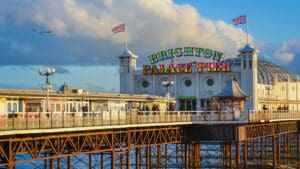
Brighton’s iconic Palace Pier has been put on the market after almost a decade under the ownership of serial entrepreneur Luke Johnson, underscoring the mounting pressure facing Britain’s leisure and hospitality businesses.
The Grade II*-listed attraction, which opened in 1899 and remains one of the UK’s most recognisable seaside landmarks, is being sold by Brighton Pier Group, which has appointed Knight Frank to oversee the sale.
The decision comes against the backdrop of declining footfall, rising employment costs and a sustained squeeze on consumer discretionary spending — a familiar combination for many operators across the UK’s visitor economy.
Anne Ackord, chief executive of Brighton Pier Group, described the pier as “a profitable, standalone business with significant potential”, but acknowledged the “extremely challenging trading environment” now facing leisure assets.
Accounts show that revenues from the pier division fell to £14.9m in 2024, down from £15.6m the previous year. Like-for-like sales declined by 4%, with the business citing a second consecutive summer of poor weather and softer tourism demand in Brighton.
An increase in the admission charge from £1 to £2, introduced in March 2025, helped to partially offset falling visitor numbers, but could not prevent a sharp drop in profitability. Earnings before interest, tax, depreciation and amortisation fell to just £300,000 in 2024, down from £1.7m a year earlier.
The pier had already seen a 3% decline in like-for-like sales in 2023, when train strikes, a fire at a hotel opposite the entrance and adverse weather disrupted trading.
No guide price has been disclosed. Brighton Pier Group acquired the asset in 2016 for £18m, when the company was still trading as Eclectic Bar Group.
In its most recent accounts, published in November, the group booked impairments against the pier, reducing the net book value of the “pier, landing stage and deck” to £13.7m, down from £17.3m the previous year.
At the time, the company said it was actively exploring asset sales in response to “continued cost-of-living pressures”, weaker consumer spending, increases in the national living wage and national insurance contributions, and a reduction in business rates relief, pressures echoed by hospitality and leisure operators nationwide.
Brighton Pier Group is chaired by Johnson, the former owner of PizzaExpress and Patisserie Valerie, who owns more than a quarter of the company. The group also operates bars and mini-golf venues.
Stretching 525 metres into the English Channel, Brighton Palace Pier features 19 fairground rides, two arcades with more than 300 machines, and space for private events. It attracts millions of visitors each year and is widely seen as a barometer for the health of Britain’s seaside and domestic tourism economy.
Ackord said the sale was intended to return capital to shareholders and allow a new owner to take the landmark forward. “This is more than just the sale of an asset, it is an opportunity to shape the next chapter of a national treasure,” she said.
John Rushby, head of specialist leisure at Knight Frank, said the pier represented “a rare opportunity” for investors seeking a heritage leisure asset with strong brand recognition, despite near-term economic headwinds.
Read more:
Brighton Palace Pier put up for sale as rising costs bite leisure sector
HSBC launches bankruptcy proceedings against Barclay brothers over log …

HSBC has initiated bankruptcy petitions against Aidan Barclay and Howard Barclay, marking a further escalation in the unravelling of the Barclay family’s business empire following the collapse of their logistics group.
Court filings show the bank lodged the petitions in the High Court in December, after recovering only about £1.1 million of a £143.5 million secured loan from the administration of Logistics Group.
The business, which owned parcel delivery firms Yodel and ArrowXL, fell into administration in March 2024 after HSBC called in its debt and the group was unable to refinance or repay the borrowing.
Administrators later confirmed that HSBC’s recovery equated to just 0.78p in the pound, with any further returns dependent on an earn-out linked to the sale of remaining subsidiaries. “Future recoveries for the secured creditor are uncertain,” administrators from Teneo said in a filing at Companies House.
ArrowXL was sold in June for an initial £2.2 million to Jacky Perrenot Group, a fraction of the £57.5 million valuation previously ascribed to the business by its directors. Yodel was sold earlier in 2024, shortly before the group entered formal insolvency proceedings.
The bankruptcy action adds to a string of high-profile asset losses for the Barclay family. In recent years they have relinquished control of the Telegraph Media Group and online retailer The Very Group, as lenders moved to enforce security over unpaid debts.
Last month International Media Investments, backed by Abu Dhabi, appointed Interpath to sell property assets held through Trenport Property Holdings, another Barclay-linked vehicle, following the failed sale of the Telegraph.
Aidan and Howard Barclay, the eldest sons of the late Sir David Barclay, were listed as directors of Logistics Group at the time it entered administration. Company filings last year recorded Aidan Barclay’s main residence as Monaco.
The family’s difficulties intensified after lenders including Lloyds Banking Group enforced security over long-running debts in 2023. A proposed £500 million sale of the Telegraph to RedBird Capital collapsed last year due to regulatory obstacles, prolonging uncertainty over the future ownership of the titles.
HSBC declined to comment on the bankruptcy petitions. Aidan and Howard Barclay were approached for comment.
Read more:
HSBC launches bankruptcy proceedings against Barclay brothers over logistics collapse
Baroness Mone allowed to keep £15,000-a-week rent from Belgravia mans …

Baroness Michelle Mone has been permitted to retain rental income of up to £15,000 a week from a luxury London mansion, despite the property being subject to a court-ordered asset freeze linked to the £148 million PPE Medpro scandal.
A judge has approved an amendment to an existing freezing order, allowing rental proceeds from a £25 million Grade II* listed property in Chester Square, Belgravia, to be kept while criminal and civil investigations continue. The property may be rented out but cannot be sold.
The mansion is owned via an Isle of Man-registered company connected to the business empire of Mone’s husband, Doug Barrowman. It was purchased for £9.25 million in December 2020, shortly after PPE Medpro, a consortium led by Barrowman, secured a £122 million government contract to supply surgical gowns during the Covid pandemic. The gowns were later ruled unfit for use.
Court documents, seen by The Times, show the ruling was made during a closed hearing at Southwark Crown Court, where Judge Tony Baumgartner stated that rental income from the property “is not restrained and there is no restriction on the use to which this income may be put”.
The Belgravia property has undergone extensive refurbishment, including the addition of a cinema room, spa facilities and a basement level. It has previously been marketed with an asking price of £25 million.
The amended order forms part of a wider £75 million asset freeze imposed in 2023 while the National Crime Agency investigates the PPE Medpro deal. PPE Medpro was ordered to repay £148 million to the Department of Health and Social Care after losing a High Court case last year, but entered administration the day before the judgment was handed down.
In separate rulings, Mone and Barrowman have also been allowed to rent out multiple other UK properties held via offshore companies, including assets in Glasgow and the Isle of Man. Income from those properties is not restricted, although proceeds from any approved sales must be held under legal supervision.
Other assets covered by the freeze include bank accounts at Coutts, C Hoare & Co and Goldman Sachs, as well as a 39-metre superyacht, Lady M. The order does not extend to a £41 million villa in St Barts or a reported $12.5 million property in Miami.
Barrowman is reported to have received at least £65 million from PPE Medpro, including £29 million transferred into a trust for the benefit of Mone and her children.
Legal experts have previously warned that the government’s ability to recover funds will depend on whether liquidators pursue directors and beneficial owners, a process that could take years and involve significant cost.
Read more:
Baroness Mone allowed to keep £15,000-a-week rent from Belgravia mansion amid PPE investigation
China’s BYD set to overtake Tesla as world’s top electric vehicle …

China’s electric vehicle champion BYD is on course to overtake Tesla as the world’s biggest seller of battery-electric cars, marking a symbolic shift in the global EV race.
The Shenzhen-based group said annual sales of its battery-powered vehicles jumped by almost 28 per cent last year to more than 2.25 million units. By contrast, Tesla is expected to report full-year sales of around 1.65 million vehicles when it releases its 2025 figures later on Friday, based on analysts’ forecasts published last week.
If confirmed, it would be the first time BYD has overtaken its American rival on an annual basis, underlining the rapid rise of Chinese manufacturers in a market long dominated by Western brands.
The milestone caps a difficult year for Tesla, which has grappled with a lukewarm reception to newer models, intensifying competition from lower-priced Chinese rivals and growing unease among some consumers and investors over the political activities of its chief executive, Elon Musk.
Chinese carmakers including BYD, Geely and MG have steadily eroded Tesla’s market share by offering well-specified electric cars at significantly lower prices. In response, Tesla launched cheaper versions of its two best-selling models in the US in October in a bid to reignite demand.
Sales at Tesla slumped in the first quarter of 2025 after a backlash linked to Musk’s role in President Donald Trump’s administration, prompting concerns that his focus was being stretched across too many ventures. Musk later pledged to “significantly” scale back his government involvement.
Despite fierce competition in its home market, which slowed BYD’s sales growth to the weakest pace in five years, the company continues to expand aggressively overseas. It has gained traction across Latin America, South East Asia and parts of Europe, even as governments impose tariffs on Chinese-made EVs.
In October, BYD said the UK had become its largest market outside China, with sales surging 880 per cent year-on-year to the end of September. Demand has been driven in part by the plug-in hybrid version of its Seal U SUV, which has resonated with British buyers seeking lower-emission vehicles without full range anxiety.
While Tesla remains one of the world’s most valuable carmakers, its lead in the electric vehicle market is narrowing as rivals catch up on technology, scale and pricing. For BYD, overtaking Tesla would cement its status as the world’s leading EV producer — and highlight how decisively China has reshaped the global automotive industry.
The question now is whether Tesla can regain momentum through new products such as its Optimus humanoid robot and self-driving “robotaxi” ambitions, or whether BYD’s cost advantage and manufacturing scale will keep it firmly in the lead.
Read more:
China’s BYD set to overtake Tesla as world’s top electric vehicle seller
Ikea pivots to city centres as ‘big box’ era stalls in the UK

Ikea is accelerating its shift towards smaller city-centre stores in Britain, as rising property taxes and changing shopping habits blunt the appeal of traditional out-of-town megastores.
Peter Jelkeby, the outgoing chief executive of Ikea UK and Ireland, said the Swedish retailer would focus future expansion on compact urban formats after strong trading at its new Oxford Street flagship and central Brighton store.
The strategy represents a clear move away from Ikea’s historic “big box” warehouse model, which dominated retail parks for decades and defined the brand’s British expansion from the late 1980s onwards.
While the group has no immediate plans to close existing large stores, Jelkeby confirmed that Ikea does not intend to open any new megastores in the UK.
“We see more potential in opening more smaller stores like Oxford Street and Hammersmith,” he said. “That’s where customers are, and that’s where growth is.”
Jelkeby acknowledged that the rising cost of business rates has played a role in the strategic rethink. Larger retail units typically attract far higher rateable values, leaving operators exposed to disproportionately large tax bills.
Upcoming reforms will intensify that pressure further, with a new surcharge on commercial properties with a rateable value above £500,000. While intended to support smaller businesses, the changes will increase the burden on supermarkets, department stores and warehouse-style retailers.
“We of course want to have lower business rates,” Jelkeby said, adding that reform needs to “come sooner rather than later so the climate for retail can be positive”.
Alongside its city-centre push, Ikea is also experimenting with mid-sized stores in retail parks that sit between its smallest urban outlets and traditional megastores. New sites in Harlow, Norwich and Chester reflect what Jelkeby described as a more flexible approach to bricks-and-mortar retail.
Ikea believes it now has “enough big box” locations across the UK and Ireland, but will continue investing in those sites by improving fulfilment, click-and-collect and in-store services rather than expanding their footprint.
The retailer closed its Tottenham megastore in north London in 2022 after concluding that central, smaller locations offered greater long-term potential in the capital.
The Oxford Street store, which opened in May, has delivered strong sales across furniture, accessories and food, with demand for its restaurant exceeding forecasts.
“We are learning fast,” Jelkeby said. “We’ve had to increase checkout capacity and scale up food operations to cope with footfall.”
The UK business is owned by the Ingka Group, Ikea’s largest global franchisee. Jelkeby will now move to lead Ikea’s German division, where he plans to explore a similar shift, using the UK as a testing ground.
“Germany is our biggest market and more traditional than the UK,” he said. “Britain has allowed us to trial new ways of meeting customers where they are.”
Read more:
Ikea pivots to city centres as ‘big box’ era stalls in the UK
Dream of ‘Europe’s Silicon Valley’ at risk as ministers urged to …

The ambition to turn the Oxford–Cambridge corridor into “Europe’s Silicon Valley” is in danger of stalling unless the government accelerates delivery of long-promised infrastructure, business leaders have warned.
A coalition of major companies, universities and investors has written to Rachel Reeves urging faster progress on transport and planning commitments for the so-called OxCam supercluster, amid growing concern that delays to the East West Rail project are undermining investor confidence.
The warning comes in a report from the Oxford-Cambridge Supercluster, backed by 46 organisations including AstraZeneca, GSK, Airbus and the Ellison Institute of Technology Oxford, founded by US tech billionaire Larry Ellison.
The corridor has been championed by the chancellor as a cornerstone of Labour’s growth strategy, with ministers promising to unlock a projected £78bn boost to the UK economy by 2035 through science, technology and life sciences expansion.
However, the report warns that uncertainty over infrastructure delivery — particularly the East West Rail (EWR) line — risks blunting that potential.
The East West Rail scheme, designed to connect Oxford and Cambridge via Milton Keynes and Bedford, is widely seen as critical to turning the region into a single integrated labour and innovation market.
But concerns are mounting that the project is slipping behind schedule. Industry leaders fear the required development consent order may not be submitted until 2027, meaning final approval could fall beyond the current parliament — putting the government’s 2035 operational target at risk.
Andy Williams, chair of the Oxford-Cambridge Supercluster board and a former senior AstraZeneca executive, said the lack of certainty was already harming confidence.
“Without clarity and pace, we risk killing investor confidence,” he said, warning that trains may not run the full route by 2035 unless action is taken quickly.
The corridor has regained political momentum after being deprioritised under Boris Johnson’s government, when regional “levelling up” became the focus. Business leaders have welcomed Labour’s renewed attention, but say ambition must now be matched by execution.
While the government committed £2.5bn in June’s spending review to progress East West Rail, the report argues that funding alone is not enough without a clear, region-wide delivery plan.
The government has taken some steps, including approving the reopening of the Cowley branch line in Oxford and appointing Lord Vallance as the corridor’s growth champion. Ministers have also promised a more detailed plan this year.
But the report calls for stronger governance across the entire region, alongside an overarching spatial strategy setting out where housing, laboratories and commercial space will be prioritised — and how supporting infrastructure will be delivered.
The report, produced with the Centre for Business Research at the University of Cambridge, shows that economic growth is already spreading beyond Oxford and Cambridge into places such as Milton Keynes and Stevenage, home to a major GSK research site.
The corridor now hosts around 3,000 knowledge-intensive firms, employing 152,000 people and generating £45bn in annual revenues. Employment growth has outpaced the UK average over the past decade.
Shaun Grady, chair of AstraZeneca UK, said East West Rail was “vital infrastructure” needed to connect campuses, labs and cities into a single talent market and ensure scientific advances translate into economic growth more quickly.
Nick Pettit, senior partner at property adviser Bidwells, added that the rail link was the “missing piece” and said the government must provide planning certainty and accelerate delivery of housing and workspace along the route.
A Department for Transport spokesperson said East West Rail remained a “catalyst for growth”, adding that officials were examining how recent planning reforms could be used to deliver benefits sooner.
If completed, the line is expected to cut journey times between Oxford and Cambridge from around three hours to just over 90 minutes — a transformation businesses say is essential if the UK is serious about building a globally competitive innovation corridor.
Read more:
Dream of ‘Europe’s Silicon Valley’ at risk as ministers urged to move faster on OxCam rail link

