
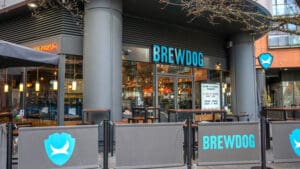
BrewDog has been sold to US cannabis and craft brewing group Tilray in a £33 million rescue deal that will safeguard hundreds of jobs but see 38 bars close with the loss of 484 roles.
The Scottish craft beer brand, founded in 2007 in Aberdeenshire, has been acquired by Tilray Brands, which owns a portfolio of US craft breweries and cannabis operations. Under the agreement, Tilray has purchased BrewDog’s UK brewing business and 11 of its pub venues across the UK and Ireland.
The transaction includes BrewDog’s main brewery in Ellon, Aberdeenshire, and its national distribution centre, The Hop Hub, in Motherwell, Lanarkshire. A total of 733 UK jobs will be preserved, with affected employees transferring to Tilray.
However, administrators confirmed that 38 bars not included in the deal will shut permanently, resulting in 484 job losses. BrewDog’s 18 franchise bars in the UK and overseas will continue trading as normal.
Irwin D Simon, chairman and chief executive of Tilray Brands, described BrewDog as “one of the most iconic, mission-driven craft beer brands in the UK”.
“It helped redefine modern craft beer through bold innovation, fearless creativity and an unwavering commitment to great beer,” he said. “As we begin a new chapter for this great brand, our priority is to refocus BrewDog on the craft beer excellence that made it beloved in the first place and strategically invest to return the operations to profitable growth.”
Simon added that Tilray was committed to ensuring BrewDog continued to “lead and inspire the global craft beer movement”.
The sale follows weeks of uncertainty after BrewDog confirmed it was working with advisers to explore strategic options amid mounting financial pressures. The company temporarily closed all 60 of its UK bars to allow staff to attend internal meetings and to comply with licensing requirements ahead of the anticipated change of ownership.
Chief executive James Taylor told employees that the closures were necessary to ensure staff could be briefed directly on developments and to manage regulatory issues tied to the ownership transition.
The deal comes after a last-minute attempt by BrewDog co-founder James Watt to buy back the company fell through. Watt, who stepped down as chief executive in May 2024 but retains a 22% stake, had been preparing to invest around £10 million of his own money as part of a potential buyout consortium. Sources close to the situation said the proposal did not materialise.
Watt co-founded BrewDog alongside Martin Dickie and built the brand into a global craft beer name through provocative marketing and rapid expansion. In 2017, private equity firm TSG Consumer Partners acquired a 21% stake in a deal that valued the company at more than $1 billion, cementing its “unicorn” status.
In recent years, however, BrewDog has struggled with mounting losses, operational costs and declining bar performance. The company reported a £37 million loss last year on turnover of £357 million, having already closed a number of venues and cut staff.
The business also faces questions from its large base of retail investors. Through its “Equity for Punks” scheme, BrewDog raised approximately £75 million between 2009 and 2021 from more than 200,000 small shareholders, offering them minority stakes and product perks. The long-term implications of the Tilray deal for those investors remain unclear.
Under the transaction, the following UK venues are understood to remain open as part of the Tilray acquisition: Birmingham, Canary Wharf, DogTap Ellon, Dublin, Edinburgh DogHouse, Lothian Road, Manchester, Paddington, Seven Dials, Tower Hill and Waterloo.
The sale marks a significant shift for BrewDog as it moves under American ownership, with Tilray expected to integrate the UK operations into its broader craft and cannabis-focused portfolio while seeking to restore profitability to one of Britain’s best-known beer brands.
Read more:
BrewDog sold to Tilray in £33m rescue deal as 38 bars close and 484 jobs cut
Author: AbellMoney
BrewDog closes all bars for a day amid sale talks as advisers oversee …

Scottish craft beer group BrewDog has closed all of its bars for a day as it seeks to finalise the sale of the business, marking a pivotal moment for one of Britain’s most high-profile independent brewers.
The Aberdeenshire-founded company confirmed that none of its sites would open on Monday to allow staff to attend company-wide meetings and to comply with licensing requirements linked to an anticipated change of ownership.
Chief executive James Taylor told employees in an internal email that the temporary shutdown was necessary to ensure colleagues across the global business could be briefed directly on the next phase of the process.
“We appreciate this is an unsettling time for everyone, and we want to ensure that all colleagues have the opportunity to hear directly from us about what happens next,” he wrote.
“To enable everyone to attend, and to comply with licensing issues arising from an anticipated change of ownership, we have taken the decision that none of our bars will open tomorrow.”
Food and beer deliveries were also cancelled, along with customer bookings for the day.
The development follows BrewDog’s announcement earlier this month that consultants AlixPartners had been appointed to oversee a structured and competitive process to evaluate strategic options, including a potential sale. The move came after the company reported sustained losses in recent years, most recently a £37 million loss in 2024.
Founded in 2007 by James Watt and Martin Dickie, BrewDog grew rapidly from a rebellious challenger brand into a global operator with around 60 bars in the UK and a presence in the US, Australia and Germany. At its peak, the group was valued at more than £1 billion and became a symbol of the craft beer revolution.
However, the company has faced mounting financial and reputational challenges. In October last year it announced job cuts across the business. Earlier this year it confirmed the closure of 10 UK bars, including its flagship Aberdeen site, and halted production of its gin and vodka lines at its Ellon distillery to focus on core beer operations.
BrewDog currently employs approximately 1,400 staff worldwide, with the majority based in the UK.
Corporate law specialists say the bar closures signal that the sale process is entering a more advanced and formal phase.
James Howell, managing director at Rubric Law, said the situation reflects a shift from exploratory talks to a tightly managed M&A campaign.
“What’s happening at BrewDog is a clear example of what unfolds when performance hasn’t met expectations,” he said. “After several years of losses and continued cost pressure, the decision to appoint advisers and run a competitive process is about value discovery and deal certainty, not just finding a buyer.”
“In practice, advisers will structure bidder rounds, control information flow and drive comparable offers. That framework matters even more when profitability is under scrutiny, because it protects value and prevents opportunistic pricing from early bidders.”
He added that buyers are likely to focus heavily on margins, lease exposure and operational efficiency rather than simply brand strength.
“Brand alone cannot bridge gaps in fundamentals,” Howell said. “One of the biggest legal risks in a process like this is weak readiness. If issues surface in due diligence — contracts, governance or shareholder rights — they can quickly affect valuation or derail momentum.”
The company’s ownership structure may also complicate proceedings. BrewDog previously raised capital through its “Equity for Punks” crowdfunding scheme, resulting in a broad base of minority shareholders. Alignment and drag-along provisions will be key to executing any transaction smoothly.
BrewDog’s trajectory has also been shaped by leadership changes. James Watt stepped down as chief executive in 2024, moving to the role of “captain and co-founder”, while Martin Dickie exited the business last year for personal reasons. Watt had faced scrutiny following allegations about workplace culture, highlighted in a BBC documentary, though a subsequent complaint to Ofcom was rejected.
The group’s shift from aggressive expansion to retrenchment mirrors broader pressures in hospitality, with rising costs, softer consumer spending and higher borrowing rates squeezing margins across the sector.
For now, BrewDog insists operations will resume as normal following the one-day closure. But the coordinated shutdown of all bars underscores the seriousness of the moment.
Whether the outcome is a full sale, break-up or recapitalisation, the process marks the end of an era for a brand that once defined Britain’s craft beer insurgency, and now finds itself navigating the realities of scale, profitability and investor expectations.
Read more:
BrewDog closes all bars for a day amid sale talks as advisers oversee potential deal
Gold surges above $5,400 after Trump’s Iran strikes, could prices hi …

Gold has surged back above $5,400 an ounce in early trading following US missile strikes on Iran, prompting fresh speculation over whether the precious metal could break through $6,000 in the coming weeks.
The renewed rally comes after a volatile start to the year for bullion. Gold hit a record high of more than $5,550 in late January, before tumbling sharply to around $4,700 by early February. Silver followed a similar path, sliding from above $120 to roughly $82. Both metals are now climbing again, with silver edging back toward $100.
The latest spike follows coordinated US and Israeli strikes on Iran over the weekend, which reportedly killed Supreme Leader Ayatollah Ali Khamenei and triggered retaliatory action by Tehran against US allies in the Gulf. Tensions around the Strait of Hormuz, a critical artery for global oil supplies, have intensified, pushing oil and safe-haven assets higher.
Market analysts describe the situation as a “classic risk-off scenario”, with investors flocking to traditional stores of value amid fears of broader regional escalation, oil supply disruption and renewed inflationary pressures.
Cameron Parry, founder and CEO of TallyMoney, said the moves were entirely consistent with previous geopolitical crises.
“Both the oil and gold price were up Monday morning, as the Strait of Hormuz and safe-haven assets became the point of focus for markets,” he said. “Geopolitical crises like the one unfolding currently will invariably apply upward pressure on the gold price and that’s precisely what is happening this time round.
“We are in a classic risk-off scenario and gold is the classic go-to asset. Gold was already benefiting from strong demand globally, not just from central banks but also retail investors keen to get exposure in an increasingly volatile geopolitical climate.
“That demand could now spike further as nations and individuals alike seek the safety of the world’s ultimate store of value. Few would bet against gold.”
Riz Malik, director at R3 Wealth, said the scale of any further gains would depend heavily on how long the conflict lasts and how Iran responds.
“Monday morning immediately saw a sharp rise in the demand for gold,” he said. “How much it will rise will depend on how prolonged this campaign is and the level of the Iranian retaliation.
“Once again global instability has been pushed to Defcon 4 and that only means one thing for precious metals. Namely, their price is set to go up.”
However, not all analysts believe a rapid surge to $6,000 is imminent.
Tony Redondo, founder at Cosmos Currency Exchange, said that while the $6,000 mark is conceivable in the near term, it would require sustained escalation.
“Even before Saturday’s military operations in Iran, the price of gold had catapulted up to the $5,300 level, but hitting $6,000 by next week would require a 15 per cent surge, a feat usually reserved for total systemic collapse,” he said.
“However, while $6,000 is unlikely within days, it is a high-probability target for March or April, especially if the Strait of Hormuz is compromised on a longer-term basis or the conflict broadens.”
Redondo added that silver’s structural supply deficit could amplify its price reaction. “Silver is closing in on $100 and its supply constraints make $120 a realistic target in the months ahead as a coiled spring reaction to geopolitical fear,” he said, cautioning that sharp rallies often invite profit-taking.
Others argue that while geopolitical shocks can act as catalysts, deeper macroeconomic forces will ultimately determine gold’s trajectory.
Anita Wright, chartered financial planner at Ribble Wealth Management, said structural pressures in the US financial system were equally important.
“This weekend’s missile strikes will undoubtedly affect the gold price, but it is important not to confuse a catalyst with the underlying driver,” she said. “Gold does not move to $6,000 because of a single weekend’s events. It moves there, if it does, because of monetary conditions.
“The US faces trillions in refinancing requirements alongside persistent fiscal deficits. Foreign appetite for US Treasuries shows visible strain, long-dated yields are rising, and equity valuations remain stretched. History tells us that when bond yields rise into an overvalued equity market, instability follows.”
Wright said that while an immediate jump to $6,000 was unlikely, materially higher gold prices over the medium term were plausible if bond market stress intensifies and the Federal Reserve returns to liquidity support.
Nouran Moustafa, practice principal and IFA at Roxton Wealth, urged investors not to chase sharp moves driven by headlines.
“Gold was expected to open higher as investors moved into safe havens after the latest escalation, and so it did,” she said. “However, a jump to $6,000 in days would require something far more severe such as direct energy supply disruption or broader financial market stress.
“Without that, we’re more likely to see sharp volatility than a sustained vertical rally.”
She warned that emotional investing during times of geopolitical stress can be costly. “Gold can act as portfolio insurance, but chasing rapid spikes rarely ends well. Sensible allocation and risk management matter more than reacting emotionally to breaking news.”
With tensions in the Middle East showing little sign of easing and global markets already on edge, gold’s next move will likely hinge on whether the conflict remains contained — or spills into something far more disruptive for energy markets and global growth.
Read more:
Gold surges above $5,400 after Trump’s Iran strikes, could prices hit $6,000 next?
Kibu secures investment offer from Peter Jones and Jenna Meek after Dr …

Circular tech start-up Kibu has secured an investment offer from entrepreneurs Peter Jones and Jenna Meek following a televised pitch on Dragons’ Den, putting repairable children’s electronics firmly in the national spotlight.
The award-winning brand, which produces modular, repairable headphones for children, appeared on the long-running BBC programme represented by co-founder and chief executive Sam Beaney. Kibu’s pitch focused on its mission to redesign children’s consumer electronics around circular principles, prioritising disassembly, repair and customisation over disposal.
Founded through a collaboration between London-based design studio Morrama, advanced manufacturing partner Batch.Works and Beaney, Kibu first launched via a successful Kickstarter campaign. Since then, the company has transitioned from prototype to scalable commercial product, positioning itself as a challenger brand in a sector dominated by low-cost, disposable devices.
Kibu’s headphones are built with modular components that can be taken apart and reassembled by children. Individual parts can be replaced in minutes, extending product lifespan and reducing electronic waste. The design also allows for aesthetic customisation, enabling users to change colours and update components as preferences evolve.
The brand has already received international recognition for innovation and sustainability, tapping into growing parental demand for durable, repairable products in an era of heightened environmental awareness.
Speaking during the broadcast, Jones praised the concept and offered backing, citing his own early experience building and selling computers as a teenager. Meek also expressed interest in supporting the venture.
Beaney told the Dragons that empowering children to build and repair their own technology shifts their relationship with ownership and value. “When a child builds something themselves, it changes how they feel about it. When they learn they can fix what they’ve made, it changes how they see everything they own,” he said.
Jo Barnard, founder and creative director of Morrama, described the brand as a blueprint for futureproof electronics. By combining onshored manufacturing with agile supply chains, she argued, Kibu could unlock wider opportunities across children’s consumer technology.
Julien Vaissieres, chief executive of Batch.Works, said the project demonstrated how manufacturing can be structured to reduce waste while maintaining commercial viability. As both a founder and a parent, he said, the appeal lay in giving children agency over the products they use daily.
Now in its 23rd series, Dragons’ Den remains one of the UK’s most visible entrepreneurial platforms, attracting around three million viewers per episode on BBC One. For Kibu, the appearance offers both capital and brand recognition at a pivotal growth stage.
With investor backing now on the table, Kibu plans to scale distribution while continuing to develop its circular design ethos. The company believes its repair-first approach could extend beyond headphones into a broader range of children’s electronics, an industry segment increasingly scrutinised for its environmental footprint.
As sustainability pressures intensify and right-to-repair legislation gains momentum across global markets, Kibu’s model may offer an early glimpse of how future consumer electronics for children could be designed, manufactured and owned.
Read more:
Kibu secures investment offer from Peter Jones and Jenna Meek after Dragons’ Den pitch
UK car production falls 13.6% in January as exports slide

Society of Motor Manufacturers and Traders (SMMT) has reported a sharp contraction in UK vehicle output at the start of the year, with total production down 13.6 per cent in January as weaker export demand weighed heavily on the sector.
A combined 67,415 vehicles left British factories during the month, comprising 65,249 cars and 2,166 commercial vehicles. Car production declined by 8.2 per cent compared with January 2025, while commercial vehicle output slumped by 68.6 per cent year on year.
The fall was primarily driven by reduced overseas demand. Although domestic appetite for UK-built cars remained broadly stable, export volumes softened, particularly in markets outside Europe. Exports typically account for the majority of British vehicle production, leaving manufacturers exposed to fluctuations in global demand and trade conditions.
The United States remained the second-largest destination for UK-built cars after the European Union, accounting for 14.1 per cent of exports. Japan followed with a 2.7 per cent share, while China and Turkey took 2.5 per cent and 2.4 per cent respectively.
Electrified vehicle output also declined. Production of battery electric vehicles (BEVs), plug-in hybrids and hybrid models fell by 10.6 per cent to 26,854 units, representing 41.2 per cent of total car output. Despite the drop, electrified vehicles continue to form a substantial share of UK production as manufacturers transition towards zero-emission platforms.
The industry body said the weak start to the year reflected subdued global demand and underlined the importance of stable trade relationships. Protectionist measures and “made in Europe” proposals in some markets were cited as additional headwinds.
Mike Hawes, chief executive of the SMMT, described January’s figures as disappointing but pointed to expected recovery later in the year as new electric models enter production.
“Weak exports to markets beyond Europe amid soft demand delivered a disappointing start to the year for UK vehicle manufacturing,” he said. “It reinforces the need for a forward-looking trade agenda that secures existing preferential access and builds new ones with markets worldwide.”
The SMMT expects overall car production to increase by more than 10 per cent to around 790,000 units in 2026, with the potential to reach one million vehicles by 2027, provided new model launches proceed on schedule and investment conditions remain supportive.
The outlook hinges on competitive energy costs, a strong domestic market and targeted supply chain support, the trade body said, as the sector continues its capital-intensive shift towards electrification.
Read more:
UK car production falls 13.6% in January as exports slide
Hornby steers sale of near 70-year-old toy brand Scalextric for £20m

Hornby has agreed to sell the iconic slot car racing brand Scalextric for £20 million in a move designed to strengthen its balance sheet and refocus the business on its core brands.
The Margate-based toy maker has struck a deal with family-owned investment vehicle Purbeck Capital Partners, which will acquire Scalextric and its associated intellectual property through a newly formed holding company, Scalextric Motorsports.
The transaction, which includes a mix of upfront and deferred payments, will see Hornby use the proceeds to reduce debt and invest in its remaining portfolio, including Airfix and its model railway operations. Hornby is backed by Frasers Group founder Mike Ashley.
Scalextric was first introduced in 1957 by inventor Fred Francis and quickly became a staple of British toy cupboards, allowing families to race miniature cars around electric tracks at home. Production was later moved to Hornby’s Margate factory, where the brand became synonymous with hands-on motorsport fun for generations.
Purbeck Capital is led by Mark Brown, the former chief executive of US spirits giant Sazerac, which owns brands such as Southern Comfort and Fireball. The Scalextric acquisition marks Purbeck’s first deal.
Brown said the firm was “honoured and thrilled” to acquire such a long-standing British motorsport brand, describing Scalextric as a business that has brought families together for nearly seven decades.
“As we look to a long-term future, with Scalextric as a now family-owned company, we are energised by the opportunity to continue bringing competitive racing fun to families, while expanding into new areas of motorsport,” he said. He added that the brand also has scope to promote physical play and hand-eye coordination at a time when many families are seeking to balance screen time with real-world activities.
As part of the agreement, Brown will also take on a role supporting Hornby with its wider strategic transformation plans. The aim is to create a group structure in which individual brands can operate more independently and profitably.
The disposal reflects Hornby’s ongoing efforts to stabilise its finances after a challenging period for the traditional toy sector, which has faced rising input costs, changing consumer habits and intense competition from digital entertainment.
By divesting Scalextric, Hornby is betting that a sharper focus on its core modelling brands, combined with a stronger balance sheet, will position the near century-old business for a more sustainable future, even as one of its most recognisable names embarks on a new chapter under separate ownership.
Read more:
Hornby steers sale of near 70-year-old toy brand Scalextric for £20m
MPs back Doug Gurr for CMA chair but demand safeguards over conflicts …

MPs have approved Doug Gurr as fit to become the next permanent chair of the Competition and Markets Authority (CMA), but warned ministers that additional safeguards are needed to protect the regulator’s independence and address potential conflicts of interest.
In a report published on Thursday following a pre-appointment hearing earlier this week, the House of Commons Business and Trade Committee said it was satisfied that Mr Gurr has “the professional competence and independence required” to take on the role as defined by the Government. However, the committee stressed that serious concerns remain about the context of his appointment and the broader direction of competition policy.
Mr Gurr, a former senior executive at Amazon, was questioned extensively by MPs about his ability to act independently, particularly given the circumstances surrounding the removal of the previous chair amid pressure to align the watchdog more closely with the Government’s pro-growth agenda. Committee members made clear that the CMA must not prioritise investment or consolidation over consumer welfare, warning that growth cannot come at the expense of competition.
MPs also expressed unease about potential conflicts of interest arising from Gurr’s long and senior career at Amazon, one of the world’s largest technology companies and a business that could fall within the CMA’s new digital market regime. The committee suggested ministers consider whether he should recuse himself from any future decision about designating Amazon with Strategic Market Status under the Digital Markets, Competition and Consumers Act 2024.
The hearing also became a wider examination of the CMA’s recent performance. MPs noted that staff numbers at the regulator have almost doubled over the past decade, yet competitive pressures in the UK economy have not improved. They criticised what they described as slow market investigations during the cost-of-living crisis and weak enforcement action in certain high-profile cases.
Concerns were also raised about the CMA’s handling of digital competition issues, including delays in seeking remedies from Google over its relationship with news publishers and the limited commitments secured from Google and Apple regarding their mobile ecosystems. The committee questioned whether the watchdog had been sufficiently assertive in deploying its new statutory powers.
Internal challenges within the CMA were also highlighted. A recent budgeting error forced a 10 per cent reduction in staff, and internal surveys suggest that only around a quarter of employees expect to remain at the organisation for the next three years. MPs indicated that rebuilding morale and confidence inside the regulator would be a significant task for the new chair.
Another issue scrutinised during the hearing was the time commitment attached to the role. The CMA chair is currently expected to dedicate two days a week to the position. The committee questioned whether that allocation is sufficient for a regulator operating at the centre of politically sensitive and economically significant decisions, particularly during periods of crisis or intense scrutiny.
While the committee ultimately endorsed Mr Gurr’s appointment, it warned that it is “not the hallmark of a robust recruitment process” to have secured only one appointable candidate for such a critical role.
Liam Byrne, the committee’s chair, said the CMA sits at the heart of whether markets work for consumers or against them. He said that although Mr Gurr is professionally competent to take on the job, ministers must take steps to maximise confidence in the appointment.
“Growth cannot mean greater concentration,” Byrne said. “Investment cannot come at the expense of consumer welfare. And operational independence must be protected in fact, not just in theory.”
The final decision now rests with the Business Secretary, but the committee’s report makes clear that Parliament will be watching closely to ensure that the CMA remains an independent and effective guardian of competition in the UK economy.
Read more:
MPs back Doug Gurr for CMA chair but demand safeguards over conflicts and independence
Ocado to axe 1,000 jobs in cost-cutting drive

Ocado Group is preparing to cut 1,000 jobs over the next year as it accelerates a cost-cutting drive aimed at stabilising finances and restoring investor confidence.
The reductions, equivalent to around 5 per cent of its global workforce , will fall heavily on the UK, with roughly two-thirds of the affected roles based domestically. Most of the cuts are expected at the company’s headquarters in Hatfield, Hertfordshire, and will largely impact technology and support functions.
The announcement came alongside Ocado’s full-year results, which revealed widening losses despite revenue growth.
Chief executive Tim Steiner said a “significant number” of roles would no longer be required as part of a broader restructuring to align the business with a lower cost base.
“These changes reflect the lower structural cost base that we have signalled over recent years,” Steiner said. “Regrettably, this means a significant number of roles will no longer be required. We will support those impacted through this process.”
Ocado said the measures are expected to generate annual cost savings of approximately £150 million.
The group employs around 20,000 people worldwide, the majority in the UK. The job losses follow several years of strategic recalibration as the company grapples with underperformance in its international technology partnerships.
For the year to 30 November, Ocado reported group revenues of £1.36 billion, up 12 per cent year-on-year. However, pre-tax losses at continuing operations widened to £377.6 million, compared with a £339.8 million loss the previous year.
The company has been under mounting pressure after setbacks in North America. US grocery chain Kroger confirmed it would close three automated customer fulfilment centres operated by Ocado after sales fell short of expectations. In January, Canadian retailer Sobeys announced the closure of its Calgary facility.
These developments have shaken confidence in Ocado’s technology-led global expansion model, which had once positioned the company as a disruptive force in grocery logistics.
By midday trading, Ocado shares had fallen more than 7 per cent, extending a sharp decline over the past 12 months.
Chris Beauchamp, chief market analyst at IG, said Ocado’s early-mover advantage in grocery delivery had eroded as established supermarket chains developed in-house technology.
“For a company once seen as the future of supermarket delivery, its fate has been overtaken by its more pedestrian, but larger, rivals,” he said.
“Rather than use Ocado’s technology, they have instead built their own and simply bypassed the newcomer, leaving Ocado as the great white elephant that failed to deliver.”
Traditional supermarket operators have increasingly invested in their own distribution infrastructure, leveraging scale and existing store networks rather than outsourcing to Ocado’s robotics-led model.
The scale of the job losses has prompted concern in Hatfield, where Ocado’s headquarters has been a significant local employer.
Andrew Lewin, Labour MP for Hatfield, described the cuts as “a serious setback”.
“Hatfield has been Ocado’s HQ for many years and people from our community have been integral to the growth and success of the business,” he said. “Ocado’s decision to cut hundreds of local jobs will hit hard.”
The announcement underscores broader pressures in the UK retail and grocery sector, where businesses are facing rising operating costs, technological change and cautious consumer spending.
Separately, Sainsbury’s confirmed that up to 300 roles are at risk as it restructures its technology and data divisions across its supermarket and Argos operations.
Ocado, which operates its own online grocery joint venture with Marks & Spencer alongside its technology licensing arm, now faces the challenge of proving that its capital-intensive robotics model can deliver sustainable returns in a more competitive and cost-sensitive environment.
The coming year will test whether aggressive cost discipline and restructuring can reposition the company for profitability — or whether further retrenchment lies ahead.
Read more:
Ocado to axe 1,000 jobs in cost-cutting drive
Nearly one million young people out of work or education as Neet rate …

The number of young people not in education, employment or training has edged closer to one million, underlining mounting pressure on Britain’s fragile labour market and intensifying calls for targeted intervention from ministers.
Official figures from the Office for National Statistics (ONS) show that an estimated 957,000 people aged 16 to 24 were classified as Neet between October and December 2025. That represents 12.8 per cent of the age group, a slight rise on the previous quarter and perilously close to the one-million mark last seen in the aftermath of the global financial crisis.
While the total is marginally lower, by 0.4 percentage points, than the same period a year earlier, the quarterly increase reflects persistent weakness in youth employment prospects, particularly as hiring in hospitality, retail and graduate schemes continues to contract.
The ONS said the latest uptick was driven primarily by a rise in the number of young women classified as Neet. At the end of 2025, 12.2 per cent of young women were not in work, education or training, up on the previous quarter. By contrast, the number of young men in the same category fell slightly.
A young person is considered Neet if they are unemployed and actively seeking work, or economically inactive, meaning they are not seeking work and are not enrolled in education or training. The data shows that the number of unemployed Neets rose 12.3 per cent quarter-on-quarter, while economically inactive Neets fell by 6.6 per cent, suggesting more young people are attempting to re-enter the labour market but struggling to secure roles.
The UK jobs market remains subdued, with vacancies recently falling to their lowest levels in five years. Youth unemployment has been disproportionately affected by employers cutting entry-level hiring in response to rising wage costs and increased national insurance contributions.
Research from the Youth Futures Foundation has pointed to long-term sickness, mental health challenges and neurodivergence as key contributors to rising economic inactivity among young people in recent years.
Joseph, 24, from Solihull, who is autistic and has been unemployed for three years, described the difficulty of breaking into the workforce.
“There’s a real taboo around needing experience to get a job, but only being able to gain experience through a job,” they said. “Confidence can definitely be an issue. I’ve only ever worked one job that’s in person. I didn’t know how things worked, the commute into work, that sort of thing.”
Joseph said autism “can be a barrier but it can also be a strength”, adding that many employers fail to understand this. They are currently being supported by a youth worker from The King’s Trust to help secure paid employment.
Work and Pensions Secretary Pat McFadden acknowledged that youth inactivity represents “a long-term challenge” and said the government was backing apprenticeships and paid work placements.
Chancellor Rachel Reeves has pledged that young people who have been out of work or education for 18 months will be offered a guaranteed paid placement. Those who refuse may face benefit sanctions, a proposal that has drawn criticism from some campaigners.
An independent inquiry into the rise in youth inactivity, led by former Labour health secretary Alan Milburn, is under way and due to report this summer. Milburn has said he will examine systemic failings across employment support, skills provision, health and welfare.
Louise Murphy, senior economist at the Resolution Foundation, warned that the UK was “perilously close” to a youth unemployment crisis.
“Today’s data adds to the picture of a generation up against real and complex barriers to finding a good job and improving their living standards,” she said. “Acting sooner rather than later can help prevent these worrying trends becoming an entrenched crisis.”
The think tank has urged Reeves to make an exception to her policy-light Spring Statement and introduce additional measures to tackle youth unemployment directly.
The data also adds to pressure on ministers over plans to scrap the lower minimum wage rate for 16 and 17-year-olds. Some employers argue that equalising rates would make it too costly to hire younger workers at a time when margins remain tight.
Government sources have indicated that while ministers are reluctant to abandon the pledge, a delay is under consideration.
Ben Harrison, director of the Work Foundation at Lancaster University, said the figures demonstrated “the magnitude of the challenge facing young people and the government”.
“There is a considerable risk that more young people will slip into long-term worklessness unless government acts to address the causes of this rise,” he said.
The last time the number of young Neets exceeded one million was between July and September 2011, in the prolonged aftermath of the 2008 financial crisis. Analysts warn that sustained weakness in entry-level recruitment risks scarring a generation, with long-term consequences for earnings and productivity.
The ONS cautioned that Neet figures can be volatile due to the smaller sample size relative to broader unemployment data. The statistics are derived from the Labour Force Survey, which has faced scrutiny over response rates and data quality in recent years. The ONS says it is working to improve the survey through increased interviewer recruitment and methodological reforms.
For now, however, the headline figure, nearly one million young people disconnected from work or education, stands as a stark reminder of the fragility of Britain’s youth labour market.
Read more:
Nearly one million young people out of work or education as Neet rate edges higher

