
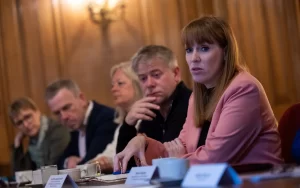
Companies may soon be required to offer regular contracts to workers on zero-hours agreements after just three months, under proposed reforms being discussed by the Labour Government.
Deputy Prime Minister Angela Rayner and Business Secretary Jonathan Reynolds informed business leaders and unions in a private meeting that new legislation could oblige employers to offer zero-hours staff a regular contract with guaranteed hours after 12 weeks. The move is part of Labour’s wider push to end “exploitative” employment practices, though details are still being finalised ahead of the unveiling of the employment rights bill next month.
The three-month threshold follows the example set by McDonald’s, which in 2017 gave staff the option to switch to contracts with minimum guaranteed hours. Most employees chose to remain on flexible terms, but the initiative has been cited as a model for balancing worker protections with business needs.
Sources involved in the discussions said opinions were split, with some business leaders suggesting a longer qualifying period and union representatives advocating for a shorter time frame. A Whitehall insider explained that the three-month proposal was designed to prompt clearer responses from businesses, with further details to be developed later.
Labour has pledged to clamp down on “one-sided flexibility” in the workplace. Proposals include requiring employers to compensate staff for late-notice shift cancellations, preventing workers from being financially disadvantaged when shifts are dropped last-minute. While Labour originally considered a full ban on zero-hours contracts, it has backed away from this after resistance from businesses, particularly in the hospitality and leisure sectors, which argue that the contracts offer valuable flexibility for both workers and employers.
The discussion over zero-hours contracts is part of Labour’s promise to deliver the largest overhaul of workers’ rights in decades. However, business leaders have expressed concern about the potential costs of the reforms. The Confederation of British Industry (CBI) reported that only 26 per cent of businesses feel confident they can absorb the financial impact without harming growth, investment, or jobs.
Tensions have also emerged within the Government over how to handle probation periods in the new system. Rayner is pushing for full employment rights from day one, after a short probation, while Reynolds reportedly favours a longer probation period, potentially lasting up to nine months.
The Government’s flagship employment rights bill is expected to be unveiled in the coming weeks, as ministers work to reconcile business concerns with their commitment to improving worker protections.
Read more:
Zero-hours contract crackdown: staff could be offered fixed hours after three months
Category: Uncategorized
When accountability fades: The toxic reality facing Bramley and beyond

Bramley, a picturesque Surrey village, has found itself the unfortunate poster child for a modern malady plaguing Britain: the disappearance of accountability.
What began as a mysterious stench in a pub’s cellar has morphed into a full-blown ecological and bureaucratic disaster, with petrol seeping into the earth and local authorities shrugging their shoulders. A petrol station once owned by the Co-op and now run by Asda has been leaking fuel for years, causing significant damage to the environment, residents, and their livelihoods. But the most disturbing part of the saga? No one wants to take responsibility.
To outsiders, the story of Bramley’s woes reads like a Kafkaesque nightmare. A broken pipe beneath the Asda forecourt leaked fuel into the village’s water system, contaminating supplies, killing fish, and forcing the replacement of pipes. Since May, 600 households have been unable to drink their tap water safely. Thames Water is doing what it can, but residents are left with a village scarred by constant roadworks and disrupted businesses, while their homes may now sit on a toxic petrol slick. Their concerns about property values seem to fall on deaf ears.
Asda, the petrol station’s current owner, has masterfully distanced itself, labelling the problem “historic.” The supermarket chain is now majority-owned by private equity giant TDR Capital, a fact that only compounds the sense of faceless corporate negligence. Meanwhile, Surrey County Council passes the buck to Waverley Borough Council, which claims no authority to intervene. The Environment Agency, citing an ongoing investigation, remains silent, while the UK Health Security Agency asserts that its role is “advisory rather than regulatory.”
Asda’s chairman, Lord Rose, who it was revealed this week is taking over from Mohsin Issa, told a residents’ meeting in the village there would be ‘no quick fix’.
To the residents of Bramley, this constellation of agencies, councils, and companies exists in theory to protect them. Yet, when their small village was thrust into crisis, each body pointed fingers elsewhere, leaving the villagers to face an unnerving reality: when something goes wrong, no one is prepared to take responsibility. It’s not just a localised problem, either—it’s emblematic of a much wider issue across Britain today.
This shift away from accountability is something Dan Davies explores in his book The Unaccountability Machine, which paints a bleak picture of how big systems are structured to avoid responsibility. The Kafkaesque dance of passing the buck seen in Bramley is a perfect example of what Davies terms an “accountability sink”—a place where decision-making is so fragmented that no one is ever to blame when things go wrong. Bramley has become an unwitting symbol of this modern malaise, where sprawling bureaucracies and corporations have lost the ability, or perhaps the will, to respond to human problems with anything other than indifference.
The Bramley saga is not just a freak occurrence; it is the result of a long-developing trend towards unaccountability. It’s a mindset that began in the early days of corporate structures, as limited liability allowed investors to reap the rewards of risk without bearing the full consequences of failure. Davies explains that this made sense when the risk was spread across individual shareholders, like a widow investing her savings in a railway company. However, in today’s world, it’s private equity giants and multinational corporations benefiting from these protections—shielded from blame when things go wrong.
So, what happens when the system becomes so unwieldy that the feedback loops between action and consequence break down entirely? For the residents of Bramley, it means they’re left navigating a labyrinth of agencies and authorities, none of which seem to have any real interest in fixing the problem. Companies like Asda, backed by private equity, are happy to assert that the issue predates their ownership, leaving villagers frustrated and feeling abandoned. It’s a game of pass-the-parcel with no winner, only losers.
Davies suggests that systems built to manage the complexity of the modern world often sever the direct link between decision-making and responsibility. As organisations grow and processes become more industrialised, those within them lose their sense of agency. It’s not that no one cares—it’s that they are operating in a framework designed to prevent anyone from caring. This is what Davies likens to a “decerebrate cat”—a system that can function, in a technical sense, but without the ability to respond meaningfully to real-world issues.
For the people of Bramley, this cold, dispassionate system is all too real. They face the frustration of speaking to low-level functionaries who simply lack the power or authority to take decisive action. In many ways, the problem goes beyond the specifics of the petrol leak: it speaks to a much larger crisis in our institutions and corporations, where the drive for efficiency and profit has rendered human-scale problems invisible.
What is particularly damning is the realisation that this could have been avoided if someone, somewhere, had cared enough to act sooner. In a simpler time, a leak would have been fixed, apologies made, and compensation offered. But now, even determining who owns the problem feels impossible. The residents are left in a void, where corporate interests, local government, and national agencies all pretend the matter is someone else’s to solve.
The truth is, the system has been designed to fail them. The rise of private equity ownership, the fracturing of regulatory responsibility, and the erosion of local authority power all contribute to a culture where it is easy to evade responsibility. And unless something changes, Bramley’s experience will not be unique. Other villages, towns, and cities across the country may soon find themselves entangled in similar webs of indifference and inaction.
The plight of Bramley is a warning. It shows what happens when responsibility is allowed to slip through the cracks, when systems are designed to protect organisations rather than the people they serve. If we don’t start addressing these accountability sinks, the question won’t be whether another village suffers, but how soon it happens.
Read more:
When accountability fades: The toxic reality facing Bramley and beyond
Wales considers 25% income tax cut to tackle rural depopulation and †…

The Welsh Government is weighing the introduction of tax breaks to stem the tide of people leaving the country, particularly from rural areas, and to preserve the Welsh language.
Inspired by the Castilla-La Mancha region in Spain, where a 25 per cent income tax reduction is offered to residents in rural areas, the Commission for Welsh-speaking Communities has recommended a similar approach to boost economic and social activity in parts of Wales affected by depopulation. The commission, which was established in 2022, argues that such tax incentives could help prevent young people from leaving, which would support both the economy and the survival of the Welsh language.
A recent survey showed that 81 per cent of young people in western Wales feel the need to leave rural communities to advance their careers. Ben Lake, Plaid Cymru MP for Ceredigion Preseli, recently raised concerns in the Commons, warning that depopulation is causing a “collapse of public services” in parts of Wales.
Over 200 rural wards have seen population declines in the past decade, with many young people moving to England. To reverse this trend, the commission suggested that the Welsh Government could explore financial incentives similar to those in Castilla-La Mancha, where residents receive significant tax breaks to encourage them to stay. In Wales, such a policy would eliminate income tax for basic-rate payers and provide substantial savings for higher earners.
However, tax experts have raised concerns. Chris Etherington, of tax advisory firm RSM, noted that while tax cuts could be a motivator, there is limited evidence to show they are effective in preventing depopulation. Rachael Griffin, a tax expert at wealth manager Quilter, warned of potential “unintended consequences,” such as complications with pension tax relief and the potential for rising property prices if wealthier individuals were drawn to the area.
The Welsh Government has yet to decide on the commission’s 50 recommendations, which aim to tackle outmigration and bolster rural communities. A spokesperson said they are considering the findings and will respond in due course.
Read more:
Wales considers 25% income tax cut to tackle rural depopulation and ‘brain drain’
Calling all solopreneurs: Create your business manifesto and win £10, …

Aspiring solopreneurs and small business owners are being offered a life-changing opportunity to accelerate their entrepreneurial dreams, thanks to Adobe’s new Manifest-o Method.
This framework, designed by experienced business professionals and powered by Adobe Express, helps transform ideas into actionable business plans.
Available now on the Adobe website, the Manifest-o Method is launching with an exciting opportunity to accelerate one inspiring business idea into reality. The prize? £10,000, access to a network of like-minded individuals, and personal counsel from Steven Bartlett himself.
Until October 13th, aspiring entrepreneurs can enter a first-of-its-kind competition by submitting their own manifesto. Powered by Adobe Express, the Manifest-o Method comes in six templates for inspiration and gives you the option to create your own from scratch.
With Adobe Express, anyone can create professional assets for their small business – whether it’s social posts, videos, food menus, labels or presentation slides – without any prior design experience, and at no cost. This makes it the perfect tool for crafting your own manifesto.
In addition to the cash prize, the winner will also score an invitation to an exclusive event with entrepreneur and best-selling author Steven Bartlett.
The winner will also have a chance to join The Express Collective — an exclusive group of like-minded individuals who already use Adobe Express for their businesses, from food trucks to unique drinks, custom stationery and clothing.
Joining The Express Collective will provide the winner with access to community events, technical workshops, and mentors that will create opportunities for advancing any business idea through practical advice, free tools and networking.
According to research commissioned by Adobe, over half of Brits (52%) believe in the power of manifestation to achieve their dreams, with younger generations leading this trend.
While some may manifest love, travel or a shiny new car – 60% of those surveyed revealed that they manifested becoming business owners, demonstrating the growing importance of confidence and visualisation to turn dreams into reality. And it’s clear manifestation is far from just wishful thinking.
Truly, if you can believe it, you can achieve it, right?
What is manifestation?
To ‘manifest’ is to bring something into reality using your thoughts and actions to create the life you’ve always dreamed of. While the concept isn’t new, recent research highlights how today’s business owners are harnessing this power to stay focused on their goals.
Successful entrepreneurs understand the value of creating a manifesto – according to the research, 61% of solopreneurs believe their business would benefit from a clear manifesto outlining their intentions and goals.
Furthermore, 53% of investors now look for a clear manifesto in business proposals, while 73% believe a manifesto has a greater impact on long-term success than a traditional business plan.
Ready to enter this life-changing competition?
Existing and aspiring solopreneurs and small business owners are called upon to create their own manifestos using Adobe Express, the quick and easy create-anything app, and submit them via a dedicated website at submityourmanifesto.co.uk.
The grand prize winner will get the £10,000, with runner-up prizes including Adobe Express Premium subscriptions. These subscriptions offer an even wider range of templates for inspiration, customisation options, collaboration features, access to a library of high-quality stock photos, and much more.
Want to learn more? Visit the Adobe Express Manifest-o Method web page here to discover the best way to create your own manifesto to help you achieve business greatness and details on how to enter.
Terms and conditions apply – find those here. Competition runs from 17 September to 13 October, 2024.
Read more:
Calling all solopreneurs: Create your business manifesto and win £10,000 with Adobe
Tax incentives and finance access top SMEs’ priorities ahead of autu …

As the autumn budget looms, tax incentives and improved access to finance have emerged as key demands from UK SMEs, according to new research from Bibby Financial Services (BFS).
The latest SME Confidence Tracker reveals that while business optimism has rebounded post-election, small business leaders are calling on the government to address critical financial barriers to unlock growth.
The survey of 1,000 SMEs found that 68% expect sales to increase over the next six months, a 7% rise since March 2024. With stabilising inflation and lower interest rates, 63% of SME leaders now feel more confident about making capital investments, while 52% are more likely to pursue major investments following the General Election.
However, concerns persist about the potential for tax hikes in the upcoming budget, with 87% of respondents calling for better tax incentives, and 81% advocating for access to low-interest financing to support expansion and job creation.
Derek Ryan, UK Managing Director of BFS, urged the government to honour its commitment to small businesses, saying: “SMEs are finally feeling confident enough to invest, but the Prime Minister’s warning of a ‘painful’ budget risks undermining this. Supporting SMEs must remain central to the government’s economic growth plan.”
Access to finance remains a significant challenge, with 49% of SMEs describing the finance landscape as complex, and 80% seeking better educational resources for navigating funding options. While commercial finance approvals have risen, many SMEs still find the process daunting, with only 18% having utilised the Bank Referral Scheme.
The Labour Party’s proposals to improve SME financing through reforms to the British Business Bank and the Bank Referral Scheme are seen as promising, but experts like Sandeep Dhillon, CEO of SME marketplace Talmix, stress the need for immediate clarity on tax policies and financial support, particularly for the tech sector, where investment has waned.
Read more:
Tax incentives and finance access top SMEs’ priorities ahead of autumn budget
Government targets large firms in crackdown on late payments to small …

The UK government is set to introduce new measures aimed at tackling late payments by large firms to small businesses, an issue that contributes to the collapse of 50,000 SMEs every year.
On average, delayed payments cost small businesses £22,000 annually, according to research from the Department for Business & Trade (DBT) and the Federation of Small Businesses.
A consultation has been launched to explore “tough” new laws designed to hold larger companies accountable for late payments, while requiring greater transparency in their payment practices. Under the proposed rules, large firms will be obligated to include payment data in their annual reports, enabling closer scrutiny of their dealings with smaller suppliers.
Previous attempts to address the issue, including the introduction of the “duty to report” legislation in 2017, have seen limited success. Research by the Chartered Institute of Procurement & Supply found only a slight improvement in the payment behaviour of large companies over the past five years, highlighting widespread non-compliance.
Prime Minister Sir Keir Starmer emphasised that eliminating late payments is central to the government’s strategy to support small business growth. “Late payments cost businesses tens of thousands of pounds and are one of the biggest reasons for business failure. We are finally bringing forward the measures that small businesses have been calling for,” he said.
Business Secretary Jonathan Reynolds echoed this sentiment, describing late payments as “simply unacceptable” and stressing the importance of holding larger firms accountable for their payment practices.
In addition to the proposed legal reforms, the government will also enhance enforcement efforts against large firms that fail to report their payment performance as required. Company directors could face criminal prosecution and unlimited fines if they breach the reporting rules. A new fair payment code will be introduced, awarding businesses gold, silver, or bronze status based on their payment standards.
Read more:
Government targets large firms in crackdown on late payments to small businesses
Asda co-owner Mohsin Issa steps back as Lord Rose takes temporary char …

Asda’s co-owner, Mohsin Issa, is stepping away from his role in the day-to-day management of the UK’s third-largest supermarket, despite the fact that a permanent chief executive has yet to be appointed.
This move allows Issa to focus on his position as CEO of EG Group, which operates petrol stations and convenience stores across Europe, the US, and Australia.
In his absence, Asda Chairman Lord Rose of Monewden, formerly CEO of Marks & Spencer, will take over Issa’s responsibilities, working alongside Rob Hattrell, a partner at TDR Capital—Asda’s majority stakeholder—and a director on the supermarket’s board. Issa will remain a non-executive director and co-owner of Asda, holding a 22.5% stake in the company.
The decision comes at a challenging time for Asda, with the retailer seeing a 6% drop in sales over the past 12 weeks, pushing its market share down to 12.6%, compared to 13.7% a year ago. Rivals Tesco, Sainsbury’s, and Morrisons have made gains, adding pressure on Asda’s leadership.
Issa’s decision to step back follows calls from Lord Rose, who publicly expressed disappointment over Asda’s shrinking market share, urging Issa to prioritise his role at EG Group. Issa’s brother, Zuber, who previously co-owned 22.5% of Asda, sold his stake to TDR Capital earlier this year to focus on his other business ventures.
Lord Rose expressed gratitude for Mohsin Issa’s contributions, particularly in launching Asda’s convenience store initiative and the rollout of a loyalty app now used by over six million customers. Issa is set to become the sole CEO of EG Group when his brother steps down from the role next month, after the completion of a deal to sell EG’s remaining UK forecourts.
Read more:
Asda co-owner Mohsin Issa steps back as Lord Rose takes temporary charge
‘Significant action’ needed to stabilise UK finances, warns OECD
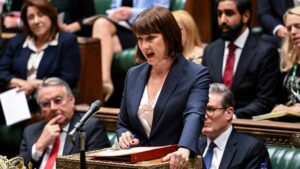
The Organisation for Economic Co-operation and Development (OECD) has warned that “significant action” is required to stabilise the UK’s public finances, urging Chancellor Rachel Reeves to reform fiscal policy.
The OECD recommends scrapping stamp duty, scaling back the pension triple lock, and updating the council tax system.
The report highlights mounting financial pressures from healthcare, pensions, and climate change, which come on top of high debt, rising interest payments, and sluggish economic growth. It follows warnings from other institutions about Britain’s unsustainable debt, with the Office for Budget Responsibility recently forecasting that debt could reach 270% of GDP over the next 50 years.
Reeves, set to present her first budget on 30 October, is expected to increase taxes to tackle £22 billion in government overspending. The OECD suggests revising the pension triple lock, currently tied to the highest of 2.5%, inflation, or wage growth, by aligning it with an average of inflation and wage growth.
Additionally, the OECD calls for the abolition of stamp duty, claiming it discourages mobility in the housing market, and urges a reassessment of the current fiscal rules that equate public investment with day-to-day spending, potentially limiting investment in productivity-enhancing projects.
Other proposals include unfreezing fuel duty, simplifying income tax, and reducing the amount of interest that companies can deduct from their tax bills. The organisation also emphasised the need for updated property valuations for council tax, which are still based on 1991 figures.
The UK’s debt has soared to nearly 100% of GDP, exacerbated by the 2008 financial crisis, the pandemic, and rising energy prices. Economists caution that debt becomes unsustainable when interest payments outpace economic growth—a scenario now facing the UK. Around 9p in every £1 of government spending will be allocated to debt interest payments over the next five years.
The Treasury acknowledges the challenging fiscal environment and said that “difficult decisions lie ahead” as the chancellor prepares for the budget.
Read more:
‘Significant action’ needed to stabilise UK finances, warns OECD
Call to Reinstate VAT-Free Shopping to Support UK Fashion Industry

Blick Rothenberg, a leading audit, tax, and business advisory firm, is urging the UK government to reintroduce VAT-free shopping relief for international tourists in support of the country’s fashion industry.
As London Fashion Week celebrates its 40th anniversary, Gabby Donald, Corporate Tax Partner at the firm, highlights the significant contributions of the UK fashion and textile industry, which adds £62 billion to the economy and supports one in every 25 jobs.
According to research commissioned by the UK Fashion and Textile Association, the industry generates over £23 billion in tax revenues annually. Donald stresses that reinstating tax-free shopping VAT relief would make the UK more competitive with EU countries, which continue to offer this benefit to international tourists, and attract more global consumers to British brands.
Donald also points to the opportunity for a modernised VAT relief system: “Redesigning this relief with a technology-enabled solution would improve the experience for consumers and reduce administrative burdens on HMRC.”
With the fashion sector playing such a critical role in the UK economy, the government is being encouraged to seize the opportunity to support its growth by restoring VAT-free shopping and helping the industry remain globally competitive.
Read more:
Call to Reinstate VAT-Free Shopping to Support UK Fashion Industry

