
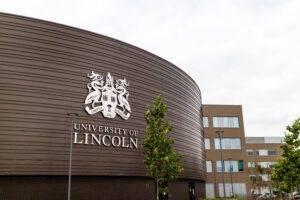
The University of Lincoln, UK, has joined a groundbreaking coalition of 17 universities, in support of a £3m international campaign which has been launched this week to drive economic growth in the Midlands.
Each year, the University contributes more than £400 million to the local economy and has forged sustainable, long-term relationships with a diverse range of organisations. These global connections will be leveraged to attract inward investment into R&D, innovation and science. This important work supports the University’s ambitions laid out in its Strategic Plan 2022-27 – of being a university which contributes significantly to the success of the region and beyond.
The campaign is led by Midlands Innovation and the Midlands Engine Partnership and hosted at Loughborough University, the Invest in UK University R&D – Midlands Campaign has been developed with a range of regional partners including the West Midlands Growth Company, Midlands Enterprise Universities and the East Midlands Freeport. It was launched at the UK Real Estate, Infrastructure and Investment Forum (UKREIIF), attended by nearly 13,000 investors, delegates and developers.
The university consortium will showcase five sectors in which the Midlands is world-renowned for the strength of its research and innovation. International alumni, industry and university connections in six markets (Australia, Germany, Japan, Singapore, South Korea and the USA) will be drawn upon to engage investors and raise the profile of the Midlands.
Vice Chancellor of the University of Lincoln, Professor Neal Juster, said: “The University of Lincoln is proud to be a member of this consortium whose aims align with, and further support, its commitment to driving economic growth and prosperity in the region and contributing significantly to the nation’s success through regional regeneration and international connectivity.
“This campaign will help to redefine how academia works in partnership with industry, and we look forward to showcasing what the University of Lincoln has to offer. From its R&D equipment and facilities spanning a range of key disciplines such as agri-food, engineering, and life science technologies, we have a wealth of opportunities for collaboration with.
“An example of this is the University’s sector-leading Lincoln Institute for Agri-food Technology, which was recently awarded the prestigious Queen’s Anniversary Prize for its work supporting the success and sustainability of the UK’s food and farming industries through innovations in research, education and technology.”
Minister of State for Science, Research and Innovation, Andrew Griffith MP, announced an award of £1.5 million from the UK’s International Science Partnerships Fund (ISPF) to support the campaign over the next two years, which has been matched by universities and regional partners. The Minister said: “The UK is home to world class research hubs and by bringing together the expertise and connections of universities, government and industry, we can bolster our efforts to win international investment into some of the Midlands’ strongest sectors.
“Our country’s universities have directly attracted around £4bn of foreign investment into their research since 2015. Today’s new campaign, supported by £1.5m from the Government’s International Science Partnership Fund, will help bring in more backing for the region’s excellent research.”
Aligning with the priorities of the new West and East Midlands Mayors and other local leaders, the campaign will help promote the region as an outstanding destination for global investment. It will support efforts from government and local growth agencies to secure game-changing funding for major regeneration projects across the region that have universities as a core partner.
The campaign will also work closely with Midlands Mindforge, an independent patient capital investment company, established by the eight research intensive universities in the Midlands Innovation partnership. Midlands Mindforge aims to deploy £250m to “invest with impact”, founding and scaling transformational science backed companies in sectors such as Clean Technologies, AI & Computational Science, Life Sciences & Health Tech. It will create highly skilled jobs in the Midlands and support the UK’s ambition to become a science and technology superpower.
The campaign is also being supported by UK Research and Innovation (UKRI), the Arts and Humanities Research Council (AHRC) and the UK’s Global Science and Innovation Network (SIN), which is jointly funded by the Department for Science, Innovation and Technology (DSIT) and the Foreign, Commonwealth and Development Office (FCDO).
Read more:
University Joins £3m Campaign to Drive Midlands Economic Growth
Category: Uncategorized
TikTok to Lay Off Significant Portion of Global Workforce Amid US Ban …

TikTok is set to lay off a significant portion of its global workforce today, following recent legislation by President Joe Biden that mandates the sale of the platform by its Chinese parent company, ByteDance, to a US-based firm or face a ban.
The social media giant, which has a global workforce of around 1,000 employees, will be issuing layoff notifications across its user operations, content, and marketing teams, according to sources reported by The Information. The precise number of layoffs remains unclear, but it is believed that TikTok’s global operations team, responsible for user support and communications, will be completely disbanded.
This large-scale layoff marks a departure from ByteDance’s usual approach of implementing cost-cutting measures in smaller stages. Insiders revealed that some team members not laid off will be reassigned to other departments such as trust and safety, marketing, content, and product.
TikTok had previously cut dozens of employees at the start of the year but has historically avoided the large-scale layoffs that have become more common among other tech companies.
The layoffs coincide with Biden’s recent signing of a law that gives ByteDance until January 19 to sell TikTok to a US-based company or face a ban. The law prohibits app stores like Apple and Google’s Play Store from offering TikTok and prevents internet hosting services from supporting the app unless ByteDance divests.
The White House has expressed concerns over national security, emphasizing the need to end Chinese-based ownership rather than impose a blanket ban on TikTok.
In response, a group of TikTok creators filed a lawsuit in US federal court last week seeking to block the new law. The lawsuit, supported by the law firm Davis Wright Tremaine LLP, argues that TikTok is a unique platform for self-expression and community formation, and that the ban threatens free speech under the First Amendment.
ByteDance also filed a lawsuit earlier this month, contending that the new legislation violates the US Constitution on several grounds, including free speech protections. This follows a similar lawsuit by TikTok creators in 2020 to prevent an earlier attempt to ban the app, and another lawsuit last year challenging a state ban in Montana.
Read more:
TikTok to Lay Off Significant Portion of Global Workforce Amid US Ban Threat
BT Scraps Digital Landline Switch Deadline Amid Vulnerability Concerns

BT has significantly postponed its plans to switch customers from traditional copper-based landlines to internet-based services, following concerns about the impact on vulnerable individuals. Initially set for completion by the end of 2025, the switch is now delayed until the end of January 2027.
The decision comes after several incidents where telecare devices, crucial for nearly two million UK residents using personal alarms, stopped working during the transition. The initial pause occurred at the end of last year due to these critical issues.
Silver Voices, a campaign group for elderly people, expressed dissatisfaction with the revised timeline, calling it “a token concession.” Dennis Reed, head of Silver Voices, stated, “The delay is for just over a year, which we don’t think is long enough to ensure sufficient safeguards for vulnerable customers. BT and other telecoms firms haven’t even defined what constitutes a vulnerable customer. We feel the deadline of January 2027 is very premature.”
The controversy stems from the potential risk of outages in internet-based services, which could render landline phones inoperable, particularly in rural areas prone to frequent service interruptions. This poses a significant risk for customers reliant on personal alarms.
BT has introduced a series of improvements aimed at protecting vulnerable customers and those with additional needs. Howard Watson, BT’s head of security and networks, emphasized the urgency of the switch due to the fragility of the 40-year-old analogue landline technology. “Managing customer migrations from analogue to digital as quickly and smoothly as possible, while making the necessary provisions for those customers with additional needs, is critically important,” Watson said.
To mitigate risks, BT plans to offer free battery backup units and hybrid phones capable of using both broadband and mobile networks. However, some campaign groups argue that these solutions are still confusing. Elizabeth Anderson, head of Digital Poverty Alliance, pointed out the need for better communication about the changes. “For many older people or those who need a simple landline running even through power cuts, there is still much to be done to communicate what the changes mean for them,” Anderson said. She also raised concerns about who would bear the cost of new phones, battery packs, and the necessary support for users to adapt to new systems.
BT’s digital voice changeover plan requires all households to have an internet connection. It remains to be seen whether other telecom firms will follow BT’s revised schedule or adopt similar measures. The company’s commitment to protecting vulnerable customers will be crucial in managing this significant technological transition.
Read more:
BT Scraps Digital Landline Switch Deadline Amid Vulnerability Concerns
UK Government Plans Training ‘Bootcamps’ to Address Worker Shortag …

The UK government is set to introduce skills “bootcamps” to train unemployed individuals for jobs in sectors such as hospitality, social care, and logistics.
This initiative, announced by Mel Stride, the Work and Pensions Secretary, aims to address potential worker shortages resulting from a crackdown on migrant visas.
Stride will highlight that, for too long, the UK has relied on labour from abroad and emphasize the need to tap into the “hidden army” of British workers. This approach is part of a broader strategy to reduce dependency on overseas workers by harnessing domestic talent.
The bootcamps will initially target the 1.5 million unemployed individuals who are actively seeking work. However, the government intends to expand the programme to include the 2.8 million long-term sick and others currently outside the workforce.
Stride expressed concern about the rise in “hidden unemployment” and the economically inactive population, which includes seven million people not engaged in work or study. He stressed the importance of integrating these individuals into the workforce to help them reap the financial, social, and health benefits of employment.
Last week, Stride and Chancellor Jeremy Hunt emphasised the availability of “ample opportunities” for the unemployed and outlined plans to assist them in finding work. The new visa rules, expected to reduce immigration by 300,000 people annually, present a challenge for certain sectors but also an opportunity for domestic job seekers to fill these roles.
Jobcentre training schemes, skills bootcamps, and revised recruitment rules will be utilised to fill vacancies with British workers. The government also aims to encourage employers to make simple changes to attract workers, such as improving access to public lavatories to encourage more women to take up HGV driving.
Funding for these initiatives will come from the £2.5 billion allocated to existing back-to-work programmes, like the Restart scheme, which provides tailored job support to the long-term unemployed. The government is adopting a carrot-and-stick approach, threatening to cut off benefits from unemployed individuals who do not accept job offers after 12 months of support.
Prime Minister Rishi Sunak is positioning welfare reform as a key issue for the upcoming election, arguing that Labour leader Sir Keir Starmer would avoid making necessary changes to reduce the costs of sickness benefits and encourage people back into work.
Alison McGovern, Labour’s acting shadow work and pensions secretary, criticized the Conservative approach, stating, “The Conservatives have run down our skills and training system. And we now have record levels of net migration. They should be putting in place proper plans to tackle worker shortages and adopting Labour’s plans to connect the immigration system to skills, not setting up another talking shop. Labour has a plan to get Britain working by cutting NHS waiting lists, reforming job centres, making work pay, and supporting people into good jobs.”
This new initiative represents a significant effort by the UK government to address the impending worker shortages caused by stricter immigration policies, focusing on utilizing domestic talent through targeted training and support programs.
Read more:
UK Government Plans Training ‘Bootcamps’ to Address Worker Shortages Amid Immigration Cuts
Food Price Rises Returning to Normal, Says Kantar

Research from Kantar indicates that food price rises are returning to more typical rates, with grocery price inflation dropping to 2.4%, the lowest since October 2021.
Despite this easing, shoppers continue to favor cheaper own-brand goods, suggesting that the habits formed during the cost-of-living crisis persist.
The findings come ahead of official inflation figures due on Wednesday, expected to show a significant drop in overall inflation. This has raised expectations that the Bank of England may cut interest rates this summer.
Fraser McKevitt, head of retail and consumer insight at Kantar, noted that typically a 3% inflation rate triggers marked changes in consumer behavior. However, after nearly two and a half years of rapidly rising prices, it might take longer for shoppers to revert to previous spending habits. Own-label lines remain resilient, growing faster than branded goods and making up over half (52%) of total spending. Premium own-label ranges have also seen a 9.9% increase from a year earlier.
Kantar also anticipates that summer sports events like the Euro 2024 men’s football tournament and the Olympic Games will boost sales, particularly of alcoholic drinks. For example, take-home beer sales peaked during England’s quarter-final match against France in the 2022 FIFA Men’s World Cup, marking the year’s highest daily takings outside of Christmas.
Overall inflation reached 11.1% in late 2022, with food and non-alcoholic drink prices rising nearly 20% last year, the highest since the 1970s. In response, the Bank of England raised interest rates to 5.25%, a 16-year high, to curb inflation by making borrowing more expensive and encouraging saving.
As inflation continues to fall, the most recent data showed a 3.2% rise in prices in the year to March. The upcoming figures are expected to show a rate close to the Bank’s 2% target, fueling speculation about a potential rate cut.
In summary, while food price inflation is normalizing, the lasting impact of high prices means consumers are still focused on cost-saving measures. The potential for interest rate cuts from the Bank of England remains a topic of keen interest as the economic landscape continues to evolve.
Read more:
Food Price Rises Returning to Normal, Says Kantar
British AI pioneers share £1 million in prizes as government unveils …

Ten teams across the country have been chosen as finalists of the inaugural Manchester Prize, a prestigious challenge prize rewarding breakthroughs in AI for public good.
Announced by the Prime Minister as the AI Seoul Summit gets underway today, the finalists will each receive a share of £1 million to develop their solutions over the next eight months.
Focusing on energy, environment, and infrastructure in its inaugural year, teams in the running for the final £1 million prize are working on breakthroughs in artificial intelligence which could help address food security, improve how solar energy flows into the electricity grid, and revolutionise battery manufacturing.
Chancellor of the Exchequer Jeremy Hunt said: “With over 50,000 people already employed in the sector and billions expected to be generated for the UK economy over the next few years, the potential of AI innovation to help power our growth is huge.
“That’s why this funding is one of the best investments we can make.”
Viscount Camrose, (pictured) Minister for AI and Intellectual Property said: “This prize puts brilliant British AI innovation at the heart of addressing some of our biggest shared challenges. A decade-long commitment by the government, we are supporting our peerless AI talent with an annual £1 million grand prize to bring through the next wave of game-changing technological solutions.
“I look forward to seeing our finalists develop their solutions further over the coming months, as we look to harness the incredible potential of AI to bring about transformative change in the fields of energy, the environment, and infrastructure.”
Among the finalists of the Manchester Prize are:
Quartz Solar AI Nowcasting by Open Climate Fix: Leveraging AI to forecast cloud formation, enhancing the integration of solar energy into the electricity grid.
CRE.AI.TIVE by Phytoform Labs: Addressing food security challenges through AI-driven discovery of crop traits resilient to climate change.
Greyparrot Insight by Greyparrot.ai: Employing AI waste analytics to map global waste flows, driving improvements in recycling and packaging design.
Polaron by Polaron: Revolutionizing battery manufacturing through AI-driven analysis of advanced materials.
In its inaugural year, the Manchester Prize called upon the ingenuity of innovators, academics, entrepreneurs, and disruptors to submit their solutions utilising AI for public benefit. The prize garnered nearly 300 entries from UK-led teams, showcasing a diverse array of groundbreaking ideas.
The finalists will each receive prizes of £100,000 to further develop their projects over the next eight months. Additionally, they will benefit from comprehensive support packages, including funding for computing resources, investor readiness support, and access to a network of experts, positioning them for success in the pursuit of the £1 million grand prize in spring 2025.
The potential of AI-powered innovation to fuel economic growth is immense, with estimates suggesting it could generate £400 billion for the UK economy by 2030. Already, over 50,000 individuals are employed in the AI sector, and with projected market growth exceeding 15% in the next six years, there are vast opportunities for new businesses to thrive and contribute to the nation’s prosperity.
The UK is already seeing the results of how AI can drive investment in its economy, with the recent announcement that British AI company Wayve has received a $1.05 billion investment to develop the next generation of AI-powered self-driving vehicles.
Dr Hayaatun Sillem CBE, CEO of the Royal Academy of Engineering and Manchester Prize judge said: “British innovators have been pivotal to the advancement of computer and information technology that has transformed the world we live in. AI has the potential to support productivity, improve delivery of public services, make our national infrastructure work better, and accelerate the transition to a net zero economy. Choosing only ten finalists from such a diverse field of applications was tough; picking a winner will be even harder. I’m looking forward to seeing how the ideas develop in the next few months.”
With AI already starting to unlock enormous opportunities in tackling climate change, transforming healthcare, and beyond, the Manchester Prize looks to spark more cutting-edge innovations in using AI for good, which will deliver real change for people across the country.
The UK is committed to fostering innovation and harnessing the transformative power of AI for the betterment of society. As these projects continue to evolve and make strides towards tangible impacts, they serve as testament to the UK’s position at the forefront of AI innovation on the global stage.
Read more:
British AI pioneers share £1 million in prizes as government unveils inaugural Manchester Prize finalists
Uber Drivers Offered Significant Discounts on Kia Electric Cars

Londoners accustomed to seeing their Uber drivers in Toyota Priuses may soon find them driving electric Kias instead as Uber is set to offer more than 35,000 of its London drivers up to £22,000 in grants and discounts to transition from hybrids, diesel, and petrol cars to fully electric vehicles.
The app-based taxi service aims to make its entire fleet of 50,000 vehicles in the capital zero-emission by the end of 2025. Currently, only a quarter of Uber’s London fleet runs on fully electric power.
To achieve this ambitious goal, Uber will launch an initiative this week, offering £5,000 grants to ensure each of its London drivers switches to electric vehicles over the next 18 months. This initiative is funded by a £145 million green surcharge fund that Uber has accumulated in the UK.
Uber has also secured significant discounts from car manufacturers. For instance, drivers interested in the £56,000 Kia EV6 will benefit from a £17,000 discount from the Korean manufacturer, coupled with the £5,000 grant from Uber, bringing the car’s price down to £34,000.
Similarly, the popular Kia Niro EV will be available for £20,000 after a £12,000 discount. Andrew Brem, general manager of Uber UK, emphasized the urgency of accelerating electrification, especially given recent slowdowns in electric car sales in Britain due to affordability concerns.
Manufacturers are supporting the scheme as they aim to meet government-enforced quotas. Car makers are required to ensure that 22 per cent of their vehicles are electric in 2024, with this quota rising to 28 per cent in 2025, or face penalties.
This move by Uber comes as UK sales data show a decline in the growth of new electric car sales to private motorists, primarily due to the high upfront costs of these vehicles. By offering substantial incentives, Uber hopes to overcome these barriers and contribute to a greener future for London’s transportation network.
Read more:
Uber Drivers Offered Significant Discounts on Kia Electric Cars
Getting AI right: How automation can help manage your business finance …

There’s no doubt that AI adoption is here and possibly more widespread than you would have thought.
Research from Equals Money of UK financial decision makers found that over three quarters (77%) are already actively adopting or experimenting with AI in their processes.
So, what role can AI play in your business finances? A core value of AI lies in its capacity to free up time by optimising rudimentary tasks. A lot of what the finance function does, such as reconciliation for example, is repeatable and ripe for automation. Equals Money’s research found that on average UK employees spend 65 minutes a day on automatable tasks, including day to day financial administration, totting up to a whopping 38 days a year.
AI seems to be the obvious solution to some of the productivity challenges that UK businesses are currently facing. However, there are a series of questions business leaders must ask themselves before and while adopting AI in order not only to achieve the desired performance, but to do so in a safe and conscientious manner.
Concerns and how to experiment
A lot of businesses are nervous about being the first mover because if AI adoption goes wrong then it may pose a big reputational risk. For those considering adoption, they need to have a good foundation to start with. AI can help to make a good business better, but using AI to fix core issues in a struggling business is where things can get dangerous.
You need to know your business inside and out, understand the processes most likely to benefit from automation, and have the relevant skills to measure the impact of these changes. That’s how you make AI work for you—not by expecting it to do all the heavy lifting from scratch, but by guiding it to enhance the good work you’re already doing.
In the loop, on the loop or out of the loop
When looking at a process that you believe could benefit from an AI tool, you should ask whether you want to be in the loop, on the loop or out of the loop. For initial adoptions, it’s unlikely you will want to be out of the loop, letting the AI do its own thing. Being on the loop means that the AI is allowed to operate freely but with regular reviews of the decisions it makes. Being in the loop will mean that while doing the majority of the leg work, the AI will not be able to make any active decisions, with all suggested decisions being reviewed by a human.
A financial team could use an AI tool for an intricate job like drafting policies and get a fairly credible response that is about 80% accurate. Human interpretation of that remaining 20% is vital to ensure the answer is not misconstrued. While the ROI from AI might stem from the removal of lower-level tasks, you still need experts who can scrutinise its responses to ensure credibility, especially for complex financial operations. AI will likely prove to be a fantastic asset, but I expect it to play that more supplementary role for a considerable period.
What about job security?
The concept of AI is a scary thought to a lot of people who think it’ll replace jobs, making their livelihoods obsolete. Our survey found that job security was cited by a third (33%) of respondents as a barrier to adoption. 85 per cent of businesses that have already adopted AI tools found it to have impacted workload, with almost half (46 per cent) claiming it has freed up employee capacity by reducing or eliminating certain tasks. However, 39 per cent felt that some job roles were at risk of being made redundant due to automation.
Transparency is key in managing this change. As with any large-scale change project, you need to bring people on the journey with you by reframing it as an opportunity to evolve. Finance leaders need to help communicate this shift. Doing so will help to turn what seems like a threat into an opportunity for personal and professional growth. Equally, with the right training or retraining in place, leadership teams can ensure that as many people as possible retain a meaningful role in the evolving landscape.
Embracing AI automation is crucial for finance leaders to gain a competitive edge. We must be receptive to change and treat AI adoption like any other transformative project. The real risk lies in being slow to adopt, allowing competitors to pass us by.
That’s not to say we should let AI run unchecked – it’s our job as decision-makers to ensure the correct level of oversight is applied to AI processes and that they are effectively managed. Not all processes should be automated and it’s key to understand which tasks can be given to AI, and which should be left to the experts.
Read more:
Getting AI right: How automation can help manage your business finances
Commercial Property Values Poised for Growth as Office Return Accelera …

The commercial property market may be approaching its nadir as more workers return to the office, according to Land Securities, one of the UK’s largest landlords.
Mark Allan, CEO of Land Securities, which owns a portfolio worth billions, stated that the values of high-quality properties have “largely bottomed out and will start to grow in the foreseeable future as rents rise.” He noted that the reset of values over the past two years, driven by rising interest rates, has stabilised, with evidence of continued rental growth attracting increased investor interest in the best assets.
Allan’s comments came as the company reported an 18 per cent increase in the number of workers entering its office buildings. The return to office work, combined with employers planning to provide more space per employee, is driving “particularly strong demand for best-located, highly sustainable, and well-amenitised office space.”
Devaluations of Landsec’s office properties in London accounted for £449 million of its total £625 million portfolio writedown last year, bringing its portfolio’s value to £9.96 billion. Central London offices and office developments make up about 60 per cent of Landsec’s portfolio, with another 20 per cent comprising shopping centres and retail outlets.
These devaluations contributed to a pre-tax loss of £341 million for the 12 months ending in March, a narrower loss compared to the £622 million loss from the previous year, thanks to rising rents and stable values in the second half. The company’s net asset value per share fell from 936p to 859p, but it still increased its total dividend by 2.6 per cent to 39.6p per share.
Landsec, which owns notable properties such as the Bluewater shopping centre in Kent and the Dominion Theatre in London’s West End, is progressing towards its goal of selling £4 billion of “non-core” property. Recently, it sold its remaining hotel portfolio to Los Angeles-based Ares Management for £400 million, and it plans to sell approximately £400 million of retail parks and a small number of standalone London assets not located in its core areas. In the longer term, Landsec aims to dispose of its “sub-scale” out-of-town leisure parks.
Proceeds from these disposals have provided Landsec with about £1 billion to invest in its committed development pipeline and other properties over the next 12 months. The company’s other top priority is investing in prime retail, driven by confidence in the performance of its existing retail locations, where it sees “really attractive” returns.
Read more:
Commercial Property Values Poised for Growth as Office Return Accelerates

