
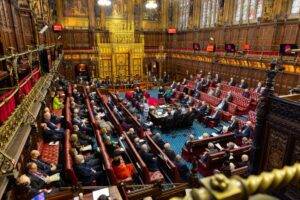
UK ministers have been urged that copyright law is ‘falling’ to protect creatives as AI firms continue to steal content to train their models, according to a House of Lords committee.
The committee has warned that “some tech firms are using copyrighted material without permission, reaping vast financial rewards.” This has been an ongoing issue amid the rise of AI with the legal framework around copyright being called into question.
Content creators and creatives have said that their content is being taken illegally to train large language models (LLM) as tech companies feed significant volumes of data to build their chatbots.
In a call to action to the government, the committee labelled the current legal framework for copyright law is ‘failing’ to ensure that creators are being rewarded for their efforts, prevent their work from being used without permission, and encourage innovation.
“The government has a duty to act. It cannot sit on its hands for the next decade and hope the courts will provide an answer” the committee warned.
John Kirk, Deputy CEO of Inspired Thinking Group, commented: “AI is having a significant impact across the creative industries and its development and adoption are showing no signs of slowing down. It is important to protect creative intellectual property for any content from creators to brands, but the reality is that anyone not on the AI train is going to be left behind. Ensuring there is a well-managed governance model in place supporting content operations can help mitigate risks and resulting hesitancy for the adoption of AI in day-to-day applications.”
“Creatives must not be scared to embrace AI, despite any fears, as it can ease the burden of content creation to meet the rapidly rising demand. Working with automation platforms, such as Storyteq’s BrandCore, can provide marketing creatives with a new approach to content delivery, streamlining creation and production through brand-compliant localisation across all content. AI isn’t the future of marketing, it’s the present, and while we must acknowledge concerns along the way, AI is transforming the creative industries for the better” Kirk added.
The committee has recommended that the government re-evaluate the current effectiveness of copyright law with a view to updating legislation if it is found that copyright holders aren’t being sufficiently protected.
Sjuul van der Leeuw, CEO of Deployteq, part of Inspired Thinking Group, said: “The rapid evolution of AI over the past year has inevitably hit bumps in the road, and it is important to address issues around trust and safety such as AI copyright when they arise. Collaboration between government, regulators and industry can ensure marketing creatives are supported when it comes to content creation, but marketers themselves should embrace AI to boost efficiencies in their own operations. For example, AI can play a crucial role in creating content for email marketing campaigns as well as analysing the first-party data collected, saving huge amounts of time and resulting in a higher impact campaign.”
The news follows Getty Images CEO Craig Peters warning Rishi Sunak to give the creative industries better support rather than gambling on the evolution of AI, off the back of media materials being harvested by AI companies for training data.
Read more:
Ministers warned copyright law ‘failing’ as AI firms steal creative’s content
Category: Uncategorized
Amazon announces revenues of $170bn for peak Christmas period

Amazon has announced revenues of $170 billion in the final quarter of 2023 thanks to a boost in Christmas shopping.
The retail giant’s financial results beat analysts’ expectations and sent shares soaring by more than 8 percent in after-hours trading.
Revenue in the fourth quarter rose by 14% compared to the same period last year. Analysts on average expected revenue of $166.21 billion, according to LSEG data.
Amazon Web Services (AWS), which is the largest cloud services unit in the world, brought in revenue of $24.2 billion in the fourth quarter, compared with analysts’ expectations of $24.26 billion.
Amazon – whose founder and chairman Jeff Bezos has a net worth of $183.41 billion – had its earnings bolstered by consumer spending over Christmas.
In what is seen as a boost to e-commerce firms, households splurged on goods and services over the holidays, despite high interest rates, a reports showed last week.
Meanwhile, growth at Alphabet and Microsoft’s cloud units beat market expectations as customers wanted to test new AI features and build them for their own applications.
The company forecast current-quarter revenue in the range of $138 billion and $143.5 billion. Analysts polled by LSEG were expecting revenue of $142.13 billion.
Net income rose to $10.6 billion in the fourth quarter from $278 million, a year earlier.
It comes as Meta shares also soared 15 percent in extended trading after the company tripled its profit and posted sharply higher revenue in the final quarter of 2023.
The California-based tech giant announced it earned $14 billion, or $5.33 per share, from October to December last year – up from $4.65 billion, or $1.76 per share, a year prior.
Revenue, meanwhile, jumped 25 percent in the quarter to $40.11 billion. This was up from $32.2 billion a year earlier – the fastest growth for any period since mid-2021 – as its online ad market continued to rebound.
CEO Mark Zuckerberg said in a statement: ‘We had a good quarter as our community and business continue to grow. We’ve made a lot of progress on our vision for advancing AI and the metaverse.’
The company, which owns Facebook, Instagram and WhatsApp, also announced its first ever quarterly dividend of 50 cents a share and an additional $50 billion in share buybacks.
Read more:
Amazon announces revenues of $170bn for peak Christmas period
Lewis Hamilton moving from Silver Arrows to Prancing Horses: Unravelin …

In the fast-paced world of Formula 1, decisions made by drivers can often be as scrutinised as the split-second manoeuvres they make on the track. The announcement of the sports greatest driver Lewis Hamilton’s move from Mercedes to Ferrari has not only set the racing world abuzz but also provides a fascinating case study on the importance of brand positioning.
Formula 1, at its core, is a battleground of cutting-edge technology, precision engineering, and top-notch talent. In theory, when it comes to performance, the differences between teams can be measured in milliseconds. So, what prompts a world-class driver to switch from the reigning champions, Mercedes, to the iconic Italian stable, Ferrari?
The answer arguably lies in the nuanced realm of brand positioning. While both Mercedes and Ferrari boast formidable engineering prowess and competitive track records, they carry distinct brand narratives. Mercedes, with its sleek Silver Arrows, symbolises precision, innovation, and efficiency. On the other hand, Ferrari, the Scuderia with its legendary Prancing Horse emblem, is synonymous with passion, tradition, and a rich history in producing super and sports cars that are coveted worldwide.
In the world of business, much like in Formula 1, products and services are not just about features and functionalities; they are about stories and emotions. Brand positioning goes beyond the tangible and ventures into the intangible, capturing the hearts and minds of consumers.
Ferrari’s global reputation as leaders in super and sports cars plays a pivotal role in the driver’s decision. The Prancing Horse logo doesn’t merely represent a mode of transportation; it embodies a lifestyle, a statement of exclusivity, and a promise of unparalleled performance. The brand’s legacy extends beyond the racetrack, seeping into the collective consciousness of enthusiasts and casual consumers alike.
In the competitive landscape of business, companies that understand the power of brand positioning can create a distinct identity that resonates with their target audience. It’s not just about being the fastest or having the most features; it’s about being the embodiment of a narrative that connects with consumers on a deeper level.
The parallels between Formula 1 and the business world are striking. In both arenas, success is not only determined by technical prowess but also by the ability to craft a compelling narrative. A brand is not just a logo or a product; it’s an experience, a promise, and a relationship with the consumer.
Read more:
Lewis Hamilton moving from Silver Arrows to Prancing Horses: Unraveling the Essence of Brand Positioning
Facebook-owner Meta triples income to $14bn in last quarter of 2023

Meta shares soared 15 percent in extended trading after the company tripled its profit and posted sharply higher revenue in the final quarter of 2023.
The California-based tech giant announced it earned $14 billion, or $5.33 per share, from October to December last year – up from $4.65 billion, or $1.76 per share, a year prior.
Revenue, meanwhile, jumped 25 percent in the quarter to $40.11 billion. This was up from $32.2 billion a year earlier – the fastest growth for any period since mid-2021 – as its online ad market continued to rebound.
CEO Mark Zuckerberg said in a statement: ‘We had a good quarter as our community and business continue to grow. We’ve made a lot of progress on our vision for advancing AI and the metaverse.’
The company, which owns Facebook, Instagram and WhatsApp, also announced its first ever quarterly dividend of 50 cents a share and an additional $50 billion in share buybacks.
Buybacks and dividends help boost stock prices by rewarding investors with cash simply for holding stock in the company. Meta’s first cash dividend of 50 cents a share will be paid out on March 26, and on a quarterly basis going forward.
It appears that the company’s self-described ‘year of efficiency’ has paid off.
Analysts, on average, were expecting earnings of $4.82 per share on revenue of $39.1 billion, according to FactSet Research.
Following a disastrous 2022 in which its share price tumbled, the company put an emphasis on cost cutting last year – which involved thousands of workers being laid off.
The company said it had 67,317 employees as of December 31, 2023, a decrease of 22 percent year-over-year.
Meta also attributed advances in AI and improvements to its ad business for the success, which is growing faster than rival Google.
Meta’s blowout results come amid reports from other tech rivals, including Amazon and Apple.
The news comes a day after Zuckerberg apologized to families who said their children had been harmed by social media during a hearing in the US Senate.
He appeared alongside TikTok CEO Shou Zi Chew, Discord boss Jason Citron, X chief Linda Yaccarino and Snapchat founder Evan Spiegel with former UK deputy Prime Minister Nick Clegg and Meta board member absent.
All were grilled by Republicans about how they protect teenagers and children on their respective apps.
‘I’m sorry for everything you’ve all gone through,’ Zuckerberg said. ‘It’s terrible. No one should have to go through the things that your families have suffered.’
Zuckerberg and Senator Marsha Blackburn got into a heated back-and-forth when the Tennessee Republican accused Facebook of facilitating sex trafficking.
Blackburn at one point accused Zuckerberg of wanting to turn Meta into the ‘premier sex trafficking site in this country.’
Senators Ted Cruz and Lindsey Graham used the occasion to chastise the Silicon Valley titans, claiming they do not do enough to protect kids from pedophiles and harmful content.
The bosses insisted that they do their utmost to shield youngsters from anything inappropriate, but conceded that they cannot always keep track of accounts due to the size and scale of their products.
Read more:
Facebook-owner Meta triples income to $14bn in last quarter of 2023
Large businesses take more space in London

Large businesses are leasing more office space in London than they were two years ago, despite several high-profile instances of corporate downsizing.
HSBC, the bank, and Clifford Chance, the “magic circle” law firm, are among those that have announced moves to much smaller offices in recent months. Nevertheless, even including those changes, the net area of office space leased in London has increased by 1.1 million sq ft since 2021, data from Knight Frank, the property agent, shows.
Shabab Qadar, Knight Frank’s head of London research, said the findings “bust a few myths” about the future of the office. He said that although the “number of bums on seats” in offices was down compared with before the pandemic, most corporate renters wanted bigger offices so that they could have more collaboration spaces and better canteens, or space for gyms and showers.
“Physical office occupancy levels are down on pre-Covid levels, but the big change that has happened since Covid is the desire of occupiers to be in best-in-class offices,” Qadar said. “These best-in-class buildings that have been recently developed are almost hotel-like in the nature of amenity provision. There is also this growing trend among occupiers to ‘de-densify’ their offices.”
The number of companies looking for new offices in London is at its highest level in a decade, with leasing agents working to find 12 million sq ft of space for their clients. About 80 per cent of companies in the market for a new office are looking for either the same amount of space or more, Knight Frank found.
However, there is a shortage of the most modern, eco-friendly office blocks that corporate renters are demanding. Not enough have been built recently or are in the pipeline, while a number of offices are likely soon to become obsolete as new sustainability rules come into force.
As such, companies are battling it out for high-end offices, rents for which are increasing quickly. Over the past two years in the City of London, 25 leases have been agreed at rents above £90 per sq ft, compared with six in the previous four years. Similarly, in the West End there have been 142 deals at rents over £100 per sq ft in the past two years, compared with 112 in the four years before. The supply-demand crunch means that agents expect rents to continue to rise.
“London’s occupational market remains robust as the bifurcation in demand and transition to office-first work policies continue to crystallise,” Philip Hobley, head of London offices at Knight Frank, said. “While vacancy rates have increased in older, secondary buildings, prime rents in best-in-class offices have continued to rise.”
Read more:
Large businesses take more space in London
‘Lilac Review” launched to level up disabled entrepreneurship

A major new independent review into addressing and overcoming the inequality faced by disabled-led businesses has been launched with backing from the UK Government.
Disabled entrepreneurs currently account for an estimated 25% of the nation’s 5.5million small businesses but represent only 8.6% of total small business turnover. Small Business Britain estimates suggest that levelling up opportunity could unlock an additional £230 billion in business turnover.
The Lilac Review aims to identify, and seeks to break down, challenges faced by disabled entrepreneurs. Issuing an action plan to drive greater change across entrepreneurship it will call for organisations across the UK to commit to a series of goals.
Jointly chaired by the Minister for Small Business, Kevin Hollinrake, the Minister for Disabled People, Mims Davies and Victoria Jenkins, CEO and Founder of adaptive fashion brand Unhidden. The Lilac Review launched on 1 February 2024 and will take place over an initial two-year period.
Kevin Hollinrake MP, Minister for Small Business and Co-Chair of The Lilac Review said: “We are committed to ensuring the UK is the best place in the world for anyone who wants to start and scale up a business.
“That’s why I am delighted to co-chair The Lilac Review to support the UK’s disabled entrepreneurs so they can follow their passion and create their own success story, without restrictions or barriers.”
Following research and consultation with a wide variety of stakeholders – particularly disabled entrepreneurs – interim research findings will be shared later this year, with a final report and recommendations set for the end of 2025.
The need for The Lilac Review was highlighted by the ‘Disability and Entrepreneurship report’, launched by Small Business Britain in March 2023 in partnership with Lloyds Bank.
Consulting over 500 disabled founders across the country – in one of the largest studies of its kind in the UK – the report found disabled entrepreneurs face significant barriers to start and grow businesses, such as higher start-up costs, challenges accessing funding and support, as well as a lack of credit by wider society. While 35 per cent of founders said their disability has positively impacted them as an entrepreneur, over half said they had no external support when starting up, 72 per cent lacked appropriate role models to guide them and 55 per cent received no financial support.
Access 2 Funding campaign also shows that 84 per cent of disabled founders don’t feel they have equal access to the same opportunities and resources as non-disabled founders. While further research also shows that disabled people on average face an additional £975 a month in costs due to the ‘Disability Price Tag’, before business costs.
Victoria Jenkins, CEO and Founder of Unhidden and Co-Chair of The Lilac Review said: “The contribution of the disabled community to society is so much higher than people are made aware of. To be able to help remove some, or all of, the barriers that are impacting us is a lifelong mission of mine and so many others. We are also worth more than what we can, or can’t, contribute from a financial respect and I hope to highlight that as well over the next two years, alongside powerful and important voices in the community.”
Driven by insight from disabled entrepreneurs, a wide audience of stakeholders will be consulted as part of The Lilac Review’s research into the challenges and solutions in this area.
A number of disabled founders will sit on the Review’s Steering Board, as well as representatives from the wider business community and UK Government including: Small Business Britain, Lloyds Bank, eBay, BT, Federation of Small Businesses (FSB), British Chamber of Commerce (BCC), The Entrepreneurs Network, Business Disability Forum, and academics from ARU Peterborough university.
Minister for Disabled People and Co-Chair of The Lilac Review Mims Davies MP said: “Disabled entrepreneurs currently make up a quarter of all small business owners – they are at the heart of our economy and its paramount they get every opportunity to succeed and thrive in their sectors.
“I’m delighted to be co-chairing the Lilac Review, which will help us make sure the UK is the best place to do business and to be a disabled entrepreneur – where your ideas and endeavours will be supported.”
Once published, The Lilac Review will share recommendations for supporting disabled entrepreneurs and a call-to-action for driving positive change across society – particularly around accessibility and inclusion in entrepreneurship.
Read more:
‘Lilac Review” launched to level up disabled entrepreneurship
What privately-owned companies can learn from PLCs on sustainability

PLCs have to answer to shareholders – and to the wider business community – on both stock performance and sustainability, and more and more often the two are inextricably intertwined.
On the one hand, being a publicly-listed company can impact the sustainability journey. Shareholders demand short-term returns and that can negatively impact long-term investment – which is where ‘green’ projects often sit.
But on the other hand, PLCs face a lot of scrutiny on their sustainability as well as their financial results. Their issues and challenges are front and centre when it comes to investment, supply chain management and other operational factors. They need a clear model for both products and materials to highlight where and how they’re trying to be more sustainable.
As Trevor Yong, business development director at sustainability consultancy Aura explains, it puts their efforts in the spotlight, which is why so many now have a Chief Sustainability Officer (CSO) on the board to drive their initiatives.
That’s quite different from private companies. Privately-owned businesses – including most SMEs – aren’t as answerable to the public in terms of their reporting and stock prices. However, they are just as accountable to consumers and customers, who are more informed than ever on sustainability issues and increasingly likely to vote with their wallets.
It isn’t just about creating a better reputation – a quarter of consumers currently make purchase decisions based on a brand’s environmental credentials, and that figure is only going to go up with each passing year.
A private affair
In fact, sustainability in private businesses, particularly SMEs, usually comes from within. It’s often the case that the owner-founder or CEO has a desire to make a product that’s green and the ethos of the business is built around that. Many SME brands, like TALA or Allbirds, have become successful largely because they’re more environmentally-friendly than their larger competitors.
And if the CEO isn’t focused on sustainability, the employees will often drive it instead. One might even pitch the need for a CSO to the leadership team (and I’ve seen cases where that person even takes on that role themselves). Employees are the voice of the customer and even privately-owned businesses have to answer to them.
Yet all too often, private businesses are followers rather than leaders when it comes to sustainability. They do enough to be legal and compliant, but without the looming risk of public scrutiny they may be reluctant to go above and beyond. They don’t have to justify their actions.
They end up ‘greenhushing’ – not talking about their efforts and outcomes if they think it will make them look bad – even though unlike PLCs they have the capacity to think long-term and make investment decisions based on what ten or twenty years from now will look like.
Learning as they go
For private businesses to establish a sustainability programme, they often replicate what’s been done elsewhere or make it up as they go along. Hence the importance of benchmarking where they are on their journey – whether that means talking to independent experts or to other business owners. Some companies will actually be further along than they think they are, while others may be feeling smug when in fact they’re still only at the start of their sustainability journey.
CEOs may not want to talk to potential competitors, but the value of sharing knowledge and talking with peers cannot be underestimated.
Creating internal accountability and processes
In addition, just because a private business doesn’t have to share its environmental targets with the world doesn’t mean that it shouldn’t have any. In a world of end-of-life labelling and Scope 3 emissions reporting, every company needs to understand where it sits and how it can prove its success against real, tangible external benchmarks.
The first step for any private company to meet its targets, even internal ones, is to take sustainability just as seriously as any PLC. That doesn’t always mean putting everything in the hands of a CSO – although having one can be incredibly valuable – but instead ensuring that it is on the agenda at every monthly board meeting.
Those companies need to be aware of what they’re legally responsible for, where there are opportunities to do better and how sustainability impacts what they deliver to their clients and customers.
One key factor is to think about sustainability at the start of the process rather than as a tick-box exercise at the end – and to cover off all the angles. For example, the product might be made from sustainable materials, but how about its packaging? Is it recyclable and labelled as such? And if it isn’t recyclable, have you said so on the labelling so that consumers don’t assume it is and contaminate actual recycling streams by ‘wishcycling’ it?
Given that it can take up to two years or more to change packaging after the fact, brands that don’t make their boxes, bottles and cartons as sustainable as possible from day one are shooting themselves in the foot.
Embrace the change
Even without PLC-level public scrutiny, sustainability has to be part of the company culture to succeed. It can also come from collaboration: SMEs are often followers rather than leaders in this space as they don’t have the scale of PLCs – and they therefore need to share knowledge, or create coalitions or partnerships, to achieve the same results.
Owners and CEOs already know that success comes from being ahead of the curve, and sustainability is right now one of the biggest curves facing businesses. The earlier it’s built into the business, the more likely it is to work.
Read more:
What privately-owned companies can learn from PLCs on sustainability
Over 3 millions BT customers could get up to £400 as ‘overchargingâ …

More than 3 million BT customers could receive up to £400 each as a class action lawsuit begins seeking £1.3bn in compensation over claims the telecoms group allegedly overcharged for landline services.
The legal action has been brought by Justin Le Patourel, a former executive of the watchdog Ofcom, and alleges that BT used its dominant position in the market to charge “excessive” amounts for about 3 million landline customers, many of them elderly and low-income households.
Le Patourel launched the claim three years ago after looking into an Ofcom investigation into BT in 2017.
Ofcom’s investigation, which looked at BT’s practices from 2015, found that people who only had a landline telephone were “getting poor value for money in a market that is not serving them well enough”.
BT cut landline prices the following year for 1 million mostly elderly customers by £7 a month but did not offer them compensation for overcharging in the past.
Le Patourel, who formed Collective Action on Land Lines (Call) to gather customers in a class action against BT, estimates that affected customers could get £300 to £400 in compensation depending on the length of their contracts.
“We believe BT has been systematically overcharging millions of customers over many years, and those customers could be owed hundreds of pounds each,” Le Patourel said. “Time really is of the essence. More than 40% of our claimants are aged over 70, and more than 150 of them are dying every day. It really is vital that BT should refund every one of them as soon as possible.”
The class action automatically includes all affected customers – including those who are now deceased, after BT gave consent to an amendment to the claim – unless they actively choose to opt out.
Le Patourel claims that more than 500,000 landline-only customers have already died.
A spokesperson for BT said: “This claim relates to a technical landline pricing issue which was resolved by Ofcom in 2017. We do not accept that our pricing was anti-competitive back then, and as such are committed to robustly defending our position at trial. We take our responsibilities to customers very seriously and are dedicated to keeping our customers connected, while helping those who need it most.”
However, when Le Patourel took his case to the Competition Appeal Tribunal in 2021 seeking permission to take BT to trial, the three-member tribunal was unanimous in ruling that the claim showed more than enough merit to be pursued.
“We conclude that there is a real prospect of success for this claim,” the tribunal concluded in its 42-page ruling at the time.
Speaking about the case, Tom Davey, Director and Co-Founder at litigation finance broker Factor Risk Management, said:”Hot on the heels of Mr Bates vs The Post Office, we are once again seeing ordinary people having to rely on the Courts, rather than regulators, to bring about the correction of injustices.
“The lack of effective regulation means that claimants have to litigate in order to bring about change and hold large corporates to account. Opt-out claims such as this are a cost-efficient way to bring about access to justice for individuals who’d have no hope otherwise for their claim to be heard.
“As the first stand-alone opt-out claim to proceed to trial, litigation funders and the wider legal industry will be watching the case keenly. The outcome will be instructive to the direction of the class action regime going forward, which is of particular importance in the context of other claims brought by consumers where breaches of competition law are alleged.
“The involvement of the CMA is not unusual, however it does come at a time when the government has expressed its wish to undo the controversial PACCAR judgment in light of public interest in the Post Office scandal. It certainly seems that the plight of consumers has risen up the political agenda this election year.”
Read more:
Over 3 millions BT customers could get up to £400 as ‘overcharging’ lawsuit begins
Train strikes to continue as drivers ‘raise profile’ for pay rise

Train drivers will keep striking to “raise the profile” of their dispute after half a decade without a pay rise, the Aslef union has warned, before another week of rolling strikes across England.
Aslef’s general secretary, Mick Whelan, has said he believes that the government will make renewed efforts to see train companies use controversial new anti-strike laws, despite the union forcing a climbdown this time round.
An overtime ban will begin to disrupt services from Monday, before trains are halted for 24 hours at national train operators around England in rolling strikes from Tuesday.
Drivers will strike at Southeastern, Southern/Gatwick Express, Great Northern, Thameslink and South Western Railway on Tuesday 30 January; at Northern Trains and TPE on Wednesday 31 January; at LNER, Greater Anglia and C2C on Friday 2 February; at West Midlands Trains, Avanti West Coast and East Midlands Railway on Saturday 3 February; and at Great Western, CrossCountry and Chiltern on Monday 5 February.
No trains at all are likely to run at most operators on their respective strike days, with other services likely to be much busier where they provide alternative routes for passengers.
The set of strikes was expected to be the first test of the minimum service levels legislation, designed to allow train operators to run 40% of the normal timetable. Only LNER, one of the three operators directly run by the Department for Transport, planned to use the new powers to demand that drivers break the strike. An immediate escalation by Aslef, which called five additional days of strikes at LNER, prompted a climbdown.
Rail industry bosses as well as unions had made clear their reservations in consultations and select committee hearings ahead of the strike laws being introduced, which could also be applied in health, education and firefighters disputes. Labour has said it will immediately repeal the laws if elected.
Speaking before the latest industrial action, Whelan said: “We made the point that it was unworkable, we believed it was terribly unsafe. We made the point, which was borne out by the government’s own impact assessment, that it would lead to more strife. Rather than trying to resolve the situation, they tried to introduce forced labour into the country, to our eternal shame.
“First time they’ve tried it, they’ve backed off. I’m of the view they’ll try it again. Nobody can tell us how to safely do it.”
Separately, the Public and Commercial Services Union said on Saturday it would use the Human Rights Act to challenge the minimum service law. The announcement was made by the PCS general secretary, Mark Serwotka, at a rally to mark the 40th anniversary of the ban on trade unions at the GCHQ headquarters.
After the threatened extended rail strikes on the London-Newcastle-Edinburgh mainline, and potential for more elsewhere, the more localised 24-hour disruption of rolling walkouts may be a relief for passengers. However, given the lack of progress in more than 18 months of strikes, what does Whelan hope to achieve?
“Well, there are two choices in life – to do something or do nothing. And we don’t actually have the choice to do nothing,” he said.
“I’ve got drivers who in February [will] have gone five years without a pay deal – half a decade. People who put their lives at risk during a pandemic, to get other key workers to work and move food and medicine around the country.”
The strikes would, Whelan said, “keep raising the profile of our dispute until somebody comes to the table to resolve it with us. I’d happily go back into talks tomorrow to find a way forward – even though we’ve been crapped on from a great height twice before when we’ve gone into long-term talks.
“We’ve gone in in good faith, and at the end the Rail Delivery Group and the government behaved dishonourably and deceitfully. Still, we have to find a way to resolve it.”
An overtime ban starting on Monday will apply at all of the companies throughout the strike period. It is likely to cause additional disruption for operators such as TransPennine Express that rely on rest day working.
The RDG has advised passengers to check before they travel, while those who have to travel should expect disruption, plan ahead and check when their first and last train will depart.
A spokesperson for the RDG said: “There are no winners from these strikes that will unfortunately cause disruption for our customers. We believe rail can have a bright future, but right now taxpayers are contributing an extra £54m a week to keep services running post-Covid.
“Aslef’s leadership need to recognise the financial challenge facing rail. Drivers have been made an offer which would take base salaries to nearly £65,000 for a four-day week before overtime – that is well above the national average and significantly more than many of our customers that have no option to work from home are paid.”
A DfT spokesperson said: “The transport secretary and rail minister have already facilitated talks that led to this fair and reasonable offer from industry – Aslef bosses should put it to their members so we can resolve the dispute, which has already happened with the RMT, TSSA and Unite unions.
“With passenger revenues not having recovered since the pandemic, the taxpayer has had to prop up the railways with £12bn in the past year alone – these strikes will not change the need for urgent workplace reforms that Aslef continue to block.”
Read more:
Train strikes to continue as drivers ‘raise profile’ for pay rise

