

Monzo is in talks about a £300m-plus fundraising that would underpin its status as the most highly valued digital bank in Britain.
It is understood that Monzo, which was founded in 2015 and now boasts 8.5m customers, is in detailed talks with a pack of blue-chip investment funds about a share sale expected to value it at more than £3.5bn.
The talks are yet to be concluded, and the identity of any new investors has yet to be determined by the company’s board, insiders said on Thursday evening.
The company is expected to finalise the details of the stake sale by the end of the year.
Insiders said the fundraising would be conducted at a premium to the £3.5bn at which it secured capital from Abu Dhabi Growth Fund in late 2021.
That would be a rarity in technology funding markets which have forced many companies to raise capital at steeply discounted valuations.
Rivals include Starling Bank, which is currently seeking a new permanent chief executive.
Revolut, which was valued at $33bn in a funding round in 2021, has yet to receive a UK banking licence despite months of talks with regulators.
Monzo has recovered spectacularly from a difficult period two years ago, when it emerged that the City watchdog was investigating potential breaches of anti-money laundering and financial crime rules.
Although it remains loss-making, reporting a loss of £116m in the year to the end of February, it is expected to be profitable this year – a major milestone for a standalone digital bank.
Its latest fundraising is likely to be viewed as the final round before Monzo unveils an initial public offering, in which it would sell shares to the public.
Existing Monzo investors include the Chinese group Tencent, Passion Capital, Accel and General Catalyst.
Some of the bank’s current shareholders are said to be keen to invest more money at the new, higher valuation.
Sky News reported during the summer that Monzo was revamping its corporate structure as it pursues an international expansion strategy that will serve as the prelude to a multibillion-pound stock market listing.
Monzo Bank Holding Group was established to avoid the company facing punitive capital treatment by British regulators as it launches in new overseas markets.
It is now the UK’s seventh-biggest bank by customer numbers, and has a small presence in the US.
Monzo’s rapid growth is being fuelled by new product development, including the recent launch of an investment service through a partnership with BlackRock, the world’s biggest asset manager.
One person close to the fundraising effort said the raise was opportunistic in that the new capital would be used to accelerate its growth.
“The company does not need the money other than to build the business faster,” they said.
Monzo is run by TS Anil, its chief executive, and chaired by Gary Hoffman, one of Britain’s most prominent bank executives.
Read more:
Digital bank Monzo in talks to sell new £300m stake
Category: Uncategorized
Sunak says UK shouldn’t ‘rush to regulate’ AI
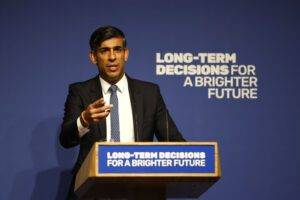
Rishi Sunak has said the UK “shouldn’t be in a rush to regulate” the development of artificial intelligence (AI) despite a dossier of potential dangers laid out by the government.
The Prime Minister made a speech on the risks and rewards of the new technology at the Royal Society this morning ahead of the UK’s AI Safety Summit at Bletchley Park next week.
Asked about regulation, Sunak said: “I think we shouldn’t be in a rush to regulate for a couple of reasons.”
He said the UK’s approach of encouraging innovation has “historically” been the right one, and stressed it was “hard to regulate something if you don’t fully understand it”.
Sunak said “We as a country tend to get this right. We tend to take a principles-based, proportionate approach to regulation that protects the things that we need to protect, whilst allowing the maximum amount of innovation to happen here.
“That is the hallmark of the UK – that’s why we have such successful innovative sectors like technology, life sciences and financial services.
“We need to not lose that as we think about AI and that’s why I think our approach is absolutely the right one for the country.”
The Prime Minister also said mitigating the extinction risk from AI should be a global priority alongside pandemics and nuclear war and said he wanted to be “honest” with the public.
It came after the government revealed a dossier of warnings about how AI could develop until 2030, and said it is unable to rule out it posing an “existential threat” to humanity.
Potential dangers cited were cyberattacks; terror groups developing bioweapons, rising unemployment; increased poverty; scams, fraud and fake news; election interference; trade secrets being stolen and “societal unrest” as people “fall victim to organised crime”.
An AI Safety Institute – based on the work of the AI Safety Taskforce – is part of the government’s plan to address these potential threats.
Sunak added: “As we understand what the risks are – if they manifest themselves – then we’ll be in a far better place to figure out what is the appropriate action to take at that moment.
“When you’re dealing with something so fast moving and not fully understood even by the people who are developing the tech themselves it’s hard to say ‘this is the best way to regulate’.
“I think first build the understanding and we can maintain our pro-innovation approach.
“Then move to something more practical down the line when we know exactly what we’re dealing with.”
Peter Kyle, Labour’s shadow science and technology secretary, said: “AI is already having huge benefits for Britain, and the potential of this next generation of AI could be endless, but it poses risks as well.
“Safety must come first to prevent this technology getting out of control. Rishi Sunak should back up his words with action and publish the next steps on how we can ensure the public is protected.
“We are still yet to see concrete proposals on how the government is going to regulate the most powerful AI models.”
Read more:
Sunak says UK shouldn’t ‘rush to regulate’ AI
Ex-NatWest chief breached Nigel Farage’s privacy, ICO rules

The former NatWest chief executive breached data protection laws when she spoke to a BBC journalist about the planned closure of Nigel Farage’s bank accounts, the UK’s information watchdog has ruled.
An Information Commissioner’s Office (ICO) report has said that Alison Rose broke rules on two counts: first by revealing that Farage had a banking relationship with its private bank, Coutts; and secondly by providing “misleading information” that led the BBC to believe the bank was closing his accounts for purely commercial reasons, linked to his wealth.
“Mr Farage’s rights were infringed because of this,” the ICO report said.
Documents obtained by Farage in July showed that while Coutts had considered the fact that he had fallen below the bank’s multimillion-pound account thresholds, the bank also decided to close his accounts due to concerns over his political views, which it said did not align with the bank’s. The Coutts documents showed the bank believed that his alleged “xenophobic, chauvinistic and racist views” posed a reputational risk to the bank.
ICO said it did not plan to take any further action, given that NatWest – which is 38.5% owned by the taxpayer – had already launched an investigation into the incident and Rose had stepped down over the scandal.
In July, Rose admitted to discussing the matter with a BBC journalist, in an alleged breach of client confidentiality that raised concerns in government and eventually led to her resignation.
An ICO spokesperson said: “Following a thorough review of the complaint raised with us, we have concluded our investigation. We upheld two parts of the complaint – namely, we found that an individual employed by NatWest shared information when they should not have done, and that by doing so they infringed the complainant’s data protection rights.
“We have been clear with the bank that these actions were unacceptable and should not happen again.”
The ICO ruling, which was first reported by the Financial Times, was issued in response to complaints filed by Farage this summer. It also comes days before NatWest’s own investigation is due to conclude, at the end of October.
That investigation, which is being conducted by the law firm Travers Smith, could result in Rose losing millions of pounds in pay. NatWest confirmed last month that she is still likely to collect £2.4m as she serves out her 12-month notice period.
Farage said: “The ICO report confirms that Dame Alison Rose was in breach of data rules, of the FCA rulebook, and oversaw a culture of deep political prejudice within the NatWest Group. She must not be rewarded for failure.”
A spokesperson for Farage told media that the former Ukip leader had not ruled out taking the matter to court.
NatWest bosses, including the outgoing chair, Howard Davies, are likely to face pressure over the ICO ruling when the bank releases its third-quarter earnings on Friday morning.
A NatWest spokesperson said: “We fully cooperate with the ICO in its assessment of any customer complaint, but it would not be appropriate for us to comment on this individual case.”
A spokesperson for Rose said: “Alison Rose was not aware of the ICO investigation, did not receive any questions from the ICO, has not seen its ruling and cannot comment on it.”
Read more:
Ex-NatWest chief breached Nigel Farage’s privacy, ICO rules
Investec and OakNorth embroiled in row over COVID taxpayer loan guaran …

Two British banks are embroiled in a dispute over a COVID loan which could leave taxpayers on the hook for a six-figure sum.
It is understood that OakNorth, the banking group founded by entrepreneur Rishi Khosla, is in talks over a £20m loan it made to a real estate joint venture between Newmark Properties and Investec Bank UK.
Part of the debt consisted of a Coronavirus Business Interruption Loan (CBIL) worth close to £300,000, according to insiders.
The joint venture is understood to be in default on its repayments, and the two banks are now said by people close to the situation to be at loggerheads over a resolution.
A failure to reach agreement could result in the joint venture being placed into administration and the taxpayer guarantee on the CBILS loan being triggered, according to one insider.
In a statement, an OakNorth spokesperson said: “OakNorth has been seeking, and continues to seek, a constructive solution with Investec, with a fully solvent outcome.
“Investec has not provided a proposal which would avoid loss to the taxpayer which is consistent with the underlying loan and CBILS documentation.”
A spokesperson for Investec said: “We are in confidential discussions with various parties, details of which cannot be disclosed.
“Investec is fully committed to paying the CBIL liability in full and strongly refutes any suggestion otherwise.
“We continue our discussions with the relevant parties to ensure this takes place.”
Further details of the discussions between them were unclear on Thursday.
Under the terms of the CBILS scheme, taxpayers underwrote 80% of the value of the loans issued by banks.
The dispute between OakNorth and Investec is one example of the continuing fallout from the emergency loan schemes set up in the early months of the pandemic to ensure that British companies were able to withstand the series of COVID lockdowns.
Tens of billions of pounds were borrowed under CBILS and its larger and smaller counterparts.
It subsequently emerged, however, that the schemes had been targeted by fraudsters, with billions of pounds of taxpayers’ money squandered.
Read more:
Investec and OakNorth embroiled in row over COVID taxpayer loan guarantee
Britain’s drivers demand ‘three factors’ from new Budget amid an …

Motoring experts have called on the Government to include vital information in the upcoming Autumn Budget to help hard-pressed drivers.
The Chancellor of the Exchequer Jeremy Hunt announced last month that the Autumn Statement would take place on November 22.
Many are expecting the Chancellor to unveil measures for first-time buyers, as well as tax cuts as the Government aims to help Britons with the cost of living crisis.
However, others will be wanting Hunt to clarify how drivers will be helped following the Government’s pledges to scrap anti-motorist laws.
Paul Holland, managing director for UK/ANZ Fleet, FLEETCOR, said the new budget would be a “transitional phase” for drivers and fleets across the UK.
He added that net zero had “slipped down the agenda” for Rishi Sunak and the Government, potentially dampening the mainstream rollout of electric vehicles.
While Rishi Sunak was optimistic about the future of electric car sales, he said more time was needed to lower costs for motorists before switching.
Paul Holland said: “Even if the Government has momentarily stalled in its drive towards an electric future, fleets themselves and road users in general have powerful incentives to switch away from fossil fuels.
“This is why we’re still seeing an increase in electric vehicle usage even after the grants for EVs have ceased.
“There are three factors driving the use of EVs, even when the Government is moving away from incentivising them: price, sustainability and flexibility.”
The expert highlighted how fuel prices needed to come down for all motorists to be able to continue driving comfortably, saying that the Government could be doing more to bring prices down.
Currently, the average price for a litre of petrol at the pumps is 155.49p, while diesel prices are almost 7p more expensive at 162.19p.
Prices for both petrol and diesel are cheaper at supermarkets as experts often urge drivers to check where they can fuel up for as cheap as possible.
The UK is on target to hit 100,000 chargers by 2025, although there are some fears over whether the Government is still planning on meeting its original target of 300,000 chargers by the end of the decade.
Some are even suggesting that the Government could bring back a form of incentive system to help motorists switch to cleaner vehicles.
Paul Holland concluded, saying: “While we await further details and the true impact of the Prime Minister’s delay to 2035 and net zero strategies, as well as what will be included in the Autumn statement, we know truly that it will not impact the progress made by all stakeholders as we all work towards sustainable mobility.”
Read more:
Britain’s drivers demand ‘three factors’ from new Budget amid anti-motorist purge
UK house prices will not stop falling until 2025, Lloyds Bank data for …

UK house prices will continue to slide this year and in 2024 and will not start to recover until 2025, Lloyds Banking Group has forecast.
The lender, which owns Halifax and is Britain’s largest mortgage provider, said that by the end of 2023 house prices would have fallen 5% over the course of the year and were likely to decrease by another 2.4% in 2024.
The forecasts, which were released on Wednesday alongside the group’s third-quarter financial results, suggest an 11% decline in property prices from their peak last year, when the market was still being fuelled by a rush for larger homes after the coronavirus pandemic.
Santander is predicting a larger drop in UK house prices for the whole of 2023 of about 7%, followed by a smaller 2% fall in 2024.
Both lenders said the first signs of growth would start to emerge only in 2025, with Lloyds economists predicting a 2.3% increase in house prices that year and Santander expecting a 2% rise.
“The housing market in 2023 has been a little bit softer than we saw in previous years,” Lloyds’ chief financial officer, William Chalmers, said. “Having said that, as you know, there has been an increase generally in the housing market for a number of years to date, and so we’re retracing a part of those steps.”
Meanwhile, Lloyds said its own finances were being squeezed, as it started to pay out higher interest rates to its savers.
It said its net interest margin, which is a key driver of bank income and accounts for the difference between what is charged for mortgages and paid on savings, narrowed from 3.14% to 3.08% in the July to September period. Lloyds blamed that on “expected mortgage and deposit pricing headwinds” and Chalmers said the decline was expected to continue into the following quarter.
Similar trends have weighed on Barclays, which on Tuesday revealed that its net interest margin had dropped, and would fall further over final three months of the year. Barclays’ chief executive, CS Venkatakrishnan, said the bank had been “very disciplined and prudent and passed through interest rates to customers”.
Competition has forced lenders to start reducing costly mortgage rates while paying out more for deposits, as savers increasingly shop around for more lucrative returns.
It follows pressure from regulators and politicians, who this year accused banks of failing to pass on interest rate rises to their savings customers at the same speed they were increasing charges for borrowers.
Lloyds still managed to report a rise in pre-tax profits to £1.9bn for the three months to September, up from £576m a year earlier. However, that figure has been restated to align with new accounting rules.
Its profits were also flattered by a 72% decrease in the amount of money put aside for potential defaults, to £187m. That compares with the £668m put aside during the same period last year, when it frontloaded its cash cushion amid fears of an economic downturn that could hit the UK housing market.
Lloyds said the number of customers falling behind on mortgage payments was “broadly stable” in the third quarter, and that the growth in defaults had also slowed, but was still slightly above pre-pandemic levels.
Santander also said it had seen a “modest increase” in customers falling further behind on mortgage payments, but added that it expected higher-for-longer interest rates to have a “more pronounced impact on households and businesses” in future.
Chalmers said Lloyds was contacting customers to offer debt advice and shift some borrowers on to better rates. “It is a very extensive outreach programme that is adopted proactively by the bank to ensure that customers that need support get it,” he said.
Danni Hewson, head of financial analysis at the investment platform AJ Bell, said it was clear that Lloyds – at least for now – was “managing to keep bad debt under some kind of control”.
She said: “The key question for investors is how long the company can continue to enjoy some sort of benefit from the higher cost of borrowing and if – or when – the strain on household finances becomes so acute the level of loans gone bad starts to balloon.”
Read more:
UK house prices will not stop falling until 2025, Lloyds Bank data forecasts
Bitcoin rises to 17-month high as ETF speculation mounts

Bitcoin reached a 17-month high on Tuesday amid rising speculation that US regulators will approve stock market funds that invest directly in cryptocurrency.
The price increased more than 10 per cent to $34,872 a token, pulling back the losses seen in last year’s crash.
The surge was driven by hopes that the Securities and Exchange Commission would approve an exchange-traded fund (ETF), abandoning its decade-long policy of refusing to approve spot ETFs.
It followed a 10 per cent surge on Monday, when bitcoin posted its best day in nearly a year.
An approval by the US SEC of an ETF that owns bitcoin on behalf of fund investors is expected to fuel demand.
It’s argued that a spot bitcoin ETF would allow investors who have been previously wary of crypto access to the asset via the stock market, bringing a new wave of capital to the sector.
Steen Jakobsen, chief investment officer at Saxo, said: “The value of … any asset, basically, is the amount of people using it.
“So the ETF would make a large audience and increase liquidity.”
Ilan Solot, co-head of digital assets at Marex, said: “The SEC accepting a spot bitcoin ETF application would validate bitcoin as an established asset class alongside all other asset classes.
“It could close the book on rogue and unregulated institutions leading the way on crypto.
“Major institutions would now have a buy-in into the sector.”
Antoni Trenchev, co-founder of digital asset firm Nexo, said: “A sense of excitement has erupted in the crypto market and now it’s just a case of waiting to see if and when something concrete emerges from the SEC.”
The price of bitcoin, a volatile asset, dropped below $16,000 in November 2022.
It came a year after it reached a record high of $69,000.
Read more:
Bitcoin rises to 17-month high as ETF speculation mounts
UK unemployment rate remains low at 4.2% as number of job vacancies fa …

The UK unemployment rate remains low, according to the latest official figures.
The figure stood at 4.2% in the three months to August this year, after changes to the Office for National Statistics (ONS) survey method.
Under the new means of assessing the labour market, there has been no change in the level of joblessness compared to the three months to July.
Despite the unemployment rate remaining static, the number of jobs on offer fell to under a million. A drop of 43,000 jobs was estimated by the ONS from its previous tally – with 988,000 vacancies available from July to September.
The number of vacancies fell across the economy – 14 of the 18 industries surveyed posted a reduced number of jobs. It was the 15th consecutive period of contraction in the labour market.
The country’s all-time lowest unemployment rate was 3.4%, recorded in December 1973 – while the highest rate was 11.9% in April 1984.
Since the pandemic years, there has been a high number of people neither in work nor looking for work – people who are classed as economically inactive. This can be because people are long-term sick.
Data from the ONS also shows there was a slight increase in the percentage of economic inactivity. The rate grew 0.1 percentage points to 20.9% from June to August compared to the three months from March to May.
A new way of crunching the labour market numbers is being adopted by the ONS in an effort to ensure accuracy, as the organisation found it harder to engage with enough people in certain groups.
The publication of unemployment data was delayed a week in an effort to produce the best estimates.
Some have been critical of the new process. The publication of experimental estimates of headline numbers raised “questions about the reliability of the data”, economics research firm Pantheon Macroeconomics said.
“The poor quality of this data will hamper key decisions, including the Bank of England’s on interest rates and the government’s on labour market inactivity,” the Resolution Foundation thinktank added.
Nevertheless, the figures demonstrated the labour market was loosening – with unemployment set to peak at 4.8% in the first three months of next year, Pantheon forecast.
As a result, it’s expected the Bank of England will keep interest rates at 5.25% next month.
Read more:
UK unemployment rate remains low at 4.2% as number of job vacancies falls
Cap on bankers’ bonuses to be scrapped within days

Britain’s financial regulators have confirmed that the cap on bankers’ bonuses will be scrapped from next week as part of a post-Brexit bid to boost the attractiveness of the City of London.
Since 2014, under rules inherited from the European Union, banks, building societies and investment firms have had to limit bonuses for employees to two times their base salary. The EU brought in the policy to try to deter bankers from the type of risky behaviour that caused the 2008 financial crisis.
But the Financial Conduct Authority (FCA) and the Prudential Regulation Authority (PRA), after almost a year of consultations, have now decided to get rid of the cap from October 31.
The regulators said they approved the changes to “strengthen the effectiveness of the remuneration regime” by allowing banks to increase how much of their staff’s pay is linked to performance.
They added that the changes should “also help remove unintended consequences of the cap”, with most lenders having had to increase the base pay for their workers to make sure they were not losing out because of the policy.
But fixed pay cannot be as easily tweaked in response to changes in the event of a downturn, for example; nor can it be so readily clawed back if poor performance or misconduct subsequently comes to light.
The cap on bonuses was never popular in either Westminster or the City of London. In the year the cap was introduced, George Osborne, who was then chancellor, described the measure as “entirely self-defeating” and tried unsuccessfully to overturn it. Andrew Bailey, who is now the Bank of England’s governor, led the central lender’s prudential regulation authority at the time and called the EU’s bonus regulations the “wrong policy”.
Politicians were worried that London was losing business and talent to rival financial centres such as New York and Hong Kong because of the cap. Banks were against it because it meant that they had to increase fixed salaries — although that was a boon for staff, who could be much more certain how much money they would be taking home each year.
The scrapping of the cap was first revealed last year by Kwasi Kwarteng when he was the chancellor. It was a key part of his plan to make post-Brexit Britain more competitive as a financial centre by taking advantage of the UK’s freedom to make its own rules after leaving the EU.
However, despite banks’ initial unhappiness when the cap was introduced, it remains to be seen whether many lenders will now want, or be able, to alter their pay structures once again.
“I very much doubt that there’ll be a dramatic shift back to the pre-financial crisis days of low base salaries and high bonuses,” Suzanne Horne, an employment lawyer at Paul Hastings, said.
Anne Sammon, a partner at Pinsent Masons, warned that the changes could lead to a “two-tier workforce”, where new employees are paid lower salaries but with higher bonuses than their colleagues.
“Firms will need to be mindful of flouting equal pay laws in these circumstances — where employees are doing similar roles but being paid lower salaries,” she added.
Commenting on the government’s decision, Julian Jessop, Economics Fellow at the free market think tank, the Institute of Economic Affairs, said: “Scrapping the bankers bonus cap is common sense. It is a clumsy rule whose costs far outweigh any potential benefits. Its removal will further strengthen the competitiveness of the UK financial sector and increase tax revenues, so it is not just bankers who will benefit.
“The cap has led firms to increase basic pay and made it harder for them to adjust variable pay. This has added to fixed costs and reduced the flexibility to respond to different financial conditions and to reward outstanding individuals appropriately.
“There are also now many more effective ways to prevent excessive risk-taking, including the ‘Senior Managers Regime’ (which makes top staff directly accountable to regulators) and deferred bonus schemes (which allow excessive payments to be clawed back later).”
Read more:
Cap on bankers’ bonuses to be scrapped within days

