

Ada Ventures, the VC firm which backs breakthrough ideas, is set to become the first investor in Europe to directly support founders in their portfolio with the cost of childcare.
The decision was sparked by a Treasury-led review into female entrepreneurship led by Dame Alison Rose. It found that primary care responsibilities remained the biggest barrier for female founders, with 46 per cent of “mum entrepreneurs” identifying it as a “very important” or “important” barrier, compared with 33 per cent of fathers with businesses.
The two-year pilot scheme by the firm will offer working parents up to 40 hours of free back-up childcare a year and will cover the cost of a range of services from babysitting to holiday clubs provided by Bubble, one of its portfolio companies.
According to a recent survey, 67% of mothers felt childcare duties in the past decade had cost them progress at work. During 2022, only 1% of VC capital was raised by women-only teams, with 87% going to all-male founding teams.
After an investigation into the venture capital market, the Commons’ Treasury select committee reported in July that the lack of investment in businesses with all-female founders was a “concern” and that they had received only 2 per cent of all venture capital funding in 2021.
The numbers exposed a long-running problem in the venture capital industry, which has been striving to increase female representation. The MPs’ committee criticised the industry for failing to invest in businesses led by women and ethnic minorities, as well as in companies outside London and southeast England.
It recommended that funds should provide statistics around the diversity of their own employees and their funding decisions as a condition of receiving access to taxpayer-funded schemes.
Harriett Baldwin, the Conservative MP who chairs the committee, spoke to a group of European female venture capitalists yesterday. “Recently, someone told me about investing in a kitchenware company,” she said. “Everyone making the decision to invest was a man. In the real world, women make 80 per cent of the decisions on kitchenware. Replicating this disparity across investments in life sciences, renewable energy or AI shows what VCs are missing out on.”
The debate around venture capital investment has intensified because it is critical to turbocharge businesses in their early stages, is a way of picking winners, and gives access to the funds and networks founders needed to become successful.
Read more:
VC firm offers childcare help for ‘mum entrepreneurs’
Category: Uncategorized
John Lewis Boss, Dame Sharon White, announces resignation amidst chall …

In a surprising turn of events, Dame Sharon White, the CEO of John Lewis, has announced her resignation from the company.
After just three years at the helm, Dame Sharon has decided to step down, leaving behind a legacy of notable achievements and a company facing unprecedented challenges.
Dame Sharon White‘s tenure at John Lewis was marked by her determination to navigate the retail giant through a rapidly changing landscape. She took on the role in 2019, becoming the first woman and the first outsider to lead the company in its 156-year history. Her appointment was seen as a bold move to bring a fresh perspective and drive transformation in the business.
During her time as CEO, Dame Sharon implemented several key initiatives aimed at revitalising the brand and adapting to the digital era. She spearheaded the expansion of John Lewis’ online presence, focusing on e-commerce and improving the company’s digital capabilities. Under her leadership, the company successfully launched a new website, enhanced its mobile app, and introduced personalized shopping experiences for customers.
Despite these efforts, John Lewis faced numerous challenges during Dame Sharon’s tenure. The rise of online retail and the increasing dominance of e-commerce giants presented significant hurdles for the company. Additionally, the economic impact of the COVID-19 pandemic further strained the retail sector, leading to store closures, reduced footfall, and a decline in consumer spending.
In a statement, Dame Sharon White expressed her gratitude for the opportunity to lead John Lewis but acknowledged the immense challenges facing the company. She emphasized the need for fresh leadership to navigate the uncertain future ahead and ensure the long-term success of the business.
The resignation of Dame Sharon White has sparked speculation about the future direction of John Lewis and the wider retail industry. With her departure, the company now faces the task of finding a suitable successor who can lead the brand through these unprecedented times. The incoming CEO will need to possess a deep understanding of both traditional retail and digital innovation, as well as the ability to drive change and adapt to evolving consumer preferences.
This news has sent shockwaves through the industry, as John Lewis has long been regarded as a stalwart of the British retail scene. The company’s success and commitment to quality have made it a household name, and its future will undoubtedly impact the broader retail landscape.
As the search for a new CEO begins, industry experts and stakeholders will closely monitor John Lewis’ next move. The company’s ability to adapt to the digital age while staying true to its core values will be crucial in determining its future success.
Read more:
John Lewis Boss, Dame Sharon White, announces resignation amidst challenging times
Northern leg of HS2 to Manchester is set to be scrapped

The northern leg of the HS2 line is set to be scrapped the government are about to formally announce.
Rumours had been circling for weeks that the high-speed rail line between Birmingham and Manchester was going to be axed by the prime minister and chancellor due to soaring costs.
But even the reports led to a huge backlash from all sides of the political spectrum with Labour mayors urging its retention. and former prime ministers Boris Johnson and Theresa May also voiced their concern over the cancellation speculation.
The first indications that the leg to Manchester could be scrapped came after the Independent reported that ministers were considering shelving the northern phase amid concerns about spiralling costs and severe delays.
The newspaper said a cost estimate revealed that the government has already spent £2.3bn on stage two of the railway from Birmingham to Manchester, but that ditching the northern phase could save up to £34bn.
Speaking about the news, Clive Wratten, CEO of the Business Travel Association (BTA) says: “Scrapping the Manchester to London leg of HS2 is a deplorable act of carelessness on behalf of the Government. Cancelling the key northern hub makes a mockery of the levelling-up agenda.
Once again, connected business travel across the UK is sacrificed by those in power negligent of the needs of those outside London.
We are on the verge of a climate crisis. Car hire is 22% up. Domestic air travel has increased. Rail is no longer the first choice. Continuous capacity challenges are forcing up costs, with service issues a consistent kick in the teeth to business travellers.
All rail infrastructure projects must be protected through investment. Travellers need a reliable and efficient alternative. We challenge you: without HS2, what will that alternative be?”
Read more:
Northern leg of HS2 to Manchester is set to be scrapped
Key Points from Jeremy Hunt’s Conservative Party Conference speech
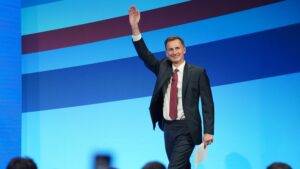
In a speech to the Conservative party conference in Manchester Jeremy Hunt has laid out his key themes for the coming year.
Firstly he said he wanted to reduce the number of officials working in government by 66,000, saving a billion pounds a year.
Hunt said it was part of a wider productivity drive and civil service reform plan to reduce the size of the state and improve efficiency.
“We have the best civil servants in the world and they saved many lives in the pandemic by working night and day,” Hunt said.
“But even after that pandemic is over we still have 66,000 more civil servants than before.
“New policies should not always mean new people. So today I’m freezing the expansion of the civil service and putting in place a plan to reduce its numbers to pre-pandemic levels.”
Hunt said that voters would face an “elemental choice” at the next election between “sound money under the Conservatives or run out of money under Labour”.
He highlighted Labour plans to borrow £28 billion to invest in the transition to net zero, arguing it would lead to higher taxes in the long term.
“Borrowing on that scale risks fuelling inflation and keeping interest rates higher,” he said.
TV & Film production
Hunt, a former culture secretary, said he wants to see Margot Robbie draped in a Union Jack for the Barbie sequel as he talked up the strength of the country’s film and TV sector
The chancellor — who told delegates that Britain is a global leader in sectors of the future such as offshore wind — noted the role of the UK in Greta Gerwig’s fantasy comedy which is estimated to have grossed $1.34 billion worldwide.
“We are Europe’s biggest film and TV production centre,” Hunt said to applause from the floor. “Next time I want to see Barbie wearing a Union Jack because that too was filmed in Britain.”
Hunt, who ran the culture department for more than two years from 2010, used his spring budget to improve the tax breaks available to studios such as Barbie producer Warner Bros Discovery if they produce their films in the UK.
Benefit claimant crackdown
Hunt said it was unfair that someone who “refuses” to look for work “gets the same as someone trying their best”.
The government will crack down on those claiming benefits who do not actively seek work, said Hunt.
He also announced the government would replace the existing Work Capability Assessment and the sanctions regime.
He claimed 100,000 people leave the workforce every year to live on benefits.
The chancellor spoke of his pride about living in a country with “a ladder everyone can climb, but also a safety net below which no one falls”.
He added this safety net was part of a “social contract” dependent on “fairness to those in work alongside compassion to those who aren’t”.
“From last year for the first time ever you can earn £1,000 a month without paying a penny of tax or national insurance,” he added.
Labour government ‘will increase debt’
A Labour government will lead to higher taxes and higher inflation, the chancellor said.
Opposition plans to borrow £28 billion to invest in the transition to net zero will increase government debt, Hunt added.
“That means higher taxes, higher mortgages and higher inflation for families. That’s not an economic policy. It’s an economic illusion.”
Hunt said public spending was growing faster than the economy.
“We need a more productive state, not a bigger state,” he said.
Hunt suggested the UK could stabilise government spending as a proportion of GDP if public sector productivity increased by 0.5 per cent every year.
John Glen, the chief secretary to the Treasury, will review how this can be done, he added.
Minimum Wage rise
Hunt also confirmed the government will accept advice to raise the living wage to at least £11 pounds an hour up from £10.42. The change will come into effect in April 2024.
Speaking to the conference, the chancellor said: “That is a pay rise for nearly two million workers and [will make] the wages of the lowest paid over £9,000 higher than they were in 2010 because if you work hard, a Conservative government will always have your back.
“We promised in our manifesto to raise the national living wage to two thirds of median income, ending low pay in this country.”
Jeremy Hunt, who last spoke to the conference five years ago as foreign secretary, started his speech with a joke that Rishi Sunak was doing a good job at “getting the over-50s back into work”.
The chancellor followed this up with recently revised ONS growth figures showing the UK had been one of the best-performing European economies since the pandemic — previous figures had shown the UK at the bottom of the list.
Hunt said he and Sunak aim to make the UK the world’s next Silicon Valley and praised the tech industry as well as successes with Covid vaccines.
Speaking about the chancellors speech, Rain Newton-Smith, CBI Chief Executive, said: “The Chancellor is right to highlight the sound fundamentals of the UK economy and to set out a positive vision for the UK on a global stage. Amidst fierce competition for investment, we need to be bold in championing the UK’s pro-enterprise credentials and commitment to research and innovation.
“With limited fiscal firepower at its disposal, the Government must focus on stability and predictability to tip the balance for investors. Instead of mixed messages, we have to press ahead with delivering our net zero commitments to unlock serious levels of business investment.
“Tackling inflation might remain the number one priority, but there’s more to do to get the economy firing again. Government and business need to pull in the same direction on tax, investment and big growth opportunities to break the low growth cycle and deliver prosperity for all.”
Read more:
Key Points from Jeremy Hunt’s Conservative Party Conference speech
Political leaders urged to support businesses navigate ‘seismic’ p …

On the eve of the Conservative and Labour Party Conferences, new analysis reveals the acute need for greater support to help British businesses navigate a pivotal 15 months of new rules related to international trade.
A new report from the Institute of Export & International Trade (IOE&IT) finds that over 20 major policy changes will impact all British firms who trade internationally between now and the end of 2024. This makes the period even busier and more pivotal than 2021, when the EU began applying full customs requirement and checks on UK exports.
The report shows that once this period of change is navigated, it will be transformational for British businesses and allow the UK to harness the potential of the new trade deals and opportunities being explored around the world. However, to capitalise on this opportunity, firms must act now to prepare – and policymakers of all colours must work together to ensure this bedding in period is a success.
Last month the government announced its plans for a significant new approach to importing goods into Great Britain via the Border Target Operating Model (BTOM). BTOM will progressively be introduced from January 2024, and will affect borders procedures for incoming food, animal and plant products. However, IOE&IT’s analysis finds that BTOM is just the beginning, with 23 major legislative and policy changes set to affect businesses either directly or through their supply chains, delivery partners or freight forwarders.
The changes set to come into force over the coming months include the fifth release of the New Computerised Transit System, the rollout of the Electronic Trade Documents Act, the EU Import Control System 2, as well as multiple updates to the documentation, risk-based checks and health certification checks on specific products. With specific requirements and levels of understanding needed for each, IOE&IT finds that the time and support needed to implement these changes will be substantial – but that the benefits will be vast.
As the country stands on the precipice of great change in how it does business with the rest of the world, the Institute of Export & International Trade is taking this report to Party Conferences with the clear message that the business community needs support, education and clarity in order to plan properly and navigate this critical period of change successfully.
Commenting on this analysis, Marco Forgione, Director General of The Institute of Export & International Trade, said: “The UK’s international trade community is on the launchpad of great change. Such a raft of new measures in so short a period of time is almost unheard of. This presents an enormous opportunity for Britain to reap the benefits of the new trade deals and partnerships we are pursuing around the world. But we need businesses and policymakers pulling together in the same direction.
“From cutting red tape to our new digital borders, these changes are undoubtedly a cause for excitement. But with so much change, there is naturally going to be some apprehension amongst business owners. This is understandable, and there will be a bedding in period – but the potential benefits if we can navigate this period successfully are profound. The digitalisation of UK trade has the potential to add £25bn to the country’s GDP. But that potential cannot be realised without certainty and support. Businesses need to feel confident that they can not only navigate these changes, but that they have sufficient time to prepare so stock levels, deliveries and suppliers aren’t negatively impacted.
“My message to our leaders at Party Conferences this season is clear, 2024 is going to see profound change in how we trade with the rest of the world. We can longer take for granted that businesses are fully aware of all the changes coming into force. It is essential there are no more delays and that we work together to give our business community the best chance to succeed. We have a golden opportunity here for British business to flourish – but they can only reap the rewards of efficient new border systems and trade deals if they are armed with the right skills and knowledge in plenty of time.”
Read more:
Political leaders urged to support businesses navigate ‘seismic’ period promising transformational benefits for international trade
Some firms unaware of England’s new single-use plastic ban which is …

Firms have said that they were not aware of a ban in England on single-use plastic cutlery, plates and polystyrene trays that comes into force on Sunday.
The ban does not extend to plastic containers and trays used in takeaways or for pre-packaged food in shops leading to environmental campaigners saying the new rules do not go far enough, and called the government’s approach “piecemeal”.
The government said it was the “next big step” in its “journey to eliminate all avoidable plastic waste by 2042”.
Plastic pollution takes hundreds of years to break down, harms waterways and is a source of greenhouse gases.
From Sunday, 1 October, shops, takeaways, food vendors and other hospitality businesses will no longer be able to sell single-use plastic cutlery, balloon sticks, polystyrene cups or food containers.
It follows a similar ban in 2022 on single-use straws, stirrers and cotton buds containing plastic.
However, under an exemption to the new rules, takeaways will still be able to use plastic containers, trays and wrap.
Retailers can also continue using plastic plates, bowls and trays for pre-packaged food such as pre-filled salad bowls and ready meals.
The government said these items were classed as “packaging” and would be tackled under separate rules. These are meant to shift the costs of dealing with packaging waste away from local authorities and onto packaging producers.
Anna Diski, plastics campaigner for Greenpeace UK, said: “Legislating token bans on a few single-use plastic items every few years… [is] completely inadequate to the scale of the problem.
“Instead of this piecemeal approach, the government needs to address the problem at source and roll out a serious strategy to cut how much plastic is being produced.”
Meanwhile, some businesses said they were not aware of the new rules at all.
Takeaway owner Herdy Ibrahim in Leeds said: “To be honest with you I haven’t heard anything about it.”
Across the road at Fast Fried Chicken, Jalal Ali said he had just bought two weeks’ supply of polystyrene boxes and wholesalers are “still full” of packaging that will be banned from Sunday.
“I’ve been to the warehouse yesterday and they still have plastic forks and polystyrene trays like I have here,” he said.
Andrew Crook, president of the National Federation of Fish Friers (NFFF), said: “We’ve been working with the Foodservice Packaging Association and Defra to get information together for our members but, of course, not all takeaways and restaurants are members of organisations so there will be places out there that will be learning the news today.”
In September, the British Independent Retail Association, that works with more than 6,000 independent businesses, warned some firms were unaware of, or unprepared for, the new rules.
Businesses that continue to supply banned single-use plastics after 1 October could be fined and local authorities will be carrying out inspections.
Environment Minister Rebecca Pow said the government had worked closely with industry over the last nine months to help it transition to greener packaging.
“This new ban will protect the environment and help to cut litter – stopping plastic pollution dirtying our streets and threatening our wildlife,” she said.
‘Special conditions’
There is backing by the public to reduce plastic waste. According to research by takeaway delivery platform Just Eat, 70% of people think the government should do more to reduce plastic use, while 73% would support a ban on plastic takeaway boxes.
Robin Clark, global director of sustainability at Just Eat, said that the UK takeaway industry used around 500 million single-use plastic boxes each year.
The firm urged the government to make sustainable packaging alternatives more widely available and affordable for businesses and consumers.
Read more:
Some firms unaware of England’s new single-use plastic ban which is just days away
UK households face tax rise of £3,500 a year by next election, thinkt …

UK households are facing an average tax rise of £3,500 a year by the next election, the country’s leading economics thinktank has said – the biggest increase over a parliament on records dating back more than 70 years.
The Institute for Fiscal Studies (IFS) said that on current forecasts the Conservatives were on track to raise £100bn more annually by 2024 than if taxes as a share of national income had stayed the same as in 2019.
In a damaging report for Rishi Sunak as the Tory party faces growing internal divisions over the issue, the thinktank said tax revenue was on track to amount to about 37% of national income in 2024, up from about 33% four years ago.
Compared with a world in which that shift had not occurred, the IFS said this amounted to an additional £100bn a year for the exchequer – the equivalent to about £3,500 more per household, although some would pay more and others less.
Meanwhile, Sunak is preparing to head to Manchester this weekend for one of the most challenging Tory party annual conferences in years. He is under pressure from rightwing MPs and supporters of his predecessor Liz Truss to launch a package of pre-election tax giveaways.
However Jeremy Hunt has already said that little room for tax cuts if he wants to meet the government’s self-imposed targets for the public finances without renewed cuts to public spending.
In analysis that is likely to stoke fresh Tory infighting, the IFS said no parliament had presided over a bigger increase in taxes than the current one – led by three Conservative prime ministers – on records dating back to 1951.
Before the 2019 general election, the Conservatives claimed Labour’s spending plans under Jeremy Corbyn would mean an additional £2,400 bill for every taxpayer in Britain.
Under Keir Starmer, Labour has seized on rising tax levels as evidence of the Tories’ failure to grow the economy, arguing the government is in a bind of its own making, as sluggish economic growth brings in less income for the exchequer to fund public services.
Aiming to demonstrate economic competence before the next election, the shadow chancellor, Rachel Reeves, has ruled out introducing a wealth tax or putting up the top rate of income tax. However, Labour faces its own internal pressures to overhaul taxation to fund the repair of austerity-starved public services while also tackling entrenched inequalities.
In separate research published on Friday, a report from the Resolution Foundation thinktank and the innovation charity Nesta’s UK 2040 Options programme warned stark wealth inequalities were holding Britain back.
Arguing that changes to wealth tax were a “no-brainer”, the report found total wealth for the richest 10% of people in the UK had grown 25 times faster than for the poorest 30% between 2006 and 2020.
Sarah Olney, the Liberal Democrat Treasury spokesperson, said the Tories had crashed the economy, with the public paying the price. “This is the same party which promised not to raise people’s taxes and is now taxing families through the nose,” she said.
The IFS said a series of taxation-raising measures had fuelled the record growth in tax revenue as a share of national income. Highlighting decisions Sunak took during his time as chancellor, the thinktank pointed to a rise in the headline rate of corporation tax from 19% to 25%, the energy profits levy and the freezing of various income tax and national insurance thresholds.
Ben Zaranko, a senior research economist at IFS, said that while high by historical standards, the UK’s tax take as a share of national income was still “fairly middling” compared with other developed countries.
Even if the government decided to announce tax cuts in the run-up to the next election, there would still be “no world in which this parliament, or indeed the period since Rishi Sunak became prime minister”, turned out to be “anything other than a tax-raising one”, Zaranko said.
He added: “This is not, for the most part, a direct consequence of the pandemic. Rather, it reflects decisions to increase government spending, in part driven by demographic change, pressures on the health service and some unwinding of austerity.
“It is likely that this parliament will mark a decisive and permanent shift to a higher-tax economy.”
A spokesperson for the Treasury said that “despite needing to take the difficult decisions to restore public finances” after the Covid pandemic and Russia’s invasion of Ukraine, the UK’s ratio of tax to gross domestic product would still remain lower than any major European economy.
“Driving down inflation is the most effective tax cut we can deliver right now, which is why we are sticking to our plan to halve it, rather than making it worse by borrowing money to fund tax cuts.”
Read more:
UK households face tax rise of £3,500 a year by next election, thinktank IFS finds
Childcare costs ‘soaring by £600-plus a month’ as staff are make …

Parents of nursery and primary school-age children are facing more than £600 of extra childcare costs a month, a study has found, as employers demand staff spend more days in the office.
More than half of parents said they had come under increasing pressure to increase time spent at their desks, in response to a survey by the flexible childcare provider Pebble.
The move by employers to issue new return-to-office mandates in recent months is resulting in higher childcare costs equating to an average of an additional £664 every month, according to a survey of 2,000 parents.
Employers were found on average to be asking their staff to return to their desks for an additional two days each week, putting pressure on family finances amid the cost of living crisis.
Sarah (not her real name) works in financial services in Scotland, and is struggling with the cost and logistics of childcare after her employer ordered all staff back to the office for four days a week, up from the previous three-day mandate.
“Nobody is happy about it, never mind working parents. It doesn’t make sense as the evidence shows working from home is very productive, while the extra time with the family was a no-brainer,” she said.
Sarah and her husband live in a rural area with no family nearby and limited childcare availability, the cost of which she described as “horrendous”. She is now looking for a job offering more home working.
“People reckon the company is going in the direction of five days in the office and I just can’t do that with the many years ahead of me with children in primary school,” she said.
Two in five parents told Pebble, which enables ad hoc bookings at nurseries and other childcare locations, they were struggling to afford additional childcare costs. Half of those surveyed said they expected to quit their current roles in order to find jobs offering more remote working.
Meanwhile, more than a third of parents surveyed said they had already changed jobs to avoid office time.
Large corporates have started to call an end to the more flexible working patterns which followed the pandemic, led by big tech firms including Amazon, Google and Meta, and banks including Citigroup and Lloyds.
Since the end of the summer, Lloyds has been encouraging staff back to their desks, and it currently expects workers to attend for two days a week.
Under a new flexible working policy, the lender said it was offering compressed working arrangements to parents and carers, with the option to squeeze a five-day working week into four.
However, one Lloyds employee, who did not want to give their name, complained of a lack of flexibility.
“I have to work Tuesdays and Wednesdays in the office, which are not days I would have chosen due to childcare reasons, and I have to work 9-5,” they said.
They claimed this was causing worry about what to do once their child starts school next year: “Having to work in the office means I will have to pay for breakfast club, and after-school club, but this still doesn’t cover the time it will take for me to commute. I’m at a loss as to what I can do.”
Some parents may have benefited from reduced childcare costs when they were required to work from home during the pandemic, but many are now struggling to find adequate and affordable care, according to Lance Beare, the chief executive of Pebble.
“We’ve seen increases in fees – due to cost of living pressures – and of course some childcare settings have closed due to the increased financial pressures,” he said.
“Forced office rollbacks means the pressure is on for parents to secure fixed provision and to commit to higher fees consistently.”
The impact of rising childcare costs was highlighted by the campaign group Pregnant Then Screwed, which surveyed more than 11,800 parents.
It found that families with an annual household income under £50,000 were being hit the hardest, prompting a fifth of parents in such households to leave the workforce.
Almost two-thirds (61%) of parents with children under five said they or their partner had reduced their working hours as a result of childcare costs.
Meanwhile, 41% said childcare fees had risen by between 5% and 10% in the past 10 months, and a further 14% said their nursery fees had gone up by more than 10%.
Read more:
Childcare costs ‘soaring by £600-plus a month’ as staff are make office return
Secrets of Success: RapidSpike CEO, Gav Winter

Ensuring websites create conversion rich opportunities is just one of RapidSpike’s three core offerings
A tech entrepreneur for more than 20 years, Gav Winter has previously founded two major technology consultancies, Gav is an award-winning entrepreneur and leader, and an expert in high-growth strategy. Today he is CEO of next-generation website monitoring company, RapidSpike.
RapidSpike is a next-generation website monitoring platform revolutionising website reliability, performance, and security. As the only solution to capture these three critical aspects of website health, the result is continually optimised customer journeys, greater website resilience, and more conversions – crucial for high-volume businesses transacting online.
Gav takes time out of his busy schedule to share his secrets of success with Business Matters …
What type of businesses do you work with?
The nature of what we do means we can work with pretty much any brand that has online-critical processes – from retail, travel, and gaming to healthcare, policing, and government.
What problem does your company solve?
The web is open 24 hours a day, every day of the year and organisations need to maximise performance, reliability, accessibility, and security if they’re going to lead from the front, enhance the customer experience, and develop genuine brand loyalty.
As such, more than simply website uptime needs to be monitored for businesses to be successful online and create conversion-rich opportunities in today’s digital-first world. Customers now expect websites to perform at a more sophisticated level than ever before.
If you fail, customers will find somewhere else to fulfil what they’re looking for. In today’s world, even marginal gains of 0.1% faster speeds can represent millions of pounds of extra revenue for the UK’s largest brands.
What is your USP?
It must be the depth of data and insight we can provide. RapidSpike knows what it’s good at – and we start in our lane, but it do it really, really well. Let’s face it, websites are rich with just about every statistic under the sun, but we extract the relevant information and understand how to convert it into tangible areas for improvement.
What are your company values? Have you ever had them challenged and if so how have you dealt with it?
Underpinning the company is a sense of responsiveness. It doesn’t matter what time of day it is, how big or small the client, or the relative size of the problem, we must be responsive as people, colleagues, partners, and a platform – it’s fundamental to the success of our business.
I wouldn’t say I’ve had them challenged as such, because people join RapidSpike to help our customers do business better. It’s something we’re all incredibly passionate about, and we were all a part of outlining what it is RapidSpike stands for – which I think is important to the long-term future of our organisation.
How do you ensure that you recruit a team that reflects your company values?
For me, it’s about having a willingness to learn, a ‘can-do’ work ethic and a positive mindset. We’re incredibly honest from the very first interaction with a colleague – as we believe alignment works both ways.
An initial telephone interview acts as more of a temperature check, before we conduct the ’16 personalities test’ to see if the candidate’s personality and skills fit the role we’re looking for – as we’re keen to find differences within the team.
Only once we’re sure of a personality and skillset match would we move to an interview. Even then, we start the conversation by encouraging candidates to forget the nerves and not try to answer a question if they don’t know it – as they can learn. Instead, we’d rather spend the time figuring out if we’d both like to work alongside each other.
Are you happy to offer a hybrid working model of home/office post-covid?
We’re completely flexible. Arguably, I’d say we were ‘digital first’ with the only stipulation being that we meet, face-to-face, for collaborative sessions when needed. While there are no rules on the time spent in the office, as a team, there’s an appetite to introduce two set ‘people work’ days per week, whereby we meet somewhere as a team – be it HQ, a coffee shop, or even in a park.
Do you have any tips for managing suppliers and customers effectively?
I think it boils down to three simple but fundamental things, communication, responsiveness, and continuous improvement. Caring what other people think makes a big difference.
If you could ask one thing of the government to change for businesses what would it be?
Create a ThinkTank which brings together actual business leaders from across the UK at varying stages of their careers. Personally, I believe it would be helpful if MPs had experience in the areas they are given to manage too – it shouldn’t simply be the ‘old boys’ club’.
What is your attitude towards your competitors?
They’re a source of inspiration. You can pick up a lot from competitors, and we shouldn’t be ashamed to admit that. Not only can they feed you with ideas, but you can learn from their mistakes too.
Any thoughts on the future of your company and your dreams?
We’re very much focused on growth. Of course, we have many of the same worries as other organisations across the country, with the rising cost of doing business – but it creates an opportunity too, because people want to future-proof their digital real estate. We’re working hard to raise further investment, but for now at least, we’re sustainable as we are.
Read more:
Secrets of Success: RapidSpike CEO, Gav Winter

