
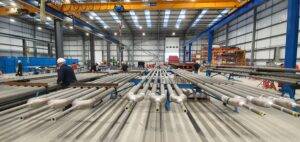
A government credit guarantee has allowed Teesside stainless steel alloy inventor and manufacturer Paralloy to secure up to £26 million of a Santander UK bank guarantee facility to support the continued growth of its export business.
Announced on National Manufacturing Day, the guarantee from UK Export Finance (UKEF) – the government’s export credit agency – allows Santander UK to overwrite a previous facility and increase the amount of facility available to Paralloy from £17 million to £26 million.
The previous facility enabled Paralloy to offer bonds on its contracts, assuring potential buyers that orders would be fulfilled even in times of market uncertainty. The newly agreed package means that the manufacturer can issue £9 million more in bank guarantees than before. This will allow Paralloy to pursue an even greater range of high-value export contracts and enter new markets, partly because the funding will help the business procure inputs whose prices have risen sharply amid global economic challenges.
Thanks in part to this facility, the company anticipates creating 75 new jobs by 2024, giving a boost to local, high-skilled jobs. This is UKEF’s second guarantee issued to Paralloy through its General Export Facility (GEF), the first of which helped Paralloy create more than 100 new jobs and drive export growth up by more than £30 million.
Launched by UKEF in 2021, the GEF product provides exporters with access to flexible financing. Now available through nine financial institutions, it provided support worth £325 million to UK exporters in 2022-23, making it UKEF’s most popular product.
Tim Reid, CEO of UKEF, said: “Working alongside Santander UK, we have increased our support for Paralloy, helping it further develop its export business and support highly skilled jobs in Teesside.
“This facility expansion shows that support which we offer through our General Export Facility is versatile and open to manufacturers in every corner of the UK who want to sell to the world.”
Founded more than 90 years ago, Billingham-based Paralloy produces patented stainless steel and nickel alloy castings used in high temperature furnaces and exports its products to more than 40 countries. Key markets include North America, Europe and the Middle East.
Paralloy supplies an industrial customer base which includes producers of blue hydrogen, direct reduction of iron used in steel manufacturing and Ethylene, as well as components for industrial gas turbines and defence.
Robert McGowan, CEO of Paralloy, said: “Getting hold of the funding to cover facilities and bonds is difficult as it ties up capital that can be used to invest in growing the company. UKEF General Export Facility – both this expansion and the original funding which it replaces – has been a gamechanger.
“It’s a vital tool that has enabled us to fuel the growth of our export sales, increase our investments, win bigger contracts and employ more people.”
Mark Ling, Head of Trade Finance & Supplier Finance at Santander UK said: “We are delighted to continue supporting Paralloy’s export journey alongside the support from UKEF. The General Export Facility offers crucial support to UK businesses, and we are pleased to work with UKEF to provide this funding to Paralloy and a growing number of other companies to help fulfil their international growth ambitions.”
Read more:
Teesside stainless steel firm grows business with £26M export finance package
Category: Uncategorized
UK government quietly disbands AI ethics advisory board just months be …

The UK government has disbanded the independent advisory board of its Centre for Data Ethics and Innovation (CDEI) without any announcement amid a wider push to position the UK as a global leader in AI governance.
Launched in June 2018 to drive a collaborative, multi-stakeholder approach to the governance of artificial intelligence (AI) and other data-driven technologies, the original remit the CDEI’s multi-disciplinary advisory board was to “anticipate gaps in the governance landscape, agree and set out best practice to guide ethical and innovative uses of data, and advise government on the need for specific policy or regulatory action”.
Since then, the centre has largely been focused on developing practical guidance for how organisations in both the public and private sectors can manage their AI technologies in an ethical way, which includes, for example, publishing an algorithmic transparency standard for all public sector bodies in November 2021 and a portfolio of AI assurance techniques in June 2023.
The decision comes ahead of the global AI safety summit being held in the UK in November and while the advisory board’s webpage notes it was officially closed on 9 September 2023, Future News said that the government updated the page in such a way that no email alerts were sent to those subscribed to the topic.
Speaking anonymously with Recorded Future, former advisory board members explained how the government attitude to the body shifted over time as it cycled through four different prime ministers and seven secretaries of state since board members were first appointed in November 2018.
“At our inception, there was a question over whether we would be moved out of government and put on a statutory footing, or be an arm’s-length body, and the assumption was that was where we were headed,” said the official, adding the CDEI was instead brought entirely under the purview of the Department for Science, Innovation and Technology (DSIT) earlier in 2023.
“They weren’t invested in what we were doing. That was part of a wider malaise where the Office for AI was also struggling to gain any traction with the government, and it had whitepapers delayed and delayed and delayed.”
The former board member further added there was also very little political will to get public sector bodies to buy into the CDEI’s work, noting for example that the algorithmic transparency standard published in November 2021 has not been widely adopted and was not promoted by the government in its March 2023 AI whitepaper (which set out its governance proposals for the technology): “I was really quite surprised and disappointed by that.”
Speaking with Computer Weekly on condition of anonymity, the same former board member added they were informed of the boards disbanding in August: “The reason given was that DSIT had decided to take a more flexible approach to consulting advisers, picking from a pool of external people, rather than having a formal advisory board.
“There was certainly an option for the board to continue. In the current environment, with so much interest in the regulation and oversight of the use of AI and data, the existing expertise on the advisory board could have contributed much more.”
However, they were clear that CDEI staff “have always worked extremely professionally with the advisory board, taking account of its advice and ensuring that the board was kept apprised of ongoing projects”.
Neil Lawrence, a professor of machine learning at the university of Cambridge and interim chair of the advisory board, also told Recorded Future that while he had “strong suspicions” about the advisory board being disbanded, “there was no conversation with me” prior to the decision being made.
In early September 2023, for example, just before the advisory board webpage was quietly changed, the government announced it had appointed figures from industry, academia and national security to the advisory board of its rebranded Frontier AI Taskforce (previously it was the AI Foundation Model Taskforce).
The stated goal of the £100m Taskforce is to promote AI safety, and it will have a particular focus on assessing “frontier” systems that pose significant risks to public safety and global security.
Commenting on the how the disbanding of the CDEI advisory board will affect UK AI governance going forward, the former advisory board members said: “The existential risks seem to be the current focus, at least in the PM’s office. You could say that it’s easy to focus on future ‘existential’ risks as it avoids having to consider the detail of what is happening now and take action.
“It’s hard to decide what to do about current uses of AI as this involves investigating the details of the technology and how it integrates with human decision-making. It also involves thinking about public sector policies and how AI is being used to implement them. This can raise tricky issues.
“I hope the CDEI will continue and that the expertise that they have built up will be made front and centre of ongoing efforts to identify the real potential and risks of AI, and what the appropriate governance responses should be.”
Responding to Computer Weekly’s request for comment, a DSIT spokesperson said: “The CDEI Advisory Board was appointed on a fixed term basis and with its work evolving to keep pace with rapid developments in data and AI, we are now tapping into a broader group of expertise from across the department beyond a formal board structure.
“This will ensure a diverse range of opinion and insight, including from former board members, can continue to inform its work and support government’s AI and innovation priorities.”
On 26 September, a number of former advisory board members – including Lawrence, Martin Hosken, Marion Oswald and Mimi Zou – published a blog with reflections on their time at the CDEI.
“During my time on the Advisory Board, CDEI has initiated world-leading, cutting-edge projects including AI Assurance, UK-US PETs prize challenges, Algorithmic Transparency Recording Standard, the Fairness Innovation Challenge, among many others,” said Zou.
“Moving forward, I have no doubt that CDEI will continue to be a leading actor in delivering the UK’s strategic priorities in the trustworthy use of data and AI and responsible innovation. I look forward to supporting this important mission for many years to come.”
The CDEI itself said: “The CDEI Advisory Board has played an important role in helping us to deliver this crucial agenda. Their expertise and insight have been invaluable in helping to set the direction of and deliver on our programmes of work around responsible data access, AI assurance and algorithmic transparency.
“As the board’s terms have now ended, we’d like to take this opportunity to thank the board for supporting some of our key projects during their time.”
Reflecting widespread interest in AI regulation and governance, a number of Parliamentary inquiries have been launched in the last year to investigate various aspects of the technology.
This includes an inquiry into an inquiry into AI governance launched in October 2022; an inquiry into autonomous weapons system launched January 2023; another into generative AI launched in July 2023; and yet another into large language models launched in September 2023.
A Lords inquiry into the use of artificial intelligence and algorithmic technologies by UK police concluded in March 2022 that the tech is being deployed by law enforcement bodies without a thorough examination of their efficacy or outcomes, and that those in charge of those deployments are essentially “making it up as they go along”.
Natalie Cramp, CEO of data company, Profusion, said: “It’s deeply disappointing that the Government has taken the decision to disband the independent AI and data ethics advisory board. It’s another indication that the Government simply doesn’t have a coherent strategy towards data and AI, nor does it have strong stakeholder engagement on this topic. In November the UK is set to hold a global summit on AI safety which is an ideal opportunity to position the UK in a leading role to define how AI can develop. However, when compared to the progress the US and Europe have made towards creating and debating AI legislation, the UK is far behind. The reality is that AI will become one of the defining technologies of the next few decades. Without well-thought-out rules that govern its development we risk, at best, wasting this opportunity to do a lot of good, and at worst, creating an environment where damaging and undesirable uses of AI thrive. This could lead to us regressing to a more unequal society.
“It’s particularly worrying that the Government has disbanded the advisory board because data ethics is a critical part of legislating a fast-moving technology like AI. When we put this move into the context of the failure to finalise a replacement of GDPR seven years after it was announced it would be scrapped, the ongoing issues around the Online Safety Bill, and the failure to introduce any wide-ranging AI regulations, it paints a picture of a Government that does not seem to have a strategy towards regulating and cultivating innovation. I hope that the AI safety summit does help to focus minds and results in the threat and opportunity of AI being taken more seriously, however, data ethics is broader than just AI which leaves questions on how the Government is going to progress this without the advisory board. The establishment of DSIT was very positive but we need real engagement and transparency with the sector, including SMEs, and the public. Concrete action is needed now before it is too late.”
Read more:
UK government quietly disbands AI ethics advisory board just months before hosting global conference
Labour mayors urge Sunak not to scrap, delay or scale back HS2

Five Labour mayors have urged Rishi Sunak not to scrap, delay or scale back HS2 as it would “leave swathes of the north with Victorian transport infrastructure that is unfit for purpose”.
Sadiq Khan, Andy Burnham, Tracy Brabin, Oliver Coppard and Steve Rotheram say they have been “inundated” with concerns from constituents about the potential “economic damage that will result from any decision not to proceed with HS2 and Northern Powerhouse Rail (NPR) in full”.
The regional mayors issued a shared statement to express dismay at the prospect of the UK government scrapping the rail project’s northern leg, ahead of a collective meeting on Wednesday.
The cabinet minister Lucy Frazer, when asked if they would listen to the mayors’ plea not to cut the rail project further, said the prime minister and chancellor “listen to a wide variety of voices”.
Frazer, the culture secretary, told Sky News: “I’m sure the prime minister and the chancellor listen to a wide variety of voices. But as you will know, it’s the responsibility of the government to keep all projects under consideration. And that’s what the chancellor is doing. He is, as he does on all matters which are spending billions of pounds of taxpayers’ funding, looking at a whole range of projects to make sure that they are value for money.”
Asked whether HS2 would run to Manchester, she said: “Well, that is a decision, as you know, for the chancellor, not for me.”
The mayors’ joint statement said: “Investment in transport infrastructure is a huge driver of economic growth – creating jobs, increasing productivity and opening up new business opportunities. HS2 and NPR will deliver this right across our regions.
“This government has said repeatedly that it is committed to levelling up in the midlands and north. Failure to deliver HS2 and NPR will leave swathes of the north with Victorian transport infrastructure that is unfit for purpose and cause huge economic damage in London and the south, where construction of the line has already begun.”
The five mayors urged the Northern Powerhouse Rail project to be delivered in full to ensure “not only north-south but west-east connectivity between Liverpool and Hull, via Manchester airport”, which they say must be non-negotiable.
The five-way statement added: “The UK does not need a new line that only goes from Birmingham to Old Oak Common, which is six miles from central London.
“This does nothing for the north of England. The full Y-shaped HS2 plan was designed to deliver economic benefit right across the country not only between the north and London but between Leeds, Sheffield, Manchester and Birmingham. All of these gains look set to be lost if media reports this week are to be believed.”
Sunak has faced a political backlash over reports he is considering axing the Birmingham to Manchester leg of HS2 amid soaring costs.
Government sources briefed the Times on Monday that the prime minister may offer to fund an underground rail station in Manchester as part of a package of transport investment in the north aimed at winning the support of Burnham, the Labour mayor of Greater Manchester.
Such a compromise would mean phase 2 – taking in a Birmingham to Manchester leg – would be delayed by up to seven years.
On Tuesday, John Stevenson, chair of the Northern Research Group of Conservative MPs, has signalled they may be open to a compromise in which the second phase of HS2 would be delayed for several years.
“At the end of the day, we think HS2 is important for the country. But our east-west connectivity, I think, would be a higher priority,” he said.
A number of senior Tories, including the former chancellor George Osborne and the ex-deputy prime minister Lord Heseltine, have said scrapping the Manchester leg of HS2 would be a “gross act of vandalism” and an abandonment of the north and Midlands.
Before Wednesday’s meeting, Khan said: “Over recent days we have seen a justifiably horrified reaction from businesses and communities across our regions concerned about the economic damage that a decision not to proceed with HS2 and Northern Powerhouse Rail in full will cause.”
Read more:
Labour mayors urge Sunak not to scrap, delay or scale back HS2
Secrets of Success: Antony Vallee, Co-Founder and CEO – Teamed

Employing staff in other countries is incredibly challenging, enter Teamed …
Antony Vallee founded Teamed to simplify the process of building teams – no matter where they are based in the world. Through their own legal entities and global infrastructure, they manage all HR, Compliance, Payroll, and Tax matters for remote talent anywhere in the world. Today their fully distributed team is helping businesses hire top talent across 75+ countries, empowering companies and employees to embrace the benefits and opportunities that come with global employment.
Combining automation and human expertise, they aim to provide both employees and employers with the best experience. No mean feat! Antony takes some time to share his story with Business Matters …
What type of businesses do you work with?
Businesses that put the employee at the forefront of their hiring processes choose to work with Teamed.
Imagine this: you are being relocated from the United States to Spain. You would have plenty of questions about changes in holiday allowances, sick pay, and tax. Your new contract could also mean there are alterations in your salary, notice period, and benefits — and not having someone to talk through what these changes mean for you could be incredibly frustrating and cause a damaging relationship with your employer.
At Teamed, we ensure both employees and employers are aligned, have all the information they need, and most importantly have a point of contact they can go to with any queries they may have. We onboard all new employees virtually over a conference call and will provide ongoing support throughout their employment.
By combining this service-led approach with best-of-breed technology to automate processes, we are able to provide the best experiences for employees and employers across the globe.
What is your USP?
Teamed is democratising global employment opportunities by making it easier than ever to hire, pay and fully support a global workforce. We’re building a market-leading experience for employers and employees by combining our unique technology with human expertise.
100% compliant. Hire talent anywhere in the world with full compliance guaranteed.
Speed: Hire and onboard talent within hours, not weeks.
100% customer retention. We’re a service-led solution you can count on.
What are your company values? Have you ever had them challenged and if so how have you dealt with it?
We’ve stayed true to our values since Teamed was founded in 2020. We have a remote, globally distributed team that works together to achieve our joint mission to enable anyone, anywhere, to access exciting career opportunities, addressing the growing demand for remote working.
Break down barriers: We act to make opportunities equally accessible, so that those with skills and ambition are not held back. Merit should be rewarded equally across boundaries.
Do what’s right: No shortcuts. No short wins. Just a solid commitment to do right by each other, and by each and every customer we serve. Because the best reputations are those that precede you.
Here today, here tomorrow: Being an owner-managed business means we’re in it for the long term. We know our success depends on being accountable, responsible and performance-obsessed.
Show backbone: We choose the courageous route to success. Sometimes that means saying no and stepping away, while staying true to our pursuit of socially responsible success. When it’s right to, we step up.
Good can always be better: Creativity is in our genes. So is the quest for constant innovation and improvement. Every day is another chance for us to be the best at what we do.
How do you ensure that you recruit a team that reflects your company values?
We hire global teams that are empowered to work when, where, and how they want. We currently employ people across 8 countries and we plan to expand our global footprint as we continue to increase our headcount in 2023.
Our values are clearly communicated to all employees and candidates and equity, diversity, and inclusion is embedded into our recruitment process.
I firmly believe that building a team that reflects the values of the company is the foundation for success, as it ensures that everyone is working towards a common goal and operating with a shared set of principles.
Are you happy to offer a hybrid working model of home/office post-covid?
One of my top priorities is empowering our employees to work in the way that best enables them to achieve optimal outcomes. I believe that when people are given the freedom and support to do their best work, amazing things can happen.
Teamed has a remote-first environment. In today’s world, more and more people are looking for flexible work arrangements that allow them to balance their professional and personal lives. By embracing a remote-first approach, we are able to attract top talent from all over the world and create a more diverse and inclusive workforce. It also allows our team members to work from wherever they feel most comfortable and productive, which can help them achieve better work-life balance and overall well-being.
Of course, we also recognise that remote work isn’t for everyone, and we have co-working resources in place to ensure that everyone has the support and environment they need to be successful, no matter where they are located. But overall, I believe that a remote-first environment is essential for building a strong, innovative, and resilient team that can adapt to change and succeed in today’s fast-paced business world.
Do you have any tips for managing suppliers and customers effectively?
A service-led approach that is complemented by technology is at the core of everything we do. By putting the needs of our end users at the centre, we are able to create a more personalised and seamless experience that meets their unique needs and preferences.
This approach not only helps us to differentiate ourselves from our competitors, but it also leads to increased customer satisfaction and loyalty. Additionally, when we combine this service-led approach with the right technology, we are able to create even greater efficiencies and value for our customers. For example, by using automation and data analytics, we can better understand our customers’ needs and tailor our services to meet those needs in real time.
Overall, I believe that a service-led approach that is complemented by technology is essential for building strong, long-term relationships with our end users and driving the success of our company.
If you could ask one thing of the government to change for businesses what would it be?
As we transition from remote working to work-from-anywhere, we would like governments around the world to embrace the new world of working by easing the regulations around working visas and tax rules.
It is positive to see some countries with a lack of work opportunities facilitating regulations around remote working. This can bring an enormous amount of value so all their regions remain populated with employed people paying their taxes and spending locally.
What is your attitude towards your competitors?
While some of our competitors have prioritised rapid growth over everything else, we at Teamed know that this approach can come at the cost of customer satisfaction. That’s why we currently boast 100% customer retention and, as we scale, we remain laser-focused on keeping the needs and preferences of our customers front and centre.
Dealing with global payroll can be complex and it is essential that any concerns or questions are promptly and effectively addressed. Paying multiple employees in multiple currencies with different exchange rates, personalised bonuses, annual leave, and commission structures can be challenging— and are not always easily modified with the self-service model some competitors offer. By providing a service-led approach that is complemented by technology, Teamed puts the customer at the centre, so employees and employers receive the highest quality support and guidance.
By doing so, we are able to create a better, more personalised experience for our employees and employers and build strong, long-term relationships. This customer-centric approach sets us apart in the market and positions us for sustainable, long-term success.
Any thoughts on the future of your company and your dreams?
We’re changing the world of work. We believe that everyone should have access to equal career opportunities, no matter where they live. That’s why Teamed’s mission is to enable anyone, anywhere, to access the best career opportunities, addressing the growing demand for remote working.
Our recent £2.5M seed round investment will empower Teamed to accelerate the development of global operations, advance its unique technology, and fund a recruitment drive for senior roles. In addition, it will allow Teamed to continue to deliver a market-leading customer experience and keep the company on track to achieve a predicted five-fold growth in 2023.
We look forward to pushing ahead with our plans to accelerate our growth and begin executing our ambitious product roadmap to build a new, more democratic, world of work.
Read more:
Secrets of Success: Antony Vallee, Co-Founder and CEO – Teamed
Number of workers taking sick leave hits 10-year high

Stress was one of the biggest contributors to a rise in workplace absences over the past year, according to research that found the number of workers taking sick leave has hit a 10-year high.
The Chartered Institute of Personnel & Development (CIPD) analysed sickness absence and employee health among 918 organisations representing 6.5 million employees, with 76% of respondents reporting they had taken time off due to stress in the past year.
Recurring cases of Covid-19 and long Covid were another trigger for workers to take time off while the cost-of-living crisis was cited by many as a reason behind sick leave.
The report comes as firms warn of continuing difficulties with recruitment and a lack of skilled staff, prompting its authors to say it was clear employers needed to offer more support to get people back to work.
They found that staff were absent from work for an average of 7.8 days over the past year, up from 5.8 days in 2019, before the pandemic and the highest since 2010.
Rachel Suff, senior employee wellbeing adviser at the CIPD, said: “External factors like the Covid-19 pandemic and the cost-of-living crisis have had profound impacts on many people’s wellbeing.”
Of the organisations responding, 50% said they have employees over the past 12 months who have experienced, or are experiencing long Covid – ie with symptoms that last 12 weeks or more – up from 46% the previous year. More than a third (37%) of organisations reported Covid-19 as still being a significant cause of short-term absence.
“These figures may underestimate the issue as not all employees with the condition report their symptoms and a fifth of respondents didn’t know whether any employees had long Covid-19 symptoms,” said the report, based on a survey conducted with the insurer Simplyhealth.
The main cause of long-term absences was mental ill health, which 63% of respondents cited as the top cause, while short-term absences continued to be dominated by minor illnesses like colds and musculoskeletal injuries, though mental ill health was also cited by 43% of respondents as a reason for workers to take a few days off work.
The rise in sickness absences comes amid a growing demand from employees to work more flexibly and to work from home in response to caring responsibilities, rising costs and stress at work.
A recent report by KPMG said two-fifths of UK workers are considering a career change due to the rising cost of living, up from 35% in 2022. The accountancy firm surveyed 1,500 UK employees about their working habits and career aspirations and found a challenging economic environment is changing their employment priorities.
A report on Monday by economists at the same firm said the UK’s low productivity, which measures the amount produced by a worker each hour, will weigh on the economy and with continued political uncertainty and high interest and slow growth in the second half of this year.
They fear the UK could “struggle to keep its head above water in the second half of the year” as “renewed signs of stress” hit the economy.
KPMG predicted UK growth will slow to just 0.4% this year, down from 4.1% in 2022, and slow further to just 0.3% in 2024, less than half the 0.8% forecast by the Organisation for Economic Cooperation & Development (OECD).
Labour said the UK was the only OECD country to have gone backwards on all three rates of employment, unemployment and economic inactivity since the start of the pandemic.
Analysis of recently published data from the OECD shows that across the Paris-based organisation’s 38 member countries, the UK is the only one to have a lower employment rate, a higher rate of unemployment and a higher rate of economic inactivity than in early 2020.
“Five other countries also have a lower employment rate, while 14 others have seen unemployment rise and five others have seen economic inactivity increase. But, under the Tories, the UK is uniquely failing on all three fronts,” Labour said.
Labour’s new shadow work and pensions secretary, Liz Kendall, said the UK was suffering a “crisis of economic inactivity” that has especially affected the over-50s and young people.
Read more:
Number of workers taking sick leave hits 10-year high
Senior business leaders back Keir Starmer’s call not to ‘diverge†…
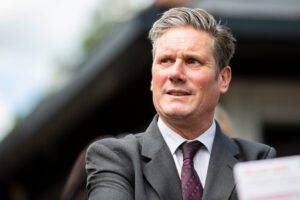
Senior business leaders and trade bodies have backed Keir Starmer’s comments that Britain should not part from the European Union on standards ranging from the environment to employment.
The Labour leader has come under fire from the Conservatives, who accused him of wanting to “unpick” Brexit after saying that “most of the conflict” since 2016 had arisen because the UK “wants to diverge and do different things to the rest of our EU partners”.
In a letter to the Guardian, dozens of business leaders and trade bodies joined with political figures hostile to Brexit in endorsing what they described as a “policy of alignment with EU standards and regulations, unless it is explicitly not in the UK’s interests to do so”.
Signatories to the letter included Peter Norris, the chair of Virgin, and Paul Drechsler, from the International Chamber of Commerce (ICC), who said that such a policy would “enable businesses and investors to have confidence in the UK’s regulatory foundations, while still allowing the UK to maintain its own regulatory autonomy”.
The letter adds: “By taking this approach, any future UK government will be able to reassure businesses and investors, both domestically and internationally, that the UK is committed to maintaining high standards and protections, strong relationships with its trading partners, while also protecting the interests of UK businesses.”
The position of “beneficial alignment” differs from “dynamic alignment” – the idea that the UK would follow evolving EU rules in an area indefinitely, which Labour is at pains to stress that it does not support.
Other signatories to the letter included Richard Griffiths, chief executive of the British Poultry Council, and Steve Brambley, chief executive of Gambica (the UK Trade Association for Instrumentation, Control, Automation and Laboratory Technology). The letter was organised by Best for Britain, which was originally launched in 2017 to oppose Brexit.
Norris said: “Leaving the single market has already increased costs for businesses and consumers and further divergence will only hike prices further during a cost of living crisis.”
The intervention comes before the Labour party conference in October, where Starmer is also likely to come under greater pressure from members of his own party who are eager for him to take an even more forthright position on deepening ties with the EU.
External groups such as Best for Britain have also been keen to add to the political argument that polling shows alignment in UK-EU relations is the most popular option in all but six constituencies in England, Wales and Scotland.
Starmer’s comments, made on a visit to Canada at an event bringing together progressive leaders, opened him up to attack from the Tories and prompted surprise from some in his own party who had come to regard Brexit as dangerous territory.
The chancellor, Jeremy Hunt, told LBC radio: “I think those kinds of comments about not wanting to diverge will worry a lot of people that what he really wants to do is to unpick Brexit.”
Read more:
Senior business leaders back Keir Starmer’s call not to ‘diverge’ from EU
Creative UK dishes out £35m investment fund

Creative UK has launched a new creative industries investment fund to support the UK’s ambitions to grow the sector by £50bn and create one million extra creative jobs by 2030.
The £35m Creative Growth Finance II (CGF II) fund will provide the investment needed to meet the targets set out in the UK government and Creative Industries Council’s recently published Sector Vision.
Caroline Norbury OBE, chief executive, Creative UK, explains: “Over the past decade, the UK’s creative industries have grown more than 1.5 times the rate of the wider economy, currently generating £108bn in economic value and employing 2.3m people. However, this country’s talented creative businesses are experiencing a significant gap between their immense growth potential and access to the vital capital they need to succeed.”
Delivered in partnership with Triodos Bank, CGF II is the largest single fund to be delivered by Creative UK, following its investment of more than £50m into the UK’s creative industries over the past decade.
Tech expert Sjuul van der Leeuw, CEO of Deployteq said: “The creative industries are at a really exciting moment, with tech innovation like AI revolutionising areas such as marketing and creative production, so it’s fantastic to see the UK’s commitment to supporting this growth. This extra investment will enable companies to master emerging technologies and turbocharge the sector’s growth, adding significant value for businesses and the wider economy.
“The funding will also enable the onboarding and training highly skilled staff adds a new dimension to businesses’ creative offerings as well as their capacity to make use of automation-enabled technologies to boost the efficiency of critical processes and reach new audiences through channels such as email marketing” he added.
CGF II continues on from the first Creative Growth Finance fund, which launched in 2019 and has since invested over £17m into more than 30 creative businesses located across the UK and operating within sectors including film & TV, virtual production, video games, advertising and software.
The existing CGF fund portfolio has so far experienced an 108% improvement of average monthly revenues, a 39% headcount growth average with more than 225 jobs created, and nearly £19m raised in further third party funding.
Phillip Bate, director of business banking, Triodos Bank UK, said: “Four years on from the launch of the first Creative Growth Finance fund, our partnership with Creative UK goes from strength to strength and continues to support companies at the forefront of innovation. For a bank only focused on financing projects with positive impact, we can see the social importance of these organisations to the UK. Creative UK’s expertise has been key to helping us grow our funding of this important sector.”
Companies benefiting from Creative UK funding include Dimension Studio (virtual production), Moonraker VFX.
Read more:
Creative UK dishes out £35m investment fund
Hollywood writers in deal to end US studio strike

Screenwriters in the US say they have reached a tentative deal with studio bosses that could see them end a strike that has lasted nearly five months.
The Writers Guild of America (WGA) said it was “exceptional – with meaningful gains and protections for writers”. WGA members must still have a final say.
Hollywood writers are striking in a row over pay and the use of artificial intelligence (AI) in the industry.
Stranger Things and the Last of Us are among the shows which have been paused.
It is the longest strike to affect Hollywood in decades and has halted most film and TV production.
A separate dispute involves actors, who are also on strike.
The writers’ walkout, which began on 2 May, has cost the US economy around $5bn (£4.08bn), according to an estimate from Milken Institute economist Kevin Klowden.
The dispute has shut down many of America’s top shows, including Billions, The Handmaid’s Tale, Hacks, Severance, Yellowjackets, The Last of Us, Stranger Things, Abbott Elementary and several daytime and late-night talk shows.
As well as issues around pay, the writers fear the impact of artificial intelligence potentially supplanting their talents.
Negotiations also broke down over staffing levels and the royalty payments that writers receive for popular streaming shows. They complain that those residuals are just a fraction of the earnings they would get from a broadcast TV show.
Traditionally, writers would receive additional payments when their programmes were repeated on a broadcast network. However, this model was undermined with the advent of streaming.
As a result part of the payments writers now receive generally include a certain amount of money which is intended to compensate for the royalties they are not receiving from broadcast repeats.
The WGA leadership and union members need to agree a three-year contract with the Alliance of Motion Picture and Television Producers (AMPTP) before they return to work.
The guild’s message on the proposed deal said details still had to be finalised, and it was not yet calling off the strike, but “we are, as of today, suspending WGA picketing”.
Hollywood trade publication Variety reported that staff on late-night talk shows could return to work as soon as Tuesday following the announcement, adding broadcasts could resume as soon as October.
But in its message to members, the union’s negotiating committee asked for patience on details of the pact.
“What remains now is for our staff to make sure everything we have agreed to is codified in final contract language,” the union said.
“And though we are eager to share the details of what has been achieved with you, we cannot do that until the last ‘i’ is dotted.”
Commenting on the news, Alistair Dent, Chief Commercial Officer at data company Profusion, said: “The deal to end the WGA strike is an interesting first glimpse into how professionals in different sectors could react to generative AI. The first thing to note is that the writers were able to act pre-emptively to protect their careers. This is because the use case for gen AI in the creative industries – like writing and image generation – is very clear. It’s much easier to secure safeguards against a technology before it has gained widespread adoption. For other professionals this may be more difficult because we simply can’t be certain how quickly AI will develop and its capacity to automate other jobs. Some may find that AI automation happens incrementally and their chosen career slowly becomes obsolete preventing a single moment to push back.
“The second thing to note is the WGA’s power to push back. Few professions in the UK and US have this type of organisational power and ability to shutter an entire industry. AI automation is likely to impact lower skilled and routine jobs first and those who undertake these activities are often the least empowered. Unions will need to play a very important role in monitoring the situation and protecting workers – we may see generative AI reinvigorating unions. The sad reality is that, unchecked, generative AI could spark a race to the bottom where businesses are incentivised to apply to more and more scenarios – regardless of the ethical implications.
“With any type of revolutionary tech there will be winners and losers. The sensible approach is to ensure that those who are likely to lose out – in this case by seeing their jobs becoming obsolete – are treated ethically. This means that businesses adopting upskilling programs that will help them adapt their career to AI. AI should create plenty of career opportunities and, if applied correctly, should support people to do their jobs better not replace them entirely.
“History has shown us that it is futile to try and hold back innovation that has such clear benefits. However, it has also taught us that any major advancement needs to be managed carefully. It should not be up to workers to strike against the misuse of AI, rather, we all need to be thoughtful about how we want AI to develop. This means bringing together businesses, governments and workers to create an ethical framework to prevent against misuse of AI and guide its development.”
Read more:
Hollywood writers in deal to end US studio strike
West Midlands tycoon, 21, saves Britain’s last remaining alloy wheel …

Britain’s last remaining manufacturer of alloy wheels has been rescued by a 21-year-old who is also vying to buy Morecambe Football Club.
West Bromwich-based Rimstock, which makes forged wheels for luxury marques including Aston Martin and Bentley, has been bought out of administration by Sarb Capital, the investment vehicle of Sarbjot Singh Johal.
The financial details of the transaction were not disclosed by Interpath, the administrators, but it was understood to be a multimillion-pound deal.
“I am delighted to have played a part in saving such an iconic business,” Singh Johal, who is based in Solihull, said. “It is integral not only as a critical supplier to the UK car manufacturing industry but also to the local community as a major employer.”
He promised further investment “to grow this important business”.
Chris Pole, the joint administrator, said the sale to Sarb “preserves a significant number of jobs in West Bromwich”.
Singh Johal has a number of business ventures, which are financed using his family’s money. He set up Vitanic, a non-alcoholic drinks brand, in 2017 and this year has been working on a deal to buy Morecambe, the League Two football club.
Rimstock was set up in 1984 by Steve Neal, the founder of the British Touring Car Championship title winners Team Dynamics. He died in July, aged 82.
The company is one of two manufacturers in Europe with the spin forges required to make premium-forged wheels. Rimstock also counts McLaren, Ferrari and Jaguar Land Rover among its customers and also supplies wheels to motorsport teams and militaries.
Rimstock fell into administration with 76 staff in July but continued trading while Interpath sounded out potential buyers.
Read more:
West Midlands tycoon, 21, saves Britain’s last remaining alloy wheel manufacturer

