

Rishi Sunak has signalled there is optimism the UK can conclude a trade deal with India after saying the two countries can “work through” the final negotiation hurdles.
Statements made by the Prime Minister and No 10 following a meeting with Indian prime minister Narendra Modi on the fringes of the G20 summit suggested fresh trade terms could be in sight.
Mr Sunak, who described his conversation with Mr Modi as “warm and productive”, told broadcasters in New Delhi on Saturday: “There is a desire on both of our parts to see a successful trade deal concluded.
“The opportunities are there for both countries, but there is a lot of hard work that is still to go and we need to work through that, as we will do.”
Downing Street said the premiers signed off on ministers and negotiating teams continuing to work “at pace” towards a free trade deal.
A trade pact with India, an agreement that could grant more favourable access for British companies to a market of 1.4 billion people, is seen as a major post-Brexit prize by the Conservative UK Government.
The Prime Minister, who is the first British leader of Indian descent, told reporters during his flight from London to New Delhi on Thursday that an agreement was “not a given” but his comments have gradually become more positive since arriving at the G20.
On Friday, he told Indian broadcaster Asian News International that “enormous progress” had been made before going further with his most recent remarks, suggesting the final obstacles could be worked through.
The deal is reportedly being held up by a variety of issues, including a disagreement over the number of visas for Indians to work in the UK and differences over the level of access British car manufacturers should be given to India’s market.
Mr Sunak, unlike his predecessor Boris Johnson, who wanted to seal a deal in time for October 2022 Diwali celebrations, said he would not set “arbitrary deadlines” for finalising an agreement.
With reports suggesting he could return to India in the autumn, the Indian government’s aim of ratifying fresh trade terms by the end of the year could be met.
Where differences can be seen between London and New Delhi has been in their stance on Russia’s invasion of Ukraine.
Mr Sunak has been outspoken in condemning Russian president Vladimir Putin’s 19-month assault on Kyiv while India has kept ties open with the Kremlin since Moscow’s forces crossed the Ukrainian border in February 2022.
The Tory leader would not confirm whether he pressed his counterpart to take a firmer stance on Russia.
He told broadcasters he thought a “very strong” joint message about Moscow’s attack had been made “under Prime Minister Modi and India’s presidency” of the G20, a group of the world’s largest economies that includes Russia and China.
A communique published on Saturday said that while recognising there were “different views” among members, G20 leaders wanted to highlight the “human suffering” being caused by the decision of Mr Putin, who stayed away from the forum in India, to blockade Ukrainian grain.
The G20 called for the reimplementation of the Black Sea Grain Initiative, which allowed safe passage for cargo ships transporting food from Ukraine’s southern ports and which the Kremlin collapsed in July, to be re-established and urged for attacks on grain stores to cease.
The wording was described as a “good and strong outcome” by Mr Sunak but there was some concern among summit watchers that some of the language around the Ukraine conflict had been watered down, potentially in a move designed to appease China.
During their meeting, Mr Sunak and Mr Modi demonstrated their cordial relationship with a hug and back slapping before talking for at least 15 minutes.
Mr Sunak told the Hindu nationalist leader that his daughters had followed India’s moon landing and that “everyone was buzzing” about the mission’s success.
Following the talks, Mr Sunak confirmed, having been lobbied on the issue by MPs, that he raised the issue of detained Briton Jagtar Singh Johal, a Sikh blogger who is at risk of the death penalty in India.
The press had uncharacteristically restricted access to the opening exchanges of the bilateral between the premiers, with the summit being tightly controlled by its Indian hosts.
The area around the Bharat Mandapam venue has been largely locked down, with independent businesses told not to open and normally busy roads left empty of the usual noisy rickshaw, motorbike and car traffic.
The Prime Minister has enjoyed extensive media coverage in India about his return to the country of his heritage, with locals also keen for a photo opportunity with his wife Akshata Murty, the daughter of NR Narayana Murty, the billionaire co-founder of Indian IT giant Infosys.
No 10 confirmed the Prime Minister’s parents and his in-laws are currently on holiday together in Bangalore, a city in southern India, but said it was coincidental that it coincided with when their children were at the G20.
Read more:
UK and India can ‘work through’ trade deal obstacles, PM says
Category: Uncategorized
Lobby groups Make UK and CBI in possible merger talks

The self-styled “voice of British business” and the manufacturers’ group Make UK have confirmed they are in talks about areas of potential collaboration that could lead to a full-blown merger.
“Make UK and the CBI are in early-stage discussions to explore how the two parties might work closer together,” Make UK, which speaks for 20,000 companies and three million people in the manufacturing and engineering sectors, told Sky News. “These discussions are positive and constructive but remain at an early stage.”
The CBI issued a virtually identical statement.
The beleaguered business leaders lobby group considered winding itself up this year after being embroiled in allegations of sexual misconduct, a saga that led to the departure of Tony Danker, its director-general, and resignations in protest by members including Aviva, John Lewis and NatWest.
Rain Newton-Smith, 48, was appointed as Danker’s successor in April having previously been the CBI’s chief economist for nine years.
Members voted in June for the group to survive in a revamped form. While the cuts would affect fewer than ten jobs, the move was seen as being symbolic of the retrenchment taking place at what was for decades Britain’s foremost business representative group.
The employers’ body has confirmed it is closing offices in Washington, Beijing and Delhi, leaving it with only one overseas presence, in Brussels.
It was unclear last night how a formal merger would work, whether the CBI’s name would disappear in favour of Make UK’s or how a combined organisation would represent non-manufacturing businesses.
Founded in 1965, the CBI, previously known as the Confederation of British Industry, now claims to speak for 170,000 businesses, from 190,000 in April. In June members voted 93 per cent for the organisation to carry on with reformed governance and culture.
Fox Williams, a law firm, was appointed to carry out an independent investigation and several people were dismissed by the CBI.
Danker has said he will sue the organisation after being made the “fall guy” for serious misconduct allegations that pre-dated his tenure.
Read more:
Lobby groups Make UK and CBI in possible merger talks
Triple lock could add £45bn a year to cost of state pensions finds ne …

Increases in the state pension will cost taxpayers up to £45 billion a year by 2050, a think tank has warned, adding pressure on ministers to raise the official retirement age.
New research by the Institute of Fiscal Studies (IFS) found that since the pensions “triple lock” was introduced in 2010, it had increased pensions by 60 per cent — 20 percentage points more than if pensions had increased by average earnings over the period.
It warned that such rises could become unsustainable in the longer term and force the government to increase the state pension age to control spending.
The triple lock was introduced by the coalition government and guaranteed that pensions would rise each year by the rate of average earnings, inflation or 2.5 per cent — whichever was higher.
The IFS research found that since then, this had resulted in the average state pension rising by 60 per cent since 2011. If pensions had only been linked to inflation they would have risen by 42 per cent and if they had been linked to earnings they would have risen by 40 per cent.
The think tank said this had resulted in the current £204 weekly pension payment being £24 more than it would have been if the triple lock did not exist.
The findings come ahead of new figures from the Office for National Statistics of earning growth for the three months to July 2023.
This is likely to show earnings outstripping inflation for the first time since 2020 and will be used to determine next April’s rise in payments for the UK’s 12 million pensioners.
The report said data covering April to June 2023 showed annual earnings growth of 8.2 per cent — higher than the current 6.8 per cent rate of inflation.
The IFS said that while the triple lock had been successful in restoring the value of pensions to around 25 per cent of average full-time earnings — a figure last reached in 1980 — it posed significant problems for the government in the longer term.
Its analysis found that the triple lock could potentially increase spending by anywhere between a further £5 billion and £45 billion per year, in today’s terms, by 2050.
The IFS warned that this could force future governments to raise the retirement age to curtail spending in a way that would discriminate against pensioners in poor health.
“The triple lock could lead to the state pension in its current form becoming sufficiently expensive that policymakers respond by implementing reforms that they would not otherwise have done, to reduce spending on the state pension,” it said.
Heidi Karjalainen, one of the authors of the report and a research economist at the IFS, said the triple lock also made it difficult for workers to predict how much they might receive from a state pension and how much it would cost the state in the future.
“An additional real risk is that retaining the triple lock for too long increases state-pension spending so significantly that it leads to insurmountable pressure for a much higher state pension age,” she said.
“This would particularly affect people with poorer health who struggle to remain in employment until they reach state pension age.”
The report comes after The Times revealed last month that the government would spend more on pensions in two years’ time than on education, policing and defence combined.
Last year, pension costs increased by £6 billion to £110 billion. By 2025 they are expected to have ballooned to £135 billion, a figure £2 billion more than the combined day-to-day budgets for the Department for Education, the Home Office and the Ministry of Defence.
Read more:
Triple lock could add £45bn a year to cost of state pensions finds new research
Electric vans reenergise Ellesmere Port factory
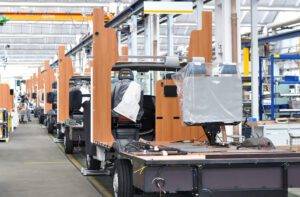
It is one of the greatest comebacks in the history of the British motor industry. Yesterday morning the first Vauxhall Combo Electric van rolled off the assembly line of the sprawling Ellesmere Port factory in Cheshire, the plant that 60 years ago gave the nation the best-selling Vauxhall Viva and for four decades from the 1980s was the self-proclaimed Home of the Astra.
Back in production after a two-year shutdown, Ellesmere Port has made history: it is Britain’s first all-electric vehicle manufacturing plant. It is also the first all-electric plant anywhere in the world for global giant Stellantis, the renamed Peugeot-Citroën French group whose marques after a bout of mergers and rescues include Vauxhall and its old German sister brand Opel, as well as Italy’s Fiat.
The resurrection of Ellesmere Port, however, raises immediate questions over another historic Vauxhall van factory, its plant at Luton, the home of the Vauxhall Vivaro, and whether ministers will step in, as they did in Cheshire, to secure an all-electric future.
The emergence of Ellesmere Port as a symbol of Britain’s attempts to keep up in the electrification of the automotive industry comes after a decade on death row. During the recession that followed the global financial crisis, its then owner, General Motors (GM) of the US, was within hours of pulling the plug before striking a deal with the workforce to cut pay and conditions. Even then uncertainties dogged the plant, first around the future in a post-Brexit world, and then its sale as part of GM’s withdrawal from Europe in a nominal €1 deal with Peugeot Citroën.
The Astra is long gone but Ellesmere Port is now producing small electric vans, the Vauxhall Combo Electric as well as the Peugeot e-Partner, the Citroën e-Berlingo and the Fiat e-Doblo. They are all essentially the same van with different finishes for different consumers in different markets.
From next year, passenger versions of those vans, people carriers badged Vauxhall Combo Life Electric and Peugeot e-Rifter, will also go into production aimed at larger families and the wheelchair-accessible market.
A shadow of the former heydays of the Viva and the Astra, the operational part of Ellesmere Port now takes up just a third of the plant compared with previously. The workforce stands at 1,000, all kept on and retrained during the run-off of the Astra and the transition to an all-electric plant. On two shifts they will be producing 50,000 vehicles a year, a fraction of the volumes in the 1970s but with the potential to add a third daily shift.
That the Ellesmere Port plant is back in production at all may come as a surprise after Stellantis’s global chief executive, the enigmatic Carlos Tavares, said bluntly that Brexit was a disaster and had led his board to completely reassess the group’s interests in the UK.
At the official reopening of production at Ellesmere Port, James Taylor, managing director of Vauxhall, indicated the decision to keep going was pragmatic. “Vauxhall has a 30 per cent share of the electric commercial vehicle market in the UK, a figure that goes up to 50 per cent if you include all the Stellantis brands,” he said. “Demand is strong and we need to keep up,”
The models coming out of Ellesmere Port are all made at the Stellantis factory at Vigo in Spain.
Brexit brings wrinkles, however. The battery cells for Ellesmere Port vans are from China. Rules of origin on car components are part of a trade and co-operation agreement between the UK and the EU and mean that Ellesmere Port vans for export to Europe could attract cross-border tariffs, making them 10 per cent more expensive. Ellesmere Port won’t get its own gigafactory but will depend on EU-based battery cell plants being developed by Stellantis.
The focus now moves on to Luton. Any van driver acquiring an electric Vivaro — and there are big fleet operators of the zero-emission vehicles like BT and British Gas — will know that they are not buying British, as the vans are assembled in France. To date Luton has been left building diesel Vivaros. But a crunch is coming as Stellantis has ruled that all Vauxhall models will be all-electric by 2028.
The company is understood to be pressing ministers to provide the sort of support for Luton that it did at Ellesmere Port, reckoned to be £30 million of taxpayers’ money out of a total £100 million refit. But Stellantis is being made all sorts of “green deal” offers to build the electric Vivaro in other European jurisdictions and the UK government will have to counter such moves.
Commenting on the reopening of Ellesmere Port, Kemi Badenoch, the business and trade secretary, said: “It is a very visible demonstration that this government has got the right plan for the UK’s automotive industry.”
Read more:
Electric vans reenergise Ellesmere Port factory
Lidl opens worlds largest warehouse in Bedfordshire
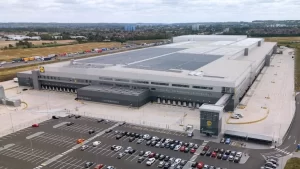
German supermarket Lidl has opened its largest warehouse in the world, in Bedfordshire.
The regional distribution centre at Houghton Regis near Luton is expected to service 150 stores and create up to 1,500 jobs, the company said.
The 1.2 million sq ft (111,000 sq metres), £300m site, includes solar panels which Lidl said could run the warehouse at certain times of the year.
All of its delivery fleet will be fuelled by biogas made from food waste.
The retailer said the warehouse was so large, it could “fit three of Lidl’s existing warehouses inside”.
It will be expected to move more than 9,400 pallets of goods each day, bound for its 150 stores.
Its existing distribution centres service approximately 60-80 stores.
The company said it would be the first Lidl GB warehouse to feature automation, “helping to store more goods and increase capacity at the distribution centre, which in turn is helping to create more jobs”.
Jeremy Hunt, Chancellor of the Exchequer, said: “It’s fantastic to see Lidl investing in the UK and creating thousands more well-paid jobs… businesses can be confident that investing in the UK is the right decision.”
Read more:
Lidl opens worlds largest warehouse in Bedfordshire
Google to face multibillion-pound lawsuit from UK consumers

Google faces a new multibillion-pound lawsuit from UK consumers accusing the company of contributing to cost-of-living price rises.
The lawsuit, on behalf of every consumer in the UK, says that Google has stifled competition in the search engine market, which caused prices to rise across the UK economy.
The lawsuit filed with the Competition Appeal Tribunal claims that Google has broken competition law and raised the cost of living for every UK consumer.
Google has been accused of shutting out competition in mobile searches, and using its market dominance to raise the prices paid by advertisers for their spot on the Google search page, according to the claim. These are then passed on to consumers.
The class action is funded by Hereford Litigation, a global commercial litigation funder. Nikki Stopford, co-founder of Consumer Voice, a consumer rights campaigner and the class representative in the action, said: “This action aims to redress the balance – not only by getting people back what they’re owed but also by holding Google to account for its actions.”
Estimated compensation of £7.3bn has been requested for about 65 million UK users over the age of 16, meaning at least £100 per person on average.
Earlier this year, the US justice department and eight states filed lawsuits against Google over allegations that the company abused its dominance of the digital advertising business.
The UK’s Competition and Markets Authority (CMA) has also launched an investigation into whether Google has abused its dominant position through its conduct in ad tech.
According to the CMA, in 2019, Google paid Apple approximately £1.2bn to ensure default status on Safari in the UK alone.
In the lawsuit, Google is accused of crowding its search pages with paid advertising – pressuring companies to pay more for “clicks”, rather than depending on consumers finding their sites themselves. The lawsuit claims that a more competitive search engine would select ads based more on relevance to the user than the price paid by the advertiser.
The lawsuit says that commercial agreements between Google and Apple to ensure Google was the default search engine for the Safari browser preinstalled with iOS, Apple’s iPhone operating system, contributed to allowing Google to maintain its dominant position on mobile.
Google Ads generated more than $224bn in revenue in 2022, accounting for almost 80% of parent company Alphabet’s revenue ($283bn in 2022).
Stopford said: “Google has fixed things, sometimes unlawfully, so it is the default search engine on practically all mobile phones in the UK. It abused its market dominance to charge advertisers more than if the market had been competitive – for example, for the sponsored links you see when you use Google to search for something. Advertisers have inevitably passed these higher costs on to shoppers.”
Luke Streatfeild, partner at legal firm Hausfeld, who is leading the litigation, said: “Google provides a great service, but it isn’t free. Instead, this claim says that Google has choked off competition in search engines for years, to the detriment of the businesses that use its services – and, ultimately, consumers. The lack of competition leads to higher prices and poorer quality, and the effects of this are felt throughout the UK economy.”
A Google spokesperson said: “This case is speculative and opportunistic – we will argue against it vigorously. People use Google because it is helpful. We only make money if ads are useful and relevant, as indicated by clicks – at a price that is set by a real-time auction.
“Advertising plays a crucial role in helping people discover new businesses, new causes and new products.”
Read more:
Google to face multibillion-pound lawsuit from UK consumers
UK set to re-join Horizon science scheme
The UK has announced that it is to re-join the EU’s flagship research scheme, Horizon.
Talks on the UK becoming a fully-fledged member of the EU’s €100bn (£85bn) programme again began after a deal was cut on post-Brexit arrangements for Northern Ireland earlier this year.
The UK’s associate membership of Horizon was agreed in principle as part of the Brexit Trade and Co-operation Agreement, but the issue became bogged down in the dispute about the Northern Ireland Protocol.
The higher education sector is likely to give the news, first reported by Bloomberg, a big welcome.
Universities and researchers have repeatedly warned that the uncertainty over whether the UK would re-join was extremely damaging.
Sources within government have also indicated that the UK will re-join the EU’s space programme, Copernicus, but not its nuclear research scheme, Euratom.
Peter Kyle, the shadow science minister, said the country had “missed out on two years of innovation” whilst being outside of the Horizon programme.
Re-joining the scheme would allow the UK to start “unlocking all the potential we have in this country”, Mr Kyle said.
Ministers had drawn up a plan B, known as Pioneer, as an alternative.
The government always insisted it was deadly serious about the possibility of going it alone with the Pioneer programme, although it wasn’t their preferred option.
Figures within government have previously suggested that Prime Minister Rishi Sunak was genuinely torn.
On the one hand, re-joining Horizon would help repair EU-UK relations and potentially play well with those who deeply disliked Brexit.
On the other hand, Mr Sunak was said to be keen to get “value for money” as well as build credibility with Leave supporters who might favour a clean break.
The UK had been expected to remain associated with the scheme after Brexit but it soon became apparent that Brussels was blocking Britain’s return.
That’s because the EU was angry at the government’s failure to fully implement a deal on post-Brexit arrangements for Northern Ireland.
Until that issue was resolved, it was clear that Horizon association would not be possible.
Then, in February, Rishi Sunak signed a deal with the European Commission President Ursula von der Leyen – the Windsor Framework.
That paved the way for talks on Horizon, which look as though they’re finally reaching their culmination.
It’s a further moment of reconciliation between the UK and the EU following the bitter disputes over Brexit that followed the 2016 Leave vote.
Read more:
UK set to re-join Horizon science scheme
The Implications of Labour’s Shadow Cabinet Reshuffle for UK SMEs
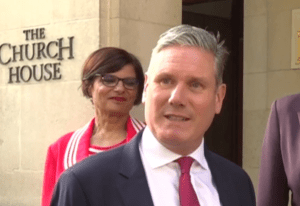
Keir Starmer, the leader of the Labour Party, has made a significant reshuffle of his shadow cabinet. While some faces have been removed from the inner circle, others have been given new roles.
The reshuffle has sparked a wave of discussions across the UK, because on current polling data Keir Starmer could have the keys to No.10, so we examine what these changes could mean for UK’s SMEs and a recent survey suggested that if that were to happen there would be an exodus of UK SMEs leaving the UK.
The reshuffle has led to the emergence of several notable names in the shadow cabinet. Among them are Angela Rayner, Lisa Nandy, Shabana Mahmood, Liz Kendall, Jonathan Ashworth, Thangam Debbonaire, Steve Reed, Lucy Powell, Hillary Benn, Peter Kyle, Pat McFadden, Darren Jones, Nick Thomas-Symonds, and Ellie Reeves.
Angela Rayner
Angela Rayner, who would become the deputy prime minister should Labour win the next election, has been appointed as the Shadow Secretary of State for Levelling Up, Housing, and Communities. She has been an MP for Ashton-under-Lyne since 2015 and her new role is seen as critical to Labour’s new deal for working people.
Lisa Nandy
Lisa Nandy, once the Shadow Levelling Up Secretary, has been moved to the role of Shadow Cabinet Minister for International Development. Nandy, who has been an MP for Wigan since 2010, is one of the first Asian female MPs in Britain’s history.
Shabana Mahmood
Shabana Mahmood, an Oxford University law graduate and a qualified barrister, has been appointed Labour’s Shadow Secretary of State for Justice. She has been an MP for Birmingham Ladywood since 2010 and is one of the UK’s first female Muslim MPs.
Liz Kendall
Liz Kendall is now the Labour Party’s Shadow Work and Pensions Secretary, a role previously held by Jonathan Ashworth. Kendall, who has served Leicester West since 2010, previously worked as the Shadow Health Minister, focusing on social care.
Jonathan Ashworth
Jonathan Ashworth, the former Shadow Work and Pensions Secretary, has taken on the role of the party’s Shadow Paymaster General. Ashworth, who has served Leicester South since 2011, was formerly an adviser to Gordon Brown and the Head of Party Relations for Ed Miliband.
Thangam Debbonaire
Thangam Debbonaire, the MP for Bristol West since 2015, has been appointed Shadow Secretary of State for Culture, Media, and Sport. Debbonaire has a history of leadership roles within the Labour Party, having served as the Shadow Leader of the House of Commons and the Shadow Secretary of State for Housing.
Steve Reed
Steve Reed, the MP for Croydon North since a 2012 by-election, is the new Shadow Secretary of State for Environment, Food, and Rural Affairs. Reed has a background in education publishing, having studied English at Sheffield University.
Lucy Powell
Lucy Powell, the MP for Manchester Central since 2012, has been made the Shadow Leader of the House of Commons. Powell, who studied chemistry at Oxford University and King’s College London, has previously worked in PR.
Hillary Benn
Hillary Benn, a veteran parliamentarian who has represented Leeds Central since 1999, has been appointed the Shadow Secretary of State for Northern Ireland. Benn has served under two Labour prime ministers, Tony Blair and Gordon Brown.
Peter Kyle
Peter Kyle, the MP for Hove since 2015, has been appointed Shadow Minister for Science, Innovation, and Technology. He was previously the Shadow Northern Ireland Secretary.
What Does This Mean for UK SMEs?
The reshuffle of Labour’s shadow cabinet brings a new focus on sectors that are crucial for UK’s SMEs. These sectors include housing and communities, international development, justice, work and pensions, culture, media and sport, environment, food and rural affairs, and science, innovation and technology.
Angela Rayner’s new role as the Shadow Secretary of State for Levelling Up, Housing, and Communities implies a strong focus on community development and housing issues. This could be beneficial for SMEs involved in the construction, real estate, and community development sectors.
With Lisa Nandy taking over as the Shadow Cabinet Minister for International Development, there could be more opportunities for SMEs looking to expand their operations abroad or those involved in projects aimed at international development.
Shabana Mahmood’s appointment as Labour’s Shadow Secretary of State for Justice could mean a renewed focus on legal issues affecting SMEs. This includes matters related to contracts, business laws, and employment regulations.
Liz Kendall’s new role as the Shadow Work and Pensions Secretary could impact SMEs in terms of employment and pension policies. Changes in these areas could affect how SMEs manage their workforce and retirement plans.
With Thangam Debbonaire becoming the Shadow Secretary of State for Culture, Media, and Sport, SMEs in these industries may see new opportunities and challenges based on Labour’s policies in these areas.
Steve Reed’s role as the Shadow Secretary of State for Environment, Food, and Rural Affairs could signal new environmental regulations and rural development initiatives. SMEs in the agriculture, food, and environmental sectors need to stay informed about any changes in this landscape.
The appointment of Peter Kyle as the Shadow Minister for Science, Innovation, and Technology underscores Labour’s focus on these sectors. This could mean more support and opportunities for SMEs operating in technology and innovation-driven industries.
The Broader Economic Implications
While Labour is currently in opposition, the policies and positions put forward by the shadow cabinet can have a significant influence on the national conversation. Therefore, it’s essential for SMEs to keep abreast of these developments.
Labour’s reshuffle signals a commitment to economic growth and sustainability. A focus on sectors like housing, environment, food, and rural affairs, and science, innovation, and technology could drive sustainable growth, innovation, and job creation. This could be an opportunity for SMEs to align their business strategies with these areas.
The reshuffle also highlights Labour’s commitment to inclusivity and diversity, as evidenced by the appointments of Angela Rayner, Lisa Nandy, and Shabana Mahmood. This could inspire SMEs to embrace diversity and inclusivity in their workplaces.
International Outreach
With Lisa Nandy becoming the Shadow Cabinet Minister for International Development, Labour signals its intention to engage more actively on the international stage. This could create opportunities for SMEs to explore international markets and partnerships.
While the implications of Labour’s shadow cabinet reshuffle for UK SMEs are yet to fully unfold, it’s crucial for businesses to agile and prepare for the future, seizing opportunities, and mitigating challenges that arise, because
Read more:
The Implications of Labour’s Shadow Cabinet Reshuffle for UK SMEs
UK businesses are failing to measure their impact on diversity and inc …

73% of businesses in the UK do not have a measurement framework for diversity and inclusion, new research has found.
The survey of UK business leaders from organisational transformation consultancy Watch This Sp_ce found that 44% are assessing the impact of their inclusion efforts informally, and 56% are not measuring impact at all. 19% of the businesses surveyed didn’t have any kind of diversity and inclusion strategy whatsoever.
This is worrying news at a time when 62% of jobseekers would reject a job offer from an organisation without a good track record on diversity and inclusion, and 68% of staff would look for a job elsewhere if their organisation was not prioritising diversity and inclusion.
Diversity and inclusion roles have increased dramatically in the UK in recent years, and 72% of businesses(5) have a dedicated budget for inclusion activities. So why aren’t businesses measuring the impact of all this spending?
According to Allegra Chapman, Co-Creator of Watch This Sp_ce, the answer is fear. “Most businesses are going into diversity and inclusion in panic mode,” Chapman says. “They know that their staff want to see action in this area, or they might very well leave, or at least become disengaged. They also know that their customers and clients are demanding action, or they will take their money elsewhere. So leaders rush into doing something, anything, without thinking through what actions are really needed, or how they will know if those actions are working.”
The result is often performative activity that generates little result, which in the long run could actually damage the reputation of the business. “Staff and customers are very quick to spot businesses that are all talk and no action,” Mo Kanjilal, Co-Creator of Watch This Sp_ce, explains. “When they see an organisation posting about International Women’s Day, but paying their female staff less than the men, they instantly assume this is a company that doesn’t care about inclusion. Paying lip-service and just wanting to be seen to be doing something can do more harm than good. You need to be prepared to actually do the work.”
When businesses are engaged in diversity and inclusion efforts that aren’t strategic or measured, it can be hugely wasteful in terms of money and resources, and also highly demotivating for the team involved. This was the inspiration for the Watch This Sp_ce team to create their Inclusion Journey Tracker, a tool that enables businesses to benchmark their current situation, identify the actions needed to move forward, and measure and celebrate their progress.
“We want everyone to truly benefit from diversity and inclusion work – individuals and the wider business,” Allegra Chapman says. “By giving businesses the framework they need to assess and measure their efforts, we can ensure that time and resources are well spent, and staff and customers can see the progress being made.”
Level One of the Inclusion Journey Tracker is completely free to access, and businesses earn an accreditation at each level, which enables them to showcase their commitment to real action on diversity and inclusion.
“We hope to see genuine commitment and meaningful impact becoming standard for businesses,” Mo Kanjilal says. “That way, organisations can reap all the benefits for innovation, productivity, engagement and improved results, and individuals can unlock their full potential and excel in their career. It’s a win for everyone.”
Read more:
UK businesses are failing to measure their impact on diversity and inclusion

