

Tastily, the leading provider of healthy, home delivered, chef-made meals, is thrilled to announce the addition of David Gandy, an internationally acclaimed supermodel as a brand ambassador and investor.
David, who is one of the most famous faces in the world of global fashion and the Founder and Creative Director of David Gandy Wellwear, has always been a strong advocate of healthy lifestyle and nutritiously balanced diet, making his appointment as Brand Ambassador for Tastily a natural fit with his personal ethos.
Renowned for his fashion career and dedication to fitness, David shared his enthusiasm for his collaboration with Tastily, stating, ““I got involved with Tastily because we need more delicious and convenient ways to eat food that is healthy, fresh and unprocessed. The variety and quality of Tastily’s meals really sets them apart. I’m happy to help more people discover Tastily as a great option for midweek meals.”
In addition to his appointment as a Brand Ambassador, David joins other investors such as Perfect Redd, the investment vehicle for Samworth Brothers, a fourth-generation British family business and owner of Cornish pasty maker Ginsters in the latest funding round. Gandy’s involvement signifies an important milestone for Tastily and strengthens its position as a leader in the fresh chef-prepared meals space in the UK.
Will McDowell, the founder of Tastily, said: “We are very excited and honoured to have David join us as our brand ambassador and investor. His passion for health and great tasting food perfectly aligns with Tastily’s core values. David’s support and involvement will help us reach a wider audience of people looking for new ways to eat well.”
As the cost-of-living crisis has gripped the UK, consumers are eating more at home, with demand for convenient and cost-effective meals increasing. According to a recent report by Waitrose, searches for “microwave meals” were up 71% on its website compared with the same time last year, while sales of microwaves were up 13% at John Lewis.
This trend, combined with the growing demand for its healthy offerings created by Michelin-trained chefs places Tastily in a strong position to further increase its market share and establish itself as the innovator and key player in the growing healthy chef-prepared meals space.
Launched in 2020, Tastily has rapidly grown to become the ultimate choice amongst health-conscious, modern foodies who are short for time. Sales have more than doubled in the last year, with thousands of meals cooked and delivered every week.
Tastily offers a flexible subscription model, allowing customers to choose from over 70 meals. The menu rotates weekly to provide variety and seasonality. Every meal is expertly crafted by professional chefs and cooked fresh to order. The meals stay fresh for 7 days in the fridge and can be oven cooked as well as microwaved.
Read more:
Healthy chef-made meal company Tastily welcomes internationally acclaimed supermodel David Gandy as brand ambassador and investor
Category: Uncategorized
B&M buys up to 51 stores from collapsed rival Wilko
Discount chain B&M has agreed to buy dozens of shops from the collapsed retailer Wilko, as talks over a bigger rescue deal hang in the balance.
B&M said it will take on up to 51 of Wilko’s 400 stores in a deal worth £13m.
Wilko fell into administration in August as it struggled with sharp losses and a cash shortage.
It is understood that a deal tabled by HMV’s owner has stalled over issues with suppliers and funding.
Wilko was founded in 1930 and by the 1990s became one of Britain’s fastest-growing retailers.
But the discount chain has faced strong competition from rivals including B&M, Poundland and Home Bargains, as the high cost of living has pushed shoppers to seek out bargains.
Wilko’s stores remain open for now as it seeks a buyer for a bigger chunk of the estate, but more than 12,500 jobs were put at risk by the collapse.
The first redundancies – 269 jobs at Wilko’s support centre in Worksop and 14 others at a subsidiary firm – started on Monday.
B&M has not confirmed which Wilko shops it has bought, or how many posts could be saved as a result of the deal.
The money raised by the sale will help recover funds for Wilko’s creditors, as administrators PwC oversee the running of the business with all of its associated costs such as employee wages.
Retail expert Catherine Shuttleworth said the deal would also allow B&M to attract more customers. The chain has stepped up its expansion plans in the wake of the pandemic, opening 21 new stores in the last financial year.
“This may also create local jobs for Wilko colleagues in the newly-owned stores,” Ms Shuttleworth said.
Several retailers and investors have reportedly been in talks with PwC about potentially buying Wilko’s shops or online brand.
At the end of last week, Canadian billionaire Doug Putman was thought to be edging closer to a deal to buy up to 300 shops. In 2019, his company Sunrise Records bought the collapsed music chain HMV and saved some 1,500 jobs and about 100 stores.
That takeover resulted in redundancies and shop closures, including the company’s flagship Oxford Street store in London – but following a major turnaround, plans are in place to reopen it later this year.
Mr Putman’s plan to buy Wilko is still “live”, a source familiar with the situation said, but the businessman is apparently struggling to nail down final funding for the deal.
Commenting on the news, Andy Prendergast, GMB National Secretary, said: “Every single redundancy is a person who will wake up facing an uncertain future. This needs to be on the forefront of everyone’s minds.
“The reality is years of mismanagement have led us here.
“We are still doing everything we can secure a deal that would protect the majority of jobs and stores. But this will be of little comfort for those not knowing how they’ll pay their bills.”
Read more:
B&M buys up to 51 stores from collapsed rival Wilko
Port of Dover to reclaim land from sea to prevent queues when EU’s b …

The Port of Dover wants to build out into the sea to avoid delays when the EU’s planned biometric border controls system starts.
The Port’s boss, Doug Bannister, said reclaiming some land would create more space to process passengers.
He has previously warned the new system could cause long queues.
The new controls, known as the Entry Exit Scheme, were first slated for introduction in 2022, but are now expected to start in autumn 2024.
After their introduction people entering the EU will have to register their fingerprints and a photograph alongside their passport.
Over the past few years the Port of Dover has seen repeated incidents of queuing at its busiest times, with post-Brexit checks adding to waiting times. Mr Bannister has insisted everything possible has now been done to minimise delays. This summer, with traffic numbers nearly back to pre-Covid levels, there no prolonged problems at the port.
However, Mr Bannister has previously warned that under the Entry Exit Scheme (EES), the time taken for non-EU citizens to comply with the new requirements could create bottlenecks.
Mr Bannister has said that working with the authorities on both sides of the Channel over the past year had made him more confident.
An app may be developed to handle part of the registration process before people arrive at the port, he suggested. However, he said the port needed a solution to prevent “unacceptable” queues materialising at the border.
Mr Bannister told the BBC that plans already existed to reclaim land in the port’s western docks, for cargo use. Now, he is looking to speed up the project so the new area can be used to hold passengers when EES starts.
This acceleration would cost an extra £2m, with the aim of finalising the design by the end of the year, and starting work in the spring. The port is hoping the government may be able to contribute financially.
The Dover boss said decisions needed to be made “imminently”.
Dover is not alone in trying to avoid difficulties as a result of EES.
Yann Leriche, chief executive of Eurotunnel’s owner Getlink, said the change was something the business “cannot mismanage”, with problems “not an option”.
Getlink is spending £100m to create a new area, where people will be able to register their data at 75 stands.
Eurotunnel is also seeing traffic recover, although it is still short of pre-pandemic levels.
Getlink has developed technology to process customs controls digitally. It says this now allows goods to cross the Channel as quickly as before Brexit – something it hopes will attract customers.
The Port of Dover says it had its busiest day since before the pandemic on Saturday 29th July, with 800 cars arriving every hour at peak times.
The average wait time over the summer was 41 minutes during busy periods, it said.
Over the the summer the port handled 1.14 million passengers travelling over to France, close to the 1.19 million in 2019.
Read more:
Port of Dover to reclaim land from sea to prevent queues when EU’s biometric border controls system starts
Chancellor to set out Autumn Statement on November 22
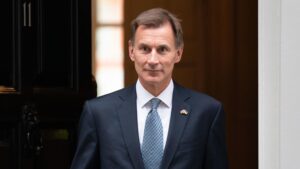
Jeremy Hunt will set out his Autumn Statement on November 22, the Chancellor has told MPs.
He has commissioned an Office for Budget Responsibility forecast, which will be presented alongside the statement.
The Prime Minister and Chancellor have spent recent months promising to halve inflation, amid a series of Bank of England interest rate rises designed to ease soaring prices.
Mr Hunt has also faced pressure from some Tory MPs for tax cuts ahead of the next general election, expected before January 2025.
But he and Rishi Sunak have so far resisted these calls, pointing to ongoing efforts to curb inflation and ensure financial stability.
Mr Hunt confirmed the date in a statement in the Commons.
“On Friday, the Office for National Statistics published an update to the UK’s GDP growth figures which shows the UK economy was 0.6 per cent larger than pre-pandemic levels by the fourth quarter of 2021.
“It means our economy had the fastest recovery from the pandemic of any large European economy, thanks to decisions such as furlough that protected millions of jobs.
“For that growth to continue we now need to halve inflation, which I am pleased to report is now nearly 40 per cent below its 11 per cent peak. I can also tell the House I will deliver the Autumn Statement on November 22,” he said.
The Treasury and new Defence Secretary Grant Shapps are also likely to come under pressure over defence funding.
Mr Shapps’ predecessor, Ben Wallace, who stepped down from the role last week, had long made clear his desire for greater spending on the UK armed forces.
Read more:
Chancellor to set out Autumn Statement on November 22
Offering employees a four-day working week may encourage people back i …

Offering a four-day working week could help to encourage staff into the office more, according to leading global workplace design experts, Unispace.
Returning for Good, a Unispace Global Workplace Insights report – which combined the results of a survey of 9,500 employees and 6,650 employers from 17 countries worldwide – revealed that 88% of professionals would be interested in trialling a four-day working week, however just 42% of employers would be keen to do so, marking a notable difference between the two groups.
According to the study, 46% of staff would be willing to work from the office every day, rather than on a hybrid basis, if the four-day working model was adopted by their employer. This is in stark comparison to 21% who are happy to do so with a more traditional employment schedule. Ultimately, 74% of employers expect that their staff will return to the office for four or more days per week at some point in the future.
Of the employees surveyed, the top sectors that were open to a four-day working week were technology, media and telecoms, consumer goods, financial services and banking and insurance.
However, the data suggests that professionals and their employers are still at odds over shifts to traditional ways of working.
Lawrence Mohuiddine, CEO EMEA at Unispace, commented:
“It is perhaps no surprise that many employees are keen on a shift to a four-day working week given the increased flexibility in how and where people work. However, we feel that it could also have real benefits for many employers, not least in their ability to encourage their staff back to the office and, in the long term, to retain their talent more effectively.”
“When combined with a return to the office, the shift to working in this way could lead to improved productivity amongst workforces too, so it is certainly something for employers to consider, particularly those who are battling high levels of staff attrition. Obviously, this is not possible for firms in every sector, but for many, it could lead to their staff returning to work from the office on a more regular basis.”
“A study by the World Economic Forum found that 90% of firms that trialled the new working model looked to retain it after the programme was finished and that this way of operating led to improved morale, fewer absences and, notably, lower levels of staff burnout.”
Read more:
Offering employees a four-day working week may encourage people back into the office
Unplugging Distractions: Mastering Concentration in the Modern World

How often do you find yourself pulled away from your tasks by distractions throughout the day? The answer for most of us is “many times.”
Picture this: you’re diligently working on a report, and suddenly, an email notification pops up on your screen. It takes a rare individual to resist the urge to peek and wonder about its content. You break away from your current task and dive into something entirely different. After handling the distraction, you return to your report, only to ask yourself, “Now, where was I?”
Multiply this scenario by countless interruptions each day, and then consider the cumulative effect over a week, a month, and an entire year. How much precious time do you estimate you’ve squandered over 12 months? And it’s not just about wasted time; it’s about the quality of your work. Constantly shifting your attention from one task to another disrupts your concentration and hinders your ability to excel in any one area.
So, what’s the solution? Here are some strategies to help you regain control:
Disable Email Alerts: Turn off those distracting email notifications. You don’t have to respond immediately to every message that lands in your inbox.
Screen Phone Calls: Don’t feel compelled to answer the phone simply because it’s ringing. Let it go to voicemail if you’re engaged in focused work.
Practice Saying No: Learn to decline distractions politely. Not every interruption deserves your immediate attention.
Discipline Yourself: Develop the self-control to resist impulsive responses to distractions. Train yourself to stay on track.
Set Internet Time Limits: Implement a 10-minute rule for internet browsing. Allocate specific times for web surfing to avoid mindless scrolling.
Communicate Your Focus: Inform colleagues and acquaintances when you’re engaged in deep, concentrated work. Set clear boundaries and expectations for interruption-free periods.
By adopting these strategies, you can regain control over your attention and productivity, ensuring that you perform at your best while minimising the impact of distractions on your life.
Good luck!
Read more:
Unplugging Distractions: Mastering Concentration in the Modern World
New Report Sheds Light on Pregnancy and Maternity Discrimination

In an ever-evolving business landscape, the welfare of employees continues to be at the forefront of responsible leadership.
A recent survey by Pregnant Then Screwed, encompassing the experiences of over 24,000 parents, has revealed the extent of pregnancy and maternity discrimination. The implications for business owners are clear, and understanding the full scope of legal obligations and potential risks is paramount.
The findings included:
52% of mothers faced some form of discrimination when pregnant, on maternity leave or when returning to work.
20% of mothers left their job following a negative or discriminatory experience.
64% of pregnant women received hurtful comments about their appearance.
10% of women were bullied or harassed when pregnant or returning to work.
7% of women lost their jobs for various reasons.
The Business Risk
The figures above translate to significant business risk exposure. The UK has stringent protections for pregnant women and new mothers, but ignorance or neglect of the legislation can lead to costly Employment Tribunal claims, reputational damage that can affect your brand’s integrity and the loss of valuable talents and skills.
What You Need to Know – Key Rights and Protections
The right to time off for ante-natal appointments.
Up to 52 weeks’ statutory maternity leave regardless of length of service.
The right to return to the same or comparable job.
Depending on length of service and salary, the right to statutory maternity pay or maternity allowance.
Extensive health and safety protection while pregnant or breastfeeding.
Redundancy protection where there is priority for suitable, alternative employment for an employee who is on maternity, adoption, or shared parental leave over other individuals at risk of redundancy where a vacancy exists.
Crucially, the Equality Act 2010 prohibits discrimination, harassment and victimisation in relation to nine “protected characteristics” one of which is pregnancy and maternity. The Act also protects job applicants and recruitment needs to avoid discrimination and conscious or unconscious bias. So, don’t ask about a woman’s plans to have children or about her childcare arrangements or decide not to appoint someone because they are pregnant. No length of service is needed for a discrimination claim and compensation is unlimited. There is also a separate award for injury to feelings.
The Employment Rights Act 1996 protects women from detriment relating to pregnancy, childbirth or maternity and any dismissal for a reason connected with these is automatically unfair. No qualifying period of service is needed unlike an “ordinary” unfair dismissal claim where two years’ service is required.
Employers need to be aware that new rights will be introduced in due course.
The Employment Relations (Flexible Working) Act 2023 is expected to be implemented in summer 2024. Employees will be able to make two requests in each 12-month period rather than one. Employers will have to consult with employees before rejecting a request and will need to deal with it in two months rather than three. Not included in the Act, but expected to be introduced at the same time, is making the right to request flexible working a day one right (26 weeks’ continuous employment is needed currently).
The Protection from Redundancy (Pregnancy and Family Leave) Act 2023 will extend the current redundancy protection so that a mother returning from a year of maternity leave can receive six months’ additional redundancy protection. There is currently no date for this change.
Transforming Challenges into Opportunities
While these new findings are disconcerting, they also present an opportunity for forward-thinking leaders. Many employers want to support pregnant employees or those on – or returning from – maternity leave because they value and want to retain their talent and skills. This is increasingly important at a time of a skills shortage and a competitive job market. This proactive approach is not just ethical; it’s strategic and sends a powerful message about your organisation’s values and commitment to employee wellbeing.
Read more:
New Report Sheds Light on Pregnancy and Maternity Discrimination
UK business optimism at 18-month high as hope interest rate hikes will …

In recent times, UK businesses have exhibited the highest level of confidence since before the Russian invasion of Ukraine, according to a new survey.
The most recent survey by Lloyds Bank reflects an unexpected surge in business confidence. The Business Barometer measure of confidence leaped by 10 points in August, hitting a score of 41%. This is the highest it has been since February 2022, pre-dating the invasion of Ukraine by Russia.
Interestingly, this increase in business confidence contrasts with other signs of economic slowdown. Last week, a measure of business activity in August plunged to its lowest level since January 2021. This raises questions about the robustness of the UK economy and the sustainability of this buoyant business sentiment.
Senior economist at Lloyds Bank, Hann-Ju Ho, said that businesses seemed relieved at the prospect of interest rates reaching their peak. Furthermore, there is an apparent optimism that measures to combat inflation are yielding results. The Bank of England has raised rates 14 times consecutively, aiming to counter an inflation rate that is nearly 7%.
According to Thursday’s survey, businesses’ hiring intentions were the strongest in 15 months. Additionally, an unprecedented number of firms are planning to raise staff wages, with the highest percentage since Lloyds began asking about pay in 2018.
The Lloyds Bank survey also highlighted that smaller firms were more optimistic than larger ones. This disparity can be attributed to the latter’s higher exposure to the global economy. Furthermore, manufacturing firms were reportedly more pessimistic than other companies, reflecting the sector-specific challenges they face.
The Bank of England has played a crucial role in shaping the UK’s economic trajectory. Its recent decision to increase interest rates for the 14th time in a row is a testament to its commitment to counter high inflation. However, the modest increase of a quarter-percentage-point was smaller than June’s 50-basis-point hike, indicating a possible approach towards a peak in interest rates.
Amidst the prevailing economic climate, financial institutions are also making strategic moves. Nationwide building society, for instance, has reduced the cost of its fixed-rate mortgage deals for new customers. This move reflects the institution’s response to the fall in swap rates, and the stabilisation of economic conditions.
Similarly, other lenders such as Barclays, NatWest, and Santander have also reduced fixed rates on selected mortgage deals. This trend offers hope to borrowers, hinting at the possibility that home borrowing costs may have reached their peak.
Expectations about future interest rates vary. Investors largely expect the Bank Rate to reach its peak at 5.75% this year, up from its current level of 5.25%. However, if inflation does not significantly decrease, the Bank of England may need to increase the Bank Rate further.
In the housing market, Deutsche Bank has forecasted a further 3% fall in average house prices over the remaining months of the year. This predicted fall would result in an annual decrease of 7%, signalling a potential correction in the housing market.
The resilience of the UK economy is evident in the face of global events and domestic challenges. The unprecedented business confidence, despite signs of an economic slowdown, underscores the adaptive nature of UK businesses.
As we look to the future, the trajectory of the UK economy will be influenced by numerous factors. These include the Bank of England’s interest rate decisions, global geopolitical events, and domestic economic policies. For now, however, UK businesses appear to be seizing the moment, demonstrating an optimism that bodes well for the nation’s economy.
Sarah Austin, founder and Director of the www.britishbusinessexcellenceawards.co.uk, commented: “The Lloyds Bank Business Barometer reflects the same positive conversations that we are seeing take place across the British Business Excellence Awards. Brands and company owners are saying that they are finally seeing the green shoots of recovery beginning to emerge across the business landscape. It is clear though, that the UK business economy is still on a knife-edge and unless those green shoots of recovery are carefully nurtured, they could quickly get blown away by the winds of inflation and the danger of fuel price rises that are starting to creep back in.
“The Treasury, Bank of England and Downing St need to work collectively to ensure we continue this return to optimism about the future.”
Read more:
UK business optimism at 18-month high as hope interest rate hikes will be paused
UK publishers urge Sunak to protect IP from AI systems
UK publishers have urged the prime minister to protect authors’ and other content makers’ intellectual property rights as part of a summit on artificial intelligence.
The intervention came as OpenAI, the company behind the ChatGPT chatbot, argued in a legal filing that authors suing the business over its use of their work to train powerful AI systems “misconceived the scope” of US copyright law.
The letter from the Publishers Association, which represents publishers of digital and print books as well as research journals and educational content, asks Rishi Sunak to make clear at the November summit that intellectual property law must be respected when AI systems absorb content produced by the UK’s creative industries.
Generative AI tools such as ChatGPT – the term for technology that produces convincing text, image and audio content from simple prompts – are trained on vast amounts of data taken from the internet, including work by published authors.
In its letter, the Publishers Association said: “On behalf of our industry and the wider content industries, we ask that your government makes a strong statement either as part of, or in parallel with, your summit to make clear that UK intellectual property law should be respected when any content is ingested by AI systems and a licence obtained in advance.”
Authors have been at the forefront of protests at what they say is unlicensed use of their work to train chatbots. Sarah Silverman, Mona Awad and Paul Tremblay are among those who are suing OpenAI over claims that the company has breached copyright law by training its chatbot on novels without the permission of authors. This week OpenAI filed a response to the lawsuits, claiming that “the use of copyrighted materials by innovators in transformative ways does not violate copyright”.
In the UK, the government has backtracked on an initial proposal to allow AI developers free use of copyrighted books and music for training AI models. The exemption was raised by the Intellectual Property Office in June 2022 but ministers have since rowed back on it. In a report published on Wednesday, MPs said the handling of the exemption proposal showed a “clear lack of understanding of the needs of the UK’s creative industries”.
The letter from the publishers’ trade body said the UK’s “world-leading” creative industries should be supported in parallel with AI development. It pointed to research that estimated the publishing industry to be worth £7bn to the UK economy, while employing 70,000 people and supporting hundreds of thousands of authors.
“This government has rightly recognised the huge growth potential of the creative and tech sectors and that is best achieved as equal partners. We hope you will consider our request and support your relevant government departments in taking action that will put in place the right business conditions for AI development in the UK,” wrote Dan Conway, chief executive of the Publishers Association.
A government spokesperson said ministers were committed to a “balanced and pragmatic” approach to the use of AI in the creative industries.
“To support this, the Intellectual Property Office is working with AI firms and rights holders to produce an agreement and guidance on copyright. This supports our ambition to make the UK a world leader in AI research and development, while making sure our copyright framework continues to promote and reward innovation and investment in the UK’s creative industries.”
Read more:
UK publishers urge Sunak to protect IP from AI systems

