

Foreign secretary James Cleverly will make a landmark visit to China on Wednesday in a bid to reaffirm the UK’s protection of national security.
Cleverly, who is currently in the Philippines, will fly to Beijing on August 30 for high-level talks with top officials including vice president Han Zheng and foreign affairs minister Wang Yi.
The trip will be the first by a UK foreign secretary since 2018 – five years ago – and a chance to further UK’s efforts to cooperate with China on cyber, security and human rights.
It comes as the Times reports prime minister Rishi Sunak is open to meeting Chinese premier Xi Jinping at the G20 next month, as relations between the two nations thaw.
Cleverly said: “It is important we manage our relationship with China across a range of issues.
“No significant global problem – from climate change to pandemic prevention, from economic instability to nuclear proliferation – can be solved without China.”
He added: “China’s size, history and global significance means they cannot be ignored, but that comes with a responsibility on the global stage.
“That responsibility means China fulfilling its international commitments and obligations”.
The UK approach to engaging with China was outlined in Cleverly’s Mansion House speech in April. It consists of national security protection when Beijing poses a threat; alignment with allies in the Indo-Pacific to uphold international law; and promoting stable China relations.
The foreign secretary is expected to discuss issues with counterparts including global climate change; Putin’s war in Ukraine; tensions in the South China Sea; and cyber activity.
He will also address Beijing’s human rights violations, including towards the Uyghur Muslims in Xinjiang province, and in Tibet, and challenge the erosion of rights and freedoms in Hong Kong, under the National Security Law, and sanctioning of UK MPs, it has been confirmed.
Cleverly is following in the footsteps of US secretary of state Antony Blinken, who visited Beijing in June, but is likely to be criticised by Tory China hawks with security concerns.
The trip would mark the first time the UK government’s current China policy faced a key test.
Read more:
James Cleverly to make landmark China visit in bid to ‘protect UK national security’
Category: Uncategorized
Axe £4bn-a-year share tax holding back stock markets, government told

Calls are increasing for the UK’s £4 billion-a-year share trading tax to be reduced or scrapped in an effort to reinvigorate our capital markets.
When buying shares Brits are charged a stamp duty of 0.5 per cent on the purchase price.
Over the weekend Chinese authorities slashed their own stamp duty on shares to give battered equity markets a shot in the arm.
Some are now calling for similar here.
James Ashton, the chief executive of the Quoted Companies Alliance, said a move to scrap the share trading tax would be a “bold” move to give London’s stock markets some much needed life.
A combination of take-private deals and a low price to earning ratio across the capital’s equity markets have seen many in the City fear for the reputation of London as a listing destination.
Ashton described the tax as “a dampener that doesn’t even exist on Wall Street.”
The Treasury brought in £3.7bn from the tax in 2022-23, after a £4.4bn windfall the year before.
Imposing stamp duty on the buying of shares puts off investors, leaves Britain at a competitive disadvantage compared to our international rivals and makes us all poorer in the long run. Like any transaction tax – for example, the stamp duty imposed on house-buying – it results in less of the activity being taxed,” said Nick King, a research fellow at the Centre for Policy Studies and author of the recent report aimed at invigorating London’s stock markets, Retail Therapy.
“That not only means less liquidity in the market, but that all our pension funds and savings end up being smaller, through a thousand tiny cuts of the knife.”
Richard Wilson, the chief executive of retail investment platform Interactive Investor, has also called for the tax to be axed to encourage pension funds into equity markets rather than bonds.
“Pension companies are increasingly cost conscious, and stamp duty is another unnecessary barrier to investing in UK shares.”
The comments point to a plunge in pension funds’ holding of UK equities in the past two decades and a mass migration to fixed income assets. The move has in part been triggered by tax tweaks rolled out in the early 2000s.
Read more:
Axe £4bn-a-year share tax holding back stock markets, government told
UK Export Finance drives export success for Derbyshire-based recycling …

A government financing guarantee helps award-winning metal recycling and waste management specialist Ward supercharge its export growth and achieve its highest annual turnover yet.
With the UK generating over 222 million tonnes of waste each year, recycling and waste management are booming sectors. They also export to a growing international market, helping this country manage its waste more sustainably while at the same time supporting jobs, boosting trade and helping to grow the economy. This is something which Ward, one of the UK’s largest independently owned recycling firms, can attest to.
The fourth-generation family business achieved record turnover and international sales in 2023 at £312m, thanks in part to backing from UK Export Finance (UKEF), the government department responsible for issuing loans, guarantees and insurance. This service is available to ensure that no viable export fails for want of finance.
Ward specialises in metal recycling and waste management, helping a range of sectors reduce their impact on the environment by collecting their materials and recycling as much as possible. It serves a growing export market for recycled scrap metal, shipping reclaimed material to a global client base.
In 2022, HSBC UK agreed to provide export funding with backing from UKEF to help Ward expand and meet significant demand for recycled metal from clients in India, Pakistan, Turkey and Egypt. HSBC UK secured a loan guarantee from UKEF for an extra £9 million in financing, with the guarantee issued under UKEF’s General Export Facility product; this allowed HSBC UK to release the funding to Ward.
Through its GEF product, UKEF provides partial guarantees to banks which help UK exporters gain access to trade finance facilities.
Ward has since used the additional funds to increase the amount of metal for export which is processed and stored at its docks in Immingham and more recently Cardiff. This allows it to load multiple ships simultaneously – each carrying up to 20,000 tonnes of material – and therefore export more metal in less time. In March 2023, less than a year after UKEF unlocked this £9 million financing deal, Ward achieved its highest monthly export sales of metals.
Tim Reid, CEO of UK Export Finance, said: “Stories like Ward’s show how UKEF, working with financial institutions like HSBC UK, can unlock new exporting opportunities for firms across the country.
“Backed by the right financing, innovative businesses like Ward are supporting growth and reducing waste in the UK whilst making global supply chains more sustainable – this is something which we are proud to support”.
James Balfour, Finance Director at Ward, said: “We have seen a phenomenal year of growth since this financing was agreed. Support from UKEF and HSBC UK has allowed us to bring our exporting business to new heights, especially in Asia and the Middle-East. I’m excited to see how our team can build on this success.”
Ward’s exporting success was recognized with a Queen’s Award for Enterprise for Excellence in International Trade in 2022.
Read more:
UK Export Finance drives export success for Derbyshire-based recycling firm WARD
Almost 60% believe they’ve been denied a promotion due to a lack of …

58 per cent of UK employees believe they’ve been denied a promotion due to lack of digital skills, according to new research.
Alongside this, 58 per cent of workers believe that their organisation doesn’t have enough time to train staff effectivity, with younger staff feeling particularly neglected as 70 per of those between 18 and 24 agree.
The findings were revealed by a survey of 250 decision makers at UK financial institutions and banks, polled via independent polling agency Censuswide, to discover how the Financial Services is being affected by the current skills crisis.
To solve issue, 91 per cent of workers claim that their organisation offers upskilling or reskilling opportunities to staff, promoting in-house development.
63 per cent of workers believe that the costs of upskilling or reskilling are too high and have prevented their organisation from offering these programmes. This worryingly jumps to 94 per cent between 18- and 24-year-olds.
A further 84 per cent of workers believe that their organisation would benefit from outsourcing digital training for staff in order to keep costs down while providing sufficient training opportunity.
It was also revealed that three quarters of workers believe that staff have resisted new technology due to a lack of understanding or digital skills, of which 86 per cent of 18-24-year-olds agreed.
Sheila Flavell CBE, Chief Operating Officer for FDM Group, commented: “Tech skills have become essential across all industries, in particular the financial services with the increasing adoption in areas such as AI and analytics. The scarcity of skilled tech professionals is holding back the industry from effectively implementing new technologies, ultimately stunting the growth of many financial services institutions.”
“Bridging the widening digital skills gap is an important area for businesses to prioritise. Promoting measures such as access to digital skills training programmes can empower staff development and give them the foundation to take up highly skilled roles in banking, FinTech and financial services.”
“Outsourcing digital training to staff and providing access to training and upskilling can offer a wider pool of staff the opportunity to improve their skills, plugging the skills gap within the industry. Solving the skills gap faced by businesses in the financial services sector isn’t an overnight task, but it is important to deliver constant progress towards solving this issue and propelling the industry forward” Flavell added.
Read more:
Almost 60% believe they’ve been denied a promotion due to a lack of digital skills
London becomes home to over 16,000 new businesses – the highest reco …

The business experts at Forbes Advisor have conducted an analysis of the most recent UK business demography statistics report from the Office for National Statistics.
Findings indicate a significant decline in the number of businesses added to the Inter-Departmental Business Register (IDBR) in Quarter 2 (Apr to June) 2023, compared to the same period in the previous year (14% decrease).
Overall, 77,095 new businesses were registered during this quarter, compared with 89,875 registered in Q2 2022.
London saw the highest number of ‘births’ compared to any other region in the UK, with 16,260 new businesses registered in Q2 2023. Wales had the most significant decrease, with 2,580 businesses born in Q2 2023 compared to 3,465 in Q2 2022 (-34%)
Further analysis reveals a drop in business creations across 14 out of 16 main industrial groups in Q2 2023, year-on-year. The transport and storage sector experienced the most substantial decrease, recording a 59% fall in the number of business ‘births’.
The analysis highlights an improvement in business survival rates during the period. The data shows a 15% decrease in business closures year-on-year during Q2 2023. In total 84,150 businesses were removed from the IDBR, as opposed to the 99,440 closures recorded in Q2 2022.
Sectors experiencing the greatest growth and decline in business ‘births’
All but two of the sixteen sectors analysed experienced a decline in business births. The largest number of business birth rates was recorded in the Health and Social Care sector with 3,400 business births in Q2 2023 vs 3,125 in Q2 2022 (+8%).
The Real Estate sector witnessed a modest rise in new business establishments, marking a slight increase (+0.6%) from 3,090 businesses registered in Q2 2022, compared with 3,110 in Q2 2023.
Following that, the Professional, Scientific, and Technical industries experienced a small decline compared to the previous year, with a marginal decrease (-0.7%) from 12,455 in Q2 2022 to 12,360 in Q2 2023 .
The sectors which recorded the greatest decrease in business births were those in Transportation and storage, which saw a 59% plummet from 8,950 in Q2 2022, to 3,665 in Q2 2023. This was followed by agriculture, forestry and fishing, which saw a 23% decrease from 1,030 in Q2 2022 to just 785 in Q2 2023. Finance and insurance, saw a 12% fall from 1,015 in Q2 2022, vs 885 in Q2 2023.
Kevin Pratt, business commentator at Forbes Advisor, says: “It is extremely challenging to launch a new business in an era of climbing interest rates on borrowing, stubbornly high inflation and a general cost of living squeeze. Little surprise, then, that we’ve seen a significant drop in the number of new firms being added to the ONS register in recent months.
“The fact that 14 out of 16 sectors have seen a decline is an indication of how widespread the problem is across UK plc. Entrepreneurial activity is the bedrock of the country’s economic success, and a sustained downturn would have far-reaching consequences.
“Businesses are battling high input costs, supply chain snags and reduced consumer demand in many sectors. There are glimmers of hope from the recent drop in the inflation rate and the possibility that the expected rise in the Bank of England Bank Rate next week might be the last of the current cycle. Falling wholesale energy prices will also boost confidence. We certainly need some good news to help arrest the decline in new business activity.”
Read more:
London becomes home to over 16,000 new businesses – the highest recorded compared to the rest of the UK
MPs calling for tax cuts show ‘questionable judgement’, economists …

Economists have warned that calls from Conservative MPs for Chancellor Jeremy Hunt to cut taxes after improved borrowing data emerged show “questionable judgement”.
Three backbench Conservatives piled the pressure on, according to the Financial Times, with calls for “personal tax reductions” to “stimulate the economy”.
The pleas came after figures from the Office for National Statistics (ONS) revealed on Tuesday that public sector borrowing for July amounted to £4.3bn – lower than the £6bn forecast by the Office for Budget Responsibility (OBR) in March.
But economists have warned against the move, suggesting the government is only just meeting its own fiscal rules, following months of gloomy news for UK plc.
Former Tory minister Sir John Redwood branded the OBR “ridiculously pessimistic” in its forecasts and called on ministers to take action on taxes and public spending, including by raising the VAT threshold for small firms, in a bid to fire up growth without risking inflation.
Sir Jacob Rees-Mogg, ex-business secretary, echoed his remarks on the OBR’s “continued failure” and said the size of its gap between forecasts and reality created space for tax cuts.
“This would pay for the total abolition of death duties and leave billions to spare – but more importantly it illustrates the mistake of setting policy based on the OBR’s auguries,” he said.
And David Jones, deputy chair of pro-Brexit European Research Group of Conservative MPs, said he thought there was “more fiscal headroom now”, linked to a “greater tax take”.
He urged: “That should be converted into personal tax reductions. The chancellor should also be looking to stimulate the economy by reviewing the rate of corporation tax.”
Aveek Bhattacharya, from the Social Market Foundation (SMF), said: “Rushing to cut taxes in response to the first piece of fiscal good news would show questionable judgement and priorities from the government.
“With inflation remaining stubbornly high, stoking demand through higher borrowing would be bad economic policy. It would also be bad social policy to raise less money through tax whilst NHS waiting lists lengthen, educational institutions are squeezed, and poverty and homelessness are at intolerable levels.”
And Carl Emmerson, of the Institute for Fiscal Studies, said: “Given the proximity of the general election I wouldn’t be surprised to hear talk about and even the possibility of tax cuts. But given the reality of the economic situation, even if they do happen it would not be surprising for bigger tax rises to be implemented once we’re on the other side.”
He added: “The government was only meeting its fiscal rules by the slimmest of margins back in March.
“While it is true that revenues have been stronger than expected since then, borrowing is still much higher than forecast just 18 months ago.”
Borrowing figures for last month were £3.4bn higher than in July 2022, but were also well below the £5bn predicted by economists, according to Reuters polling.
A Treasury spokesperson said: “Driving down inflation is the most effective tax cut we can deliver right now which is why we are sticking to our plan to halve it, rather than making it worse by borrowing money to fund tax cuts.
“We have taken 3m people out of paying tax altogether since 2010 through raising personal thresholds, and the Chancellor has said he wants to lower the tax burden further but sound money must come first.”
Read more:
MPs calling for tax cuts show ‘questionable judgement’, economists warn
How to plan for the death of a business partner.

It was Benjamin Franklin who once said “…nothing can be said to be certain, except death and taxes.”
Business owners know only too well the importance of dealing with taxes, but rarely think about or plan for how they will deal with the death of a business partner or shareholder.
As a nation, we’re not good at talking about death. So, it is hardly surprising that recent research shows that half of UK adults don’t even have a will. Yet, as Here Jen Goodwin, a solicitor in the corporate and commercial team at solicitors Jackson Lees explains as a business owner, failing to plan for death is a serious risk, not just to your family but also to your business.
As unpleasant as it is to think about, a responsible business owner needs to have considered what will happen to ownership of their business if they or a co-owner dies or becomes seriously ill while still active in the business. Indeed, it is healthy to include these issues as part of your business continuity and risk planning particularly when you consider a Legal & General survey which found that 59% of businesses believed that they would have to stop trading in less than a year after the death or critical illness of a key individual.
Aside from not wanting to think about the worst, one of the reasons more businesses don’t plan better around death or critical illness is because they wrongly assume that their families will automatically benefit from the value built up in the business in the event of their death, but that is not necessarily the case.
The default position is usually that shares in a company will pass to the estate of the deceased, leaving family members with shares and not cash, and surviving co-owners with new shareholders who often have little or no working knowledge of or interest in the company. It can be a less than ideal situation for both sides.
Yet, there is a simple solution to avoid this by having a cross-option agreement.
What are they?
A cross-option agreement is a contract between the shareholders of a private limited company and is a private document that does not need to be filed at Companies House. It gives the other shareholders the option to purchase the shares of a shareholder who is incapacitated or has passed away. This option allows the surviving shareholders to retain control of the business without having to introduce new shareholders.
The agreement will also provide the beneficiaries of a deceased shareholder (very often the spouse, children or other close family members) a similar option to require the surviving shareholders to purchase the deceased’s shares, just in case those surviving shareholders don’t exercise their own option to buy.
For those left behind, whether personally or professionally, it provides real peace of mind. For family members, it provides certainty that the demands of the business will not fall on them and for those left in the business, it provides clarity as to the business’s future.
Importantly, as the name suggests, cross-option agreements provide just that, options. The parties do not have to exercise their rights under the options. If neither the surviving shareholders nor the estate of the deceased exercise their rights then the shares will be inherited in accordance with the relevant will or intestacy rules and any applicable shareholders agreement, which might be particularly welcome in a family-run enterprise where one individual has been identified to take over from the deceased.
What is included?
The main elements of a cross-option agreement include the details of the shares eligible to be bought or sold, the rules around how the shares are to be valued (or if there is to be a fixed price) and a timescale as to when the transaction should take place and payments be made.
Valuing and paying for shares on death
Depending on the terms of the cross-option agreement, the shares may need to be independently valued. Some agreements contain a formula which might take into account market value and a multiple of profits. There will of course be tax implications for both sides in any sale and it is absolutely essential that both sides seek independent financial advice prior to entering into a cross-option and on exercising their option.
The cross-options are very often backed by an insurance policy taken out by each shareholder known as a shareholder protection policy. This is so that when an option is exercised, the purchasers have the cash available to buy the shares, otherwise they may need to fund the purchase price themselves or find a way for the business to fund it, which many will be unable to afford. This can leave a surviving shareholder in the very difficult position of being legally bound to purchase shares following exercise of an option by the estate, but without the money to be able to pay the purchase price.
These insurance policies are different to ‘key man’ or ‘key person’ insurance, which simply insure the business itself against the losses stemming directly from the absence of a critical person. Shareholder protection insurance pays out to the owners of the business for the sole purpose of acquiring the shares of the deceased or critically ill shareholder.
What else to think about?
At the same time as completing a cross-option agreement, you should also update your will to reflect what is in the agreement.
Just as important is to review and renew the cross-option agreement and any shareholder protection insurance every few years to make sure it still reflects the current business and value.
While you may not consider making such provisions for your business when you’re still young, fit and healthy a priority, considering a cross-option agreement could be a fundamental part of securing your businesses legacy.
Read more:
How to plan for the death of a business partner.
Jaguar to repurpose used EV batteries for Northamptonshire energy stor …
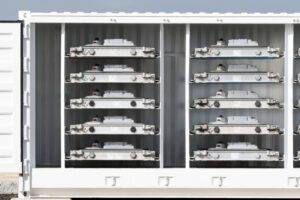
Jaguar Land Rover (JLR) and Wykes Engineering are teaming up to develop what they claim will be one of the UK’s largest energy storage systems made from old electric car batteries.
The two firms have announced today JLR is set to supply second-life batteries originally used for its Jaguar I-PACE electric vehicles (EVs) to renewables technology specialist Wykes Engineering, which then plans to slot these batteries into an energy storage system at a renewable energy part in Northamptonshire.
The battery storage system is to be spread across three locations at the Wykes-owned Chelveston renewable energy park, which boats over 85MW of installed wind and solar generation on site. The park is capable of producing 175,000MWh of electricity per year, which is enough to power more than 60,000 homes in the local area, according to JLR.
The batteries for the proposed facility have been taken from prototype and engineering test vehicles, with JLR hoping to supply enough batteries to store 7.5MWh of energy – enough to power 750 homes for a day – by the end of 2023.
According to JLR, batteries are simply removed from its Jaguar I-PACE and slotted into racks in containers on-site, with a single system housing 30 second-hand units and capable of storing up to 2.5MWh of energy at full capacity.
Moreover, each system is linked to an advanced inverter to maximise efficiency and manage energy, and is capable of supplying power direct to the grid during peak hours, in addition to drawing power out of the grid during off-peak hours to store for future use.
JLR said its second-life EV batteries were still able to be deployed in low-energy situations even after their performance falls below the stringent requirements of an electric vehicle, which typically still leaves a battery with as much as 80 per cent of its original capacity.
However, once the battery health falls below the required level for these second-life use cases, JLR said it planned to recycle the batteries to recover raw materials for re-use.
The partnership is designed to support JLR’s circular economy efforts as well as its ambition to achieve net zero emissions by 2039, according to François Dossa, executive director of strategy and sustainability at the automaker.
“Our sustainability approach addresses the entire value chain of our vehicles, including circularity of EV batteries,” Dossa explained. “Our EV batteries are engineered to the highest standards and this innovative project, in collaboration with Wykes Engineering, proves they can be safely reused for energy sector application to increase renewable energy opportunities. Using the 70 to 80 per cent residual capacity in EV batteries, before being recycled, demonstrates full adoption of circularity principles.
“Working together with industry-leading partners, we are developing a complete EV ecosystem, from batteries to charging, supporting our net-zero transformation.”
According to McKinsey & Company research, second-life battery supply for stationary applications, such as renewable energy storage, could exceed 200 gigawatt-hours per year by 2030, creating a over $30bn of economic value globally.
David Wykes, managing director of Wykes Engineering, added that the partnership with JLR could present a solution to potentially costly grid capacity issues.
“One of the major benefits of the system we’ve developed is that the containers are connected to the Grid in such a way that they can absorb solar energy, that could otherwise be lost when the grid reaches capacity,” he said. “This excess energy can now be stored in the second life I-PACE batteries and discharged later. This allows us to ‘overplant’ the solar park and maximise the amount of power we generate for the area of land we are using.”
The new follows last month’s announcement that JLR’s parent company Tata Group plans to build a flagship £4bn gigafactory in the UK – its first battery factory outside India – after months of negotiation with government to secure a major support package.
The new battery factory is reportedly earmarked for a site in Somerset and is expected to create around 4,000 UK jobs as well as thousands more across its supply chain, providing a major boost to the UK’s fledgling EV manufacturing industry.
The automaker has also recently set out plans to invest £15bn over the next five years in ramping up its electric vehicle offering, including through the production of its new all-electric Jaguar and Range Rover models at manufacturing sites in the UK.
Read more:
Jaguar to repurpose used EV batteries for Northamptonshire energy storage system
NatWest boss’s ‘£2.4m exit deal’ is a disgrace, says Nigel Fara …

Nigel Farage branded Dame Alison Rose’s NatWest exit an “absolute disgrace”, after it emerged she could be set to receive a pay package worth more than £2.4million.
The bank revealed on Wednesday that Rose was seeing out her 12-month notice period on her contract, one month after she resigned as chief executive.
She is due to receive £1.155 million in salary for the year, £1.155 million in NatWest shares — over a five-year period — and £115,566 in pension payments, NatWest said.
But it added that the board was yet to decide if it would attempt to claw back past bonus awards related to her performance, following an investigation into the Farage scandal, and added that the sums expected were not guaranteed.
NatWest said: “Like other employees where an investigation outcome is pending, Alison is currently receiving her fixed pay. This is in line with her contractual notice period and remains under continual review, as the independent investigation continues. As previously confirmed, no decision on her remuneration will be taken until the relevant investigations are complete.”
Rose, 54, quit as NatWest’s chief executive on July 25, after she admitted leaking confidential customer information about Farage to a BBC journalist at a charity dinner.
Her briefing to the BBC’s business editor resulted in an inaccurate story suggesting the Brexiteer had been debanked by Coutts — which NatWest owns — as he did not meet its wealth threshold.
Farage was later able to get hold of a 40-page dossier which revealed he had his accounts closed by the private bank because his views did not align with its inclusive values.
In a video posted on Twitter, the former Brexit Party leader said: “When I heard about it I thought perhaps it was a sick joke.”
The Conservative MP Sir Jake Berry called the amount a “disgraceful reward” for failure, and the former Brexit secretary David Davis urged the government to step in.
Ministers are understood to be waiting to see the result of the law firm Travers Smith’s investigation into the scandal, commissioned by NatWest. Harriett Baldwin, who chairs the Treasury select committee, said the bank should consider using claw-back rules to minimise the payout to Rose.
Farage said: “It’s an absolute disgrace. This is classic of the establishment — clubbing together and looking after their own. This is not just a reward for failure — it’s for breaking every rule in the book.
“Dame Alison Rose breached client confidentiality — far from receiving £2.4 million in compensation I think there should be serious questions asked about her damehood.”
Referring to Fred Goodwin, the former RBS chief executive, Farage added: “He lost his knighthood — he didn’t break the law as far as I’m aware.”
The politician-turned-broadcaster, currently in the US for the first Republican primary debate, also took aim at Sir Howard Davies, the NatWest chairman, for kicking the scandal “into the long grass”.
He said he is not due to receive a subject access request on him from the bank — to identify any further breaches — until the end of October. Farage added: “They’ve chosen a city law firm to investigate, headed up by a man who calls Brexiteers racists and xenophobes.”
Rose resigned in July after pressure from Downing Street and the Treasury over her position. NatWest Group is still part-owned by the taxpayer. She was followed out the door by Peter Flavel, Coutts’s chief executive.
After the scandal, Rishi Sunak, the prime minister, reaffirmed that banks should not restrict freedom of speech by shutting accounts of those with opposing views.
Andrew Griffith, the City minister, also hauled leading bankers into a meeting, as the government announced new requirements on banks to protect the freedom of expression of customers.
The Treasury said banks will be forced to explain and delay any decision to close an account under new rules, to combat account closures over political beliefs. The changes will increase the notice period banks have to offer to 90 days — giving customers more time to challenge a decision through the Financial Ombudsman Service.
NatWest said that it would review Rose’s planned pay and bonus payouts in relation to investigations into her actions in the Farage affair. It said: “Ms Rose’s notice period and the payments she will continue to receive for the notice period will be reviewed on a continuing basis, having regard to the internal and external investigations relating to the account closure arrangements at Coutts and associated events.
“Decisions on these awards, along with any decisions regarding other remuneration matters, will be made taking into account the findings of the investigations, as appropriate.”
It added that policies allowing the company to potentially “claw back” bonus payments will apply to the former boss.
Read more:
NatWest boss’s ‘£2.4m exit deal’ is a disgrace, says Nigel Farage

