

Chancellor Jeremy Hunt has been urged to freeze business rates again, amid warnings that a multi-billion hike in bills could dent investment and leave many small firms “on the brink”.
Last autumn the chancellor announced a major support package worth £13.6 billion to help businesses still recovering from the pandemic. It included freezing business rates, which usually increase annually, as well as increasing the discount for retail hospitality and leisure businesses from 50 per cent to 75 per cent for 12 months, capped at £110,000 per firm.
However, business rates are now set to increase again next April under the government’s “multiplier”, which is pegged to inflation in September, as measured by the consumer price index.
While inflation fell in July from 7.9 per cent to 6.8 per cent, the Treasury is braced for it to rebound again in August, meaning firms could face a steep increase in their rates. Coupled with the ending of 75 per cent rate relief, it will add further financial strain for many firms.
An analysis by UKHospitality suggests that increasing business rates by inflation could increase bills for the hospitality sector by £220 million next year. This would come on top of an additional £630 million cost from rates relief ending, leaving restaurants, pubs and cafés facing an additional bill of £850 million in the new financial year.
It would mean that a restaurant with an average rateable value of £51,000 that would have benefited from £19,500 in relief this year could be facing an annual business rates bill of £26,000 next year.
The industry argues that government support this year was vital to keeping many businesses afloat during the energy and cost of living crisis, and that ending this could see many smaller firms closing.
One London-based restaurant, which had been planning to open three new venues in the next year, creating 60 new jobs, said that it would be forced to cancel the expansion unless Hunt extended government support.
It added that inflation increases and the loss of 75 per cent relief would mean its annual business rate bill would rise from £51,220 to £204,880 from April — an increase of £154,000.
Kate Nicholls, chief executive of UKHospitality, said: “The looming business rates hike facing hospitality businesses is a ticking time bomb that has the potential to cause as much damage next year as the energy crisis. The ending of current business rates relief next April could mean an additional £630 million hit, while an inflationary increase to rates adds a further £220 million. Together, it’s an almost billion-pound bill that could put businesses on the brink.
“The current business rates relief package has been critical for businesses to navigate cost pressures across energy, food and drink, as well as workforce pressures, and has kept small, independent businesses afloat. These are the ones struggling the most, with independent business markedly less confident in their future prospects.
“We need to see urgent action from government to avoid this upcoming bill, with firm commitments that there will be no inflationary increase to the total sum of business rates, and that business rates relief will continue for hospitality businesses.
“Inaction is the difference between firms scaling up, investing and driving economic growth and recovery, or accelerating price rises for consumers — or even worse, businesses shutting their doors for good.”
Read more:
New calls for Hunt to freeze business rates
Category: Uncategorized
Disney’s British Subsidiary Makes a Comeback with West End Magic

After a period of unprecedented challenges brought about by Covid restrictions, Disney’s British arm has made a remarkable recovery, much to the delight of theatre-goers and Disney fans alike.
Drawing income from across Europe, the company’s UK-based operations have witnessed a surge in revenue, thanks to the easing of Covid restrictions and a boost in subscriptions to its Disney+ streaming service.
With the end of Covid restrictions in the UK, audiences flocked back to London’s West End, the capital’s bustling theatre district. Disney’s shows, including crowd favourites like Frozen and The Lion King, were once again able to captivate audiences with their enchanting performances. This return to live theatre gave a considerable boost to Disney’s British subsidiary, marking a significant step in its post-pandemic recovery.
In addition to the reopening of theatre, the Disney+ streaming service also saw a growth in subscriptions. This growth not only highlighted the brand’s diversification but also contributed significantly to the increased revenue. This dual success underscores the brand’s resilience and adaptability in the face of adversity.
The financial figures for the year up to October 2022 provide a positive picture of Disney’s UK operations. Revenues returned to and even exceeded pre-Covid levels, reaching £3.1 billion, up from £2.6 billion the previous year. This impressive turnaround signals the strength of Disney’s brand and its ability to bounce back even in the most challenging of circumstances.
Despite the positive trends, Disney’s UK division did face some challenges. The Ukraine war impacted the company’s operations, particularly curtailing its activities in Russia. Nevertheless, the company managed to maintain a healthy profit margin, demonstrating its robustness in the face of geopolitical tensions.
At the helm of this recovery was Bob Iger, the global leader of Disney. His leadership has played a crucial role in steering the company through a challenging period and towards a path of recovery. After a year of loss in 2021, Disney’s UK division managed to turn the tide, reporting a healthy profit of £402 million. This financial turnaround is a testament to the brand’s resilience and strategic planning.
The future looks promising for Disney’s British subsidiary, as it continues to captivate audiences with its magic, both on stage and on screen.
Read more:
Disney’s British Subsidiary Makes a Comeback with West End Magic
Government encourages pubs to open early so country can get behind Lio …

The government is encouraging councils to get pubs open earlier on Sunday ahead of the Women’s World Cup final.
It comes after pubs called for licensing laws to be relaxed to allow venues to serve alcohol from 10:00 BST ahead of the much-anticipated match.
The British Beer and Pub Association (BBPA) wants pubs to be able to sell drinks before kick-off.
Government called for “rapid” action from councils.
“The whole nation is ready to get behind the Lionesses this Sunday in what is England’s biggest game since 1966,” said Levelling Up Secretary Michael Gove.
“I’ve asked councils to do everything they can to help pubs get open earlier on Sunday, so people can come together and enjoy a drink before kick-off for this special occasion,” Mr Gove added.
Pubs can open when they choose on Sundays, but when they can sell alcohol depends on each pub’s licence.
Most pubs are likely to be unable to serve alcohol until 11am, with some being restricted until midday, according to the British Beer and Pub Association (BBPA).
Individual pubs can apply for a temporary event notice (TEN) to vary their hours – although that requires five working days to process, so pubs would have had to have applied by last Friday.
“In cases where an application is being rapidly considered to allow a short extension to licensing hours, the government is encouraging local authorities to continue to do everything they can to complete the process in time, working closely with local police forces,” the government said in a statement.
Kate Nicholls, chief executive of UK Hospitality, said: “I’d echo the government’s support for local authorities taking a pragmatic view to venues opening early to allow people to make the most of this momentous occasion”.
Temporary blanket tweaks to licensing laws that apply in England and Wales for special events have to be approved by both the House of Commons and the House of Lords under the Licensing Act 2003.
This has been done in the past ahead of big celebrations such as the Platinum Jubilee and the Euro 2020 final.
However, as Parliament is currently in recess, the government is not planning to recall MPs to make the change ahead of the England v Spain final, and is instead writing to council leaders to speed up licence applications where they have been applied for, to allow for extended Sunday hours.
Lionesses eye glory – but ‘no plans’ for bank holiday
England reach first Women’s World Cup final
How England crashed Australia’s party to reach final
If any individual venues had waited until the day of the semi-final to apply for a special exemption to serve alcohol earlier, it would likely have been too late to gain permission for Sunday’s final.
The BBPA, which represents more than 20,000 pubs, told the BBC it did not believe many pubs would have applied for the temporary notice for the big match.
Chief executive Emma McClarkin said the government’s support was “great news”, especially during what has been a “tricky summer”.
July’s exceptionally wet weather and the rising cost of living have dampened peoples’ spending on leisure activities.
Alun Cairns MP, chair of the All-Party Parliamentary Beer Group, said he had raised the issue with the home secretary directly.
“We need to do all we can to support the team, whilst at the same time backing our great British pubs.”
‘Carnival atmosphere’
Clive Watson, chair of the City Pub Company, said that it was expecting “brisk trade” and “a carnival atmosphere” across its 43 pubs if England win. Most of its pubs have a licence to serve alcohol from 12:00.
Many of the chain’s venues will be open from 10:30 on Sunday.
“This is an historic sporting event for England. It’s not just about pubs selling more pints – it’s bringing everyone together to cheer the Lionesses on.”
The World Cup final is already expected to bring a £41m boost to the hospitality sector across the UK, according to the industry trade body.
UK Hospitality estimates that an extra one million people will be drawn into pubs, bars and restaurants in the hopes of seeing a win for the Lionesses.
Ms Nicholls said many people wanted to come out for breakfast or brunch to get ready for this historic match.
“Demand from fans has been exceptional”, she added, with pub bookings filling “rapidly”.
Sunday trading rules can be tweaked for “an occasion of exceptional international, national, or local significance”.
The pub chain Young’s, which has more than 200 venues across the country, said that most would be opening by 10:30 ahead of the match at 11:00.
For those that can’t serve alcohol before 12:00, they will be serving tea, coffee and a breakfast menu.
Football fan zones in London have already sold out in anticipation of the Lionesses’ match.
Boxpark said 2,500 tickets were sold in just eight minutes across their sites in Shoreditch, Wembley and Croydon after the team confirmed its place at the final.
If England do win, the government has said there are “no plans” for an extra bank holiday.
Read more:
Government encourages pubs to open early so country can get behind Lionesses in World Cup Final
Energy bills predicted to drop in October

Annual energy bills for a typical household are expected to fall slightly to £1,926 from October, according to a new forecast.
Consultancy firm Cornwall Insight predicts bills could drop by £148 under a new official price cap set to be announced by Ofgem next week.
The energy price cap limits how much suppliers can charge households for each unit of energy they use.
But bills still remain far higher than before Russia’s invasion of Ukraine.
Kate Mulvany, senior consultant at Cornwall Insight, told the BBC’s Today programme that while wholesale energy prices had been falling, the drop in bills from October will probably be a little less than consumers were hoping for.
“Unfortunately… our forecasting to the end of this decade is that prices are going to stay higher than people were used to before the energy price crisis.”
The energy watchdog, Ofgem, sets a maximum price that suppliers can charge customers per unit of gas and electricity.
It applies to households on variable or default tariffs in England, Wales and Scotland, but the actual amount paid by customers will vary depending on the amount of gas and electricity they use.
Changes to the energy price cap come into force every quarter to reflect changes in wholesale prices, and it stood at £2,074 for a typical household in July.
The price of wholesale energy increased as Covid restrictions were eased and then rocketed after Russia’s invasion of Ukraine last year.
In October last year, the government stepped in to limit a typical household’s annual gas and electricity bill to £2,500. It also gave a £400 winter discount to every household, which was paid in six instalments between October and March.
This support has been wound down, although cost-of-living payments will continue to be made to people on lower incomes and those receiving certain benefits.
‘Stubbornly high prices’
The End Fuel Poverty Coalition warned that few customers would feel better off, despite the decrease in the price cap.
“Any declines in wholesale costs are almost cancelled out by the end of the government’s Energy Bills Support Scheme, which means bills stay at similar levels to last year while people have less ability to pay these stubbornly high prices,” it said.
“This coming winter will not feel any better than last as energy bills remain at dangerously high levels.”
Cornwall Insight warned that it was still important that the government explores alternative options for energy bills, such as social tariffs, to make sure they are affordable.
In a statement, Cornwall Insight said that the slow reduction of bills along with the “volatility” associated with the energy price cap might mean more customers look to going back to a fixed tariff for their gas and electricity.
“With so many unknowns in the energy market, each household must decide for themselves what is the best avenue for them,” its principal consultant Dr Craig Lowrey said.
It also suggested that the UK was particularly susceptible to changes in wholesale prices because of its reliance on gas imports.
According to Ms Mulvany, one of the big drivers behind the high prices being forecast over the next decade is that nuclear power stations in the UK are expected to retire, so they will stop producing a “very substantial amount of energy that the UK relies on”.
A spokesman for the Department for Energy Security and Net Zero said that the government “will always ensure that the energy market is working for consumers to protect them from sky-high bills and that households are getting the best deal”.
Read more:
Energy bills predicted to drop in October
Retail sales drop in July as rain dampens demand
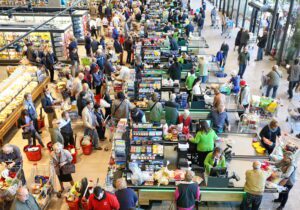
Retail sales volumes fell by 1.2% in July after the wet weather hit summer clothing sales and the cost of living weighed on food shoppers.
The Office for National Statistics (ONS) said it was a particularly bad month for supermarkets.
“The summer washout combined with the increased cost of living meant sluggish sales for both clothing and food,” it said.
Department stores also reported falling demand for household goods.
Illustrating how much prices have risen, the ONS said that compared to February 2020 – the last full month before Covid struck – total retail sales were 16.4% higher by value but 1.8% lower in the volume of goods people bought.
Earlier this week, new figures showed that inflation, which measures the rate at which prices are rising, slowed again to 6.8%. However, food prices are still increasing at a high rate.
The ONS said sales volumes at supermarkets fell by 2.6% July after a rise in June.
It said “some of the fall was because of the poor weather reducing summer clothing sales. However, food sales in supermarkets also fell back”.
Retail sales between June and July fell by more than expected. Economists had forecast a drop of around 0.6%.
Ruth Gregory, deputy chief UK economist at Capital Economics, said she was cautious about reading too much into the retail sales figures since it “had a lot to do with last month being the sixth wettest July since records began in 1836”.
“But with the Bank of England’s interest rate hikes still feeding through and consumer confidence falling, we remain downbeat on the outlook for overall spending this year,” she said.
Department stores said sales volumes fell by 2.9% between June and July. As well as clothing, they reported a fall in demand for furniture and lighting.
For some retailers, the poor weather meant customers changed what they bought.
Gary Grant, founder and chairman of The Entertainer toy retailer, told the BBC’s Today programme that parents had spent more on items to keep children occupied during the rain.
He said that while its outdoor toy sales were “substantially down” on a year ago, “our indoor sales, whether that be our stationery items, our craft items, our puzzles, our games, things that you would need to keep your children occupied in the house, those sales have increased”.
The rain also helped online retailers as shoppers stayed at home, with sales up by 2.8% in July.
In total, the share of retail sales online last month rose to 27.4% – the highest since last February – compared to 26% in June.
Meanwhile, the ONS revised down the growth in retail sales for June from a rise of 0.7% to an increase of 0.6%.
Silvia Rindone, managing partner of strategy and transactions at the accountancy firm EY, said that sales could bounce back in August as children prepare to go back to school.
“Retailers should see sales improve in August as families start shopping for the start of the new school year in September. ‘Back to school’ is often the highest spending season in retail after Christmas,” she said.
Looking ahead to the festive period, Mr Grant said people tended to hold-off making big ticket purchases until the final few months of the year.
While The Entertainer is gaining from the popularity of the Barbie film at the moment, in particular sales of dolls and clothing, items such as Barbie’s caravan or her house, which can cost as much as £300, will be “the big Christmas present”, he said.
Read more:
Retail sales drop in July as rain dampens demand
UK Government must step up global AI safety summit plans

As the first major global AI safety summit approaches, Prime Minister Rishi Sunak is yet to provide crucial details such as an exact date and invitee lists, as officials from four counties around the world urge the UK to speed up the planning process, according to spokespeople from Politico.
Earlier this year, the UK announced they would host the first major global summit on AI safety in Autumn this year and Sunak spoke at London Tech Week stating that he wants the UK to be the home of global safety regulation, however other nations are stating the provisional date of “early November” for the summit is “pretty vague”.
Global leaders are coming forward to prompt the UK to offer more concrete plans as an anonymous senior European diplomat urged the UK to “step up its summit planning to ensure that substantive outcomes can be achieved”.
Sunak has made his goal for AI clear, describing the “incredible potential” AI offers, also highlighting the importance of safety while recently investing £400m of its £1bn net zero innovation fund towards 12 artificial intelligence initiatives to support the transition to green energy.
Sridhar Iyengar, Managing Director for Zoho Europe, commented: “Artificial Intelligence has the potential to be an incredibly useful business tool, offering improved efficiencies and enhanced customer journeys through the use of customer service assistants, data analysis, forecasting and more. It is exciting to see the UK government prioritise becoming the global home of AI regulation. As the first major global summit on AI approaches, businesses across the UK should ensure they are prioritising safe implementation of AI, as well as following guidance advised by government and policymakers.”
“To drive the trust in the use of AI, government, industry experts and business need to collaborate to help develop the right rules, regulation and education which can accelerate adoption. Businesses can support this by taking care to implement ethical policies for staff to follow to ensure AI is used safely and risks are reduced. This collaboration can help a safe playing field to be developed, and can contribute to the UK taking a leading position in the development of AI.”
Yi Ding, Assistant Professor of Information Systems at the Gillmore Centre for Financial Technology, said: “The development of Artificial Intelligence is essential to promote innovation and cement the UK as a top tech destination, however, this should not be done without safety and regulations being kept top of mind. It is encouraging to see the UK take such a prominent foot forward in the AI race and as we take a leading position in developing safe AI, businesses should follow suit.”
“Innovation, R&D and educating should continue to be a focus for businesses in the UK, supporting the governments agenda of becoming both a tech super power status and leader in AI. This emerging piece of tech offers itself as a valuable tool for tasks such as data analysis, forecasting to support strategic decision making and much more, meaning businesses should embrace its offerings, while taking caution around potential repercussions as regulations are developed. It is exciting times as we head towards the first major global AI summit, hosted in the UK, as business decision makers and tech leaders hope for clarity around how AI can be used safely.”
A UK Government spokesperson said: “The UK will host the first major global summit on AI safety this autumn.
“Our preparations and discussions with international partners are already in full flow, with Matt Clifford and Jonathan Black recently appointed as the Prime Minister’s Representatives.
“Together they’ll spearhead talks and negotiations to make sure the summit results in the development of a shared approach to mitigating the risks of AI.
Read more:
UK Government must step up global AI safety summit plans
A-level results: Number of top grades down on last year but still abov …

The proportion of top A-level grades is down on last year but still remains above pre-pandemic levels.
A* and A grades were awarded to 27.2% of students, compared to 36.4% last year, 44.7% in 2021 and 38.5% in 2020.
But the number is up by 1.8% compared to pre-pandemic levels, when 25.4% of A-level entries were awarded A or A* grades.
Follow the latest A-level news live here
The overall pass rate – the proportion of entries graded A* to E – has fallen to 97.3% this year, which is lower than 2022 (98.4%) and the pre-pandemic year of 2019 (97.6%). In fact, the rate is at its lowest level since 2008 when it stood at 97.2%.
Pupils in England saw the biggest drop in top marks, with the share of exams graded A or above down by 9% compared to 2022.
Welsh students saw a 7% drop in top grades while Northern Ireland saw a decrease of 6%.
But compared to the last summer before the pandemic in 2019, the number of top grades awarded in England is up by 2%, in Wales by 7% and in Northern Ireland by 9%.
The figures, published by the Joint Council for Qualifications (JCQ), cover A-level entries from students in England, Wales and Northern Ireland.
In England, exams regulator Ofqual had said this year’s A-level results would be lower than last year following efforts to return to pre-pandemic grading.
It comes after COVID-19 led to an increase in top grades in 2020 and 2021, with results based on teacher assessments instead of exams.
In Wales and Northern Ireland, exam regulators have said they do not plan to return to pre-pandemic grading until 2024.
Many A-level students in Wales and Northern Ireland were given advance information about topics to expect in their exam papers this summer but students in England were not given the same support.
“The reality is that those systems are different anyway, they’re different awarding bodies,” Education Secretary Gillian Keegan told Sky News when asked if there were questions about fairness.
“University admissions officers know the difference in these systems so they’re quite sophisticated in understanding the difference between the English system and the Scottish system.”
There are still regional differences when it comes to the share of students achieving top grades.
Compared to pre-pandemic levels, the number of pupils receiving A-A* grades is still up by 3.1%. That compares to the North East, where 1% fewer pupils achieved top marks.
But overall, students in the South East achieved the greatest share of top marks, with more than 3 in 10 papers (30.3%) receiving A-A* grades. That compared to 22% in the North East, 22.3% in the East Midlands, 22.9% in the West Midlands, 24.1% in the North West and 26.6% in the East.
Boys scored more A* grades this year compared to girls, at 9.1% compared to 8.8%.
A total of 3,820 students in England alone scored three A* grades, according to separate figures from exams regulator Ofqual.
This is down from 8,570 last year, but up from 2,785 in 2019.
Maths still remains the most popular A-level subject, followed by Psychology, Biology, Chemistry, History, Sociology, Business Studies, Art and Design, Economics and Physics.
Computing saw the biggest increase in entries, up by 64% since 2019. Media and film studies, as well as political studies and economics, also saw increases in entries.
There is still a big difference in the type of subjects male and female students are choosing to take at A-level.
Of the 15 most popular subjects, 77% of those choosing to take physics are male compared to 78% of those studying English Literature being female.
UCAS also says fewer A-level pupils have gained a place at their first choice of university or college compared to last year.
It said 79% secured their first choice, compared to 81% in 2022, when exams were re-introduced and 74% in 2019, when grading arrangements were the same as this year.
A further 9% of students are in clearing, which compared to 12% in 2019 and 7% in 2022.
Elsewhere, 12% have been placed at their insurance choice, compared to 14% in 2019 and 11% in 2022.
More than twice the number of students from advantaged backgrounds (76,780) were accepted compared to those from disadvantaged backgrounds (25,760).
UCAS Chief Executive Clare Merchant said: “Today’s data shows that challenges in widening participation to the most disadvantaged students still persist.
“This demonstrates that we all need to continue the efforts to ensure the most disadvantaged individuals in society are able to benefit from life-changing opportunities in higher education and training, particularly as the 18-year-old population grows”.
Overall, 414,940 applicants have gained a place at university or college, down from 425,830 last year but up on 408,960 in 2019.
Pupils in Scotland received their results last week and the Scottish Qualifications Authority figures showed that the Higher pass rate was down from last year but it remained above 2019 levels.
Read more:
A-level results: Number of top grades down on last year but still above pre-pandemic levels
£1 billion growth fund to help scale UK FinTechs prior to IPO launche …

UK FinTech Growth Partners LLP has unveiled the FinTech Growth Fund, backed by Barclays, NatWest, Mastercard, London Stock Exchange Group and Peel Hunt.
It promises to invest in UK FinTechs, predominantly between Series B and pre-IPO, to enable them to scale into world-class global organisations.
The idea for the fund grew out of the landmark Kalifa Review which outlined a five-point plan to help the UK retain its status as a global leader in financial services through securing the success of UK FinTech.
It identified an annual funding gap for growth stage FinTech estimated at £2bn and recommended a £1bn growth fund which would sufficiently fill this gap in order to sustain our world leading ecosystem.
Currently these FinTechs struggle to find domestic capital to help them scale, resulting in a loss of IP and a growing divergence between the UK and the US at post-seed funding levels.
The first deployment of capital into businesses is scheduled for Q4 2023 with a strong pipeline of opportunities already identified. The fund will look to undertake, on average, four to eight investments per year, with investments between £10 million and £100m.
The fund will make minority investments and all investments will be for equity and equity-linked securities.
Alongside the investment capital, the FinTech Growth Fund will provide strategic support to its portfolio companies to help them achieve their corporate ambitions, giving them access to an ecosystem of deep, relevant experience across FinTech, venture capital, and the wider financial services ecosystem.
The UK FinTech Growth Partners executive team includes Angel Issa, former global head of corporate development & strategic investments at Nomura, having previously held similar roles at BNP Paribas and Morgan Stanley; Joe Parkin, former managing director – head of banks, digital channels and UK inorganic at BlackRock; Kaushalya Somasundaram, former executive director and UK head of payments, partnerships & industry relations at Square, and former managing director and global head of FinTech partnerships & strategic innovation investments director at HSBC; and Phil Vidler, CEO of FinTech Alliance, formerly group strategy director at Pollinate and head of global markets for HM Treasury.
Its non-executive advisory board will be chaired by former Chancellor of the Exchequer Lord Philip Hammond, and will also feature notable UK financial services and FinTech figures, including Clare Bousfield, Sir Charles Bowman, Dame Jayne-Anne Gadhia (pictured), Lord Gerry Grimstone, Alastair Lukies CBE, Dame Helena Morrissey, Romi Savova and Philip Smith.
“The UK has always been at the forefront of innovation in FinTech but there is a very clear and well evidenced growth funding gap,” said Phil Vidler, managing partner.
“The FinTech Growth Fund will address the lack of available growth capital by providing a first of its kind domestic, growth-stage, FinTech focused venture capital fund backed by strategic investors.
“Our aim is to not only provide the capital needed for founders to scale their businesses, but to also engage with stakeholders across the nation to support the wider ecosystem. In doing so, we believe we can ensure the UK remains a global leader in FinTech.”
Sir Ron Kalifa, author of the Kalifa Review, added: “I am delighted to welcome the launch of the UK FinTech Growth Fund as a private sector initiative, backed by institutional capital, responding to one of the key recommendations of the Review.
“The fund represents another key building block in the support ecosystem for growth stage UK FinTech businesses. This is an important step forward towards ensuring the UK retains its leadership role in FinTech.”
Outside its core remit, UK FinTech Growth Partners will commit to providing wider holistic support for the UK FinTech ecosystem. This extensive commitment will be realised through the ‘Beyond Investing’ programme which will consist of initiatives focused on national connectivity, support for early-stage founders, and talent, diversity, equity and inclusion.
Read more:
£1 billion growth fund to help scale UK FinTechs prior to IPO launched
Retirees to Receive an 8% Boost to Pensions as Rishi Sunak Commits to …

Retirees in the UK can expect an 8% increase in their pensions next year, as Chancellor Rishi Sunak reaffirms his commitment to the ‘triple lock’ policy.
This policy dictates that the state pension rises each April by the highest of three factors: average earnings, prices, or 2.5%. Despite a dip in the headline Consumer Prices Index (CPI) rate last month, pensioners are still set to receive a larger increase due to significant growth in employees’ average total pay.
The ‘triple lock’ policy, a key component of the Conservative Party’s manifesto, ensures that the state pension increases annually by the highest of three factors: average earnings, prices, or 2.5%. This mechanism aims to protect pensioners’ income and keep it in line with the cost of living. By using the highest value among the three components, the policy guarantees that pensioners receive a fair share of the economic growth.
The calculation for the upcoming state pension increase in April considers two main factors: inflation data and average earnings growth. The inflation data from September, published in mid-October, will contribute to the calculation. Additionally, the average earnings growth from May to July this year will be taken into account. The combination of these two factors will determine the final percentage increase in the state pension.
Current Pension Rate and Potential Rise
As of now, the base state pension rate stands at £203.85 per week. If the state pension rise aligns with the 7.8% wage growth observed between April and June, pensioners can expect a weekly increase of £15.90 next spring. This potential rise in pension income will provide retirees with additional financial stability and, in turn, stimulate the economy.
Sunak’s Assurance
Prime Minister Rishi Sunak has expressed his comfort with the projected 8% rise in the state pension next April. When questioned about his commitment to the triple lock policy, Sunak assured the public that the government remains devoted to its policy on pensions. He emphasized that the decision on pension increases is determined through a statutory and legal process that takes place in the autumn.
Balancing Inflation and Support
While acknowledging that higher inflation is a concern, Sunak believes it is crucial to support individuals and families facing the pressures of rising prices. The government has already provided substantial support to households, including covering half of the typical family’s energy bill. Sunak likened the scale of this support to the furlough scheme and highlighted that the average family has received approximately £1,500 of assistance on their energy bills.
Budget Implications
The commitment to upholding the triple lock policy means that Chancellor Jeremy Hunt will need to allocate billions of pounds more for state pension increases than initially anticipated. In March, the spring budget projected a 6.2% rise in pensions for the upcoming year. However, with the significant growth in average earnings, the budget will need to be adjusted to accommodate this higher increase.
It is worth noting that during the Covid-19 crisis, the triple lock policy was temporarily suspended. As Chancellor, Rishi Sunak implemented this suspension due to distortions in wages caused by the pandemic. Consequently, pensioners received a 3.1% increase in April 2022, aligning with inflation at the time. The upcoming 8% rise in pensions can be seen as a compensation for the lower increase experienced in the previous year.
While the increase in state pensions provides retirees with financial relief, it also has wider implications for the economy. The additional income for pensioners can stimulate consumer spending and contribute to economic growth. However, critics argue that the triple lock policy places a significant burden on the government’s budget, especially with the current economic challenges. The potential £2 billion increase in pension costs, as suggested by former pensions minister Steve Webb, highlights the financial strain faced by the government.
Read more:
Retirees to Receive an 8% Boost to Pensions as Rishi Sunak Commits to ‘Triple Lock’

