
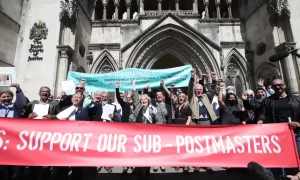
A public inquiry into the Horizon IT scandal at the Post Office has produced enough evidence for police to investigate senior staff, according to lawyers for postmasters who were wrongly convicted of crimes including theft and fraud.
Hundreds of people who owned and operated post offices were wrongfully investigated, prosecuted and convicted between 1999 and 2015 because of bugs in a computer system called Horizon.
During the current public inquiry into the scandal, widely considered one of the gravest miscarriages of justice in British history, postmasters have claimed that senior Post Office staff either knew about the system’s failings or “shut their eyes” to them.
Paul Marshall, a barrister who is representing post office operators in their continuing fight for compensation, said he believed that enough evidence had emerged for police to consider prosecuting former Post Office executives.
“On the face of it, the material is sufficient for the police to investigate whether, over a substantial period of time, the Post Office was engaged in perverting the course of justice or a conspiracy to pervert the courses of justice,” he told the Guardian.
“In my view, the Post Office was engaged in a sustained attack on the rule of law itself.”
Lawyers for the post office owner-managers reportedly want Sir Wyn Williams, chairman of the public inquiry into the scandal, to pass files to the director of public prosecutions once the inquiry is completed next year.
Janet Skinner, a branch operator who was wrongly jailed for nine months, told the Times that collating evidence that may form the basis for an investigation into former senior Post Office staff was a focus for her legal team.
During the course of the statutory inquiry, evidence has emerged indicating that Post Office investigators responsible for looking into allegations against branch operators did not believe that they had stolen anything.
Last week, Post Office accounts revealed that the company has almost halved the amount it has set aside for payments to branch managers wrongly convicted in the scandal, from £487m to £244m, as fewer than expected have won or brought appeals.
The Post Office said: “We fully share the aims of the current public inquiry, set up to independently establish what went wrong in the past and accountability.
“We’re acutely aware of the human cost of the scandal and we’re doing all we can to right the wrongs of the past as far as that is possible. Both Post Office and government are committed to providing full, fair and final compensation for victims.”
Read more:
Post Office Horizon inquiry: ‘enough evidence for police investigation’
Month: December 2023
FTSE 100 ends year up 3.8% but trails rival markets in Europe and US

The London Stock Exchange has ended the year trailing rival markets in Europe and the US, as a stagnating economy and a volatile political climate deterred investment and cast a shadow over the nation’s economic prospects.
The FTSE 100 index of blue-chip companies reached 7,733 points on Friday, the final trading day of the year. While a late rally helped the index to its highest closing level since late May, it has gained just under 4% since January, compared with a global average of 20%, as measured by the MSCI All Country World Index.
As in previous years, the FTSE 100’s lack of technology companies left it floundering against Wall Street, where the S&P 500 index has jumped by 25% this year to the brink of a record high.
The Nasdaq Composite index has risen by 45% this year, lifted by a boom in big tech stocks such as the chipmaker Nvidia, whose shares have soared by 240% as the boom in artificial intelligence drove demand for its high-end semiconductors.
Germany’s DAX index rallied by 20%, while France’s CAC gained 16.75% and Italy’s FTSE MIB surged almost 30%, as European markets recovered from losses in 2022.
The pan-European Stoxx 600, which tracks the largest companies across European markets, gained more than 12%.
Susannah Streeter, the head of money and markets at Hargreaves Lansdown, described the FTSE 100’s 3.8% rise this year as “paltry” when compared with its international peers.
“Britain’s blue-chip index still appears unloved with attention grabbed by the bright lights of Wall Street and the tech-heavy makeup of New York’s exchanges, with a frenzy for all things AI fuelling buying behaviour,” Streeter said.
“Even though the Brexit hangover has eased, the UK’s stagnating economy and volatile political scene of recent years appears to be putting off investors,” she added.
The year started brightly for the FTSE 100. It broke through the 8,000 points mark for the first time, hitting a record high of 8,047 points in mid-February. But trading through the rest of the year was choppy, as concerns over the UK’s weak growth and rising interest rates weighed on stocks.
The smaller FTSE 250 index of medium-sized companies had a slightly better year, gaining about 4.5%.
Rolls-Royce was the top riser on the FTSE 100 this year. The engineering company gained 220% as traders welcomed the turnaround plan being implemented by the new chief executive, Tufan Erginbilgiç.
Rolls’s strength helped the UK’s aerospace and defence sector to rise by more than 67% in 2023, also aided by a 30% jump in shares in the weapons maker BAE Systems, while the aerospace manufacturer Melrose’s share price doubled this year.
At the other end of the leaderboard, the mining company Anglo American fell by 39% this year, a dire performance that raised speculation it could become a takeover target. In December, Anglo cut its production outlook, after problems with iron ore and copper mining.
Shares in the wealth manager St James’s Place lost 37%, in a year in which regulators pressed it to revamp its fee structure to reduce overall charges for existing investments.
Not every international stock market rallied this year. China’s CSI 300 index fell by more than 11% in 2023, as weak economic growth, a liquidity crisis in the property sector and geopolitical tensions all weighed on shares.
The pound has enjoyed its best year against the US dollar since 2017, gaining 5% as it climbed from $1.21 in January to $1.27 at the end of December.
But that rally was partly down to the dollar’s weakness; the greenback lost about 2% against a basket of currencies. Traders anticipate several cuts to US interest rates in 2024, as the Federal Reserve tries to achieve a “soft landing” – lowering inflation without causing a recession.
Read more:
FTSE 100 ends year up 3.8% but trails rival markets in Europe and US
House prices fall nearly 2% over year

House prices fell 1.8 per cent over the course of 2023, and are unlikely to rebound next year according to Nationwide.
The decline since last December leaves the average price almost 4.5 per cent below the all-time high recorded in late summer 2022. Nationwide predicts that they will likely remain flat or record a fall of up to 2 per cent in the year ahead.
Robert Gardner, the building society’s chief economist, said: “Housing market activity was weak throughout 2023. The total number of transactions has been running at around 10 per cent below pre-pandemic levels over the past six months, with those involving a mortgage down even more (around 20 per cent), reflecting the impact of higher borrowing costs. On the flip side, the volume of cash transactions has continued to run above pre-Covid levels.
“Even though house prices are modestly lower and incomes have been rising strongly, at least in cash terms, this hasn’t been enough to offset the impact of higher mortgage rates, which in recent months were still more than three times the record lows prevailing in 2021 in the wake of the pandemic.”
Gardner said high mortgage rates were stretching affordability while, at the same time, “deposit requirements remain prohibitively high for many of those wanting to buy”.
He added: “If the economy remains sluggish and mortgage rates moderate only gradually, as we expect, house prices are likely to record another small decline or remain broadly flat (perhaps 0 to -2 per cent) over the course of 2024.”
Gardner expects affordability to improve over time thanks to income growth and lower mortgage rates. Yet activity is expected to remain “fairly subdued in the interim”.
Prices in December were broadly flat compared with November, with the average UK home now costing £257,443. Northern Ireland and Scotland have been the only parts of the UK to see prices rise in 2023. East Anglia was the weakest performing region with prices down 5.2 per cent over the year.
Across England overall, prices were down 2.9 per cent compared with the final quarter of 2022, while in Wales there was a 1.9 per cent decline.
Across northern England, which comprises North, North West, Yorkshire & The Humber, East Midlands and West Midlands, prices were down 1.8 per cent year on year. Yorkshire & The Humber was the best performing northern region with an annual rate of change of -0.5 per cent.
Southern England — the South West, Outer South East, Outer Metropolitan, London and East Anglia — saw a 3.4 per cent year-on-year fall. London was once again the best performing southern region, registering a smaller annual decline of 2.4 per cent.
Throughout this year there were signs that more buyers were looking towards smaller, less expensive properties, with transaction volumes for flats holding up better than other property types. This may be because affordability for flats has held up relatively better as they experienced less of a price increase over the pandemic period, Nationwide said.
“However, in our most recent data, we have seen a convergence in the annual rate of price growth for different property types,” Gardner said. “During 2023, the price of semi-detached properties held up best, recording a 1.8 per cent year-on-year fall. Meanwhile, flats and terraced houses both saw a 2.1 per cent annual decline, while detached properties were the weakest performing with prices down 2.7 per cent over the year.”
Read more:
House prices fall nearly 2% over year
Just under 5,000 ‘festive filers’ submitted their tax return on Ch …
Nearly 4,800 ‘festive filers’ filled out their tax returns on Christmas Day, according to HM Revenue and Customs (HMRC).
While others were opening gifts, tucking into turkey, and falling comatose on the sofa, 4,757 people submitted a self-assessment tax return, ahead of the 31 January deadline.
HMRC also recorded 8,876 returns submitted on Christmas Eve and 12,136 on Boxing Day.
The peak time was between noon and 12.59pm on Boxing Day when HMRC received 1,121 returns.
Myrtle Lloyd, HMRC’s director general for customer services, said: “Our Christmas Day filers proved that there is no time like the present to get started on self-assessment, and with our online tool it can be a simple task that’s easy to fit around other festive commitments.
“There’s no need to delay, getting it done ahead of the January 31 deadline means less stress and longer to work out payment options. Get started today by searching ‘self-assessment’ on gov.uk.”
More Christmas Day admin
Christmas Day also appeared to be the ideal day for 3,000 people to register to vote.
A total of 3,273 applications were submitted on 25 December this year, with 3,218 online and 55 on paper forms, government figures show.
The majority (62%) were from people aged 34 and under, while just 3% came from those aged 65 and over.
The number is up by nearly 1,000 compared with Christmas Day 2022, when 2,313 people made an application.
Local elections are taking place across much of England on 2 May, along with high-profile mayoral contests in areas including London, Greater Manchester and Merseyside, plus elections for police commissioners in most of England and Wales.
There is also going to be a by-election to choose a new MP in Wellingborough, although an exact date has yet to be confirmed.
And there is also likely to be a general election, with one due to take place no later than 28 January 2025.
Read more:
Just under 5,000 ‘festive filers’ submitted their tax return on Christmas Day
Increased HMRC VAT investigations bring in £11.4bn of unpaid tax

Increased tax compliance measures have yielded £11.4bn in unpaid tax as investigations into rich people and mid-size businesses grew.
The sum came as HM Revenue and Customs (HMRC) opened 23% more inquiries into unpaid value added tax (VAT), according to a freedom of information request from Thomson Reuters, upping the number of investigations to 109,400 in the last financial year from 88,700 the year before.
The biggest expansion of scrutiny was into wealthy individuals and mid-size businesses while the largest sum came from a step up in large business VAT probes.
The division examining these entities grew the number of investigations 60% from 3,253 in the financial year ending 31 March 2022 to 5,203 in the year ending March 2023.
Increases, however, were across the three sections ensuring VAT compliance.
Cases opened into individuals and small businesses were up 22% while cases into large businesses rose 17%.
The biggest increase from VAT compliance investigations came from the large businesses section, which took in an additional £5bn last year.
VAT makes up roughly 20% of the total tax take, making it one of the biggest revenue sources for the state, along with national insurance and income tax.
Additional resources had been given to HMRC as part of efforts to recoup greater tax yields.
More than 3,000 staff were added to HMRC customer compliance units since the 2021 to 2022 financial year.
But the gap between what HMRC estimated it is owed in VAT and what it collected was greater last year than the year before.
The gap stood at £8.8bn in the 2022-2023 tax year, up from £7.6bn in 2021-2022, bucking a previously downward trend.
High inflation has meant more tax is being paid as people earn more and pay higher amounts for goods and services.
Read more:
Increased HMRC VAT investigations bring in £11.4bn of unpaid tax
Retailers to pay for consumers’ e-waste recycling from 2026

British households will benefit from improved routes for recycling electronic goods from 2026, under government plans to have producers and retailers pay for household and in-store collections.
Consumers would be able to have electrical waste (e-waste) – from cables to toasters and power tools – collected from their homes or drop items off during a weekly shop, the Department for Environment, Food and Rural Affairs (Defra) said in a consultation published on Thursday. The ambition is for retailers, rather than the taxpayer, to pick up the tab for these new ways of disposing of defunct, often toxic products safely. The measures are due to come into force in two years’ time.
Almost half a billion small electrical items ended up in landfill last year, according to data from the not-for-profit Material Focus. This problem was particularly acute during Christmas, when 500 tonnes of Christmas lights were thrown away, the government said.
The latest proposals build on efforts to grapple with the issue that the UK helped develop as a member of the EU. This included the Waste from Electrical and Electronic Equipment (WEEE) directive, which came into effect in 2012. As with other waste-related rules they follow a principle that the producer of the waste will foot the bill for its disposal, which the UK and EU have followed in areas such as plastic packaging.
The EU this year adopted policy recommendations for member states to improve collection of recycled materials, although targets vary by country.
Post-Brexit, the UK has failed to keep pace with some EU regulatory efforts. The bloc is attempting to reduce e-waste with laws including a right to repair products, and requiring common chargers for phones (USB C) rather than Apple’s specialised lightning charger from 2024 onward. Cables, which are often hoarded as well as wrongly disposed of, are a major contributor to electronic waste.
A lack of effective recycling capacity in areas such as battery processing has also left the UK lagging behind European peers on a range of recycling rates. An OECD study of British data shows it failed to meet its recycling targets for household e-waste from 2017 to 2020. The review by the economic thinktank found “further efforts are needed” for the UK to prevent illegal dumping and export of electronic waste including bringing in a proposed mandatory waste tracking system.
The struggle to meet recycling targets comes despite Britain being one of the heaviest consumers of such items, according to a study by the consumer group U-Switch using data from the Global E-Waste Monitor report. The UK was second only to Norway for the amount of electrical waste it generates per person. Comparable data on electronic waste is patchy and needs improvement, MPs have warned.
Measures aimed at easing the problem of electronic waste now include requiring larger retailers to create “collection drop points for electrical items in-store” for free, and without the need to exchange this with a new purchase.
From 2026 onward, bricks-and-mortar retailers and online sellers would have to collect any broken or rejected large electrical goods including fridges or cookers when they are delivering a replacement product, Defra said.
The recycling minister, Robbie Moore, said: “Every year millions of household electricals across the UK end up in the bin rather than being correctly recycled or reused. This is a sheer waste of our natural resources and has to stop.”
He added: “We all have a drawer of old tech somewhere that we don’t know what to do with and our proposals will ensure these gadgets are easy to dispose of without the need for a trip to your local tip. Our plans will also drive the move to a more circular economy and create new jobs by making all recycling simpler.”
Read more:
Retailers to pay for consumers’ e-waste recycling from 2026
New York Times sues OpenAI and Microsoft for ‘scraping content’

The New York Times is suing Microsoft and OpenAI for billions of dollars over copyright infringement, alleging that the powerful technology companies used its information to train their artificial intelligence models and to “free-ride”.
The use of its data without permission or compensation undermined its business model and threatened independent journalism “vital to our democracy”, the media organisation said in documents filed with a federal court of Manhattan.
The lawsuit has laid bare the controversial use by technology companies of accurate and high-quality data provided by content creators, such as journalists, which are needed to power the “large-language models” that form the backbone of generative artificial intelligence.
This case will be watched closely by other parties in the creative industries concerned that their intellectual property is being breached. Some critics claim that the word “train” — used to refer to the data that is collected to fuel AI — is Silicon Valley spin and that a more appropriate word is “scrape”.
A series of copyright lawsuits have been filed by authors and artists against OpenAI and other tech companies in the US. They include the comic Sarah Silverman and Pulitzer prize-winning novelist Michael Chabon. However elements of those claims have been rejected by judges because they failed to prove that identical material had been reproduced by the AI, unlike the NYT which appears to have proved facsimile use.
Dr Andres Guadamuz, a reader in intellectual property law at the University of Sussex, who has been following the cases, said the newspaper’s filing appeared more solid and was a “negotiating tactic” after the Springer deal had established value in news content.
“It is probably one of the strongest cases so far. They have managed to get some outputs that appear to be an entire replication of the source material of the inputs. And that is a big deal. A lot of cases have been dismissed due to the fact that a lot of the lawsuits have not been able to show infringing outputs,” he said.
The New York Times claims it can demonstrate facsimile use of its content. In a list of examples, it set out how the chatbot could recite significant portions of the publisher’s work verbatim, including the text of in-depth investigations that ChatGPT could not have found elsewhere, accurately mimicking its style.
For example, it allegedly could quote its restaurant critics from reviews they had written for the media group. A request to the chatbot to type out the start of a New York Times piece “because I’m being paywalled out of reading the New York Times’s article”, prompted the response “Certainly! Here’s the first paragraph”, demonstrating how the chatbot could be used to avoid paying for the content, the company claimed.
The New York Times found that the chatbot also would invent copy in its own style, purporting to be by one of its journalists. In response to a query requesting a portion of a New York Times article, it found that “Bing Chat completely fabricated a paragraph, including specific quotes … that appear nowhere in The Times article in question or anywhere else on the internet”.
The use of its data to finesse the AI models was financially motivated, the publisher claimed. “Microsoft’s deployment of Times-trained AI throughout its product line helped to boost its market capitalisation by a trillion dollars in the past year alone. And OpenAI’s release of ChatGPT has driven its valuation to as high as $90 billion,” it said.
Some media organisations, including Axel Springer, the German multinational media group that publishes Politico, Bild and Insider, and the Associated Press, the news agency, have sought to do commercial deals with OpenAI to license their content. Others such as the BBC, The Guardian and Lonely Planet have stopped the AI company from scraping the content on their websites.
The New York Times said it had tried and failed to negotiate with the technology companies, disputing that their content fell under the argument of “fair use”.
The row also demonstrates how the traditional internet search model has been upended. Where users were directed to company websites so that businesses did not miss out on revenue from visitors, with chatbots responses can be instantaneous. They also can be unsourced and inaccurate.
Read more:
New York Times sues OpenAI and Microsoft for ‘scraping content’
Sunak set to end inheritance tax in spring ahead of election

The government is considering axing inheritance tax in three months’ time in a pre-election giveaway to boost Rishi Sunak’s chances of victory.
The move is one of a handful of major tax cuts that have been discussed by senior figures in Number 10.
The Prime Minister has ordered a “gear change” on tax, having made bringing down inflation, rather than reducing the tax burden, the priority early in his premiership.
Other cuts being considered include increasing the threshold at which people start paying the 40 per cent rate of income tax, and reducing the basic 20 per cent rate.
But scrapping inheritance tax is the least likely of the three moves to be matched by Labour – potentially creating the tax “dividing line” craved by Tory election strategists.
Conservative MPs who have led calls for tax cuts welcomed the news, with one describing inheritance tax as “immoral” because it often applies to earnings that were previously taxed.
The Tories are also looking to win over younger voters by promising to slash the up-front cost of a home for first-time buyers.
Michael Gove, the Housing Secretary, told The Times newspaper that the Government is planning to offer government support for much-longer first term mortgages to reduce the cost of a deposit.
The news that major tax reductions are being planned for March could help calm Tory jitters. It comes after Conservative MPs clashed over the Rwanda deportation Bill earlier this month.
Mr Sunak faces a challenge in the new year as he attempts to keep Tory MPs united and re-energise Conservative voters disillusioned with the Government.
An inheritance tax cut was seriously considered for the Autumn Statement in November, but tax changes more directly focused on boosting economic growth were announced instead.
The Tories are going into election year around 20 percentage points behind Labour in the polls – a margin that, if replicated on voting day, would hand Sir Keir Starmer a vast Commons majority.
The Labour leader has told his shadow cabinet to be ready for an early election in the spring, with his team treating indications that an autumn vote is most likely with suspicion.
Tory election strategists see regaining the Conservatives’ reputation for tax-cutting, after years of overseeing a soaring tax burden, as a key plank of their campaign.
The overall tax burden is heading to its highest level for around 70 years, with a freeze on many tax threshold levels used to recover money spent in the Covid pandemic.
But in November’s Autumn Statement, Mr Sunak and Jeremy Hunt, the Chancellor, signalled a change in approach, delivering the biggest single package of tax cuts since the 1980s.
That focused on measures to boost economic growth, with National Insurance for employees cut and businesses given an investment tax cut via full expensing.
The Budget expected in March – likely to be the final fiscal statement before the next election – will be geared towards winning over voters, according to Tory insiders involved in the package.
While just four per cent of households pay inheritance tax each year, according to HMRC figures from 2021, Tory pollsters have picked up that many more families view it with disdain.
Inheritance tax is charged on the part of someone’s estate above the tax-free threshold, which is £325,000. That can rise to £500,000 if a home is given to a child or grandchild.
The current inheritance tax rate is 40 per cent. Abolishing the tax entirely would create a hole in the Treasury finances of around £8 billion a year.
Were the move to happen, it is unclear exactly when it would kick in. Tax cuts announced in the Budget often take effect that April – the start of each financial year.
The Treasury, which will quicken preparations for the Budget when returning in the new year, could be limited in its manoeuvrability by the lack of fiscal headroom.
Mr Hunt was left with just £13 billion spare while still hitting his debt reduction targets after the Autumn Statement. That is half the average fiscal headroom enjoyed since 2010.
It means an unexpected deterioration in the economic forecasts – for example, downgraded growth after this year’s rising interest rates – could limit space for the tax cuts desired.
But recent forecasts predicting that interest rates paid on government debt will be lower than expected suggests Mr Hunt could have billions of pounds more to play with than had been assumed last month.
The news that inheritance and income tax cuts are being considered for the Budget was hailed by some Conservative MPs.
Ranil Jayawardena, a former Cabinet minister and the chairman of the Conservative Growth Group, said: “Time is running out, and the Government needs to be bold. It’s time to axe the death tax.
“It’s a double tax, because it’s a tax on money which has already been taxed, and it piles on the pressure at the most sad and stressful of times. It is the least popular of taxes with people of all incomes because it is anti-aspirational, anti-family and is simply unfair. It needs to go.
“Of course, the Government should seek to reform income tax to make it family-friendly too. Married couples and civil partners should have fully transferable income tax allowances, which would particularly help working-age parents with children when a family’s finances are tested the most. Let’s reward people who are trying to do the right thing.”
David Jones, a former Wales secretary, said: “Both income tax and inheritance tax need to be cut. Inheritance tax, in particular, should be abolished. It is an immoral tax on assets that have mostly been amassed out of taxed income. In my experience, it is arguably the most hated tax of all.”
In the autumn, some Tory MPs pushed for cuts to income tax rather than inheritance tax, arguing that benefiting workers rather than those with personal wealth was wiser.
The next general election must be held by January 2025 at the latest, but a date next autumn is widely expected to be picked.
Read more:
Sunak set to end inheritance tax in spring ahead of election
Archangels invests £13.8M in tech & life science companies

Edinburgh-based investment syndicate, Archangels, invested more than £13.8m during 2023 in eleven of Scotland’s best early-stage tech and life science companies.
The total investment for 2023 among 11 businesses represents a small increase on Archangels’ investment activity in 2022.
The year saw Archangels make two new investments including Bioliberty who secured £2.2M to fund the development of its soft robotic glove and, more recently, 1nhaler who secured £2M to develop its unique dry powder inhaler device.
Other portfolio businesses to receive follow-on funding included Cytomos, Calcivis, Administrate and BioCaptiva.
Co-investors on deals totalling £21.7M during 2023 included British Business Bank, Scottish Enterprise, Par Equity, Mercia and various Scottish angel syndicates. Earlier this year, Archangels bolstered its funding fire power through a £12m co-investment agreement with British Business Investments via its Regional Angels Programme.
As well as funding some of Scotland’s brightest businesses, Archangels also scored a major success for its investors with the acquisition of medical AI company Blackford Analysis by Bayer, a global life science company.
David Ovens, Joint Managing Director at Archangels, said: “We started 2023 knowing that we faced a difficult macro-economic and geopolitical environment, and that proved to be the case. However, despite those challenges, Archangels has remained consistent and steadfast in our support for some of Scotland’s most exciting tech and life sciences companies. The exit we achieved through the sale of Blackford, our two new investments and our deal with BBI were all significant success stories for our investors. While the outlook for 2024 remains relatively unchanged from this year, we can look forward with confidence to another busy year of investment in Scotland’s buoyant tech and life science sectors.”
Read more:
Archangels invests £13.8M in tech & life science companies

