
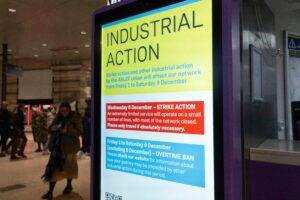
Commuters across Britain are bracing for further travel disruption as train drivers at 16 rail companies and London Underground tube drivers have announced strike action for next month.
Members of Aslef, the train drivers’ union, will stage a series of one-day walkouts from April 5 to 8, along with a six-day ban on overtime. The strikes coincide with the Easter Holidays, affecting families and returning office workers.
The London Underground tube drivers’ strike is scheduled for April 8, as well as May 4. This coordinated action aims to maximize disruption, coinciding with high-profile events in London, including a Peter Kay gig at the O2 and football matches at clubs like Arsenal and Chelsea.
The strikes stem from long-running disputes over pay and working conditions. Train drivers have not received a pay rise since April 2019, while tube drivers are protesting changes to their working conditions, including longer shifts and reduced agreements.
Aslef General Secretary Mick Whelan criticized the government and train companies for their handling of the dispute, accusing them of being “intransigent” and “tone-deaf.” Despite repeated attempts to negotiate, including renewed mandates for industrial action, no resolution has been reached.
Finn Brennan, the London Underground union organiser, highlighted the failure of management to assure drivers that changes to terms and conditions will not be imposed without agreement. Tube drivers have overwhelmingly voted in favour of strikes, with a 98 percent approval rate.
The announcement of strikes follows previous travel chaos in February and January, demonstrating ongoing tensions between unions, management, and the government.
Both Aslef and London Underground management express a desire to minimize disruption and resolve the disputes. However, negotiations have yet to yield a solution acceptable to all parties.
With the potential for significant disruption to travel plans and public events, passengers are advised to monitor developments closely and plan alternative routes if necessary.
Responding to the announcement of the new strike dates BusinessLDN Deputy Chief Executive Muniya Barua said: “It’s hugely frustrating for Londoners, visitors and businesses that the capital is set to grind to a halt once again due to industrial action.
“At a time when our economy is flatlining, these disruptive strikes will hit sectors such as hospitality and retail that rely on footfall especially hard.
“All sides should work together to break the current deadlock.”
Read more:
Commuter Chaos Looms as Train and Tube Drivers Announce Strikes
Category: Uncategorized
Ocean Harvesting to raise €500,000 for InfinityWEC Design Update and …

Ocean Harvesting Technologies AB, the developer of the wave energy converter InfinityWEC, is raising 500,000 Euro to fund a design update of its technology and prepare for upcoming sea trials.
Since 2017, Ocean Harvesting has been dedicated to the development of the InfinityWEC wave energy converter. Recent efforts have focused on refining the ball screw actuation system in the power take-off and enhancing simulation models for the sixth generation of the technology. The company plans to continue full-scale system design work throughout 2024, with a subsequent 1:3 scale sea trial project scheduled for 2025-2026.
The InfinityWEC converter aims to harness the vast renewable energy potential of ocean waves. By providing consistent electricity production that complements wind and solar power, the technology offers value-added benefits such as reducing the need for extensive energy storage infrastructure.
Mikael Sidenmark, CEO of Ocean Harvesting, highlights the efficiency of the ball screw actuators in the power take-off system, which, combined with advanced model predictive control algorithms, maximizes energy output from each wave while minimizing buoy motions and loads.
The InfinityWEC design emphasizes circularity and environmental sustainability, utilizing low-cost, low-carbon materials and achieving high material efficiency. Engineered for large-scale production and efficient deployment, the technology offers competitive energy production costs and minimal environmental impact.
In 2024, Ocean Harvesting will focus on implementing an enhanced model predictive control algorithm in the control system, completing full-scale system design, and advancing buoy technology as part of the EU-financed WECHull+ project. Preparation for the 1:3 scale sea trial project is also underway, supported by a 2 million Euro grant from the Swedish Energy Agency.
Ocean Harvesting’s commitment to innovation and sustainability positions it as a key player in the global transition towards renewable energy sources, contributing to the advancement of wave energy technology.
Read more:
Ocean Harvesting to raise €500,000 for InfinityWEC Design Update and Sea Trials Preparation
HMRC Reverses Decision to Close Telephone Helpline

HM Revenue and Customs (HMRC) has swiftly reversed its decision to close its self-assessment telephone helpline for half of the year, following significant public backlash.
Originally, HMRC announced plans to close the helpline between April and September, redirecting taxpayers to online services. However, less than a day later, the tax authority announced that it would halt the closure.
HMRC’s chief executive, Jim Harra, emphasized the need for change to align with the public’s readiness to manage tax affairs online. He stated, “We’ve listened to the feedback, and we’re halting the helpline changes as we recognize more needs to be done to ensure all taxpayers’ needs are met, whilst also encouraging them to transition to online services.”
This reversal comes amidst ongoing challenges with long waiting times on the telephone helpline and widespread criticism of HMRC’s services. With over 12 million individuals required to complete self-assessment forms annually, the availability of assistance via telephone remains crucial for many taxpayers.
The decision to reverse the closure reflects HMRC’s acknowledgment of the importance of providing accessible support to taxpayers while also promoting the transition to digital services.
Commenting on HMRC’s change of heart, Seb Maley, CEO of Qdos – a tax insurance provider – commented: “HMRC’s announcement about the closure of the self-assessment helpline came out of the blue and would have impacted millions of self-employed workers – so it’s good to see that the tax office has decided to pause its plans for now.
“I’m not sure how these plans reached this point to begin with, though – closing the helplines wouldn’t have been at all helpful. The tax system is complex at the best of times, while HMRC has no hesitation in scrutinising and penalising mistakes.
“While HMRC recognises that its plans need to match the public appetite for change, this rather embarrassing U-turn will raise some questions about how credible the plans were in the first place.”
Read more:
HMRC Reverses Decision to Close Telephone Helpline
Why some of the old rules still apply in business

In today’s fast-paced business landscape, the phrase ‘This is how we do things around here’ seems to have lost its relevance.
Gone are the days when craftsmen and tradespeople meticulously honed their skills, passing down traditions to the next generation with pride. As we transition from the incremental era of yesteryears to the exponential age of today, it’s easy to believe that the rules of the past no longer apply.
We’ve witnessed seismic shifts in how we consume media, shop, bank, and communicate, both virtually and in person. But just as we learned twenty years ago, the answer was not Bricks OR Clicks but Bricks AND Clicks (i.e real and virtual access to our brands), perhaps it’s time to revisit some timeless principles. Despite the allure of wholesale change, there’s value in acknowledging and retaining the fundamental truths that have guided business for generations.
In his post of Amazon CEO, Jeff Bezos spent as much time on what he knew would NOT change as he did on what he predicted would change in the next ten years. As he put it, he knew spending money on the former perennials (low prices, fast delivery, vast choice) would pay back for a decade or more, whereas the latter might not be so long lasting. As historians say, those who ignore or forget history will be forced to learn its painful lessons all over again.
So, are there things in this shiny, fresh, brand marketing world that we can retain from the days of yore when seemingly everything has changed?
Inevitably, I intend to argue yes. But only in part of course.
How many of you still watch shows on the same TV station, at the same time, and the same channel as it was first broadcast? The data says not many and it continues to decline every year. More and more of us are watching more content than ever on a big panel in the living room AND a smaller panel in our hand at a time, and on the channel of our choosing. That’s a new way to watch what we used to call TV.
We are also getting more dynamic and personalised ads served to us on social media because our phone heard us talking the night before to friends about the topic that we are now being served an ad for. That’s a new tool that has the power to surprise! Outdoor media, which used to be the preserve of simple static printed ads for consumer goods, has now become giant, weatherproof cinema screens with engaging and fun content for luxury brands.
So yes, a lot has changed. But to the point, a lot has also stayed the same.
For starters, we are still communicating with each other. And all the best communications find ways to engage an audience, not to interrupt and repeatedly shout at them. The same is true of storytelling: authentic, human, and emotional. These are the things we love – from the tales of the Roman Empire, to Norsemen crossing the seas to seeing humankind head back to the Moon and then venture to Mars. We love a good story.
In marketing, there is no B2B (business to business) or B2C (business to consumer), but everything is now B2A (business to audience) engagement. So, treat everyone as a fully-fledged member of the human race and you are more likely to get their interest, followship and support – all the things a brand desperately needs to create behavioural change and repeat purchases.
The second thing that hasn’t changed is relevance. Don’t advertise dog food to someone who doesn’t own a dog. You’re paying to advertise there, and it’s being wasted. It doesn’t matter if your customer sees the ad as a 5 second spot on TikTok instead of a 30 second spot on ITV, it’s still true. We used to accept that 99% of direct mail was wasted because the 1% buying the product paid back the cost of the mailer. But then we realised that meant 99 out of 100 people when looking at a message from your brand were then rejecting it and carrying it to the dustbin. Not great.
The same is true of today’s online ads. Don’t make someone wait for a to watch a YouTube video with an unskippable ad to serve me a dull bit of film about a product I have no interest in. You are spending money to make your customer feel that bit worse about you.
And the third thing that hasn’t changed is craft. Whatever the piece of communication you want to put out in the world, we all know the positive impression great content can leave you with. There is still a level of perceived reassurance, or shall we call it a quality impression, about seeing a lovely bit of film or an amazing still image from a brand or a well written piece of copy. Even if we haven’t heard of the brand prior to seeing it, engaging content, effective audience targeting, and timing, is going to have a disproportionate effect in terms of brand impression and purchase intent.
It’s interesting isn’t it, because I would bet that in your own business, whatever product you make or service you provide, if you are not thinking about the humanity, the relevance and the craft of what you do, you will be less successful. The same is true of brand marketing and yes, in short, some of the old rules do still apply. Just like old dogs learning new tricks.
Read more:
Why some of the old rules still apply in business
UK Businesses Struggle to Keep Pace with Cyber Threats, warns Microsof …

The UK are better prepared for cyber attacks than they were a few years ago, according to Microsoft’s UK security boss. However, a larger majority of UK businesses are still vulnerable to threats.
Paul Kelly, who looks after security for Microsoft in the UK, said “We’re in a better position than five years earlier,” and warns that the UK gets attacked a lot online, especially compared to other countries in Europe.
Dr. Chris Brauer, the Innovation Director at Goldsmiths, disclosed that 39 per cent of UK organisations face significant risks. These are attributed to factors such as a substantial skills gap, a lack of leadership involvement, and insufficient investment in research, development, and technology.
The report underscored that those businesses leveraging AI-powered cybersecurity, which complements human expertise, demonstrate twice the resilience against cyberattacks.
It is estimated that integrating AI into cyber defence measures could result in annual savings of £52 billion for the UK. Nonetheless, merely about 43 per cent of businesses have allocated resources for cybersecurity incidents.
Andy Ward, VP International for Absolute Software, commented: “In an era where cyber threats evolve faster than businesses can adapt, the UK’s strides in cybersecurity are commendable, yet the vulnerability of most businesses serves as an urgent call for action. It’s not just about setting up defences, but adopting a culture of resilience that integrates cybersecurity as a fundamental part of business strategy.”
“As cyber threats in the UK become more frequent, our shared goal is to enhance cybersecurity by protecting against threats, deterring attacks, and preparing defences, all while ensuring clear visibility and control over networks. To tackle cybersecurity hurdles, it’s essential to implement a resilient framework that boosts oversight and control of the network, establishing a robust cyber defence stance.”
Oseloka Obiora, CTO at RiverSafe “There is a large importance of having network visibility in order to strengthen cybersecurity resilience. While there is acknowledgement towards strides made in the UK’s cyber defence, the general lack of preparedness among most businesses remains a pressing concern. With robust network visibility, IT teams can swiftly detect and address vulnerabilities, ultimately minimising the impact of cyber threats and avoiding potential disruptions, particularly in complex or dispersed systems.”
Read more:
UK Businesses Struggle to Keep Pace with Cyber Threats, warns Microsoft
Ted Baker Faces Administration, Putting Hundreds of Jobs in Jeopardy

Fashion retailer Ted Baker is on the brink of administration, posing a threat to hundreds of high street jobs across Britain.
No Ordinary Designer Label, operating under the Ted Baker brand, initiated steps towards appointing Teneo Financial Advisory as administrators, as disclosed to Sky News on Tuesday.
The impending administration is likely to lead to store closures and job losses, although the extent of these repercussions remains uncertain.
While job roles are in jeopardy, there will be no immediate redundancies announced at the onset of the insolvency process, according to insider reports.
This development follows Ted Baker’s delisting from the London stock market approximately 18 months ago, subsequent to its acquisition by ABG for around £210 million.
Recently, a brand licensing partnership with AARC, a Dutch company, collapsed due to disputes between the involved parties.
Despite the insolvency proceedings, Ted Baker is expected to continue trading.
The retailer’s tumultuous journey commenced in 2019 with the departure of founder Ray Kelvin amid allegations of inappropriate conduct towards female colleagues. Subsequently, Ted Baker faced numerous profit warnings and accounting discrepancies, compounded by navigating the challenges of the COVID-19 pandemic from a financially vulnerable position.
In 2020, the company shed hundreds of jobs and raised £100 million to bolster its financial standing.
ABG, Ted Baker’s parent company, has seen a surge in valuation in recent years, following reports of selling a controlling interest in 2019 to a division of BlackRock, the world’s largest asset management firm, for $870 million. ABG boasts ownership of Forever21 and collaborations with notable figures such as David Beckham’s consumer goods empire.
Additional shareholders of ABG include investment firms General Atlantic and Lion Capital, as well as GIC, the sovereign wealth fund of Singapore.
John McNamara, ABG’s Chief Strategy and Transition Officer, expressed regret over the situation, attributing the challenges to arrears accumulated during the period under AARC’s management. McNamara affirmed ABG’s commitment to finding a new partner to uphold and expand the Ted Baker brand in the UK and Europe.
Teneo Financial Advisory declined to provide comment on the matter.
Read more:
Ted Baker Faces Administration, Putting Hundreds of Jobs in Jeopardy
Everyone says they want feedback on their ideas – but this isn’t e …

Let’s face it – receiving feedback can be uncomfortable.
Even the most well-meaning and gently delivered constructive criticism can feel like a complete shock to the system, and most people do not take feedback as well as they’d perhaps like. This can be problematic enough when it comes to employee experience of performance reviews, but when it’s your own business you’re receiving feedback on, it can feel much more personal. And far more emotive.
This is an unfortunate reality, as feedback – even difficult to swallow feedback – is key to improving our ideas and ultimately, our business.
The fear of feedback
The reason for fearing feedback is rather simple – it just doesn’t feel good to be criticised.
Our brains are hardwired to perceive feedback as inherently threatening. This might be because it’s a blow to our egos, has the potential to undermine others’ perceptions of us, or is simply a bit embarrassing. Especially as a business owner, it can be incredibly difficult to hear the idea that you’ve worked hard on and become personally invested in is, well, bad.
Given how uncomfortable feedback can be to hear and act upon, the natural response to perceived criticism is often less-than-ideal. In many ways, these responses align with what’s known as the stages of grief. Denial, for example, is one of the most common, albeit unconscious, responses, where it is much easier to simply ignore or dismiss feedback than face an uncomfortable reality. How easy is it to say to ourselves “they don’t know what they’re taking about”.
Similarly, a recipient may respond with a feeling of helpless dejection, brooding and ruminating over negative feedback, whilst sadly doing little to address the problem. Or perhaps they will procrastinate, where it becomes easier to put off and delay the issues making us feel uncomfortable rather than face them head-on with action and course-correction.
Accountability as a business owner
Despite the innate discomfort that feedback evokes in us, perhaps one of the biggest shifts in receiving feedback as a business owner (compared to being an employee) is the dramatic change in accountability, and its impact on the bottom line.
As a business owner, it’s natural to become personally invested in your ideas. In fact, this is something to be encouraged, as that personal investment is often the driving force behind taking your business to bigger and better heights. However, despite your personal engagement, the distinction between a good or bad idea could now be the difference between making or losing money. It really matters.
While feedback can still feel like a slap in the face, that feedback is a necessary function of ensuring your money is being funnelled into the best possible ideas that translate directly into your profit and cash. Feedback then, should be welcomed and treated as objectively as you can.
The challenges of soliciting feedback
Many of the difficulties in receiving feedback are also present in giving it. It can be just as uncomfortable giving constructive criticism as it can be taking it. People are wary of getting it wrong and that hinders the quality of their input.
The issue for a lot of business owners, especially owners of smaller businesses, is where can you find the kind of valuable feedback you need to prevent yourself pouring time and resources into a terrible idea?
While asking for feedback from within your organisation is valuable – and certainly one good way for bosses to remain accountable to employees and foster an environment of open communication – the inherent power imbalance present in this dynamic often makes it difficult to obtain candid feedback. Confidentiality helps. But is it really trusted?
Compounding this, people are fundamentally social creatures. We thrive on building positive relationships with each other, both personal and professional, and don’t want to be perceived as being mean or unkind when we do deliver feedback.
This isn’t simply because employees don’t want to upset their boss – though this may indeed play a role – it’s because employees can be just as unconsciously biased as the owner of the business. It can be incredibly difficult to gain objective perspective on your own day-to-day work, and this is no different for employees, who will often experience a confirmation bias when it comes to the activities and ideas they have a role in. This is why opening yourself to external perspectives and the feedback they can provide is so crucial.
External feedback, then, is vital. But be wary about this too. Consultants can be great but in the end they want to stay in the relationship and sell you more work. That may hinder true honesty.
Coaches and mentors are meant to be objective, but they too need to stay in a good relationship and that might make them wary about too much honesty. If you have such a person (and it’s a great idea to get one), when was the last time they told you something that made you feel genuinely uncomfortable. They should. But do they?
Peer group share sessions can be very powerful, as attendees are not beholden to one another. In theory. But we still must listen carefully to hear behind normal good manners and unwillingness to upset each other. You may have to ask pointed questions, often prefacing them with some variation of “please don’t worry about upsetting me, I need to know what you really think”.
Final thoughts
The ability to solicit and positively act upon valuable feedback isn’t just good for you as an individual, it’s good for your business. Doing it has profit-driven benefits.
As hard as it may be, overcoming those natural but unhelpful responses to feedback or perceived criticism allows you to improve your decisions, improving both performance and results.
Ultimately, when it’s your own money and the success of your business on the line, there is no room to be precious about feedback. Seek it out. Take it on the chin. Use it to your advantage.
Read more:
Everyone says they want feedback on their ideas – but this isn’t entirely true. Even for the business critical issues
Providing credibility to your numbers

Who and what data you trust in business is important and increasingly audits are being used to provide confirmation of the facts – whether to shareholders, potential investors or banks.
An audit is a statutory requirement for many businesses and is often performed on a voluntary basis by firms who do not otherwise have a legal requirement to have one undertaken.
The purpose of a statutory audit to form an independent opinion on the financial statements of the audited entity on whether the financial statements show a true and fair view and have been properly prepared in accordance with accounting standards.
There has been some speculation that audit thresholds may increase which in my opinion will be a shame as many smaller firms do (and could) benefit from them. Audits have more value than being just a tick box exercise and that’s an important message.
Currently you don’t need an audit if your business meets two of these three criteria:
Turnover of up to £10.2m
Net assets of £5.1m
50 or fewer employees
You do need an audit regardless of the above if your business operates in a regulated area where audits are mandatory, such as insurance or banking or if your shareholders (with at least 10% of a holding in the business) make a request for an audit. There are also specific rules for groups and subsidiary companies.
So, for businesses outside of these criteria, why bother with an audit?
The key point is that an audit provides reassurance and a credibility to your numbers. Management accounts whilst telling a certain story are not verified, and if in the future you will be looking for investors, to sell your business or to obtain significant bank lending then an audit can play a crucial role.
It may also highlight areas where your business might be missing out, such on lucrative tax reliefs as well as other tax benefits, or where your systems and processes could benefit from tightening up.
Who do you pick to carry out an audit?
Auditors need to be independent, and they are there to verify a set of financial statements which set out the performance of the business and give assurance that the numbers and the narrative are materially correct.
Like anything you pay for what you get, and the real value from an audit which many firms miss is to instruct a well-rounded firm who will look at your business holistically, may spot opportunities and who should tell you what tax reliefs you might be missing out on. They will also provide a management letter which gives advice on operational efficiencies – what is or isn’t being done well. Investors find this letter a useful document as it summarises for them what might be needed, what policies and procedures especially, to help steer a business onto a more productive and profitable path. It also provides confirmation that the right processes and procedures are in place for that business as it can benchmark against similar firms.
Just a couple of examples of audit success that I have seen recently is firstly where a business had not claimed tens of thousands of pounds in R&D credits as they hadn’t thought they qualified and significant tax rebates were subsequently claimed for them.
Also, where a group of businesses had not been structured for optimal tax efficiencies and a simple reorganisation produced significant tax savings for them. I could go on as there are so many other examples I have seen over the years, and the key point is that auditors who are professional, well-rounded businesspeople are able to spot opportunities that businesses can benefit from.
Of course, auditors are there to look for other things which may hide behind the numbers and with the risk of business fraud being at an all-time high, knowing you have the robust systems in place to identify risk and prevent it as well as cash and payment controls could mean the difference between success or failure.
Audit could be your eyes and ears on the ground where it is impossible to have oversight of all your operations so I would urge business owners to think about how it could help them on their business journey, rather than think of it as something burdensome that needs to be done once key thresholds are met.
Read more:
Providing credibility to your numbers
Britain Set to Trial ‘Flying Taxis’ by 2026, Potentially Boosting …

The UK is gearing up to trial its first electric flying taxis by 2026, a move that could see these futuristic modes of transport in regular use by the end of the decade, according to government sources.
Unveiled on Monday, the Future of Flight initiative sets out a roadmap aimed at bringing technology once relegated to the realms of science fiction into the skies of the UK. After initial trials in 2026, the first piloted flying taxi services are slated to commence regular operations by 2028, with demonstrations of pilot-less variants expected by 2030.
To accommodate this innovative mode of transportation, the government plans to construct ‘vertiports’ across the UK. These vertiports, akin to mini airports designed for drones and electric aircraft capable of vertical take-offs, will serve as pivotal hubs for this groundbreaking technology.
In addition to revolutionising passenger transport, the government is exploring the expanded use of drones for crime prevention and facilitating emergency medical deliveries, with projections suggesting that drone technology could inject a substantial £45bn into the UK economy by 2030.
While trials of flying air taxis have already kicked off in the US, experts within the aviation sector believe that the world stands on the brink of a new revolution. A multitude of startups has emerged globally, with established industry giants like Boeing and Airbus throwing their weight behind various ventures.
The Civil Aviation Authority (CAA) forecasts widespread adoption of flying taxis, with the inaugural commercial flight of an electric vertical take-off and landing (eVTOL) aircraft slated for the Paris Olympics.
Aviation and Technology Minister, Anthony Browne, commented, “Cutting-edge battery technology is poised to revolutionize transportation as we know it. This plan ensures that we have the necessary infrastructure and regulations in place to turn this vision into reality. From flying taxis to emergency service drones, we’re positioning the UK at the forefront of this transformative shift in transportation, thereby enhancing people’s lives and bolstering the economy.”
Browne is scheduled to visit Vertical Aerospace’s Bristol facility today, where the UK-based company is conducting trials of a five-seater air taxi capable of reaching speeds of up to 200mph.
Duncan Walker, Chief Executive of Skyports and Chairman of the Future of Flight Industry Group, remarked, “The UK boasts one of the world’s most significant aerospace industries and is ideally positioned to lead the charge into the next era of aviation. The government and industry share a collective commitment to fostering the development, industrialization, and integration of new aviation technologies. Sustained collaboration will ensure that we capitalize on the substantial domestic and international market opportunities presented by the future of flight.”
Read more:
Britain Set to Trial ‘Flying Taxis’ by 2026, Potentially Boosting UK Economy by £45bn

